飞猪AI问一问

Search documents
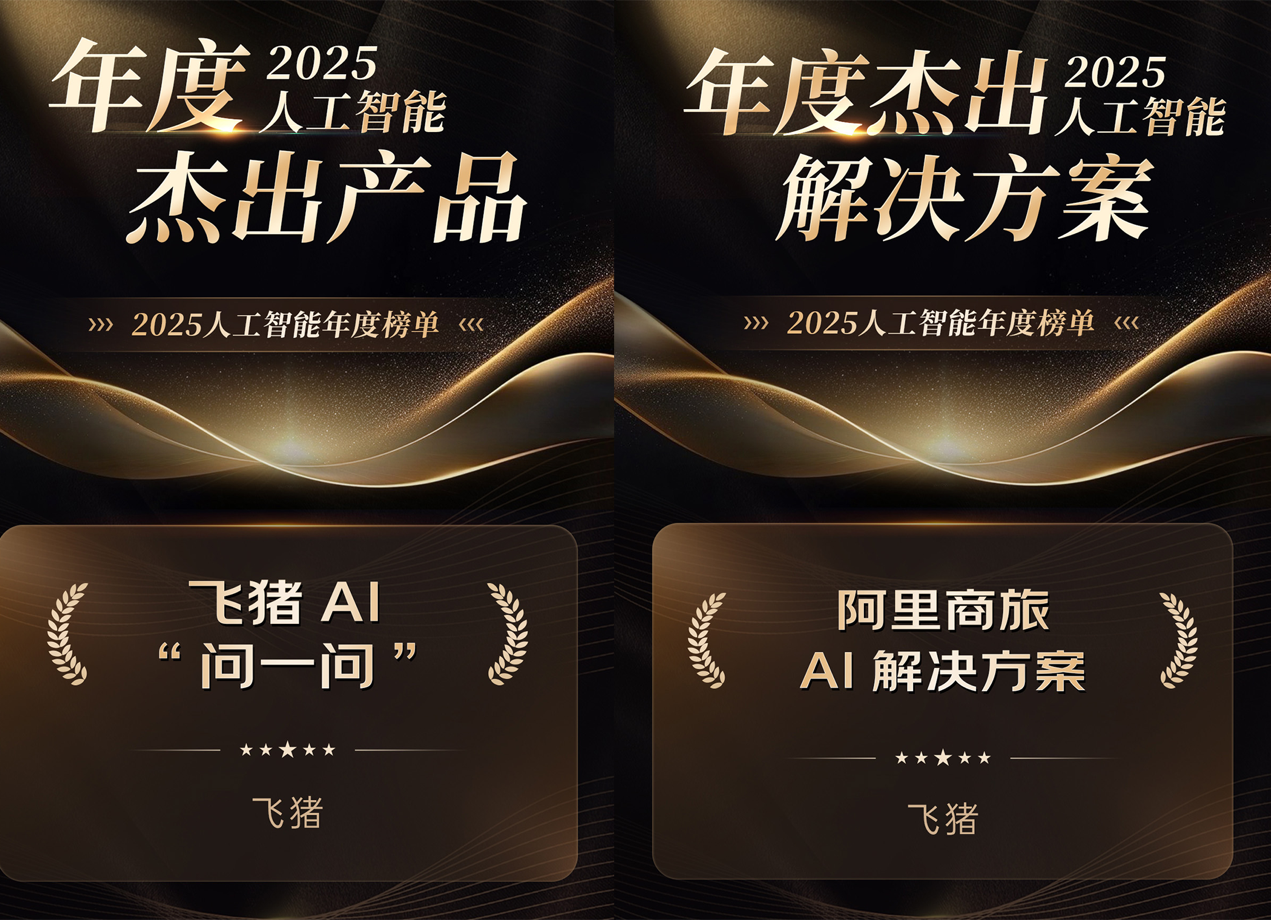
B端C端全覆盖 飞猪两款AI产品入选“2025人工智能年度榜单”
Jin Rong Jie· 2025-12-11 07:21
Core Insights - The "2025 Artificial Intelligence Annual List" was unveiled at the MEET2026 Smart Future Conference, highlighting significant AI products and solutions, with Fliggy's Travel AI "Ask Me" and Alibaba's Business Travel AI Solution recognized as outstanding entries [1][3] - Fliggy is the only travel company included in the list, indicating its strong position in the online travel market with two leading AI products [1] Group 1: AI Product Recognition - Fliggy's "Ask Me" is a multi-agent driven travel AI product launched in April 2023, designed to provide practical travel solutions akin to professional travel service providers [3] - The product scored 724.92 out of 900 in the first systematic "AI Travel Assistant Evaluation System," ranking first among competitors [3] Group 2: Business Travel AI Solution - Alibaba's Business Travel AI, released in August 2023, offers a comprehensive solution with modules for employee travel recommendations and corporate management, significantly reducing travel resource waste by approximately 20% [3] - The solution can save over 90% of planning time for business trips, showcasing its efficiency for medium to large enterprises [3] Group 3: Industry Trends - The "2025 Annual AI Top Ten Trends Report" was also released, indicating that AI is moving towards infrastructure-based computing, reshaping traffic entry points, and emphasizing multi-modal applications as key to AI deployment [3] - The report notes a shift in interaction paradigms from "people seeking services" to "services seeking people," highlighting the evolution of AI interactions [3]

模力工场 023 周 AI 应用榜:从旅行生活到 AI 基建,“Agent 时代拼图”再添新砖
AI前线· 2025-12-10 05:18
Core Insights - The article highlights the increasing adoption of AI technology in China, with over 35% of the population using generative AI, indicating a significant shift towards a technology-driven transformation [1] - The upcoming event "AI Shining China" on December 28, 2025, in Xiamen will unveil the results of the annual "AI Application Ecosystem Survey" and gather industry leaders to discuss AI implementation and commercial prospects [1] - The article emphasizes the importance of collaboration and innovation in the AI space, as demonstrated by the "Vibe Coding Sprint" event, which encourages participants to create demos using AI in real-world scenarios [3][4] AI Application Trends - This week's AI application ranking features 55 new applications, with 10 selected for their impact across various sectors, showcasing AI's integration from consumer services to industrial infrastructure [6] - Notable applications include Fliggy's AI travel assistant, which offers personalized trip planning and price comparison, and Style3D, which digitizes the entire clothing design and marketing process [6][10] - The article outlines a clear path of AI technology permeating and reshaping industries, starting from consumer-facing applications to foundational infrastructure that supports advanced AI solutions [13] Featured Applications - Fliggy's AI travel assistant provides a one-stop service for travel planning, leveraging real data to enhance user experience [8] - Style3D combines AI and 3D technology to streamline the clothing manufacturing process, reducing the need for physical samples and accelerating content generation [11] - Other applications include FlagOS for unified AI system stacks, YRCache for high-performance inference, and OrcatermAI for enhanced command-line operations, all contributing to a robust AI ecosystem [10][12]

“年轻态”产品居双节市场C位
Huan Qiu Wang· 2025-09-29 02:22
Core Insights - The upcoming National Day and Mid-Autumn Festival holidays are expected to see high tourist activity and spending, with a significant focus on younger travelers, particularly those born after 2000, who make up 62% of the tourist demographic during this period [2][3] Group 1: Travel Trends - The peak travel period is anticipated to last from September 27 to October 12, with a notable rise in interest for unique travel experiences among younger tourists [2] - Popular new travel trends include cultural tours, archaeological trips, and experiences that allow for local cultural immersion, such as staying near local markets [3][4] - The search volume for "border tourism" has increased by 40% year-on-year, with regions like Xinjiang and Heilongjiang becoming popular destinations for experiencing diverse cultures without leaving the country [3] Group 2: Technology Integration - The introduction of AI tools, such as the "Ask Me" feature by Fliggy, enhances travel planning by providing personalized itineraries and budget options based on user preferences [4][5] - The AI assistant can help users plan multi-destination trips efficiently, catering to the growing trend of combining multiple travel locations during holidays [5] Group 3: Changing Preferences in International Travel - Young travelers are shifting the outbound tourism landscape towards emerging and diverse destinations, driven by a desire for unique cultural experiences [6] - The trend indicates that travelers aged 25-29 are increasingly viewing travel as a lifestyle, seeking immersive experiences that reflect their interests [6]

票根当钱花、机器狗陪游!国庆中秋,解锁这些新玩法
Sou Hu Cai Jing· 2025-09-27 16:19
Core Insights - The Mid-Autumn Festival and National Day holidays have significantly boosted domestic travel and consumption, with domestic travel willingness increasing by 30% and outbound travel willingness rising over 40% compared to last year [1] - The "ticket economy" has emerged as a new engine for urban consumption, linking various sectors such as dining, retail, and cultural events through ticket-based promotions [2][4] - Technological advancements are transforming the tourism experience, with smart tourism becoming a new trend in the cultural and tourism consumption market [5][7][8] - Seasonal activities and government policies are enhancing consumer experiences, with over 3.3 billion yuan in consumption subsidies being distributed to stimulate market activity [9][12] Group 1: Ticket Economy - The "ticket economy" is gaining traction in various cities, promoting a model that connects events like sports and performances with discounts in dining and retail [2] - In Beijing, ticket holders for major events can access discounts at over 200 merchants, while other regions are implementing similar strategies to enhance local consumption [2][4] - The integration of ticketing with services and experiences is being explored in places like Ningxia and Shanghai, indicating a broader trend towards leveraging ticketing for consumer benefits [4] Group 2: Technological Integration - High-tech solutions are becoming integral to the tourism experience, with innovations like robot guides and AI tools enhancing visitor engagement and decision-making [5][8] - Various tourist attractions are adopting smart technologies, such as interactive robots and AI-driven itinerary planning, to improve visitor experiences [7][8] - The use of AI tools for personalized travel planning is increasing, allowing users to create customized travel plans based on their preferences [8] Group 3: Seasonal Activities and Government Support - Local governments are launching seasonal events to enrich visitor experiences, such as themed activities in various regions during the autumn season [9][11] - The "Cohesion of Urban Clusters" initiative is promoting collaborative consumption experiences across multiple cities, enhancing the overall cultural tourism landscape [11] - The national policy measures aimed at expanding service consumption are expected to provide a stable boost to the holiday economy, with significant financial support for consumer incentives [12]

人工智能周报(25年第38周):阿里开源深度研究Agent模型Deep Research,美团首款Agent小美公测-20250922
Guoxin Securities· 2025-09-22 11:07
Investment Rating - The report maintains an "Outperform" rating for the industry [3][4][30]. Core Views - The AI sector has shown significant impact on the advertising business, cloud computing scenarios, and enterprise efficiency for internet giants, evidenced by Tencent's advertising growth of 20% in Q2 and Alibaba Cloud's acceleration to 26% [2][27]. - Recent developments include the launch of self-developed chips by companies like Baidu and Alibaba, which is expected to enhance market share for cloud service providers [2][27]. - The report recommends focusing on the AI theme, highlighting companies such as Tencent Holdings, Alibaba, Kuaishou, Baidu Group, Meitu, and Tencent Music, which are less correlated with macroeconomic fluctuations [2][27]. Company Dynamics - Baidu AI search has reached 365 million monthly active users, leading the domestic AI search industry [15]. - Tencent has launched a professional-grade AI 3D workspace called Mix Yuan 3D Studio, aimed at 3D designers and game developers [15]. - Meitu's first AI Agent product, "Xiao Mei," has entered public testing, enhancing local life service experiences [21]. Underlying Technology - Tongyi's DeepResearch model has been fully open-sourced, achieving state-of-the-art results with 30 billion parameters [22]. - ByteDance has released the Seedream 4.0 image creation model, allowing various creative modes [22]. - Alibaba has introduced the Wan2.2-Animate model for motion generation, enabling dynamic expressions in images [23]. Industry Policy - Guangdong province is supporting AI integration in the toy industry, aiming to create new market opportunities [25]. - Sichuan province plans to establish a "computing power supermarket" by 2027, aiming for unified scheduling and efficient use of computing resources [26].
人工智能周报(25年第38周):阿里开源深度研究 Agent 模型 Deep Research,美团首款 Agent 小美公测-20250922
Guoxin Securities· 2025-09-22 11:02
Investment Rating - The report maintains an "Outperform" rating for the industry [3][4][30]. Core Views - The AI sector has shown significant impact on the advertising business, cloud computing scenarios, and enterprise efficiency for internet giants, evidenced by Tencent's advertising growth of 20% in Q2 and Alibaba Cloud's growth accelerating to 26% [2][27]. - Recent developments include the launch of self-developed chips by companies like Baidu and Alibaba, which is expected to enhance market share for cloud service providers [2][27]. - The report recommends focusing on the AI theme, highlighting companies such as Tencent Holdings, Alibaba, Kuaishou, Baidu Group, Meitu, and Tencent Music, which are less correlated with macroeconomic fluctuations [2][27]. Company Dynamics - Baidu's AI search has reached 365 million monthly active users, leading the domestic AI search market [15]. - Tencent has launched a professional-grade AI 3D workspace called "Mix Yuan 3D Studio" aimed at 3D designers and game developers [15]. - The AI digital human from Keling can generate 1-minute videos, significantly lowering industry barriers [15]. - Meitu's first AI agent product "Xiao Mei" has entered public testing, enhancing local service experiences [21]. Underlying Technology - Tongyi's DeepResearch model has been fully open-sourced, achieving state-of-the-art results [22]. - ByteDance has released the Seedream 4.0 image creation model, enabling various creative modes [22]. - Alibaba has open-sourced the Wan2.2-Animate model for motion generation, allowing photos to come to life [23]. - Alibaba's next-generation model architecture Qwen3-Next has been introduced, featuring significant improvements in efficiency and performance [24]. Industry Policy - Guangdong province is supporting AI integration with robotics to create new markets for companion toys [25]. - Sichuan province plans to establish a "computing power supermarket" by 2027, aiming for unified scheduling and efficient use of computing resources [26].

国庆临近订单大增 在线旅游平台加码AI应用
Zheng Quan Shi Bao Wang· 2025-09-19 12:47
Group 1: Travel Trends - The upcoming National Day holiday coinciding with the Mid-Autumn Festival has created an eight-day "super golden week," leading to a significant increase in travel demand, with online travel platforms seeing a notable rise in orders [1] - Ctrip's 2025 National Day travel trend forecast indicates that cross-province travel orders have increased by 45% year-on-year [1] - Tuniu reports a double-digit growth in travel bookings for the National Day and Mid-Autumn holiday compared to the same period last year, with a marked increase in self-driving tours and packaged travel products [1] Group 2: Destination Preferences - Ctrip data shows that orders for inter-provincial border cities have surged by 58%, with specific regions like Zhaotong and Hezhou seeing increases of 95% and 88% respectively [2] - Emotional value is becoming a core factor in destination selection, with searches for hotels in remote areas like Xinjiang and Tibet rising by 60% [2] - Popular outbound destinations include Japan, Thailand, and Hong Kong, with Malaysia and Singapore also emerging as top choices, highlighting the strong appeal of Southeast Asia [2] Group 3: Outbound and Inbound Travel - Tuniu indicates a significant increase in outbound travel bookings for the National Day and Mid-Autumn holiday, with popular destinations including Japan, Maldives, and Singapore [3] - The inbound travel market is also active, with popular source countries including South Korea, Japan, and the United States, and major cities like Shanghai and Beijing being popular inbound destinations [3] - The pursuit of emotional value and interest in niche exploration reflect a more diversified and emotional travel preference among tourists [3] Group 4: AI Applications in Travel - Several online travel platforms are accelerating the implementation of AI applications ahead of the holiday, with Fliggy launching an AI feature that helps users plan trips based on holiday schedules [4] - Fliggy's AI product has undergone multiple iterations since its launch, enhancing its ability to meet user needs [4] - Qunar is also integrating AI into its app, aiming to reconstruct the entire travel planning and booking process using AI technologies [4]


氪星晚报|通义DeepResearch模型、框架、方案全开源;奇瑞汽车香港IPO据悉已获足额认购;诺和诺德:拟于明年年初在美国“全面”推出口服版司美格鲁肽
3 6 Ke· 2025-09-17 12:33
Group 1: Company Developments - Han Yi Co., Ltd. plans to reduce its shareholding by up to 2,940,000 shares, accounting for 3% of the total share capital, due to the shareholder's personal financial needs [1] - Novo Nordisk aims to launch the oral version of its weight loss drug, Semaglutide (Wegovy), in the U.S. early next year, highlighting its competitive advantages over rivals [2] - Chery Automobile's IPO in Hong Kong has reportedly received full subscription, seeking to raise up to HKD 9.14 billion [4] - Qingtian Technology has completed a Pre-A round financing of several hundred million yuan, led by Shenzhen Qianhai Ark [5] - MaiMai Technology has also completed a Pre-A round financing exceeding 100 million yuan, with a post-investment valuation exceeding 1 billion yuan [5] Group 2: Industry Insights - Meta's CEO Mark Zuckerberg believes AI glasses will be a primary means of integrating superintelligence into daily life, indicating a significant growth potential in the AI eyewear market [1] - The global smart eyewear market is projected to reach 2.555 million units shipped in Q2 2025, a 54.9% year-on-year increase, with China's market expected to see a 145.5% growth [8] - The Chinese government is confident in completing the core tasks of state-owned enterprise reform by the end of the year, which may impact the overall business environment [9]
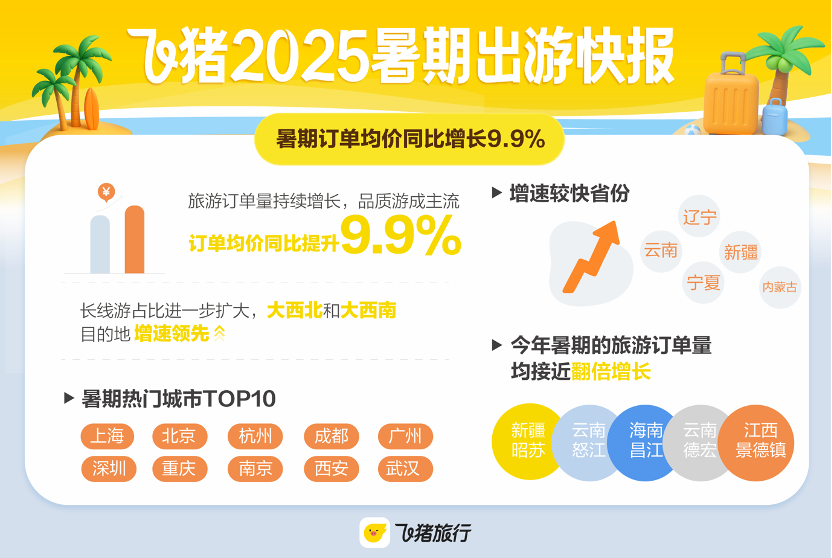
飞猪《2025暑期出游快报》:学生占比持续增加 “演出+旅行”热度高
Zheng Quan Ri Bao Wang· 2025-08-26 06:46
Core Insights - The travel demand during the summer of 2023 is strong, with significant growth in orders for flights, hotels, car rentals, and local activities, reflecting a 9.9% year-on-year increase in average order value [1][3]. Group 1: Travel Trends - Long-distance travel has increased, with destinations like Xinjiang, Inner Mongolia, Yunnan, Liaoning, and Ningxia showing leading growth rates [3]. - Popular travel destinations include Shanghai, Beijing, Hangzhou, Chengdu, and Guangzhou, with certain locations like Xinjiang Zhaosu and Yunnan Nujiang experiencing nearly double the order volume compared to last year [3]. Group 2: Event-Driven Travel - There is a notable trend of traveling to events, such as concerts and exhibitions, with significant increases in hotel and attraction searches around venues during events like ChinaJoy2025 and various concerts [3][4]. - For instance, searches for hotels near the venue of the Times Youth Team concert surged over seven times after ticket sales began [3]. Group 3: Family and Theme Park Preferences - Theme parks remain a favorite for families, with Shanghai Disneyland, Beijing Universal Resort, and other major parks being highly sought after [4]. - Innovative experiences, such as NPC interactions in parks like Xuzhou Park, have led to a threefold increase in search interest during these events [4]. Group 4: Student Travel Dynamics - The student demographic is increasingly active in travel, with a rise in travel participation among students, although the trend of "special forces" style travel among university students has declined, indicating a shift towards higher quality and more immersive travel experiences [4]. Group 5: International Travel Growth - Popular international destinations include Japan, South Korea, Hong Kong, Malaysia, Thailand, Singapore, the USA, Vietnam, France, and Indonesia, with long-haul destinations like Iceland, Austria, Switzerland, Tanzania, and Greece seeing over 50% year-on-year growth [4]. Group 6: AI Travel Planning - The launch of the AI travel planning tool by the company has gained traction, with more users utilizing AI for travel planning and making purchases based on AI recommendations [5].
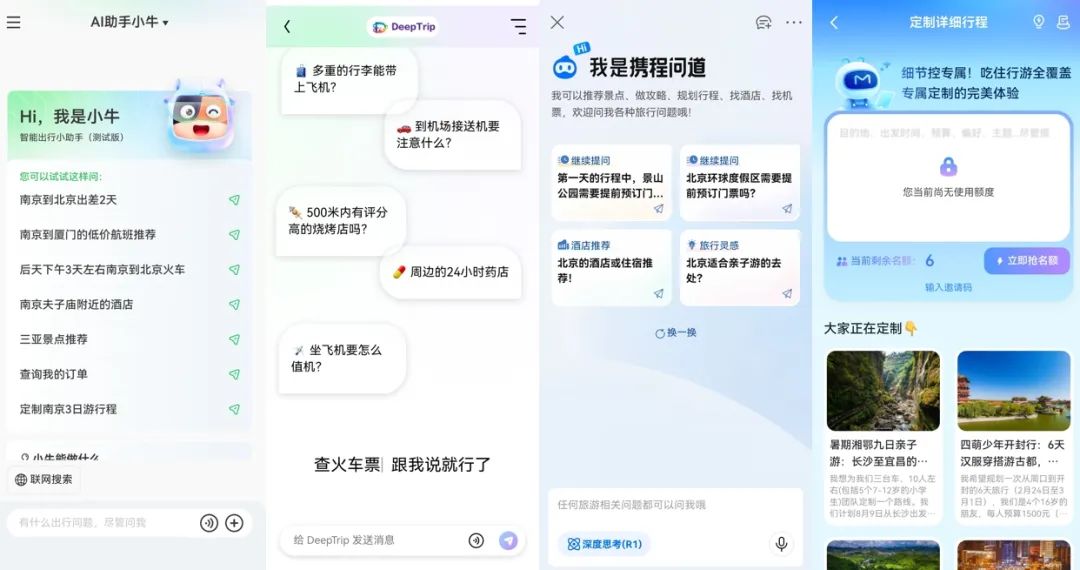
省心还是添乱?AI旅游助手在争议中前进
3 6 Ke· 2025-08-21 00:04
Core Insights - The online travel industry is experiencing a rapid transformation driven by AI, with major platforms launching various AI travel assistants to enhance user experience and efficiency [1][3][26] - Despite the advancements, the penetration of AI in the online travel sector remains slow, particularly on the consumer side, due to the highly personalized nature of consumer demands and the complexity of data involved [3][17] - The current AI travel assistants face significant challenges, including outdated training data, data silos, and a lack of customized solutions to meet evolving user needs [3][20][21] AI Travel Assistants Overview - Major platforms like Mafengwo, Tuniu, Fliggy, Tongcheng Travel, and Ctrip have introduced AI travel assistants, each with unique features aimed at addressing user pain points [1][4][11] - The AI assistants provide comprehensive services, including ticket booking, hotel recommendations, and itinerary planning, but the user experience varies across platforms [4][9][11] Efficiency and Experience Optimization - AI travel assistants are designed to enhance efficiency by offering one-stop services for travel planning, from ticket queries to hotel bookings [4][16] - The depth of understanding and response quality varies, with some platforms providing detailed explanations and recommendations, while others offer more basic responses [4][9][11] Challenges in AI Implementation - The accuracy of AI-generated travel information is often compromised due to the fast-changing nature of travel-related data, leading to user dissatisfaction [18][20] - The lack of scene-specific customization and the tendency for AI-generated itineraries to be formulaic limit the effectiveness of these assistants in catering to niche travel needs [20][21] Future Directions - Companies are exploring ways to leverage their unique data and technological advantages to improve the accuracy and personalization of AI travel assistants [22][23] - The introduction of multi-agent systems aims to enhance the efficiency and accuracy of AI responses by integrating various specialized functions [23][24] - A shift towards user-centric design, where AI assistants adapt to individual preferences and provide tailored recommendations, is seen as a potential solution to current limitations [25][26]