GB200/GB300

Search documents
工业富联小作文分析--英伟达直接提供L10?
傅里叶的猫· 2025-11-24 05:32
Core Viewpoint - The article discusses the recent rumors surrounding Industrial Fulian (富联) and its relationship with NVIDIA, particularly regarding the potential impact of NVIDIA's Level-10 (L10) system on the company's performance and market position [2][3][5]. Group 1: Market Rumors and Clarifications - There has been a surge of rumors about Industrial Fulian, primarily focusing on its role as a core asset in computing power and its advancements with ASIC manufacturers like Google [2]. - An analyst's comments during Wistron’s Q3 earnings call suggested that NVIDIA might supply L10 systems directly to partners, which has led to confusion regarding the company's product strategy [3]. - The article emphasizes that the claims about transitioning from L6 to L12 are incorrect, as NVIDIA has only achieved L6 so far [3]. Group 2: Performance Expectations - The article mentions that despite the rumors, Industrial Fulian's Q4 cabinet deliveries are expected to grow by over 30% quarter-on-quarter, indicating a positive outlook for the company's performance [4]. - The downward revision of Q4 performance guidance is questioned, as it seems unreasonable to adjust forecasts so soon after the Q3 report, especially when other business segments remain stable [5]. - The cloud computing segment is projected to see a continued increase in gross margin due to successful GB200 shipments and improved production efficiency with GB300 [5]. Group 3: Competitive Landscape - The article outlines the various levels of integration in the production process, from component manufacturing to multi-rack cluster integration, highlighting the complexity of the supply chain [6]. - It notes that in the GB200/300 series, CSPs (Cloud Service Providers) can customize their AI server trays significantly, which may be impacted by NVIDIA's push for standardized L10 trays [11]. - JP Morgan's analysis suggests that CSPs may oppose NVIDIA's standardization efforts, which could lead to a more concentrated competitive landscape among ODMs [10][11]. Group 4: Future Prospects - Industrial Fulian's ASIC customization business is expected to enter a substantial deployment phase next year, with projections indicating a revenue contribution ratio of 2:8 for ASIC to GPU [9]. - The article concludes that the current situation remains uncertain, and the market tends to react negatively to any adverse news, necessitating a rational perspective on the developments [11].



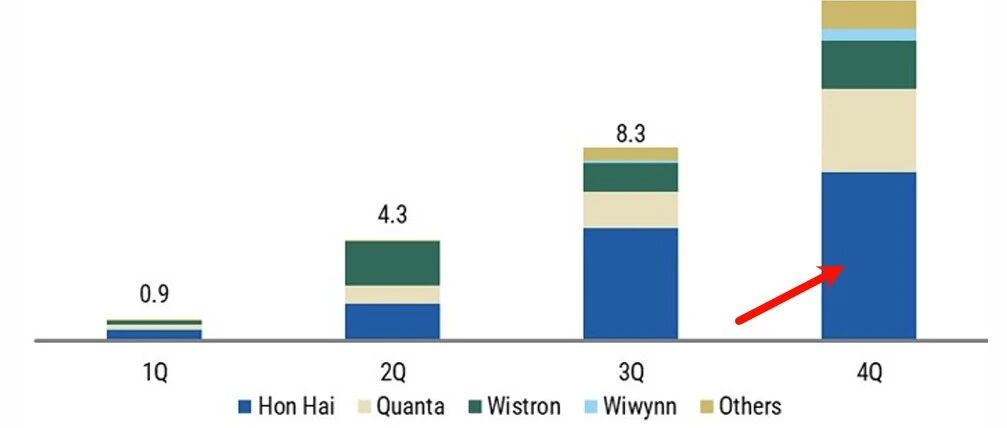
GB200/GB300四季度有望大幅放量 瑞银维持英伟达(NVDA.US)“买入”评级
Zhi Tong Cai Jing· 2025-08-27 07:01
Core Viewpoint - UBS raised the target price for NVIDIA (NVDA.US) from $175 to $205 while maintaining a "Buy" rating, citing strong momentum in demand [1] Group 1: Demand and Revenue Projections - Overall demand signals remain strong, with Texas Oncor receiving approximately 40 gigawatts of high-confidence data center load requests, despite potential duplicate orders [1] - NVIDIA is expected to report strong performance guidance, with partners indicating a potential deployment of 30,000 racks this year, leading to significant volume increases in Q4 [1] - The company anticipates generating billions in quarterly revenue following an agreement with the U.S. government, allowing the sale of H20 chips with a 15% revenue return [1] Group 2: Financial Forecasts - For Q2 (July), revenue is projected at approximately $46 billion, exceeding expectations by about $1 billion [2] - Q3 revenue guidance, excluding the Chinese market, is estimated at $54-55 billion, potentially reaching $57 billion when including China [2] - The business segment is expected to see a quarter-over-quarter growth of 20-25%, contributing $7-8 billion to revenue growth [2] Group 3: Data Center and Gaming Business Insights - Total revenue for the data center in Q3 is projected to reach $49 billion, while the gaming segment may face growth pressure due to a high base in Q1 [2] - There may be some impairment provisions for reusable H20 inventory in the Chinese market, but NVIDIA is believed to have placed new wafer orders for Hopper chips and is developing the Blackwell version [2] - The U.S. government is likely to increase sales license limits to China as part of the agreement [2]
美股英伟达8月财报前瞻预测,万字深度报告 NVDA
3 6 Ke· 2025-08-26 00:48
Core Viewpoint - The analysis predicts that Nvidia's upcoming earnings report is likely to exceed expectations, but the stock price has already priced in many positive factors, making significant upward movement more challenging [1][3]. Group 1: Nvidia's Market Position and Catalysts - Nvidia's market capitalization has reached $4.34 trillion, surpassing Japan's annual GDP, driven by expectations of a dominant position in the AI era [3]. - The company has established a strong competitive moat not only through GPU performance but also by building an ecosystem around chips, networks, memory, and supply chains [4]. - Future catalysts for Nvidia include significant growth in data center capital expenditures, with major cloud providers planning substantial investments [6][10]. Group 2: Cloud Providers' Capital Expenditures - Major cloud giants are expected to increase their capital expenditures significantly, with Amazon forecasting $100-120 billion for FY2025, Microsoft exceeding $900 billion, and Google raising its forecast to $85 billion [10][13]. - The combined capital expenditure of these four giants is projected to reach approximately $364 billion in 2025, a 57% year-over-year increase, accounting for 77% of global cloud capital expenditure growth [13]. Group 3: Demand for AI Infrastructure - The demand for Nvidia's GPUs is surging, with new cloud service providers and AI infrastructure companies purchasing them in large quantities [13][22]. - ODM server manufacturers are experiencing explosive demand, with Foxconn's AI server business growing by 60% year-over-year and expected to increase by 170% in Q3 [23][25]. - Global AI server shipments are projected to grow by 24.3% in 2025, with a compound annual growth rate of approximately 27% from 2022 to 2027 [25]. Group 4: Software and Ecosystem Monetization - Nvidia's CUDA ecosystem, relied upon by over 6 million developers, is a core barrier to entry, allowing the company to convert hardware advantages into recurring software and cloud service revenues [27]. - The introduction of services like DGX Cloud is expected to generate significant annual revenue potential, showcasing the "compute as a service" model [28]. Group 5: Institutional Support and Market Sentiment - Major Wall Street institutions have raised Nvidia's 12-month price targets, with an average target of $194, indicating over 10% upside potential [31][32]. - Institutional holdings in Nvidia have increased, with a notable rise in the number of hedge funds holding significant positions, reflecting a bullish sentiment [38][39]. Group 6: Risks and Market Dynamics - The market's tolerance for risk is low, and any earnings report that merely meets expectations may not result in significant stock price increases [40]. - Concerns about the sustainability of AI infrastructure investments and potential market corrections are prevalent, with comparisons drawn to the dot-com bubble [41][43]. - Nvidia faces uncertainties in the Chinese market, with recent production halts for specific AI chips, but is reportedly developing a new chip to regain market share [44][47].