
Gemini 3.1

Search documents
AI 时代,只要你学得足够慢,就可以不用学?
佩妮Penny的世界· 2026-03-30 11:53
Core Viewpoint - The article discusses the rapid changes brought by AI in the workplace, emphasizing the necessity for individuals to adapt and present themselves as proficient in AI to remain relevant in their jobs [1][4]. Group 1: Impact of AI on Employment - Companies are increasingly requiring employees to integrate AI into their daily workflows, making it a key performance metric [4]. - There is a notable decline in the demand for entry-level positions, with companies preferring candidates who demonstrate strong AI skills over traditional qualifications [9][10]. - The hiring practices have shifted, with firms now favoring candidates who can effectively utilize AI tools, leading to a reduction in the hiring of interns and junior staff [12]. Group 2: AI's Role in Job Efficiency - AI tools are becoming more efficient than junior employees, with one junior analyst plus AI being able to support multiple senior analysts [12]. - The efficiency of AI in specific tasks is highlighted, with AI potentially outperforming individuals with less than three years of experience in certain fields [13]. - The reliance on AI has led to concerns about the quality of work produced, as many young professionals may lack the ability to critically assess AI-generated outputs [13]. Group 3: Job Market Trends - The article lists the top ten occupations at risk of being replaced by AI, including computer programmers (74.5% exposure) and customer service representatives (70.1% exposure) [18]. - There is a demographic trend where certain groups, such as women and individuals with graduate degrees, are more affected by AI's impact on job security [18]. - The shift in job requirements indicates that traditional educational qualifications are becoming less valuable compared to practical AI skills [19]. Group 4: Future of Work - The future workforce may see a division where AI handles tasks it excels at, while humans focus on areas requiring creativity and problem-solving [19]. - The article suggests that young professionals should embrace self-employment and flexible work arrangements as a response to the changing job landscape [21]. - The importance of retaining human qualities such as imagination and curiosity is emphasized as essential for navigating the evolving work environment [23].

多Agent 狂吞token,Claude 顶不住了:一人月烧15万美元,免费AI正在退场
AI前线· 2026-03-30 10:15
Core Insights - Anthropic's Claude Code is experiencing rapid internal and external usage growth, with 80% of employees using it daily and some high-frequency users incurring bills exceeding $100,000 per month [2][3] - The paid subscription user base for Claude has more than doubled this year, with most new users opting for the lowest tier Pro plan at $20 per month [3] - Despite growth, Claude still lags behind OpenAI's ChatGPT in terms of user acquisition and market presence [5] Group 1: User Engagement and Subscription Growth - Anthropic has launched over 50 significant feature updates for Claude in the past 52 days, indicating a strong focus on product development [2] - External usage of Claude is accelerating, with reports of users spending over $1,000 daily on Claude Code or Codex tokens, equating to an annual expenditure of $365,000 [3] - The majority of new subscribers are choosing the Pro plan, priced at $20 per month, while higher-tier plans are available at $100 and $200 per month [3] Group 2: Service Limitations and User Experience - Anthropic has adjusted its usage limits for Claude during peak demand periods to balance service capacity with user demand, which may lead to users exhausting their session limits more quickly during high-traffic times [7][8] - Users are facing potential risks with Claude Code, including a high-risk defect that could lead to unintended data loss during project development [9][10] - The company has not disclosed specific token usage limits for different subscription tiers, leading to user frustration regarding planning their usage [8] Group 3: Market Dynamics and Competitive Landscape - The free AI model is becoming less viable, with companies like Google scaling back on free offerings due to resource constraints and user behavior [11][12] - Google has faced challenges in maintaining a competitive edge, leading to a tightening of free access to its AI models, which has resulted in user dissatisfaction [13][22] - Anthropic's strategy focuses on converting users into long-term customers, contrasting with OpenAI's aggressive growth tactics aimed at market share expansion [23][24] Group 4: Financial Implications and Future Outlook - The cost of AI inference is rising, with token generation increasing significantly, making the free model unsustainable for many companies [14][15] - Companies are recognizing that free services attract low-value users who do not convert to paying customers, leading to increased operational costs [21][22] - Anthropic's model may allow for profitability in the long run as the cost of inference decreases and user engagement patterns evolve [25][26]


计算机行业重大事项点评:AI+应用:MaaS钟摆下的历史性机会
Huachuang Securities· 2026-03-09 06:48
Investment Rating - The report maintains a "Recommendation" rating for the computer industry, expecting the industry index to outperform the benchmark index by more than 5% in the next 3-6 months [3][17]. Core Insights - The AI industry is at a pivotal transition from "technology validation" to "commercialization," with AI-native applications reshaping the global tech landscape. Major players like OpenAI, Anthropic, and Google Gemini are driving enterprise-level services, marking a shift from growth-at-all-costs to value realization [6]. - The report highlights the emergence of AI agents as a significant trend, with the year 2026 expected to be a landmark year for AI agent products, comparable to the launch of large models in 2025 [6]. - The competitive landscape is shifting, with traditional software giants facing threats from AI-native companies that leverage more agile organizational structures and fewer historical burdens [6]. Industry Overview - The computer industry comprises 337 listed companies with a total market capitalization of approximately 60,008.15 billion yuan and a circulating market value of about 54,005.61 billion yuan [3]. - The absolute performance of the industry over the past 12 months has been 5.5%, while its relative performance has underperformed the benchmark by 12.3% [4]. Key Areas of Focus 1. **Large Models**: Hong Kong stocks are becoming a global hub for AI asset valuation, with companies like MiniMax and Zhizhu standing out for their foundational model capabilities [6]. 2. **Internet Sector**: Alibaba and Tencent are currently undervalued, with Alibaba leading in open-source ecosystems and Tencent integrating AI deeply into its WeChat ecosystem [6]. 3. **AI in Enterprise Services**: Companies like Kingdee International are transitioning from SaaS providers to AI-native enterprise service platforms, marking a significant shift in management paradigms [6]. 4. **AI in Industry**: Hikvision and other companies are leading in smart control and predictive maintenance in industrial settings, positioning these areas as key application scenarios for AI agents [6]. 5. **AI Infrastructure**: Domestic database firms are rapidly developing vector databases and AI operational capabilities, benefiting from dual trends of domestic substitution and intelligent upgrades [6]. 6. **AI for Science**: Companies like Hualan and Jiuan Medical are integrating AI into drug development and medical diagnostics, reshaping innovation paradigms in the life sciences [6]. 7. **Companion Technology**: Companies are developing companion robots to address emotional needs among China's large population of single individuals [6]. 8. **Data Services**: High-quality data service providers are experiencing growth due to the surge in demand for multimodal data, positioning them as essential players in the AI era [6].
GPT5.4即将推出!GPT5.3 INSTANT发布,回答更精准更少ai味。谷歌发布gemni3.1轻量化版本,阿里千问技术负责人离职【Vic TALK第1586期】
Vic TALK· 2026-03-04 05:39
推特:https://x.com/victalk6886 Telegram :victalk2021 #clawdbot #aivideo #ai agent #ai 私人助理 #moltbook #人工智能社交平台 #ai雇佣人类 #seedance #simplclaw #agentwars #GLM-5 #elys #perplexityai #moonlake #banban2 ...

AI主线开年布局-春节期间海内外大模型产业动态
2026-02-24 14:15
Summary of Key Points from the Conference Call Industry Overview - The conference call discusses the developments in the AI industry, particularly focusing on domestic models like Zhipu and Minimax, which have shown strong performance in Agent AI and cost optimization, leading in usage on third-party platforms like Open Router [1][2]. Core Insights and Arguments - **Domestic Model Performance**: Zhipu and Minimax have released new versions (GM5 and M2.5) that excel in coding and agent capabilities, with Zhipu performing well in benchmark tests and Minimax leading in agent capabilities and cost optimization [2]. - **Token Demand Growth**: The rise of Agent AI has significantly increased token demand, making global developers more price-sensitive. Domestic models are capturing substantial demand due to their high cost-performance ratio [1][2]. - **Revenue Growth**: Kimi's K2.5 version generated revenue equivalent to its entire previous year's income within 20 days post-launch, with a higher proportion of revenue coming from overseas [4]. - **ByteDance's C-DOS 2.0**: ByteDance's C-DOS 2.0 is recognized as a leader in video generation, outperforming competitors in effectiveness, cost-performance, and usability, especially during the Spring Festival [5]. - **Alibaba's Progress**: Alibaba's Qianwen 3.5 has improved in multi-modal understanding and reasoning capabilities, maintaining a strong open-source approach despite a slower C-end deployment compared to ByteDance [6]. - **OpenAI's Revenue Goals**: OpenAI aims for $280 billion in revenue by 2030, planning to invest $665 billion in computing power, indicating strong commercial expectations [7]. - **Google's Gemini 3.1**: Google released Gemini 3.1, which is considered to have the leading comprehensive capabilities globally, competing closely with OpenAI's GPT-5.2 [7]. Additional Important Insights - **Future Trends**: The AI industry is expected to see significant advancements in reasoning technology by 2026, with unified models being a key trend that integrates content understanding and generation across various media [3][9]. - **SaaS Model Challenges**: The SaaS model faces challenges, particularly with user-based pricing, but underlying demand for AI infrastructure remains strong, benefiting companies in cloud computing and related fields [11]. - **Investment Opportunities**: Despite short-term pressures, companies with strong industry knowledge and customer barriers are expected to prove their value in the long term, with high-margin companies like TaxFriend and Glodon maintaining significant advantages in the AI era [12]. - **Multi-Agent Collaboration**: The Multi-Agent Scaling Law suggests that collaborative agents can significantly enhance overall efficiency, as demonstrated by Kimi K2.5, which utilizes multiple agents for improved task performance [17]. Conclusion - The AI industry is rapidly evolving, with domestic companies gaining ground through innovative models and competitive pricing. Key players like ByteDance and Alibaba are making strides in multi-modal capabilities, while global giants like OpenAI and Google set ambitious revenue targets. Investors should focus on the ongoing demand for AI solutions and the potential for significant advancements in technology and infrastructure.
8500亿美元!OpenAI刷新AI公司估值纪录,领先第二名2.2倍
Sou Hu Cai Jing· 2026-02-20 14:57
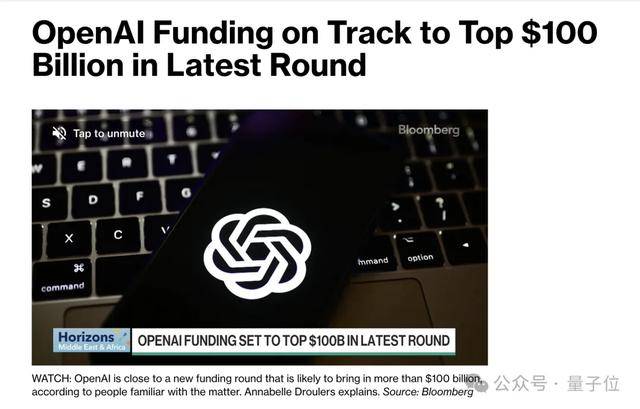
Group 1 - OpenAI is nearing the completion of a new funding round, expected to raise over $100 billion, surpassing its previous record of $40 billion set in early 2025 [1] - The company's overall valuation may exceed $850 billion, making it the highest-valued company in the AI sector, although it would fall to second place behind SpaceX if its valuation of approximately $1.25 trillion is included [4] - The funding round includes major strategic investors such as Amazon, SoftBank, NVIDIA, and Microsoft, with SoftBank having already invested $34.6 billion for an 11% stake [7][8] Group 2 - The initial discussions for OpenAI's valuation were around $830 billion, which has now been adjusted to over $850 billion [7] - Amazon is expected to invest up to $50 billion, SoftBank up to $30 billion, and NVIDIA is discussing a $20 billion investment, with funds being allocated in tranches rather than a lump sum [8] - In the AI landscape, Google has recently released Gemini 3.1, reclaiming its position in AI models, while rumors suggest upcoming updates for GPT, including a new adult mode and GPT 5.3 [9]
X @Demis Hassabis
Demis Hassabis· 2026-02-20 03:48
This is incredible btw - using Gemini 3.1 as a city builder. I used to dream about this when painstakingly making virtual cities for simulation games like Republic.Google DeepMind (@GoogleDeepMind):We used Gemini 3.1 Pro to build a realistic city planner app. 🏙️Watch how the model tackles complex terrain, maps out infrastructure, and simulates traffic to generate a high-quality visualization. https://t.co/SKoVzwtBy8 ...