
GitHub Actions

Search documents
Claude Code“隐形技术栈”被扒出来了,2430次测试揭秘工具偏好清单
3 6 Ke· 2026-02-27 09:27
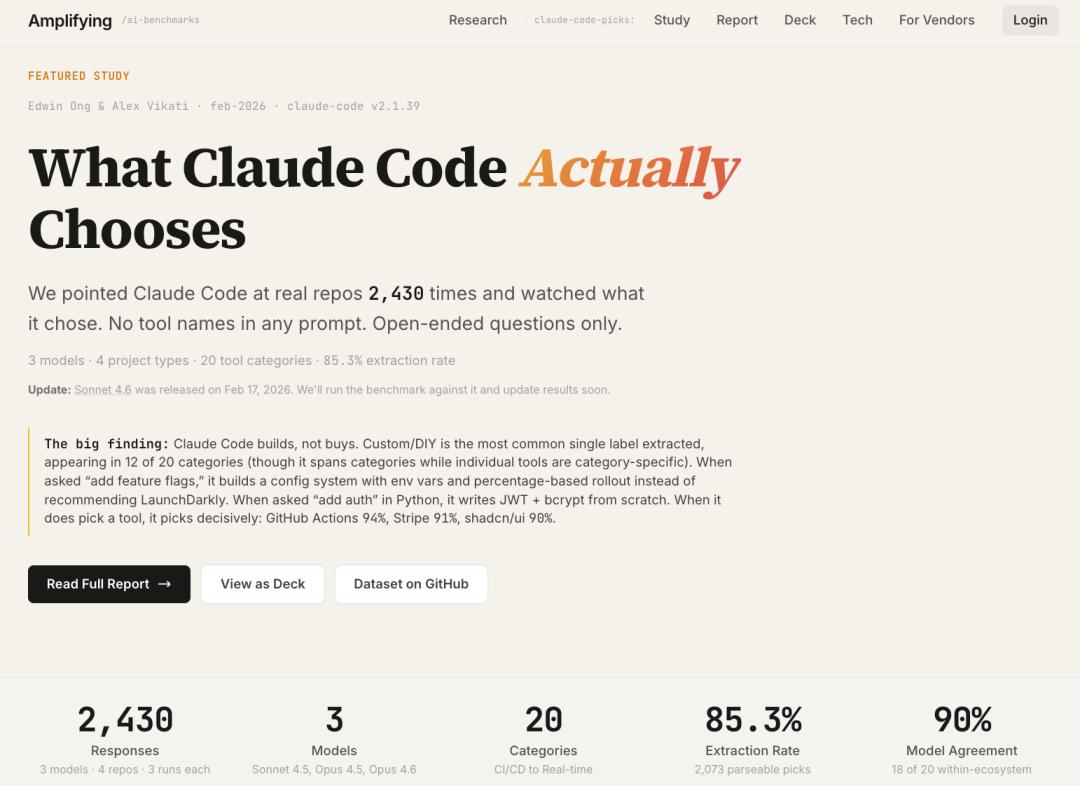
Core Insights - The study conducted by Amplifying.ai reveals Claude Code's preference for building custom solutions over recommending third-party tools, with 12% of all major selections being self-built solutions [5][27] - A default technology stack has emerged, with Claude Code favoring specific third-party tools such as Vercel, PostgreSQL, and Stripe [6][30] - Certain tool categories have become dominated by single tools, with GitHub Actions, Stripe, and shadcn/ui capturing 94%, 91%, and 90% of their respective categories [7][31] - Consistency in tool selection is high among different models within the same technology ecosystem, with 90% agreement on preferred tools across 20 categories [8][49] Experiment Setup - The research covered three models and involved 4 project types and 20 tool categories, analyzing a total of 2,430 tool selection behaviors [2][11] - Open-ended prompts were used throughout the experiment, ensuring no specific tool names were mentioned [4][13] - The study included a clean code environment for each test run to ensure unbiased results [11] Key Findings - Claude Code shows a strong inclination towards self-built solutions, particularly in feature flags and authentication, where it frequently opts for custom implementations [27][28] - The study identified a high extraction rate of 85.3%, indicating a strong ability to identify primary tool recommendations from responses [19] - The models demonstrated varying preferences, with Opus 4.6 showing a tendency to recommend newer tools and custom solutions compared to its predecessors [56] Tool Selection Preferences - GitHub Actions, Stripe, and shadcn/ui are the most frequently recommended tools, dominating their respective categories with high selection rates [30][31] - The study highlights that project context significantly influences tool selection, with different models showing consistent preferences within the same technology ecosystem [9][62] - The research indicates a trend towards custom solutions, particularly in areas like feature flags and authentication, where models prefer building from scratch rather than using established services [47][39] Model Comparison - The three models (Sonnet 4.5, Opus 4.5, Opus 4.6) showed high agreement on tool preferences, with only a few categories exhibiting real divergence [49][50] - The study emphasizes that the choice of tools is heavily influenced by the specific programming ecosystem, with distinct preferences emerging for JavaScript and Python projects [61][62] - The models' recommendations reflect a shift towards a new technology stack shaped by AI-assisted development, indicating a potential change in industry standards [62]

Microsoft reshuffles teams to bolster GitHub as AI coding and agent wars heat up
Business Insider· 2026-01-08 10:00
Core Insights - Microsoft aims to revamp GitHub to enhance its competitiveness against AI coding tools like Cursor and Anthropic's Claude Code, indicating a strategic shift in its approach to software development platforms [1][4] - The formation of the CoreAI Platform and Tools group in January 2025, led by Jay Parikh, consolidates Microsoft's developer division, AI platform team, and GitHub to streamline AI tool development [2] - Recent organizational changes include reallocating Microsoft engineers to GitHub to improve coordination and sales efforts, reflecting a commitment to integrate AI capabilities more effectively [3] Strategic Goals - The primary objective is to position GitHub as a central hub for AI-powered software development, moving beyond its traditional role as a code storage platform [5] - Microsoft envisions GitHub's AI tools being accessible across various development environments, aiming to create a dashboard for managing multiple AI agents [5] - Investments will focus on enhancing core GitHub functionalities, including GitHub Actions for automation, analytics tools for performance insights, and security measures to comply with local data storage regulations [6]

炸锅!GitHub 要对自托管运行器收费。开发者怒喷:吃相难看
程序员的那些事· 2025-12-24 02:47
Core Viewpoint - GitHub will start charging for self-hosted runners used in GitHub Actions from March 1, 2026, at a rate of $0.002 per minute, marking a significant shift from its previous free service model [4][5]. Pricing Changes - GitHub will reduce the prices of its hosted runners by 20% and 39% starting January 1, 2026, but the introduction of charges for self-hosted runners has led to strong dissatisfaction among developers [7][10]. - The company claims that 96% of customers will not notice a billing change, as most affected users will spend less [10]. Developer Reactions - Developers express strong discontent over the new charging model, feeling it is unreasonable to pay for resources on their own servers [8][11]. - Complaints extend beyond pricing to concerns about GitHub's neglect of core platform optimizations, with users reporting issues such as complex deployment configurations and unstable service [12]. Competitive Landscape - GitHub's pricing policy may be a response to competitive pressures, as alternatives like Depot offer optimized runners at lower costs [13]. - To address developer concerns, GitHub has promised to increase investment in self-hosted Actions and improve the platform's core functionalities [14]. User Experience Issues - Developers have noted that the performance of self-hosted runners is significantly better than GitHub's cloud-hosted options, with some reporting build speeds up to 10 times faster [12]. - The dissatisfaction has led some projects, like Zig, to abandon GitHub due to instability and lack of maintenance in the Actions service [15].

“用自己服务器也要向GitHub交钱?”微软新规引开发者众怒,官方紧急喊停!
猿大侠· 2025-12-24 01:06
Core Viewpoint - GitHub announced a pricing adjustment for self-hosted runners under GitHub Actions, introducing a fee of $0.002 per minute starting March 1, 2026, which sparked significant backlash from the developer community [1][2][10]. Summary by Sections GitHub Actions Overview - GitHub Actions, launched in October 2018, is an automation platform primarily used for CI/CD, allowing developers to automate tasks related to their code repositories [4][6]. - The "runner" is a program that executes tasks defined in workflows, and GitHub provides two types: self-hosted runners and GitHub-hosted runners [7][15]. Pricing Changes - The new pricing policy will charge $0.002 per minute for self-hosted runners executing tasks in private repositories, while public repository usage remains free [8][9]. - GitHub will reduce the pricing for GitHub-hosted runners by 20% to 39% starting January 1, 2026, as part of a "simplified pricing and improved user experience" initiative [8]. Developer Reactions - Many developers expressed strong dissatisfaction with the new fee structure, feeling it unfair to pay for using their own hardware [10][17]. - Some developers calculated that their monthly costs could increase significantly, with one user estimating an additional $3,500 per month [17]. GitHub's Justification - GitHub stated that the costs of maintaining and improving the infrastructure for self-hosted runners were previously subsidized by the pricing of GitHub-hosted runners [12]. - The company emphasized the need for a pricing model that aligns costs with actual usage and the value provided to users [12][13]. Response to Backlash - In response to the backlash, GitHub decided to postpone the implementation of the self-hosted runner fee, while still proceeding with the planned price reduction for GitHub-hosted runners [20][21]. - GitHub acknowledged a failure to gather community feedback before announcing the changes and committed to better engagement with the developer community moving forward [22].

速递|谷歌风投在种子轮仅4 个月后再次加码开发者工具初创公司 Blacksmith
Z Potentials· 2025-09-19 02:43
Core Insights - The article highlights the rapid growth and funding success of Blacksmith, a startup focused on accelerating code deployment processes in the AI-driven software industry [1][2]. Funding and Performance - Blacksmith secured a $10 million Series A funding round led by Google Ventures, completing the deal in just 14 days, following a $3.5 million seed round in May [2]. - The company has seen significant growth in annual recurring revenue (ARR), increasing from $1 million to $3.5 million after expanding its team from 4 to 8 members and acquiring over 700 customers [3]. Market Position and Services - Blacksmith offers continuous integration and continuous delivery (CI/CD) services that complement GitHub Actions, addressing the high costs and unpredictability associated with software deployment [2][3]. - The startup operates on high-performance gaming-grade CPUs, achieving up to 2x processing speed and reducing computing costs by up to 75% compared to traditional cloud service providers [4][6]. Business Model and Strategy - By utilizing a bare-metal architecture, Blacksmith claims to have better economic control than large-scale cloud providers, allowing for improved profit margins as they scale their customer base [6]. - The target customers are enterprises with engineering teams of over 500, and notable clients include Ashby, Chroma, and Supabase [6][7]. Team and Background - The founding team of Blacksmith has experience from Faire and Cockroach Labs, where they recognized the challenges in the software release process [3]. - The company graduated from Y Combinator's winter 2024 batch and currently has a team of 11 members [7].

多姆克卸任,GitHub并入微软CoreAI:1.5亿开发者何去何从?
3 6 Ke· 2025-08-15 00:02
Core Insights - The departure of GitHub CEO Thomas Dohmke marks a significant turning point in Microsoft's developer ecosystem and cloud computing strategy, raising concerns about the integration of GitHub into Microsoft's CoreAI division [2][4][9] - Under Dohmke's leadership, GitHub transformed into a core pillar of Microsoft's AI strategy, growing to 150 million developers and establishing key AI tools like Copilot, which has attracted 20 million users [2][4] Impact of Departure - Dohmke's exit could disrupt GitHub's independent developer culture, which has been a key attraction for global developers, while potentially accelerating AI tool development [4][5][8] - The restructuring involves integrating GitHub directly into the CoreAI department, led by former Meta executive Jay Parikh, without appointing a new CEO, which raises concerns about decision-making efficiency [4][5] AI Integration and Development - The integration of GitHub into CoreAI is seen as a move to enhance AI tool development speed, but it risks undermining the platform's innovative foundation [5][9] - GitHub's AI development tools, including Copilot Chat and GitHub Actions, have seen significant usage growth, with GitHub Actions processing 3 billion minutes of work per month, a 64% year-over-year increase [4][7] Market Position and Competition - Microsoft holds a substantial advantage with a large developer ecosystem, which is crucial for AI training data accumulation, as developers use tools like Copilot daily [7][9] - Investors are advised to monitor key metrics such as Copilot's market penetration, GitHub Actions' user activity, and Azure AI Foundry's growth to gauge GitHub's continued success post-restructuring [8][9] Long-term Outlook - The integration of GitHub into CoreAI reflects Microsoft's long-term commitment to AI-driven software development, with the potential to reshape the industry landscape [9][10] - While short-term stock volatility may occur due to leadership changes, the long-term outlook remains positive, as GitHub's AI tools are embedded in millions of developers' workflows [9][10]

微软全面接管!全球最大代码托管平台结束独立运营
Guan Cha Zhe Wang· 2025-08-13 02:03
Core Insights - GitHub CEO Thomas Dohmke announced his resignation effective by the end of 2025 to pursue new entrepreneurial projects [1] - GitHub will continue to operate as part of Microsoft's CoreAI organization, with the existing leadership team taking over [1] - This marks the first time GitHub has lost its "subsidiary" status since Microsoft's acquisition for $7.5 billion in 2018 [1] Company Strategy - GitHub will deepen its integration with Microsoft's CoreAI strategy, enhancing collaboration between core products like Copilot, GitHub Actions, and Advanced Security with Microsoft's AI infrastructure and cloud services [2] - The Copilot+ strategy will see larger-scale application and validation on the GitHub platform [2] Market Position - Analysts believe that Dohmke's departure will not undermine GitHub's position in the AI development tools market [2] - Dohmke's entrepreneurial background may introduce new dynamics to the AI ecosystem, as he understands developer market pain points and how to build ecosystems with a platform mindset [2]

GitHub CEO辞职,微软全面接管,被收购7年后,全球最大代码托管平台结束独立运营
3 6 Ke· 2025-08-12 09:06
Core Perspective - GitHub is undergoing significant changes as its CEO Thomas Dohmke announces his departure, marking a shift from its previously promised independent operation under Microsoft [1][2][7] Leadership Changes - Thomas Dohmke, the second CEO of GitHub, is leaving to return to entrepreneurship, similar to the first CEO Nat Friedman, who also left to pursue startup opportunities [3][6][7] - Dohmke will remain until the end of 2025 to assist in the transition as GitHub integrates into Microsoft's CoreAI team, losing its independent leadership structure [1][7][12] GitHub's Current Status - GitHub currently hosts over 1 billion code repositories and branches, with more than 150 million developers, experiencing significant growth in open-source projects and contributions [9] - The platform has seen a doubling of AI project numbers in the past year, indicating a strong market presence and innovation [9] Technological Advancements - GitHub has improved its accessibility and usability, achieving FedRAMP certification and enhancing security features, which have reduced average vulnerability fix times by 60% [9][10] - GitHub Copilot has evolved into a leading AI-powered coding assistant, with over 20 million users, and has established partnerships with major AI companies [10][14] Organizational Changes - The CoreAI department, established in January 2023, will oversee GitHub's integration, focusing on AI-driven product development and enhancing the feedback loop between AI platforms and products [13][14] - This restructuring aligns with Microsoft's broader strategy to prioritize AI technologies across its services [13][14] Community Reactions - There are mixed reactions from the developer community regarding GitHub's future under Microsoft's tighter integration, with some expressing optimism based on past improvements, while others voice concerns about potential declines in platform openness and performance [16][22]
