
HarmonyOS操作系统

Search documents
鸿蒙生态如何打造出境服务新体验?解决出境游"三大难"
经济观察报· 2025-12-26 12:23
Core Viewpoint - Huawei aims to enhance outbound travel experiences by leveraging its HarmonyOS capabilities and fostering partnerships to create a comprehensive service ecosystem for travelers [1][24]. Group 1: Market Trends - By 2025, China's outbound tourism market is projected to experience a robust recovery with an average annual growth rate of 44.3% [2]. - The traditional group travel model is declining, with over 70% of travelers now opting for independent travel, particularly among the "digital natives" of Generation Z [3]. Group 2: User Experience Challenges - Travelers face significant "experience degradation" when transitioning from a highly integrated domestic digital ecosystem to fragmented services abroad [4][5]. - The mismatch in service distribution mechanisms between domestic and international contexts leads to difficulties in accessing essential services while traveling [5]. Group 3: Structural Gaps in Outbound Services - There are three major structural gaps in outbound travel services: 1. **Infrastructure Connection Gap**: Variability in network standards and roaming agreements across countries creates technical barriers [8]. 2. **Information Gap**: The lack of a unified digital intermediary complicates information access and decision-making for travelers [10]. 3. **Local Service Access Gap**: Travelers face high "digital identity costs" when trying to access local services, which are often distributed through traditional app-based models [12][14]. Group 4: Comprehensive Service Integration - Huawei proposes a solution that integrates pre-trip, in-trip, and post-trip services into a seamless experience, addressing the identified gaps [17][18]. - The integration includes features like itinerary management, local service recommendations, and AI-enhanced photo sharing to enhance user satisfaction [20][22]. Group 5: Ecosystem Development - Huawei is building a robust ecosystem by empowering partners and developers to enhance outbound travel services, as seen with the integration of services like Grab and Keeta [25][26]. - The HarmonyOS has launched over 120 outbound service cards, covering essential travel needs such as dining, accommodation, and shopping [27]. - The installed base of HarmonyOS devices has surpassed 32 million, indicating a significant market opportunity for global partners [28].


鸿蒙生态如何打造出境服务新体验?解决出境游"三大难"
Jing Ji Guan Cha Wang· 2025-12-26 11:32
Core Insights - The outbound tourism market in China is experiencing a strong recovery with an average annual growth rate of 44.3% by 2025 [1] - The traditional group tours are declining, with over 70% of travelers now opting for independent travel, primarily driven by the "digital natives" of Generation Z [2] Group 1: Industry Challenges - There is a significant "experience downgrade" for travelers accustomed to a highly integrated digital lifestyle in China when they travel abroad [2][3] - The outbound tourism experience is hindered by three major structural gaps: infrastructure connectivity, information exchange, and local service access [4] - The "infrastructure connectivity gap" arises from differences in network standards, complex roaming agreements, and varying levels of communication infrastructure across countries [5] - The "information exchange gap" is characterized by increased decision-making costs due to fragmented information sources and language barriers, making it difficult for travelers to navigate unfamiliar environments [7] - The "local service access gap" reflects the challenges faced by short-term visitors in establishing a digital identity to access local services, which often requires extensive setup [9][10] Group 2: Solutions Proposed by Huawei - Huawei aims to address these gaps by providing a comprehensive solution that integrates services across the entire travel experience, from pre-trip planning to post-trip sharing [11][12] - The proposed solution includes a unified service platform that aggregates travel information, visa updates, personalized itinerary suggestions, and easy booking options [14] - During the trip, Huawei's services will offer seamless connectivity, navigation, and local recommendations, enhancing the overall travel experience [15][16] - Huawei is also focusing on upgrading its core technologies and services, such as the Petal Maps and Tianji Tong app, to support global connectivity and enhance user experience [17] Group 3: Ecosystem Development - Huawei is building a collaborative ecosystem by empowering partners and developers to enhance outbound travel services, ensuring users have access to high-quality offerings [18][20] - The integration of services like Grab and Keeta into Huawei's ecosystem has significantly improved user experience, with Grab reporting an 18-fold increase in monthly orders after joining [18][19] - As of now, over 120 outbound service cards have been launched within the HarmonyOS ecosystem, covering essential travel needs such as dining, accommodation, and shopping [20] - The number of devices equipped with HarmonyOS has surpassed 32 million, indicating a substantial market opportunity for global partners [21]
鸿蒙星光盛典:一场科技与人文交织的“追光”盛会
证券时报· 2025-12-25 11:02
Core Viewpoint - The "Harmony Starry Night Gala" showcases the achievements of the HarmonyOS ecosystem, emphasizing its role in China's digital transformation and technological self-reliance [7][8][18]. Group 1: Event Overview - The gala was co-hosted by the Central Radio and Television Station and the Guangdong Provincial Government, featuring a visually stunning display with 40,000 light balls [1][2]. - The event's narrative focused on "breakthrough, growth, belief, and future," with prominent hosts and performers conveying a message of unity and warmth [4][6]. Group 2: Technological Integration - The stage design embodied the concept of "Harmony's initial opening, interconnecting the stars," blending Eastern philosophy with futuristic technology [6]. - The gala integrated cutting-edge technologies like AR and AI, illustrating the future of interconnectedness [6]. Group 3: HarmonyOS Achievements - HarmonyOS has evolved significantly since its launch in August 2019, with the upcoming HarmonyOS 5 and the recently released HarmonyOS 6 marking important milestones [8]. - The system has become a strong competitor to Android and iOS, providing users with a "third choice" in operating systems [10]. Group 4: Ecosystem Growth - The Harmony ecosystem now boasts over 350,000 applications and services, with a compatibility rate exceeding 95% across 18 major sectors [12]. - The number of registered developers in the Harmony ecosystem has surpassed 10 million, with over 7.32 million individuals learning Harmony development skills [12][14]. Group 5: Open Source Development - Open-source HarmonyOS is the fastest-growing open-source operating system, with over 1300 hardware products and more than 70 industry-specific versions developed [14][16]. - The system has been customized for various industries, including energy and telecommunications, demonstrating its versatility [14]. Group 6: National Significance - HarmonyOS represents China's first fully self-developed operating system, enhancing national information security and digital sovereignty [18]. - The ecosystem promotes collaboration among various market players, contributing to the overall digital economy and innovation [18][20]. Group 7: User Experience and Future Vision - HarmonyOS aims to provide a seamless user experience, with features designed to bridge digital divides and promote inclusivity [18]. - The ongoing journey of HarmonyOS reflects China's commitment to technological independence and innovation, inviting users and developers to participate in its growth [21][20].
国内首个:龙芯中科联合北航打造卫星数据“中国方案”;世界最大直径水下盾构隧道完成黄河段掘进丨智能制造日报
创业邦· 2025-06-23 04:07
Group 1 - The world's largest diameter underwater shield tunnel has successfully completed the Yellow River section excavation, marking a significant milestone in the construction of this project [1] - The project team has implemented innovative techniques to adapt to the unique geological conditions of the Yellow River basin, including increasing the shield machine's cutter head opening rate and installing a high-flow central flushing system [1] - The "Shanhe" shield machine has completed 1,376 rings and 2,752 meters of excavation, achieving 83% of the construction progress [1] Group 2 - Longxin Zhongke has partnered with Beihang University to launch China's first cross-satellite instant data service system based on Longxin, aimed at providing reliable navigation and communication coverage in complex environments [1] - This system is expected to support various sectors, including low-altitude economy, smart oceans, and emergency management, extending its influence to countries along the Belt and Road Initiative [1] Group 3 - Chuangye Huikang Technology Co., Ltd. has signed a cooperation agreement with Zhejiang University to establish a joint laboratory focused on AI applications in medicine, particularly centered around medical large models [1] - The laboratory will be located at Chuangye Huikang's headquarters and will concentrate on research and transformation of AI+medical innovations [1] Group 4 - Huawei is set to launch the new generation commercial tablet, the Qingyun C5, which features an 11.5-inch 120Hz full-screen display and runs on the HarmonyOS operating system [1]



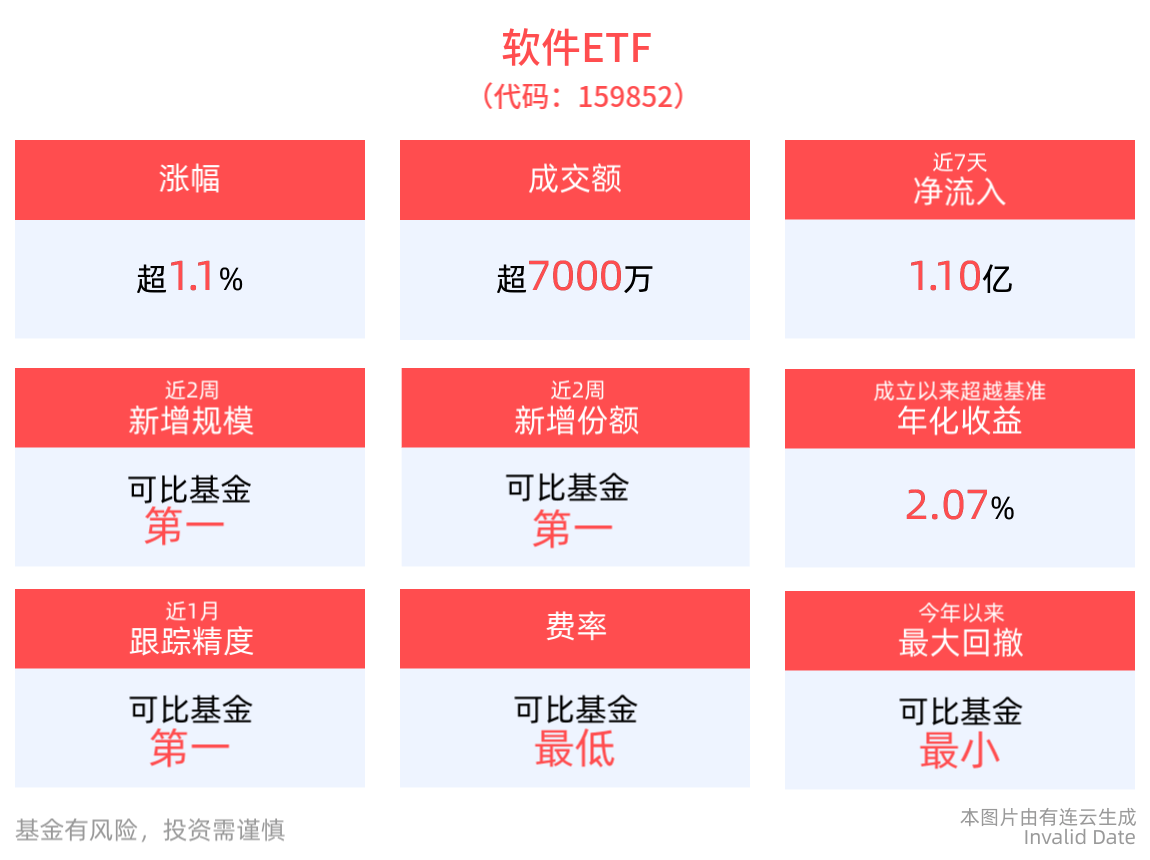
科技成长布局时点已逐步临近,软件ETF(159852)上涨1.24%
Sou Hu Cai Jing· 2025-05-12 03:11
Group 1 - The software ETF has shown significant liquidity with an intraday turnover of 2.23% and a transaction volume of 70.31 million yuan, ranking first among comparable funds in terms of average daily trading volume over the past week at 241 million yuan [3] - The software ETF has experienced a notable increase in scale, growing by 225 million yuan over the past two weeks, also ranking first among comparable funds [3] - The software ETF's share count has increased by 10.2 million shares in the last two weeks, marking a significant growth and leading among comparable funds [3] Group 2 - In terms of capital inflow, the software ETF has seen net inflows for 6 out of the last 7 trading days, totaling 11 million yuan [3] - Leveraged funds are actively investing, with the latest margin buying amounting to 17.76 million yuan and a margin balance of 112 million yuan [3] - The launch of Huawei's first HarmonyOS-based computer on May 8 signifies a major breakthrough for domestic operating systems in the PC sector, with the official release scheduled for May 19 [3] Group 3 - The top ten weighted stocks in the CSI Software Service Index account for 60.07%, including companies like iFlytek, Kingsoft Office, and Tonghuashun [4] - Investors can also access AI software investment opportunities through the software ETF linked fund (012620) [4]
零跑朱江明自曝年薪8万, IPO后没领过工资;国行版苹果AI百度技术占比仅35%,因战略失误错失份额;阿里正在大批出售旗下资产
雷峰网· 2025-05-09 00:35
Group 1 - Apple collaborates with Baidu and Alibaba for AI, with Baidu's technology share at 35% and Alibaba's at 65%, due to strategic missteps by Baidu [4] - Li Auto's CEO Zhu Jiangming claims his current annual salary is 80,000, solely for social security payments, and he has not drawn a salary since the IPO [6] - Alibaba is selling off assets, including shares in Wanda Film and YTO Express, totaling nearly 600 million [8][9] Group 2 - Microsoft has ceased providing office software to BGI Genomics, which has now partnered with Kingsoft Office for a strategic collaboration [10] - Geely has implemented a rotating presidency system, with Dai Qing as the first president, focusing on optimizing management structure [13] - Neta Auto's parent company, Hozon Auto, is beginning to repay debts, having previously faced issues with tax and service interruptions [14] Group 3 - OpenAI appoints Fidji Simo as CEO of its new applications division, indicating a strategic shift towards enhancing product development and market expansion [22][23] - Intel is negotiating wafer foundry collaborations with Nvidia and Google, with confirmed orders from Microsoft [24] - Apple is expanding its in-house chip development for future devices, including smart glasses and AI servers, with production expected to start by late 2026 or 2027 [25]



国产PC操作系统破局,首款鸿蒙电脑要来了
Xin Lang Cai Jing· 2025-05-08 06:16
Core Viewpoint - Huawei officially launched its first HarmonyOS-based computer, marking a significant step in the development of domestic operating systems in the personal computer sector [1][2] Group 1: Product Launch and Features - The HarmonyOS computer was unveiled at the HarmonyOS Computer Technology and Ecosystem Communication Conference in Shenzhen on May 8, with a formal release scheduled for May 19 [1] - The computer is built on the Harmony kernel and features a new Star Shield security architecture to ensure user privacy [1] - It integrates an AI assistant named "Xiao Yi" that can generate PPTs, manage knowledge across devices, and automatically create meeting minutes through voice commands [1] Group 2: Ecosystem Development - Over the past year, HarmonyOS has made significant progress in ecosystem development, with more than 20,000 native applications and meta-services launched, and over 7.2 million developers contributing [1] - The number of compatible applications for the PC ecosystem is expected to exceed 2,000 by the end of the year, with over 300 applications already adapted [2] Group 3: Market Position and Growth Potential - The HarmonyOS computer supports over 1,000 external devices, including more than 800 standard peripherals and over 250 non-standard devices [2] - The launch of the HarmonyOS computer signifies a breakthrough for domestic operating systems in the PC market, potentially opening new revenue growth points for Huawei [2] - According to CounterPoint, Huawei is projected to rank third in China's PC market by Q4 2024, with a market share of 13.2% [2] - IDC data indicates that Huawei's share in the commercial PC market has increased from 3% to 9% by Q1 2025, with a potential demand of 15 million units in China, suggesting a possible increase of 300,000 units if HarmonyOS PCs capture 20% of the market [2]