
MSD

Search documents
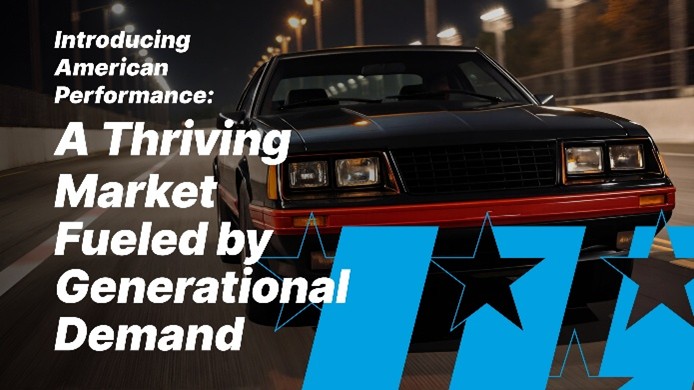
Holley Performance Brands Redefines a Legacy With Launch of “American Performance” Vertical
Globenewswire· 2026-01-22 14:00
Core Insights - Holley Performance Brands has rebranded its consumer vertical from "Domestic Muscle" to "American Performance," reflecting a generational shift in automotive enthusiasm and sustained growth in American vehicle platforms from the 1980s to 2000s [1][5] Market Trends - The previous "Domestic Muscle" segment was perceived as a legacy category, primarily focused on older muscle cars from the 1960s and 1970s, which were plateauing in demand [2] - Holley's research indicates that demand is expanding due to younger enthusiasts entering their peak spending years, engaging with vehicles they grew up with [2][5] Segment Definition - The American Performance segment includes trucks, SUVs, and cars that are 20 years or older, as well as modern American performance vehicles like Mustangs, Corvettes, and Challengers [3] Research Findings - Platforms from 1980 to 2009 account for over 78% of Holley's event participation and 81% of segment sales, indicating strong demand beyond traditional muscle cars [6] - Trucks represent 80% of the top vehicle searches on Holley.com, highlighting their dominance in search and sales activity [6] - Over 70% of attendees at Holley's LS Fest are under 45 years old, engaging with 1980s to 1990s platforms, showcasing a younger and more diverse buyer demographic [6] Cultural Influence - Pop culture is driving renewed interest in vehicles, with media moments and nostalgia contributing to rising values for models like the Buick Grand National and Fox Body Mustang [6] Market Potential - The American Performance segment represents a market exceeding $5 billion and contributes approximately 60% of Holley Performance Brands' annual revenue [9]


2025年职场红利盘点:在这些赛道里,捡回“上行”信心(全文版)
3 6 Ke· 2025-12-19 06:47
Group 1 - The article discusses the impact of AI on the workplace, highlighting both the potential benefits and the challenges faced by employees as AI technologies evolve [2][3] - It notes that many companies are still hesitant to invest in employer branding, focusing instead on product performance and financial results, which diminishes the importance of employee relations [3] - The trend of seeking "versatile talents" in job descriptions is increasing, while the concept of "one-person companies" emerges as a response to workforce reductions, raising questions about the value of teamwork [3] Group 2 - The article reflects on the struggles of an AI startup team, emphasizing the challenges of navigating the AI landscape and the impact of rising price sensitivity among consumers [3][4] - It mentions the organization of various events, including AI talent salons and recruitment fairs, aimed at fostering community and industry engagement [4] - The publication aims to maintain high content standards and neutrality while exploring monetization strategies through paid content, indicating a shift in the media landscape [4] Group 3 - The article presents a list of the top 50 employers in the workplace bonus category, showcasing companies that have excelled in employer branding and employee engagement [8][15] - It highlights the importance of adapting to changing market demands and the emergence of new job roles in sectors like IP management and overseas market promotion due to the globalization of brands [11] - The narrative emphasizes the need for companies to innovate and adapt to the evolving economic landscape, particularly in the context of AI and automation [11]

看懂这些关键领域,在2026年捡回“上行”信心(限免阅读)
3 6 Ke· 2025-12-18 15:17
Group 1 - The core theme of the articles revolves around the impact of AI on the workplace, highlighting both the potential benefits and challenges faced by employees and companies in adapting to AI technologies [2][3]. - The narrative discusses the cautious approach of capital investment in AI applications, emphasizing that many startups have failed due to pursuing "pseudo-demand" [2]. - The emergence of AI tools has led to a significant shift in job dynamics, with the introduction of "super individuals" potentially displacing other workers in the same demand unit [2]. Group 2 - The articles reflect on the harsh realities faced by employees in China, where few companies invest in employer branding, focusing instead on product strength and performance [3]. - There is a trend of companies expanding job descriptions to seek "composite talents," raising questions about the necessity of teamwork in the workplace [3]. - The narrative also touches on the struggles of an entrepreneurial team from 36Kr, noting the challenges faced in the AI startup landscape and the impact of rising price sensitivity among consumers [3]. Group 3 - The articles mention various events organized by the company, including AI talent salons and large recruitment fairs, aimed at fostering community and industry engagement [4]. - The company has produced influential deep reports, despite facing pushback from some companies regarding content [4]. - The focus remains on maintaining high content standards and neutrality while exploring monetization through paid content [4]. Group 4 - The "Top 50 Employers for Workplace Benefits" list includes companies in advanced manufacturing, such as Momenta, SiLing Robotics, and Gree Electric, showcasing leaders in the industry [6][10]. - The articles highlight the growth and challenges faced by these companies, including the need for skilled talent in areas like AI and robotics [8][11]. - The narrative emphasizes the importance of innovation and adaptation in the rapidly evolving job market, particularly in sectors influenced by AI and automation [13].
泡沫破裂与生死时速 ——自动驾驶行业进入“务实生存”新阶段
Zhong Guo Qi Che Bao Wang· 2025-12-15 01:32
Core Viewpoint - The autonomous driving industry is experiencing a significant downturn, marked by the collapse of once-prominent unicorn companies, reflecting the harsh realities of the market after a period of excessive capital influx [2][3]. Group 1: Industry Collapse - By the end of 2025, the autonomous driving sector is witnessing the end of its "crazy era," with companies like Maimo Zhixing halting operations due to financial distress and judicial account freezes [2]. - The downfall of Maimo Zhixing and Zongmu Technology serves as a warning for the industry, indicating that the collapse of high-valuation companies is no longer an isolated incident but a reflection of systemic issues within the sector [2]. Group 2: Strategic Pitfalls - Companies that have fallen from grace share similar trajectories, having initially thrived during a booming market by securing substantial funding and high valuations based on promising technology narratives [3]. - Maimo Zhixing's reliance on a single major client, Great Wall Motors, created a dependency that ultimately limited its market expansion and technological autonomy, leading to missed opportunities [4]. Group 3: Market Dynamics - The shift in Great Wall Motors towards more open technological collaborations has destabilized Maimo Zhixing's foundational partnerships, exacerbating its vulnerabilities in a competitive landscape [4]. - The global capital market's increasing caution towards hard technology investments has redirected funds away from the uncertain profitability of autonomous driving towards more immediately rewarding sectors like AI [4]. Group 4: Technological Missteps - Maimo Zhixing's failure to adapt to the industry's shift towards "light mapping" technology has hindered its competitiveness, as it continued to invest heavily in outdated systems [5]. - The choice of technology routes has significant implications for cost structure, data iteration efficiency, and scalability, with companies like Momenta successfully leveraging their capabilities to enter global markets [6]. Group 5: Market Polarization - The collapse of weaker firms has led to a stark division in the industry, with leading companies like Horizon Robotics solidifying their positions through extensive partnerships and market penetration [8]. - The competition has shifted from mere technological prowess to the speed of technological iteration, cost control, and the ability to commercialize effectively [9]. Group 6: Future Outlook - The autonomous driving sector is transitioning from its initial chaotic phase to a more mature stage focused on deepening and consolidating market positions, with capital becoming more selective in its investments [10].

一颗芯片,颠覆智驾江湖
半导体芯闻· 2025-08-22 11:28
Core Viewpoint - The emergence of Momenta's self-developed driving chip marks a significant shift in the domestic intelligent driving industry, transitioning from a software-only company to a full-stack supplier, posing new competitive challenges to existing players in the market [1][2][20]. Company Overview - Momenta, established in 2016, focuses on high-performance intelligent driving solutions, targeting both L2 and L4 markets, and has partnerships with major global automakers, including SAIC, BYD, and Toyota [2][3]. - The company holds the largest market share in urban NOA technology at 60.1%, with cumulative sales of 114,000 vehicles equipped with its technology [3][19]. Self-Developed Chip Significance - Momenta's self-developed chip is positioned for the mid-range market, offering cost advantages and compatibility with existing products, which enhances its competitive edge [6][19]. - The strategy of "downward integration" is expected to create stronger competitive barriers and higher value capture capabilities for the company [6][10]. Impact on Competitors - The introduction of Momenta's chip poses significant challenges to NVIDIA and Qualcomm, as it allows automakers to transition smoothly from their solutions, increasing competitive pressure on these established players [8][10]. - Domestic chip manufacturers like Horizon Robotics and Black Sesame are also facing heightened competition, as Momenta's software expertise may overshadow their advantages [10][11]. Implications for Automakers - Automakers are reevaluating the necessity and cost-effectiveness of in-house chip development in light of Momenta's competitive offerings, particularly for resource-constrained new entrants [12][14]. - The shift towards Momenta's integrated solutions may lead to a reassessment of self-research strategies among automakers, balancing differentiation with cost advantages [15][21]. Strategic Challenges Ahead - Momenta faces challenges in achieving large-scale production and meeting stringent automotive safety standards, which are critical for its long-term success [20][21]. - The competitive landscape is expected to intensify as established players like NVIDIA and Qualcomm may respond with price cuts or enhanced technology to counter Momenta's market entry [20][21].



Holley (HLLY) FY Conference Transcript
2025-06-04 18:40
Summary of Holley (HLLY) FY Conference Call - June 04, 2025 Company Overview - Holley specializes in automotive aftermarket products, enhancing vehicle performance and enjoyment for car enthusiasts [2][3] - The company has a history of over 120 years, focusing on iconic brands in the automotive sector [6][27] Market Insights - The automotive enthusiast market in the U.S. comprises approximately 70 million individuals, surpassing other hobbies like golf and fishing [5] - The market for trucks, SUVs, and CUVs is valued at $26 billion, representing 80% of new vehicle sales in the U.S. [10] - Holley operates in four main verticals: domestic muscle cars, trucks/SUVs, import vehicles, and safety/racing [10][11] Financial Performance - In Q1, Holley reported a 3.3% year-over-year growth in core business, marking the first growth in five quarters [12][13] - Direct-to-consumer sales grew over 10%, while third-party marketplace sales increased by 50% [15] - The company achieved $8.1 million in product innovation and strategic pricing during the quarter [15] - Free cash flow was negatively impacted by timing issues, with expectations of recovery in Q2 [17] Operational Efficiency - Holley has cut operational inefficiencies by over $30 million in the past two and a half years, with a target of an additional $5-10 million this year [29][30] - The company reduced its SKU count by 45%, improving inventory management [32] - Past dues were reduced by 20%, and the company is focused on freeing up cash by eliminating unproductive inventory [18] Strategic Initiatives - Holley aims to enhance the consumer experience and improve its direct-to-consumer model, which has grown from 15% to 20-25% of sales [42] - The company is exploring transformational M&A opportunities to further strengthen its market position [23] - Holley is expanding into new markets, including Mexico, and is looking to enter additional international markets [22] Challenges and Risks - The automotive aftermarket industry has faced softness over the past three years, with market conditions being challenging [20] - Tariff impacts remain a concern, but Holley has managed to mitigate some effects through supplier consolidation and moderate pricing actions [49][50] Consumer Engagement - Holley has a strong social media presence with 8 million followers and hosts events that attract over 50,000 attendees [38][40] - The company emphasizes the importance of brand recognition and consumer loyalty in the automotive aftermarket [42] Future Outlook - Holley maintains a guidance of approximately $120 million in EBITDA for the year, with expectations of generating $40-50 million in free cash flow [36] - The company is focused on deleveraging and improving its balance sheet through strategic financial management [36][37] Conclusion - Holley is positioned for growth in the automotive aftermarket, leveraging its strong brand portfolio and operational improvements while navigating market challenges and consumer trends [37][42]