
MTTS5000

Search documents
GPU四小龙,春节不打盹儿
第一财经· 2026-02-14 14:37
Core Viewpoint - The article highlights the rapid advancements in domestic GPU technology and its integration with large AI models, emphasizing the importance of timely adaptation to stay competitive in the AI landscape [3][11]. Group 1: Domestic GPU Developments - Domestic GPU companies, referred to as the "four little dragons," including Moer Technology, Muxi Co., TianShu ZhiXin, and Biran Technology, are actively adapting to new large AI models released during the Spring Festival [3][6]. - Moer Technology's MTTS5000 and Muxi's XiYun C series have successfully adapted to the new GLM-5 model from Zhipu AI, showcasing the efficiency of GPU architecture in model adaptation [5][6]. - The adaptation process is crucial as it enhances the performance of AI models on specific hardware, with GPU architectures allowing for quicker adjustments compared to specialized architectures like NPU [6][11]. Group 2: AI Model Releases - ByteDance's Seedance 2.0, a video generation model, has blurred the lines between reality and virtuality, paving the way for large-scale applications in AI-generated content [7]. - Alibaba's Qwen-Image-2.0 has shown competitive performance in image generation, ranking just below models from Google and OpenAI in benchmark tests [7]. - MiniMax's MiniMax-M2.5 model is notable for its cost-effectiveness, allowing continuous operation at a low cost, which could drive broader adoption in productivity scenarios [7][8]. Group 3: Market Dynamics and Trends - The release of DeepSeek's models has significantly impacted the AI landscape, boosting confidence in domestic AI applications and prompting a shift in how companies approach model training and deployment [11][12]. - The demand for GPU capabilities in inference tasks is increasing, with domestic companies like Muxi and Moer Technology positioned to compete with NVIDIA, especially as the latter's products face restrictions in China [13][21]. - The collaboration between domestic chip manufacturers and AI model developers is becoming more routine, with strategic partnerships being formed to enhance compatibility and performance [16][18]. Group 4: Future Outlook - The expectation for future releases from DeepSeek could stimulate further deployment of AI models in various sectors, particularly in state-owned enterprises [17]. - Domestic chip companies are accelerating their product iterations to meet the growing demand for AI capabilities, with plans for multiple new architectures and products in the coming years [18][19]. - The overall sentiment is optimistic regarding the ability of domestic firms to close the gap with international competitors, with a focus on practical applications and performance differentiation [21].


GPU四小龙,春节不打盹儿
Di Yi Cai Jing· 2026-02-14 10:23
Core Insights - The collaboration between domestic GPUs and large models is improving significantly, with multiple companies launching new models around the Spring Festival period [1][9] - Domestic GPU companies are adapting quickly to new large models, indicating a competitive landscape where timely adaptation is crucial for success [2][4] Group 1: Domestic GPU Developments - Major domestic GPU companies, including Moore Threads, Muxi, and Tensu Zhixin, have successfully adapted to new large models like GLM-5 and Seedance 2.0 [2][3] - The adaptation process involves optimizing performance from initial capabilities, which can vary significantly based on the architecture used [2][7] - The rapid response of these companies during the Spring Festival highlights their commitment to staying competitive in the AI landscape [5][6] Group 2: Large Model Innovations - ByteDance's Seedance 2.0 and Alibaba's Qwen-Image-2.0 are notable advancements in video and image generation, respectively, with capabilities approaching those of leading global models [3][6] - MiniMax's M2.5 model offers cost-effective solutions for productivity applications, showcasing the potential for widespread adoption in various sectors [3][9] - The release of these models is expected to drive further integration of AI technologies in domestic industries, enhancing the overall market landscape [9][10] Group 3: Market Dynamics and Future Outlook - The release of DeepSeek's models has significantly impacted the AI market, prompting a shift in how companies perceive and utilize large models [6][12] - Domestic chip manufacturers are increasingly forming strategic partnerships with large model developers, indicating a trend towards closer collaboration [9][11] - The anticipated advancements in model capabilities are expected to stimulate further deployment in various sectors, particularly in state-owned enterprises [9][10]
GPU四小龙,春节不打盹儿 | 海斌访谈
第一财经网· 2026-02-14 10:16
Core Viewpoint - Companies that do not take action in the AI wave, particularly in the release of large models and domestic chip enterprises, may fall behind in the industry Group 1: Domestic GPU and Model Development - Domestic GPUs are increasingly well-matched with domestic models, with a surge in large model releases around the Spring Festival [2] - ByteDance launched the video generation model Seedance 2.0, while Zhizhu and MiniMax released their respective models GLM-5 and MiniMax-M2.5 [5][6] - Domestic GPU companies are on standby during the Spring Festival to quickly adapt to new models, indicating the fast-paced nature of AI technology [2][4] Group 2: Model Adaptation and Performance - Companies like Moer Thread and Nuxi have successfully adapted new models to their GPUs, with Moer Thread's MTTS5000 and Nuxi's Xiyun C series being highlighted [4] - Adapting models to run efficiently on GPUs can significantly improve performance, with general GPU architectures allowing for quicker adjustments compared to specialized architectures like NPU [4] - The adaptation process is crucial for ensuring that large models perform optimally on domestic chips, which is essential for competitive positioning [4] Group 3: Market Dynamics and Future Expectations - The release of DeepSeek's models has raised expectations for domestic AI capabilities, with significant improvements noted in the past year [9][10] - Domestic chip companies are increasingly collaborating with large model enterprises, establishing a routine for Day 0 adaptations [14] - The anticipated release of new models from DeepSeek could further stimulate deployment efforts among state-owned enterprises, expanding market opportunities for domestic GPU companies [14] Group 4: Competitive Landscape and Technological Advancements - Domestic GPU companies are beginning to compete with international firms like NVIDIA, particularly in inference tasks where performance requirements are less stringent [11] - The rapid iteration of domestic chips is driven by the growing demand for AI computing power, with companies like Moer Thread and Nuxi accelerating their product development cycles [15][16] - The industry is optimistic about overcoming existing technological gaps, with a belief that domestic firms will eventually achieve parity with international competitors [16]

国产GPU突围:从“输血”到“造血”,殊途能否同归?
Jing Ji Guan Cha Wang· 2026-02-07 01:01
Core Insights - The domestic GPU companies, Moore Threads and Muxi Co., have released their first annual performance forecasts post-listing, indicating significant revenue growth for 2025, although net profit losses persist but are narrowing [1][2] Revenue Forecasts - Moore Threads expects revenue between 1.45 billion to 1.52 billion yuan for 2025, representing over a twofold year-on-year increase, while net profit is projected to be a loss of 950 million to 1.06 billion yuan, which is a reduction compared to the previous year [1] - Muxi Co. anticipates revenue of approximately 1.6 billion to 1.7 billion yuan, also maintaining a high growth rate, with expected losses between 650 million to 798 million yuan, indicating a decrease in losses [1] Common Advantages - Both companies exhibit significant technological breakthroughs, with Moore Threads launching its fourth-generation GPU architecture and achieving mass production of the MTTS5000 chip, while Muxi has developed a software ecosystem compatible with mainstream technologies [1] - Their commercialization processes are accelerating, having crossed the initial startup "valley of death," and are beginning to transition from reliance on external funding to self-sustaining revenue generation [1] - Both companies are seizing the opportunity presented by international restrictions to capture market share amid the domestic substitution wave [1] Strategic Path Differences - Muxi appears to follow a traditional chip design model, focusing on GPU chip design, tape-out, and sales, with performance metrics directly linked to market acceptance [2] - Moore Threads demonstrates a stronger system thinking and ecosystem-building approach, positioning itself as a provider of integrated "chip + solution" services, aiming to establish market presence through end-to-end computing power services [2] Revenue Structure Concerns - Moore Threads' revenue forecast indicates that nearly 80% of its income for the first half of 2025 will come from "cluster construction" related businesses, raising questions about the sustainability of this revenue model [2][3] - The reliance on cluster construction projects, which may have lower profit margins and are more service-oriented, suggests that Moore Threads' standalone GPU chip market competitiveness is not fully realized [3] Market Perspectives - Some market views suggest that providing comprehensive computing power solutions from hardware to software is an effective way to penetrate the market and establish benchmark cases, which can lead to deeper customer understanding and future sales of independent chip products [4] - The analysis indicates that both companies' paths have their advantages and challenges, with Muxi's model testing core chip capabilities and standardization, while Moore Threads' model demands higher requirements for system integration and ecosystem operation [4] Industry Transition - The performance forecasts of Moore Threads and Muxi Co. reflect a critical transition for domestic GPUs from "technology validation" to "commercial expansion," following a logic of "hardware defining scenarios - ecosystem locking customers - cost sharing through scale" [4][5] - As high-performance chips like C600/C700 and ecosystems such as MUSA and MXMACA are produced, domestic GPUs are expected to break the monopoly of international giants in fields like AI training and scientific computing, positioning themselves favorably in the competitive global GPU market [5]
DeepSeek新模型曝光;AI产业链业绩兑现丨新鲜早科技
2 1 Shi Ji Jing Ji Bao Dao· 2026-01-22 02:30
Group 1: Technology Developments - DeepSeek has updated its GitHub repository, revealing a new model architecture "MODEL1," which is expected to be more efficient and suitable for edge devices compared to its predecessor DeepSeek-V3.2 [2] - Longji Technology announced significant progress in Co-packaged Optics (CPO) technology, with successful customer sample deliveries and testing, addressing the growing demand for high-bandwidth, low-latency optical interconnects [11] - Shanghai Yiyou Intelligent Control Technology has launched its first automated production line for robot joints in Zhangjiang, aiming to meet the increasing demand and reduce costs for humanoid robots [10] Group 2: Financial Performance and Projections - Moole Technology expects a net loss of 950 million to 1.06 billion yuan for 2025, despite launching a leading GPU product and experiencing revenue growth due to the AI industry's expansion [17] - Demingli anticipates a net profit of 650 million to 800 million yuan for 2025, representing a year-on-year increase of 85.42% to 128.21%, driven by advancements in storage solutions and AI demand [18] - Tianfu Communication projects a net profit of 1.881 billion to 2.150 billion yuan for 2025, reflecting a growth of 40% to 60% due to the accelerating AI industry and global data center construction [19] Group 3: Regulatory and Market Responses - The European Union plans to phase out "high-risk suppliers" in critical sectors, interpreted as targeting Chinese tech firms like Huawei, which has expressed concerns over the fairness of such regulations [2] - Pinduoduo was fined 100,000 yuan for failing to report tax information as required, highlighting regulatory scrutiny on internet platform companies [4] - Zhiyu Technology announced a temporary limit on the sale of its GLM Coding Plan due to high demand and resource constraints, reducing daily sales to 20% of current levels [3]

没抢到摩尔线程的别着急,还有机会借“芯”暴富
阿尔法工场研究院· 2025-12-08 00:06
Core Viewpoint - The article discusses the rapid rise of domestic GPU companies in China, particularly focusing on the successful IPOs of Moer Technology and Muxi Technology, highlighting the significant growth and investment opportunities in the Chinese GPU market driven by the demand for AI computing power [5][11][31]. Group 1: Market Dynamics - Moer Technology's stock surged to a peak of 688 CNY per share, five times its issue price, with a market capitalization exceeding 270 billion CNY [6][31]. - The IPO of Moer Technology marks a significant milestone as it becomes the first fully functional GPU company to be listed on the Science and Technology Innovation Board in China [6][11]. - The simultaneous IPO of Muxi Technology, with an issue price of 104.66 CNY per share and a subscription rate of 2,261.68 times, indicates strong market interest in domestic GPU companies [9][31]. Group 2: Investment and Growth - Moer Technology has raised over 10 billion CNY through multiple funding rounds, with a shareholder count reaching 86 before its IPO [17][31]. - The company has achieved a remarkable revenue growth from 4.6 million CNY in 2022 to 438 million CNY in 2024, reflecting a compound annual growth rate (CAGR) of 208.44% [30][31]. - Muxi Technology's revenue growth is even more pronounced, increasing from 426,400 CNY in 2022 to 743 million CNY in 2024, with a staggering CAGR of 4,074.52% [30][31]. Group 3: Technological Advancements - Moer Technology has successfully produced five chips and developed four generations of GPU architectures, establishing a comprehensive product matrix that supports AI, scientific computing, and graphics rendering [21][28]. - Muxi Technology focuses on high-performance computing, with its MXC and MXN series chips showing unique advantages in AI training and inference [22][31]. - Both companies are positioned to benefit from the increasing demand for domestic GPU solutions, especially in light of the exit of NVIDIA from the Chinese market due to export controls [26][31]. Group 4: Future Outlook - The article suggests that the successful IPOs of Moer Technology and Muxi Technology are just the beginning, with the potential for increased capital attention on the GPU industry, which could accelerate the domestic GPU replacement process [31]. - The growing demand for AI computing power is expected to create unprecedented opportunities for domestic GPU companies, as evidenced by the rising interest in the sector [24][31].

5年回报超6000倍,摩尔线程投资人真赢麻了
36氪· 2025-12-05 13:35
Core Viewpoint - The article highlights the significant rise of Moole Technology, which has become the first fully functional GPU company to be listed on the Chinese stock market, achieving a market capitalization exceeding 270 billion yuan shortly after its IPO, reflecting a growing trend in the domestic GPU industry driven by the demand for AI computing power [3][6][30]. Group 1: Company Overview - Moole Technology opened at a price of 688 yuan per share, which is five times its issue price, leading to a market valuation surpassing 270 billion yuan [6]. - The company was established by Zhang Jianzhong, a former Nvidia executive, with the goal of creating a Chinese equivalent to Nvidia [13][15]. - Moole Technology has successfully raised over 10 billion yuan through multiple funding rounds before its IPO, attracting 86 shareholders [15][18]. Group 2: Industry Context - The article discusses the competitive landscape of the GPU market in China, particularly the emergence of domestic companies like Moole Technology and Muxi Integrated Circuit, which are capitalizing on the growing demand for AI computing [10][23]. - The demand for GPUs has surged due to the explosive growth of artificial intelligence, prompting significant investments in the sector [19][20]. - The article notes that the current geopolitical climate, particularly U.S. export controls, has created a vacuum in the Chinese market, presenting a historic opportunity for domestic GPU companies [25]. Group 3: Financial Performance - Moole Technology's revenue is projected to grow from 46 million yuan in 2022 to 438 million yuan in 2024, reflecting a compound annual growth rate of 208.44% [29]. - Muxi's revenue is expected to increase dramatically from 426,400 yuan in 2022 to 74.3 million yuan in 2024, with a compound annual growth rate of 4074.52% [30]. - The article emphasizes that the successful IPOs of Moole Technology and Muxi are just the beginning, with other domestic GPU companies also preparing for public offerings, which could enhance the overall capital interest in the GPU industry [30].
摩尔线程中签号出了 您中了吗?
Shang Hai Zheng Quan Bao· 2025-11-25 14:35
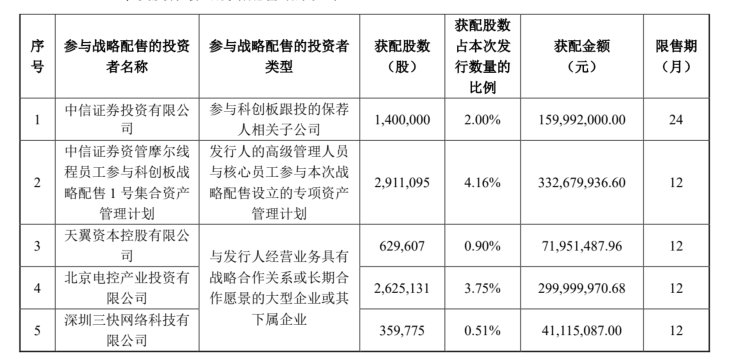
Core Viewpoint - Moer Thread has successfully completed its initial public offering (IPO) and strategic placement, with a total of 70 million shares issued, of which 14 million shares (20%) were allocated for strategic investors [1][2]. Group 1: IPO Details - The IPO price was set at 114.28 yuan per share, with a total of 1.6 billion yuan raised from strategic placements [3][7]. - Strategic investors include CITIC Securities, Southern Industrial Asset Management, and China Insurance Investment Fund, among others [1][2]. Group 2: Company Performance and Market Potential - Moer Thread's revenue has shown significant growth, increasing from 46 million yuan in 2022 to 438 million yuan in 2024, representing a compound annual growth rate (CAGR) of over 208% [5]. - The global GPU market is projected to reach 3.62 trillion yuan by 2029, with China's market expected to grow to 1.36 trillion yuan, capturing a market share increase from 15.6% in 2024 to 37.8% [5]. Group 3: Technological Advancements - The company has successfully mass-produced five chip models and completed four GPU architecture iterations, covering various applications such as AI computing, high-performance computing, and graphics rendering [5][6]. - Moer Thread has invested over 4.3 billion yuan in R&D from 2022 to mid-2025, with over 77% of its workforce dedicated to research and development [6]. Group 4: Future Plans - The funds raised from the IPO will primarily be used for the development of next-generation AI training and inference chips, graphics chips, and AI SoC chips, as well as to supplement working capital [7].
国产GPU第一股即将打新:发行价114.28元/股,预计募集资金80亿元
Hua Er Jie Jian Wen· 2025-11-20 12:33
Core Viewpoint - Moore Threads, known as the "Chinese version of Nvidia," has set its IPO price and is nearing its listing on the STAR Market, marking a significant milestone for domestic GPU companies [1][4]. Group 1: IPO Details - The company announced an issuance of 70 million shares at a price of 114.28 yuan per share, aiming to raise a total of 8 billion yuan, with a net amount expected to be 7.576 billion yuan after deducting issuance costs [4]. - This IPO is the largest fundraising project in the A-share market this year and will position Moore Threads as the first domestic GPU stock upon listing [4][5]. Group 2: Financial Performance - In the first half of 2025, the company's revenue reached 702 million yuan, surpassing the total revenue of the previous three years combined, with a compound annual growth rate exceeding 208% [4][7]. - The gross profit margin is projected to rise from -70.08% in 2022 to 70.71% in 2024, indicating a significant improvement in market acceptance of its products [7]. Group 3: Technological Advancements - Since its establishment in 2020, Moore Threads has focused on the independent research and development of full-function GPUs, achieving breakthroughs in AI computing acceleration, graphics rendering, and other areas [6]. - The company has successfully mass-produced five chips and completed four GPU architecture iterations, creating a diverse product matrix for various applications [6]. Group 4: Market Position and Future Prospects - The management anticipates achieving consolidated profitability by 2027, with expected orders exceeding 2 billion yuan from clients as of June 30, 2025 [5]. - The company has invested over 4.3 billion yuan in R&D from 2022 to mid-2025, with a workforce comprising over 77% R&D personnel, and holds 514 authorized patents [8].
摩尔线程启动科创板IPO发行 以全功能GPU筑基人工智能时代
Zheng Quan Ri Bao Wang· 2025-11-13 13:47
Core Viewpoint - Moer Technology has officially launched its IPO on the Sci-Tech Innovation Board, marking a significant step in China's journey towards building a self-controlled computing power system, with the company positioned as the first domestic GPU stock [1] Company Overview - Moer Technology, established in 2020, focuses on the independent research and development of full-function GPUs, aligning closely with national strategic needs [1] - The company has achieved technological breakthroughs with its fully self-developed MUSA unified system architecture, enabling a single chip to support AI computing acceleration, graphics rendering, physical simulation, scientific computing, and ultra-high-definition video encoding and decoding [1][2] Market Potential - The global GPU market is projected to reach 3.62 trillion yuan by 2029, with China's market expected to grow to 1.36 trillion yuan, increasing its global share from 15.6% in 2024 to 37.8%, reflecting a compound annual growth rate of 51.1% [2] - Moer Technology's revenue is forecasted to grow from 46 million yuan in 2022 to 438 million yuan in 2024, with a compound annual growth rate exceeding 208%, and revenue for the first half of 2025 reaching 702 million yuan [2] Technological Advancements - Over the past five years, Moer Technology has successfully mass-produced five chips and completed four GPU architecture iterations, creating a diverse product matrix covering AI computing, high-performance computing, graphics rendering, and more [2] - The company has maintained a high level of R&D investment, exceeding 4.3 billion yuan from 2022 to June 2025, with over 77% of its workforce dedicated to R&D [3] - Moer Technology has obtained 514 authorized patents, covering key technology areas such as processor architecture design and AI applications [3] Performance Metrics - Moer Technology's products are nearing or have reached international advanced levels, with the MTTS80 graphics card's single-precision floating-point performance comparable to NVIDIA's RTX 3060 [3] - The efficiency of the GPU computing cluster built on the MTTS5000 exceeds that of equivalent foreign GPU clusters [3] IPO Fund Utilization - The funds raised from the IPO will primarily be used for the development of next-generation self-controlled AI training and inference chips, graphics chips, and AI SoC chips, as well as to supplement working capital [4] - The company aims to enhance its innovation project investments in response to national strategies for accelerating key technology independence and building new computing power infrastructure [4]