Music1.5

Search documents
OpenAI进军音乐模型!
智通财经网· 2025-10-26 03:46
Core Insights - OpenAI is developing an AI music model in collaboration with students from the Juilliard School, aiming to enhance its AI ecosystem and user engagement [1] - The music model will allow users to generate music based on text and audio prompts, potentially transforming content creation for platforms like TikTok [1] - OpenAI's previous music models, MuseNet and Jukebox, have not been integrated into its current offerings due to technical limitations [2] Group 1: OpenAI's Music Model Development - OpenAI is actively working on an AI music model, collaborating with Juilliard students for music score annotation [1] - The model aims to generate music for various applications, including adding guitar accompaniments to existing vocal tracks [1] - OpenAI currently has over 800 million active users, and the music model is expected to enhance user retention [1] Group 2: Competitive Landscape in AI Music - The AI music generation sector is becoming a competitive focus, with advancements in computing power and model architecture [3] - Google has launched its second-generation music production model, Lyria, which aligns with OpenAI's commercial direction [3] - Startups like Suno and Udio have successfully commercialized their AI music products, with Suno achieving an annual recurring revenue of $150 million, a nearly fourfold increase from the previous year [3] Group 3: Emerging Players in AI Music - Chinese companies are rapidly developing AI music models, with ByteDance's Seed-Music and Alibaba's InspireMusic leading the charge [3] - Kunlun Wanwei has released the Mureka O1 model, which surpasses Suno V4 in multiple performance metrics [3] - Tencent AI Lab has introduced the SongGeneration model, focusing on improving sound quality, musicality, and generation speed [3][4]
OpenAI放大招:进军音乐模型
财联社· 2025-10-25 14:40
Core Viewpoint - OpenAI is developing an AI music model in collaboration with students from the Juilliard School, aiming to enhance its AI ecosystem and user engagement through music generation capabilities [2][3]. Group 1: OpenAI's Music Model Development - OpenAI's engineers are working on annotating music scores to train the new AI music model, which can generate music based on text and audio prompts [2]. - The music model could allow users to create background music for short videos, significantly lowering the content creation barrier [2]. - OpenAI currently has over 800 million active users, and the music model is expected to further enhance user stickiness within its ecosystem [3]. Group 2: Commercial Potential and Integration - The music model has potential applications in both personal entertainment and commercial scenarios, such as aiding advertising companies in creating lyrics and melodies [4]. - OpenAI has previously launched music generation models like MuseNet and Jukebox, but these have not been integrated into ChatGPT or Sora due to technical and cost limitations [6]. Group 3: Global AI Music Competition - The advancement in computing power and model architecture has made music generation technology more practical, marking it as a new focus in the AI technology competition [7]. - Google has launched its second-generation music production model, Lyria, which aligns with OpenAI's commercial direction for its music model [7]. - Startups like Suno and Udio have successfully commercialized their AI music generation products, with Suno achieving an annual recurring revenue of $150 million, nearly quadrupling from the previous year [7]. Group 4: Emergence of Chinese AI Music Models - Chinese companies are rapidly developing their AI music models, with ByteDance's Seed-Music and Alibaba's InspireMusic being notable examples [8][9]. - Kunlun Wanwei released the world's first music reasoning model, Mureka O1, which outperformed Suno V4 in several performance metrics [10]. - Tencent AI Lab has also introduced the SongGeneration model, focusing on improving sound quality, musicality, and generation speed [11].


罗永浩大战西贝,张兰却被骂上热搜;宗馥莉或另立门户,启用新品牌“娃小宗”;西贝贾国龙道歉;美的回应一天工作14小时离职被欠薪……
商业洞察· 2025-09-15 09:28
Core Viewpoint - The article discusses the controversy surrounding Zhang Lan's live-streaming event for the restaurant brand "Ma Liu Ji," which aimed to counter negative perceptions about pre-packaged food amid a public debate sparked by the conflict between Luo Yonghao and Xibei regarding the transparency of pre-packaged dishes. However, the live-stream backfired due to hygiene concerns raised by viewers [3][4][11]. Group 1: Marketing Strategy and Public Perception - Zhang Lan attempted to leverage the ongoing debate about pre-packaged food to promote her brand and demonstrate that "Ma Liu Ji" does not serve pre-packaged dishes [3][11]. - The live-stream was intended to showcase the kitchen's cleanliness and cooking process but instead highlighted hygiene issues, such as Zhang not washing her hands before handling food and wearing inappropriate attire [4][11]. - The backlash from viewers labeled the event as a publicity stunt, questioning the authenticity of the brand's claims about not using pre-packaged food [7][8][11]. Group 2: Brand Reputation and Historical Context - "Ma Liu Ji" has faced previous controversies, including a case of moldy food, which has negatively impacted its reputation and made consumers skeptical of its claims during the live-stream [10][11]. - Zhang Lan's history of capitalizing on trending topics for publicity, such as the divorce of Wang Xiaofei and Big S, indicates a pattern of seeking attention without addressing underlying quality issues [12][11]. - The article emphasizes that businesses should focus on product quality and consumer trust rather than relying solely on marketing tactics to drive sales [12]. Group 3: Industry Implications - The incident serves as a cautionary tale for other businesses in the food industry, highlighting the importance of maintaining hygiene standards and genuine consumer engagement [12]. - The article suggests that in the age of the internet, consumers are quick to scrutinize brands, and any misstep can lead to significant backlash [12].


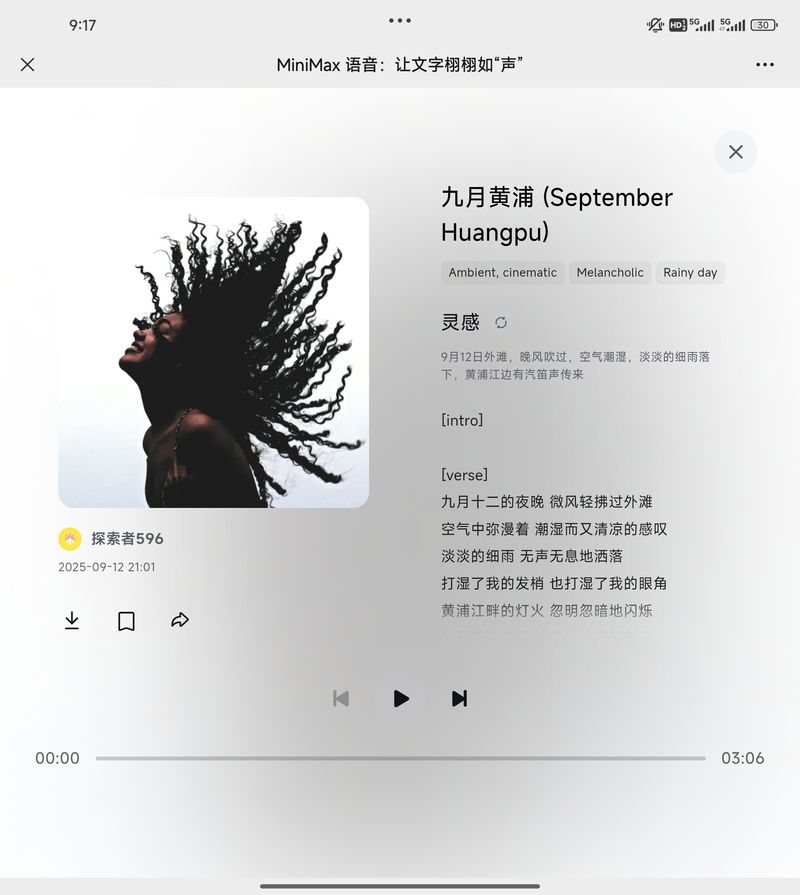
MiniMax上线新一代音乐生成模型可生成整首歌曲 记者实测
Xin Jing Bao· 2025-09-14 06:41
Core Insights - MiniMax has launched its new music generation model, Music1.5, which significantly improves music generation duration, control precision, and arrangement performance [1][4] - The model can generate songs up to 4 minutes long, producing complete tracks rather than just demo samples [4] Group 1: Model Capabilities - Music1.5 can create songs with a duration of up to 4 minutes, addressing the previous limitation of AI-generated music typically lasting only seconds to a minute [3][4] - Users can generate high-quality songs by inputting just a few keywords or a natural language description, with advanced options for defining different lyrical sections [4] Group 2: Performance and Quality - The model has been tested to produce a complete song titled "September Huangpu," which, despite minor flaws, includes all essential components of a full track [1][3] - Music1.5 features deep modeling of vocal techniques, allowing for the generation of diverse vocal tones and styles, resulting in a more natural and emotionally expressive sound [4]
宗馥莉或另立门户,启用新品牌“娃小宗”;老乡鸡客服回应西贝与罗永浩争议;雀巢投资者要求董事长辞职丨邦早报
创业邦· 2025-09-14 01:09
Group 1 - Wahaha is planning to launch a new brand "Wawa Xiaozong" starting from the 2026 sales year to address historical compliance issues after the founder's passing [3] - Beijing Huiyuan Food and Beverage Co., Ltd. issued a statement regarding a power struggle involving false documents and disruptions to operations, leading to significant stock shortages on e-commerce platforms [6] - Anker's CTO Liu Haifeng has left the company, which is prioritizing its embodied intelligence projects this year [10] Group 2 - Tesla is facing a lawsuit alleging discrimination against U.S. citizens in favor of visa holders to reduce labor costs, with claims of over 6,000 layoffs affecting mostly American workers [13][14] - Nvidia and OpenAI are in discussions for a significant investment in the UK to enhance AI infrastructure, potentially amounting to billions [14] - xAI has laid off 500 employees from its data annotation team as part of a strategic shift towards expanding its professional AI mentor team [14] Group 3 - Guizhou Moutai has denied rumors about opening direct supply channels for its products, emphasizing that such claims are false and warning consumers to be cautious [20] - The price of Moutai's "Flying Moutai" has surged from 1,499 yuan to over 3,390 yuan, with significant profits for distributors and scalpers [22] - OpenAI is expected to generate $50 billion in revenue by reducing revenue shares with partners like Microsoft [24] Group 4 - The National Health Commission's draft national standard for pre-prepared dishes has passed expert review and will soon seek public opinion, marking a shift towards regulatory compliance in the industry [26] - China's contribution to the global open-source ecosystem for large models has reached 18.7%, ranking second after the U.S. [28]