SMR

Search documents
AI 抢电时代:新能源如何把电力交付变成全球竞争力
Sou Hu Cai Jing· 2026-01-27 00:16
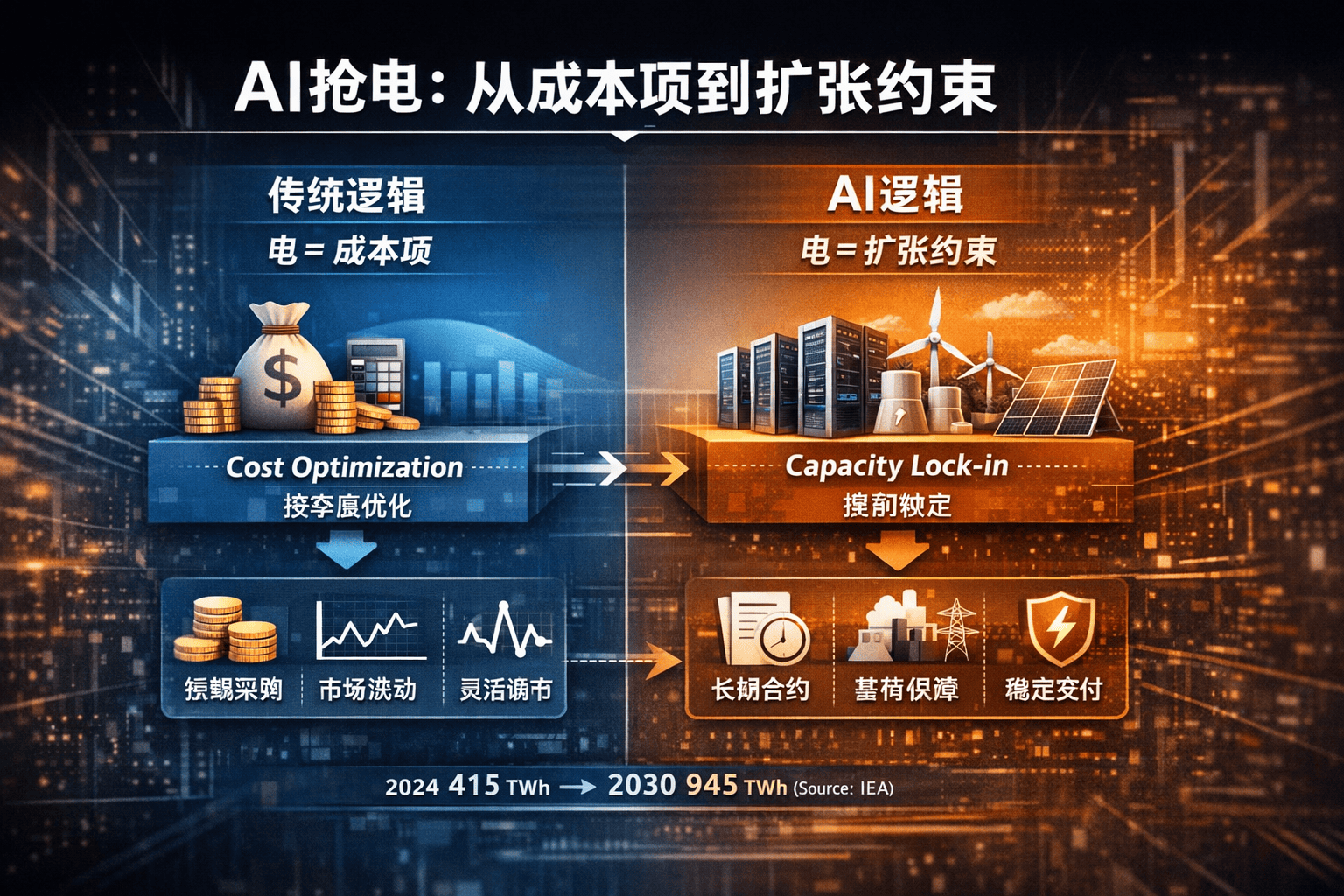
Core Insights - The article discusses the rising importance of electricity supply in the context of AI expansion, highlighting that the focus has shifted from merely generating power to ensuring reliable delivery and capacity [1][6]. Group 1: AI Electricity Demand Surge - The demand for electricity from data centers is expected to grow significantly, with the International Energy Agency (IEA) projecting global data center electricity consumption to reach approximately 415 TWh in 2024 and potentially rise to about 945 TWh by 2030, nearly doubling [4]. - This growth is characterized by structural changes, driven by the expansion of computing infrastructure, increased power density of devices, and longer operational hours [4]. Group 2: Supply Constraints - The key issue is not a global electricity shortage but rather the concentration of demand at specific grid nodes, leading to challenges in connection and delivery [5]. - In regions like Northern Virginia, new data center loads face lengthy queue and expansion periods for grid connection, with some studies indicating that connection research could take over 10 years [5]. Group 3: Capital Strategies - Companies are shifting their approach to electricity from a cost item to a strategic limit on expansion, locking in deliverable capacity through long-term power purchase agreements (PPAs) and bundled supply arrangements [7]. - The combination of high demand growth, supply-side constraints, and capital strategies indicates that electricity has become a primary constraint for AI expansion, with structural and sustainable implications [7]. Group 4: Repricing of Electricity - The trading logic of electricity is evolving, with a focus on long-term stability and deliverable capacity rather than just price optimization [8]. - Companies like Meta and Google are entering into long-term agreements to secure stable power supplies, emphasizing the importance of reliability and predictability in electricity delivery [8][9]. Group 5: Investment Pathways in New Energy - The article outlines three main investment pathways: renewable energy and storage, stable low-carbon power sources, and the integration of energy with AI infrastructure [13][14]. - The focus is on transforming electricity from a commodity into a deliverable capability, with an emphasis on ensuring that power can be reliably accessed and delivered [13]. Group 6: Collaboration and Market Entry - Chinese renewable energy companies are encouraged to form partnerships with local entities to enhance project delivery capabilities and meet the rigid electricity demands of developed markets [15][18]. - This collaborative approach aims to leverage China's manufacturing and delivery strengths while addressing local regulatory and operational challenges [16].

机械设备:核能算力深度协同,重塑能源数字战略格局
Huafu Securities· 2025-11-02 06:58
Investment Rating - The industry rating is "Outperform the Market," indicating that the overall return of the industry is expected to exceed the market benchmark index by more than 5% in the next 6 months [14]. Core Insights - The report highlights a significant increase in global AI computing power and electricity demand, with major US tech companies deeply engaging in the nuclear energy sector through various models. Government policies are strengthening support for the collaboration between AI and nuclear energy [3]. - The report emphasizes the need for top-level design and policy support to promote the deep collaboration between nuclear energy and computing power, suggesting the establishment of demonstration projects and long-term power supply agreements [4]. - Small Modular Reactors (SMRs) are identified as a key solution to meet the growing energy demands of AI, with continuous attention from tech giants. The commercialization of fission is expected to occur before fusion [5]. Summary by Sections International and Domestic Opportunities - The international layout is making breakthroughs, while domestic exploration opportunities are becoming more prominent. Companies in China are actively engaging in forward-looking explorations, with the energy demand continuing to grow and the clean, stable characteristics of nuclear energy aligning well with computing power needs [3]. Policy and Market Expansion - To drive the deep collaboration between nuclear energy and computing power, it is essential to establish demonstration projects and provide policy support. The report suggests a collaborative model involving government, state-owned enterprises, and private enterprises to enhance international competitiveness [4]. Company Recommendations - The report recommends focusing on several companies, including: - Jingye Intelligent, which is developing SMR technology in collaboration with Zhejiang University [6]. - Jiadian Co., which leads in the nuclear power business with its helium fan products [6]. - Guoguang Electric, which provides key components for the ITER project [6]. - Lansi Heavy Industry, covering the entire nuclear energy supply chain [6]. - Kexin Electromechanical, which has developed high-temperature gas-cooled reactor products [6].
日韩接力投资美国 美股成最大赢家? 日本前脚砸下5500亿美元 韩国立马抛出3500亿美元
智通财经网· 2025-10-29 13:22
Core Insights - The recent trade agreement between the U.S. and South Korea marks a significant development following the framework agreement reached in July, with South Korea committing to invest $350 billion in the U.S. [1][2] - The agreement includes a reduction of tariffs on South Korean goods from 25% to 15%, which is expected to enhance the competitiveness of South Korean manufacturers in the U.S. market [2][3] - The deal is projected to have a positive impact on the U.S. economy, particularly in boosting manufacturing capacity and non-farm employment, aligning with the "America First" policy [5] Investment Commitments - South Korea plans to invest $1.5 billion in the shipbuilding sector and an additional $2 billion in various investments in the U.S. [1][2] - The investment will be supported by domestic and international commercial banks, which will help alleviate pressure on the Korean won in the foreign exchange market [3] - The agreement stipulates that annual investments from South Korea will be capped at $20 billion, ensuring that it does not negatively impact the currency market [2][3] Tariff Adjustments - The agreement ensures that tariffs on semiconductors will not be less favorable than those applied to Taiwan, a key competitor for South Korean chip manufacturers [3] - The reduction in tariffs is expected to significantly benefit South Korean automotive manufacturers, who have faced disadvantages due to higher tariffs compared to Japanese counterparts [2][3] Economic Impact - The trade agreement is anticipated to serve as a catalyst for the ongoing bull market in U.S. stocks, as substantial investments from Japan and South Korea are expected to bolster market valuations and fundamentals [4] - The investment plans from Japan and South Korea cover a wide range of sectors, including energy and AI, which are crucial for the U.S. economy [4] - The U.S. government will establish an investment committee to oversee the selection of projects, enhancing the execution and compliance of the investment agreements [4]
中金2025下半年展望 | 电力设备+工控:传统赛道有韧性,关注新质生产力、核能、出海方向
中金点睛· 2025-07-10 23:31
Core Viewpoint - The resilience of the power grid and industrial control sectors is expected to continue in the first half of 2025, with potential opportunities for performance and valuation recovery in the second half of the year [1] Power Grid Sector - Domestic power grid investment showed strong growth in the first five months of 2025, with a total investment of 204 billion yuan, a year-on-year increase of 19.8% [5] - The approval pace for ultra-high voltage projects is expected to accelerate in the second half of the year, with significant projects already approved [7] - The demand for ultra-high voltage equipment remains strong, with a projected annual growth rate of around 10% for power grid investment from 2024 to 2026 [10] - The first half of 2025 saw a robust demand for primary network investments, with a notable increase in bidding amounts for key equipment [10] Industrial Control Sector - The industrial control market has shown signs of recovery, with the OEM market experiencing a 3.3% year-on-year growth in the first quarter of 2025, marking the first positive growth in three years [24] - The demand for new technologies, particularly in automation and robotics, is expected to enhance profitability and valuation flexibility for industrial control companies [3] - The overall capital expenditure momentum remains slightly subdued, but a narrow fluctuation in the new cycle is anticipated [18] Investment Themes - Focus on new productive forces, including AIDC and humanoid robots, which are expected to bring significant valuation elasticity [3] - The revival of nuclear energy is highlighted, with a focus on nuclear power equipment and small modular reactors (SMR) as key investment areas [48] - The overseas market for power grid investment is projected to maintain high growth, driven by energy transition and grid upgrades, with a 14.4% year-on-year increase expected in 2024 [4] Nuclear Energy Sector - The global nuclear power industry is experiencing a strategic revival, with significant investments and approvals in various countries, including China and the U.S. [49] - The demand for nuclear energy is increasing due to the need for stable, low-carbon baseload power, with a focus on SMR and controlled nuclear fusion technologies [62] - The nuclear power sector is expected to see a re-evaluation of its investment value as countries prioritize energy security and decarbonization [61]