T型玻璃

Search documents
一家卖布起家的芯片供应商,刚刚宣布
半导体芯闻· 2026-02-04 10:17
Core Viewpoint - Nitto Boseki plans to launch an upgraded version of its fiberglass cloth by 2028 to enhance heat deformation resistance, catering to the growing demand from AI semiconductor applications [1][2] Group 1: Product Development and Market Demand - The new product is a next-generation T-type glass designed to minimize thermal expansion, with a thermal expansion coefficient improved by 30%, decreasing from 2.8 ppm to 2.0 ppm [1] - The increasing size and performance of AI chips are expected to exacerbate thermal expansion issues, leading to higher demand for fiberglass cloth [1] - Nitto Boseki controls approximately 90% of the global T-type glass market, indicating a strong market position [1] Group 2: Financial Performance and Investments - Nitto Boseki plans to invest 15 billion yen (approximately 96 million USD) to triple the production capacity of its fiberglass yarn at its Fukushima facility, with construction of new facilities expected to start in 2027 [2] - The company anticipates a 16% increase in operating profit for the current fiscal year, reaching 19 billion yen, nearing its target of 20 billion yen for fiscal year 2027 [2] - The stock price of Nitto Boseki has surged, increasing by 173% from the end of 2024, significantly outperforming the Nikkei average index's 34.6% rise during the same period [2] Group 3: Competitive Landscape - Other manufacturers, such as Unitika, are also producing high-performance glass cloth for smartphone chip substrates, indicating a competitive market [3] - Asahi Kasei is developing quartz cloth, which offers faster transmission speeds than glass cloth, with plans for mass production starting this year [3] - Shin-Etsu Chemical is exploring quartz cloth applications and plans to produce high-demand products, showcasing the industry's focus on advanced materials [3]

生成式AI无过热迹象!小摩:明年AI资本支出增速至少 20%!
智通财经网· 2025-08-26 08:59
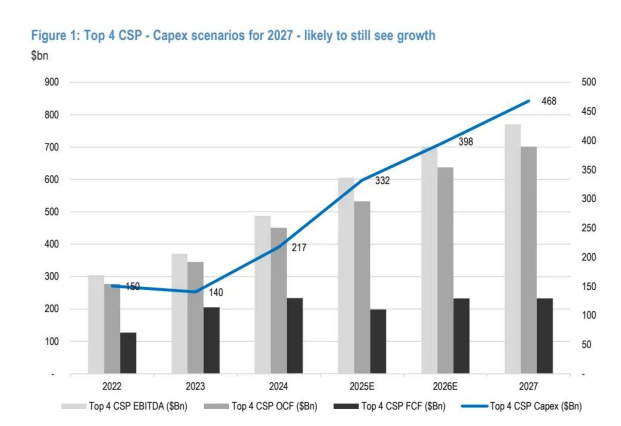
Core Viewpoint - Market concerns about AI capital expenditure (capex) potentially peaking in 2026 are prevalent, but JPMorgan presents a counterargument based on four key points: no signs of overheating in generative AI, continuous entry of new investment players, significant expansion of AI application scenarios, and the potential demand release in the Chinese market [1][2]. Group 1: AI Capital Expenditure Insights - JPMorgan predicts that AI capex growth will reach at least 20% in 2026, with further growth expected in 2027 if the penetration rate of reasoning models continues to rise [3]. - The top four cloud service providers (CSPs) are expected to maintain strong capital expenditure supported by robust operating cash flow, with a projected cumulative EBITDA and operating cash flow CAGR of 23% from 2022 to 2026 [5][4]. - The capital expenditure of the top four CSPs is anticipated to increase from $150 billion in 2022 to a projected $398 billion in 2026, with a consensus forecast showing a cumulative free cash flow CAGR of 16% [7]. Group 2: New Investment Players and Market Dynamics - New players, including private AI labs and sovereign funds, are entering the AI capex space, enhancing investment capabilities despite concerns about spending stability [9]. - The Chinese CSP market is just beginning its AI investment journey, with significant spending intentions from companies like ByteDance and Alibaba, although supply constraints from GPU availability pose challenges [10]. Group 3: Supply Chain and Growth Projections - The Google TPU supply chain is expected to experience the fastest growth in 2026, driven by strong internal demand and recovery from previous supply issues [11]. - NVIDIA's supply chain is projected to maintain robust growth in 2026, with no significant delays anticipated in production schedules [13]. - The ODM sector is showing strong performance, particularly with companies like Hon Hai, which have seen significant stock price increases due to strong demand for NVIDIA products [15]. Group 4: Pricing Trends and Earnings Adjustments - Discussions of price increases across various non-AI sectors are emerging, which could drive the next round of earnings per share (EPS) adjustments [16]. - The Asian technology sector is experiencing a pause in earnings revisions, but future price increases and sustained AI demand are expected to be key drivers for further EPS adjustments [17][18].

生成式AI无过热迹象!小摩:明年AI资本支出增速至少20%!
Sou Hu Cai Jing· 2025-08-26 08:34
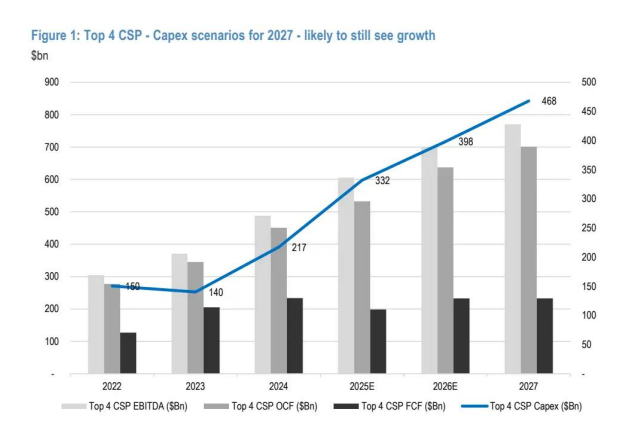
Core Viewpoints - Concerns about AI capital expenditure (capex) peaking in 2026 are overstated, with strong growth certainty expected in 2026-2027 [1][2] - Major cloud service providers (CSPs) can sustain capital expenditure through increasing operating cash flow, with no signs of overheating in generative AI [2][4] - New investment players, including private AI labs and sovereign funds, are entering the market, further driving AI investment [2][9] AI Capital Expenditure Growth - Morgan Stanley predicts at least 20% growth in AI capex for 2026, with potential for further increases in 2027 if enterprise-level AI adoption continues [2][8] - The top four CSPs (Google, Amazon, Meta, Microsoft) are expected to see a compound annual growth rate (CAGR) of 23% in EBITDA and operating cash flow from 2022 to 2026 [6][7] - Capital expenditure for these CSPs is projected to rise from $150 billion in 2022 to $398 billion in 2026, with a CAGR of 16% in free cash flow [7][8] Investment Opportunities - The AI supply chain growth ranking for 2026 shows Google TPU leading, followed by NVIDIA, AMD, and AWS [3][11] - Non-AI sectors are experiencing price increases, which could drive the next round of earnings per share (EPS) adjustments in the tech sector [17] - Chinese CSPs are just beginning their AI investments, with significant potential for growth despite supply constraints [10][19] Supply Chain Dynamics - The supply chain for NVIDIA is expected to maintain strong growth in 2026, with no significant delays in production plans [13][14] - ODMs are experiencing a catch-up trend, with companies like Hon Hai (Foxconn) showing strong stock performance [15] - The Asian AI supply chain is benefiting from increased demand for Google TPU and other components, with PCB and CCL suppliers positioned to gain [11][12] Valuation and Earnings Adjustments - The recent stagnation in earnings adjustments for Asian tech stocks is attributed to currency fluctuations and preemptive demand ahead of tariffs [18][19] - Future price increases and sustained AI demand are expected to drive further EPS adjustments [18][21] - The valuation of Asian tech stocks remains reasonable, with no bubble expectations in most large tech segments [18][21]