TPU v7芯片

Search documents
争夺AI制高点,谷歌和Anthropic必有一战
美股研究社· 2026-01-23 10:55
Core Viewpoint - Anthropic is aggressively seeking a $25 billion funding round to enhance its competitive edge in the AI programming tools market, where developer experience and agent capabilities are becoming crucial [5][43]. Group 1: Anthropic's Position and Strategy - Anthropic's Claude Code holds a 52% market share in the AI programming tools sector, demonstrating its dominance over competitors [5]. - The company has developed Cowork, a desktop application that allows Claude to access user files and execute complex tasks, expanding its application beyond mere programming [22][25]. - Anthropic's revenue growth is significant, with projected annual revenue increasing from $1 billion in 2025 to $15.2 billion in 2026, indicating a 15-fold growth rate [45][46]. Group 2: Google's Competitive Landscape - Google is positioned as a challenger in the AI programming space, with its Antigravity tool set to launch in late 2025, which emphasizes agent-first design [6][8]. - Antigravity's adoption rates are reportedly lower than established tools like Cursor and GitHub Copilot, indicating a struggle to gain traction in the developer community [13][14]. - Despite its resources, Google's full-stack advantages have not translated into competitive strength in the programming tools market [20][26]. Group 3: Hardware and Infrastructure - Anthropic has secured a deal to purchase nearly 1 million Google TPU v7 chips for $42 billion, which will provide over 1GW of computing capacity [30][31]. - The TPU v7 offers significant cost and performance advantages over NVIDIA GPUs, with a 30-44% reduction in total ownership costs and a nearly 10-fold performance increase compared to its predecessor [33][34]. - This partnership allows Anthropic to reduce dependency on NVIDIA and ensures a stable supply chain for its AI model training needs [38][39]. Group 4: Investment and Market Dynamics - Anthropic's valuation is projected to reach $350 billion following its upcoming funding round, a significant increase from $61.5 billion in March 2024 [43]. - The investment landscape is shifting, with firms like Sequoia Capital diversifying their bets across multiple AI companies, indicating a belief in a multi-winner scenario in the AI sector [50][52]. - The capital-intensive nature of AI development is creating high barriers to entry, with only companies capable of securing substantial funding able to compete effectively [53][54]. Group 5: Future Outlook - The competition between Google and Anthropic is characterized by different strategic focuses, with Google leveraging its infrastructure and Anthropic concentrating on developer tools [59][60]. - The battle for dominance in AI programming tools is critical, as developers are key to shaping the future of software production [61].



Anthropic打响“去CUDA”第一枪,210亿美元豪购谷歌100万块TPU
3 6 Ke· 2026-01-04 07:29
Core Insights - Anthropic has gained a significant lead in the AI arms race with its Claude Opus 4.5, which can replicate complex AI systems in a fraction of the time previously required by Google engineers [1][3] - The company is making a bold move by purchasing 1 million TPU v7 chips to build its own supercomputing infrastructure, which could reshape its competitive landscape against giants like NVIDIA [6][11] Group 1: Anthropic's Competitive Edge - Claude Opus 4.5 has demonstrated remarkable capabilities, allowing tasks that previously took years to be completed in mere months [2][3] - Anthropic's strategy focuses on maximizing output with minimal resources, emphasizing efficiency and quality over sheer scale [5][19] - The company has achieved a tenfold revenue growth over the past three years, indicating strong market demand for its AI solutions [24] Group 2: Infrastructure and Investment - Anthropic's acquisition of 1 million TPU v7 chips is projected to cost around $21 billion, marking a significant investment in its computational capabilities [11][12] - The deployment of these chips will be managed in collaboration with partners like TeraWulf and Hut8, while operational tasks will be outsourced to Fluidstack [9] - This move allows Anthropic to maintain control over its computing resources, reducing reliance on traditional cloud providers and their associated costs [12] Group 3: Market Position and Future Outlook - Anthropic is positioning itself as a provider of enterprise-focused AI models, rather than a consumer-level product, which may lead to stronger customer retention and integration [20][23] - The company has secured approximately $100 billion in computational commitments, indicating robust financial backing for future growth [19] - There are speculations about potential investments from Google and Amazon, which could further elevate Anthropic's market valuation beyond $350 billion [39][40]


千亿液冷龙头诞生!英伟达、谷歌芯片功耗飙升引爆散热革命,这些A股公司有望受益!
私募排排网· 2025-12-24 12:00
Core Viewpoint - The A-share market has rebounded after a two-month consolidation, with the AI computing power industry chain experiencing significant growth, particularly in liquid cooling technology, which is expected to see substantial market expansion by 2026 [2][14]. Group 1: AI Computing Power and Liquid Cooling Technology - The stock price of CPO leader Xinyi Sheng reached a historical high of 466.66 yuan, marking a tenfold increase from its lowest price of 46.56 yuan on April 9 [2]. - Liquid cooling technology is becoming a trend in the cooling sector due to its advantages over traditional air cooling, including lower energy consumption and noise, as well as improved cooling efficiency [3][14]. - Google’s TPU v7 chip has a power consumption of 980W, necessitating the use of liquid cooling systems, which will increase the value of these systems [3][7]. Group 2: Market Growth and Projections - The liquid cooling market is projected to reach a scale of 24-29 billion USD by 2026, driven by the expected shipment of 2.2-2.3 million Google TPU v7 chips [7]. - The Chinese liquid cooling server market is expected to grow to 2.37 billion USD in 2024, a 67% increase from 2023, with a compound annual growth rate of 47.6% from 2023 to 2028 [14]. - The penetration rate of liquid cooling in servers is currently at 5%, indicating significant growth potential in the coming years [14]. Group 3: Company Performance and Stock Insights - A-share liquid cooling concept stocks have shown strong performance, with companies like Hongfuhuan and Yidong Electronics seeing over 40% growth in the last three months [16]. - Hongfuhuan focuses on liquid cooling products for networking and servers, having established partnerships with major domestic and international clients [16]. - Yidong Electronics has a strong integrated advantage in the liquid cooling sector, having achieved mass production of AI chip cooling components [16].

AI人工智能ETF(512930)涨超1.4%,谷歌将上市TPUV7重塑AI芯片竞争格局
Xin Lang Cai Jing· 2025-12-19 05:27
Core Viewpoint - The upcoming launch of Google's TPU v7 chip represents a significant advancement in AI computing power, with performance metrics comparable to NVIDIA's B200, which is expected to drive demand in the ASIC chip and related industries [1][2]. Group 1: Market Performance - The CSI Artificial Intelligence Theme Index (930713) rose by 1.59%, with notable gains from constituent stocks such as Jingsheng Electronics (600699) up 7.92% and Desay SV (002920) up 7.38% [1]. - The AI Artificial Intelligence ETF (512930) increased by 1.43%, with the latest price at 2.13 yuan [1]. Group 2: Technological Advancements - Google's TPU v7 chip, named "Ironwood," features a peak computing power of 4614 TFLOPs (FP8 precision), 192GB of HBM3e memory, and a memory bandwidth of 7.4TB/s, with a power consumption of approximately 1000W [1][2]. - Compared to its predecessor, the Ironwood chip's computing power has increased by 4.7 times, and its energy efficiency has reached 29.3 TFLOPs per watt, doubling that of the previous generation [1]. Group 3: Industry Implications - The TPU v7 chip focuses on AI inference scenarios and utilizes a 100% liquid cooling architecture, which is expected to significantly reduce the cost of large model inference [2]. - As Google Cloud accelerates its commercial deployment, major overseas companies like Meta are planning to access computing power through rental agreements, which will further stimulate growth in the ASIC chip and supporting industry chain, including liquid cooling, power supply, and PCB sectors [2]. Group 4: Index Composition - As of November 28, 2025, the top ten weighted stocks in the CSI Artificial Intelligence Theme Index include companies such as Zhongji Xuchuang (300308) and Hikvision (002415), collectively accounting for 63.92% of the index [2].
替代英伟达,亚马逊AWS已部署超过100万枚自研AI芯片
3 6 Ke· 2025-12-03 10:01
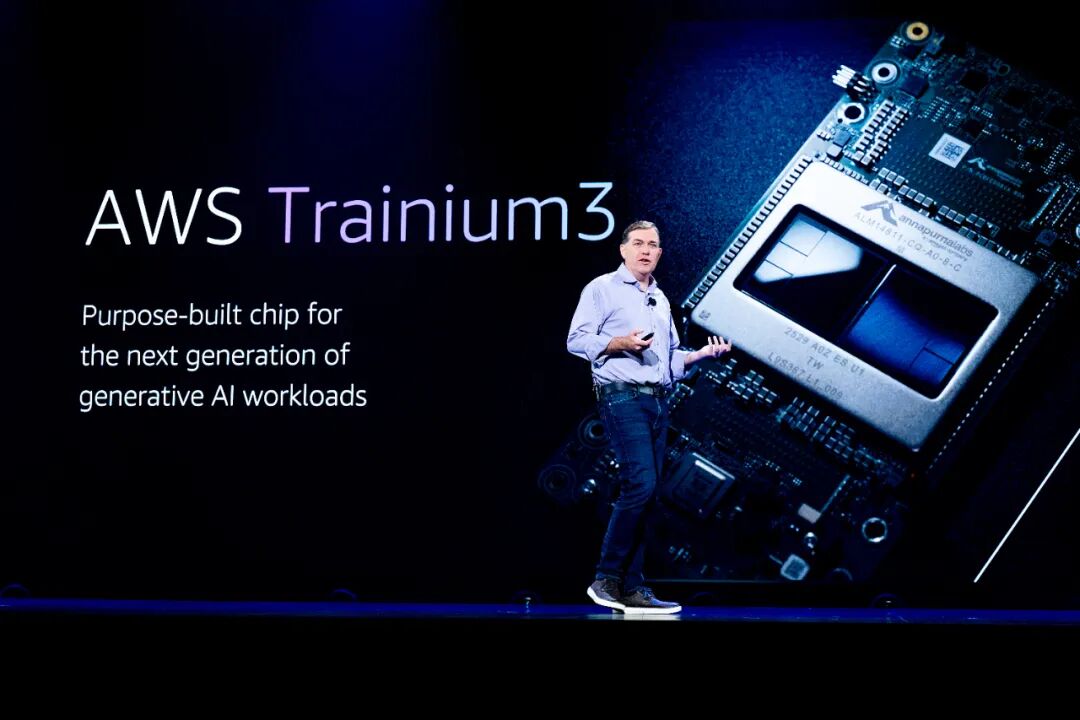
Core Insights - Amazon AWS has launched its new AI chip, Trainium 3, at the re:Invent 2025 conference, which utilizes a 3nm process technology and is expected to significantly enhance performance and reduce costs compared to previous generations [1][2]. Group 1: Product Launch and Features - Amazon AWS has introduced the Trainium 3 AI chip, which is designed to improve performance and reduce training costs by up to 50% compared to its predecessors [1][2]. - The next-generation AI chip, Trainium 4, is currently in the design phase and is projected to offer over six times the performance of Trainium 3 under FP4 computing precision [2]. - The Amazon Nova 2 series of self-developed models was also launched, including Lite, Pro, Sonic, and Omni, with thousands of enterprise customers already utilizing the Amazon Nova series [1]. Group 2: Deployment and Performance Metrics - Over 1 million Trainium AI chips have been deployed by Amazon AWS, generating billions in revenue annually [2][3]. - The power capacity for Amazon AWS has doubled since 2022, with an additional 3.8GW of computing power added in the past year, and is expected to double again by 2027 [2]. - Trainium 3 can produce five times the number of tokens per megawatt of power compared to the previous generation, indicating a significant efficiency improvement [2]. Group 3: Competitive Landscape - Amazon AWS's Trainium series chips are not sold directly but are provided through cloud services, with notable clients including Anthropic and Databricks [3]. - The competitive landscape shows that Amazon AWS and Google are successfully developing and deploying their own AI chips, which could disrupt NVIDIA's dominance in the AI chip market, where NVIDIA currently holds over 60% market share [8][12]. - The cost advantages of self-developed chips are highlighted, with potential savings of up to one-third compared to equivalent NVIDIA chips, as cloud providers aim to reduce reliance on NVIDIA [8][9].