Tulkas T100

Search documents
AI算力行业周报:Meta与康宁签订60亿美元光纤大单,英伟达即将举办CPO网络研讨会
Huaxin Securities· 2026-02-04 08:24
Investment Rating - The investment rating for the AI computing industry is maintained as "Buy" for specific companies such as沃尔核材, 天孚通信, and 长飞光纤, while 立讯精密 is rated as "Add" [7]. Core Insights - Meta has signed a long-term supply agreement with Corning for fiber optic cables worth up to $6 billion to accelerate AI data center construction, highlighting the strong demand for fiber optics in computing infrastructure [3]. - Nvidia is hosting a webinar focused on co-packaged silicon photonics (CPO) switches, emphasizing their strategic value in scaling AI computing capabilities [4]. - The report suggests focusing on companies like 天孚通信, 立讯精密, 长飞光纤, and 沃尔核材 for potential investment opportunities [5]. Weekly Market Analysis - From January 26 to January 30, the communication industry saw a significant increase of 5.83%, ranking second among all sectors, while the electronics sector experienced a decline of 2.51% [12][19]. - The AI computing-related sub-sectors mostly showed an upward trend, with the communication network equipment and devices sector leading with an increase of 8.56% [19]. Company Announcements - Lotus Holdings announced progress in its transition to computing power business, including various contracts for GPU servers and cloud services [49]. - Tongfu Microelectronics reported a reduction in shareholding by its major shareholder, which will not affect the company's governance or operations [51]. - Tianfu Communication completed a share reduction plan by a board member, which was executed in accordance with regulations and did not impact company control [52].






AI算力行业周报:Meta与康宁签订60亿美元光纤大单,英伟达即将举办CPO网络研讨会-20260204
Huaxin Securities· 2026-02-04 07:53
Investment Rating - The report maintains a "Buy" rating for companies such as沃尔核材 (Worley), 天孚通信 (Tianfu Communication), and 长飞光纤 (Changfei Fiber) while recommending "Accumulate" for 立讯精密 (Luxshare Precision) [7] Core Insights - Meta has signed a long-term supply agreement with Corning for fiber optic cables worth up to $6 billion to accelerate AI data center construction, highlighting the strong demand for fiber optics in the AI infrastructure [3] - Nvidia is hosting a webinar focused on co-packaged silicon photonics (CPO) switches, emphasizing their strategic value in scaling AI computing power [4] - The report suggests focusing on companies like 天孚通信, 立讯精密, 长飞光纤, and 沃尔核材 due to their potential in the AI computing sector [5] Weekly Market Analysis - From January 26 to January 30, the communication sector saw a significant increase of 5.83%, ranking second among all sectors, while the electronics sector decreased by 2.51% [12][19] - The AI computing-related sub-sectors mostly showed an upward trend, with the communication network equipment and devices sector leading with an increase of 8.56% [19] - The report indicates a divergence in capital flow, with the communication sector experiencing a net inflow of 11.53 billion yuan, while the electronics sector faced a net outflow of 55.83 billion yuan [23][25] Company Announcements - Lotus Holdings announced progress in its transition to computing power business, including various contracts for GPU servers and cloud services [49] - Tongfu Microelectronics reported a reduction in shareholding by its major shareholder, which will not affect the company's governance structure [51] - Tianfu Communication completed a share reduction plan by a board member, which was executed in accordance with regulations and did not impact company control [52]
这款芯片,算力是英伟达10倍
Xin Lang Cai Jing· 2026-01-28 03:31
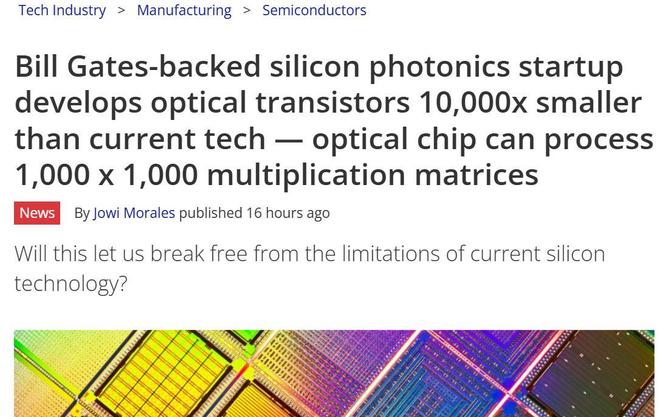
Core Insights - Neurophos, an AI chip company based in Austin, Texas, has announced significant testing results for its Optical Processing Unit (OPU), claiming it achieves ten times the performance of NVIDIA's latest AI supercomputer while maintaining similar power consumption levels [3][4] - The breakthrough is attributed to larger computational matrices and higher clock frequencies, which provide a key advantage over traditional GPUs [3][4] Company Highlights - Neurophos's CEO, Patrick Bowen, detailed the OPU's hardware design, featuring a 1000 x 1000 pixel photonic sensor matrix, which is 15 times larger than the typical 256 x 256 pixel matrices used in most AI GPUs [4] - The company has successfully reduced the physical size of photonic transistors by approximately 10,000 times, addressing integration challenges faced by traditional silicon photonic chips [4][6] - The first-generation optical accelerator, Tulkas T100, has a core unit size of about 25 square millimeters and operates at a clock frequency of 56 GHz, significantly surpassing traditional electronic chip performance limits [5][6] Industry Context - Photonics is emerging as a key area in the semiconductor field, with major tech companies like NVIDIA and AMD investing in optical technologies to enhance data transmission and processing capabilities [7] - The advancements in optical computing, such as those demonstrated by Neurophos, represent important milestones in the maturation of the photonics industry, which aims to overcome limitations of traditional electronic chips [7][8] - The ongoing demand for AI computing power is pushing the boundaries of traditional electronic chip performance, making photonics a promising direction for future breakthroughs [8]


盖茨押注硅光突破:旗下Neurophos首款光子芯片性能达英伟达AI超算十倍
Huan Qiu Wang Zi Xun· 2026-01-27 09:02
Core Insights - Neurophos, an AI chip startup backed by the Gates Frontier Fund, has achieved a significant breakthrough in silicon photonics with its optical processing unit (OPU), which is approximately 10,000 times smaller than existing technologies and features a 1000×1000 pixel scale photonic computing matrix on a single chip [1][3] Group 1: Technology Advancements - The first optical accelerator, Tulkas T100, boasts AI computing performance that is ten times that of NVIDIA's latest Vera Rubin NVL72 supercomputer at FP4/INT4 precision, while maintaining similar power consumption levels [3] - Key technological advancements include a 1000×1000 photonic tile, significantly larger than the current GPU standard of 256×256, and a clock frequency of 56 GHz, which is much higher than the 9.1 GHz of Intel's Core i9-14900KF and 2.6 GHz of NVIDIA's RTX Pro 6000 GPU [3] Group 2: Production and Challenges - The CEO of Neurophos stated that traditional silicon photonic transistors are about 2 millimeters long, making high-density integration difficult, but their technology miniaturizes these transistors to a scale compatible with CMOS processes, enabling large-scale parallel optical computing [3] - Despite the advancements, the technology is still in the engineering validation stage, with mass production not expected before 2028, and several challenges remain, including on-chip SRAM capacity, vector processing unit expansion, and optoelectronic co-design [4]