
CPO交换机

Search documents
AI珠峰系列五:CPO渐行渐近,有望重构高效算力互连架构
GF SECURITIES· 2026-03-29 03:28
Investment Rating - The industry investment rating is "Buy" [2] Core Insights - CPO (Co-packaged Optics) is emerging as the next-generation interconnect architecture for optical communication, promising significant improvements in efficiency and performance compared to traditional optical modules [6][19] - Major global players like NVIDIA, Broadcom, and Marvell are actively developing CPO technologies, indicating a trend towards commercialization [6][36] - The manufacturing of CPO involves complex processes that require collaboration across multiple sectors, including optical assembly and packaging [6][54] Summary by Sections 1. CPO: Next-Generation Optical Interconnect Architecture - CPO represents a significant technological advancement over traditional optical modules, addressing the limitations of long-distance electrical signal transmission [14] - The integration of optical engines with switching chips in CPO reduces signal degradation and power consumption, with potential power savings of up to 65% compared to traditional optical modules [19][20] - The transition from traditional optical modules to CPO is marked by a reduction in interconnect distances, enhancing bandwidth density and energy efficiency [32] 2. CPO Manufacturing Processes and Equipment - CPO manufacturing involves both front-end and back-end processes, including the integration of optical and electronic components [54] - Key components in CPO manufacturing include optical engines, electronic integrated circuits, and advanced packaging techniques [54][56] - Testing and quality assurance in CPO production are complex due to the need for both optical and electrical assessments [80] 3. Investment Recommendations: Focus on Core Equipment Manufacturers - Companies such as Lianxun Instruments, Robotec, Maiwei Co., and Zhiliang are highlighted as potential beneficiaries in the CPO packaging and testing equipment sectors [6][54] - The report emphasizes the importance of monitoring developments in CPO technology and its applications in AI server interconnects [6][54]




GTC 2026|黄仁勋五层蛋糕重构AI价值体系,投资逻辑全解析 | 市场观察
私募排排网· 2026-03-25 09:49
Core Viewpoint - The article discusses Jensen Huang's "AI Five-Layer Cake" framework presented at NVIDIA GTC 2026, which outlines how value in the AI era is created and distributed across various industries, emphasizing the interconnectedness of the AI ecosystem and its implications for investment logic and asset allocation [3][5]. Group 1: AI Five-Layer Cake Theory - The "AI Five-Layer Cake" consists of five interconnected layers that collectively drive the AI industry's growth, where progress in each layer directly impacts the value realization of the upper layers [6]. - The five layers are: 1. **Energy Layer**: The foundation of AI, emphasizing the need for efficient energy supply and the projected doubling of global data center electricity consumption to 945 TWh by 2030 [7]. 2. **Chip Layer**: The core of computational power, with advancements in chip technology critical for AI expansion, including NVIDIA's new GPU architecture expected to achieve 50 PFLOPS [8]. 3. **Infrastructure Layer**: The physical embodiment of AI capabilities, with significant investments in AI factories and supercomputers, highlighting the importance of cooling technologies and innovative data center designs [9]. 4. **Model Layer**: The brain of AI, focusing on the transition from language models to physical AI, with open-source models driving demand across the architecture stack [10]. 5. **Application Layer**: The final interface where AI creates measurable economic value, with a shift towards AI agents capable of executing complex tasks across various sectors [11]. Group 2: Investment Logic from the Five-Layer Cake - Huang's framework provides a comprehensive investment strategy that emphasizes prioritizing foundational layers, driven by the exponential growth of token consumption and the need for heavy asset infrastructure [12][13]. - Key investment logic includes: 1. **Bottom-Up Approach**: Prioritizing investments in energy, chips, and infrastructure, which are expected to see more stable performance compared to upper layers [14]. 2. **Token Economy**: The increasing demand for tokens in AI applications, making "cost per token" a critical competitive metric [14]. 3. **Heavy Asset Infrastructure**: The construction of AI factories and data centers represents a new wave of capital expenditure, akin to a modern infrastructure boom [14]. 4. **Positive Feedback Loop**: The interdependence of applications, models, infrastructure, chips, and energy creates a strong positive cycle that enhances value across the entire AI ecosystem [14]. Group 3: Layer-Specific Investment Strategies - **Energy Layer**: Focus on green energy, grid equipment, and storage technologies as core beneficiaries of AI's energy demands [16]. - **Chip Layer**: Investment in GPUs, LPU, and advanced packaging technologies, driven by domestic alternatives and technological advancements [18]. - **Infrastructure Layer**: Capitalizing on the construction of AI factories and data centers, with a focus on liquid cooling and optical interconnects [20]. - **Model Layer**: Targeting investments in general models and open-source ecosystems, while being mindful of competitive pressures [22]. - **Application Layer**: Emphasizing sectors with high barriers to entry and strong profitability potential, such as embodied intelligence and industry-specific AI applications [24]. Group 4: Overall Industry Outlook - The AI industry is in its early stages of industrialization, with significant long-term growth potential as it transitions from training to inference, driving value across the entire supply chain [26].


从GTC到OFC-模型和算力的奔跑
2026-03-24 01:27
Summary of Conference Call Records Industry Overview - The conference call discusses the advancements in AI applications and the optical communication industry, particularly focusing on the transition from copper to optical connections and the implications for various companies involved in these technologies. Key Points and Arguments AI Application Growth - The emergence of intelligent models is accelerating, with 2026 expected to be the year of AI application explosion, supported by existing commercial benefits that can sustain related companies for at least five years, alleviating concerns about returns on computing power investments [1][2][11]. Demand for Optical Modules - The demand for 1.6T optical modules is expected to double year-on-year by 2025, with companies like Zhongji Xuchuang and Xinyi Sheng projected to have a PE ratio below 20 in 2026, indicating a reasonable undervaluation [1][5]. Copper Connection Lifecycle - The lifecycle of copper connections is being extended, with Nvidia and Broadcom confirming that copper will remain dominant in Scale-up interconnections until at least 2027, transitioning to CPO (Co-packaged Optics) only after 2028 [1][7][8]. Technological Advancements - Significant advancements in pluggable optical module technology were noted, with breakthroughs in single-wave 400G silicon photonics and EML solutions, enhancing competition with CPO technologies [1][3][4]. Supply and Demand in Optical Chips - There is a current shortage of optical chips, with Lumentum expecting revenues exceeding $100 million by Q4 2026. Domestic manufacturers like Yuanjie Technology and Changguang Huaxin are making clear progress in the CW and EML sectors [1][6]. Investment Recommendations - The optical communication sector is experiencing high demand, with recommendations to invest in leading companies like Zhongji Xuchuang and Xinyi Sheng, which are expected to maintain high growth rates due to increasing demand for optical modules [5][11]. CPO Technology Development - CPO technology is anticipated to see significant developments, with Nvidia announcing the mass production of its CPO switch chips in collaboration with TSMC. The technology is expected to be implemented in Scale-out applications by Q4 2026 [7][8]. Market Dynamics - Nvidia and Broadcom support the continued use of copper connections due to their cost-effectiveness and low power consumption, with expectations that this trend will persist until at least 2028 [9][10]. Long-term Outlook for AI Computing Power - The long-term sustainability of AI computing power investments is viewed positively, with expectations of continued growth over the next 3 to 5 years, driven by the ongoing demand for computing power in AI applications [11]. Additional Important Insights - The conference highlighted the competitive landscape between copper and optical connections, emphasizing that while copper has advantages in short-distance applications, optical connections are superior for long-distance and high-bandwidth needs [2][3]. - The potential for domestic companies to capture market share in the optical chip sector is significant, given the high barriers to entry and the current supply-demand imbalance [6]. - The introduction of new applications, such as Nvidia's Groq LPU, is expected to provide new growth opportunities for copper connections, reinforcing their relevance in the market [10].


盛会直击:英伟达GTC大会四大核心重磅发布
Mei Ri Jing Ji Xin Wen· 2026-03-23 02:47AI Processing
英伟达在GPU领域深耕多年,自1999年发布首款GPU至今,已有约27年时间。其芯片制程从220纳米迭 代至4纳米左右,未来还将向1.6纳米推进,这也是我们较为期待的投资价值。 本轮AI浪潮始于2023年,当时市场主流GPU为A100与H100。截至目前,市场主流GPU已更新为 Blackwell架构芯片。A100与H100的核心技术特征是什么?其中H100芯片性能强劲,在2023年AI浪潮爆 发后,迅速成为市场炙手可热的GPU产品。 H100由中国台湾台积电采用4纳米工艺代工生产,单芯片集成800亿个晶体管,还专门内置了 Transformer模型引擎。为什么要专门针对Transformer做硬件适配?当前国内外我们耳熟能详的各类大模 型,其底层架构基本都是基于Transformer基础架构针对性优化发展而来。 英伟达极具前瞻性地在Hopper架构中,从硬件层面对Transformer做了专项优化,也就是引入了对应的专 用引擎。英伟达也凭借这一核心优势,在短短两年多的时间里,从一家规模中等的企业,成长为全球市 值第一的科技巨头,由此也能充分看到AI产业的强劲爆发力。 英伟达在2023年前后发布的Blackw ...
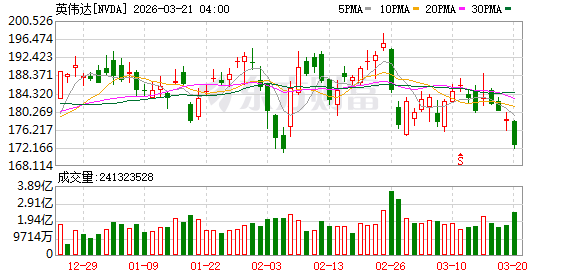
黄仁勋:“信心十足”
财联社· 2026-03-18 01:14
Core Viewpoint - Nvidia's CEO Jensen Huang has stated that the previously mentioned $1 trillion annual sales target for AI accelerated chips does not include other product lines, indicating that total revenue could exceed this figure as the company enters new markets [3][6]. Group 1: AI Accelerated Chips - Huang confirmed that by the end of 2027, Nvidia's next-generation AI accelerated chips are expected to generate at least $1 trillion in revenue [3]. - The company is confident in achieving and delivering over $1 trillion in business, with Huang expressing strong confidence in reaching this revenue target [6]. Group 2: Market Demand and Competition - Huang noted that demand is accelerating at a significant scale, and the company is prepared to support this demand through supply [7]. - Despite the ambitious revenue forecast, analysts on Wall Street are concerned that this prediction does not indicate an acceleration in Nvidia's revenue growth compared to potential competitors [7]. Group 3: Data Center Sales - Nvidia previously projected that by the end of 2026, data center equipment sales would reach $500 billion; the latest forecast extends this timeline by one year while doubling the cumulative scale [8]. Group 4: Shareholder Returns - Nvidia plans to allocate more cash for shareholder returns in the second half of the year, including stock buybacks and dividends [9]. - CFO Colette Kress stated that after completing planned investments, approximately 50% of free cash flow will be used for shareholder returns [10].

上海调降商业房首付比例,xAI大规模招募银行家 | 财经日日评
吴晓波频道· 2026-03-18 00:38
Group 1: Real Estate Market - Shanghai has lowered the minimum down payment ratio for commercial housing loans from 50% to 30%, marking the first adjustment in over a decade, aimed at stimulating the commercial real estate market [2][3] - The commercial real estate market is facing high inventory pressure due to overly optimistic early planning and weak demand absorption, necessitating the reduction in down payment requirements to enhance liquidity [2][3] - Beike's net income for 2025 showed a slight increase of 1.2% year-on-year to 946 billion yuan, despite a significant decline in Q4 revenue by 28.7% [8][9] Group 2: AI and Technology Developments - NVIDIA's CEO Jensen Huang announced that the flagship computing chips Blackwell and Rubin are expected to generate at least $1 trillion in revenue by the end of 2027, significantly up from the previous estimate of $500 billion by 2026 [4][5] - Alibaba has established the Alibaba Token Hub (ATH) to focus on the creation, delivery, and application of tokens, indicating a strategic shift towards AI and tokenization in its business model [6][7] - xAI is launching a large-scale recruitment drive for financial professionals to enhance its AI model Grok's capabilities in financial modeling, amidst a backdrop of high turnover among its founding team [10][11] Group 3: Financial Services and Market Trends - Ant Group's acquisition of Yao Cai Securities has been approved, allowing it to integrate securities trading services into its Alipay platform, thereby enhancing its financial service offerings [12][13] - The public fund distribution landscape is evolving, with Ant Fund leading in equity fund holdings, reflecting a shift in competitive dynamics among distribution channels [14][15] - The stock market experienced a decline, with the Shanghai Composite Index falling by 0.85%, as market sentiment remains cautious amid external uncertainties [16][17]


半导体早参 | 英伟达GTC大会发布新一代芯片架构及推理芯片,云计算服务提供商Nebius与Meta达成价值270亿美元的AI算力供应协议
Mei Ri Jing Ji Xin Wen· 2026-03-17 01:44
Market Performance - The Shanghai Composite Index fell by 0.26% to close at 4084.79 points, while the Shenzhen Component Index rose by 0.19% to 14307.58 points, and the ChiNext Index increased by 1.41% to 3357.02 points [1] - The overnight performance of U.S. markets showed the Dow Jones Industrial Average up by 0.83%, the Nasdaq Composite up by 1.22%, and the S&P 500 up by 1.01% [1] Semiconductor Industry Insights - NVIDIA's CEO Jensen Huang raised the revenue forecast to $1 trillion by January 2027 during the GTC conference, showcasing new architectures and platforms [1] - The Philadelphia Semiconductor Index rose by 1.96%, with notable increases in stocks such as Micron Technology (up 3.68%) and ARM (up 5.14%) [1] Mobile Phone Market Trends - Some mobile phone brands have implemented price increases ranging from 300 to 500 yuan, with total price changes nearing 1000 yuan due to the cancellation of store subsidies [2] - OPPO and vivo announced price hikes for certain models starting mid-March, influenced by rising memory chip prices and supply constraints [2] Equipment Sector Outlook - CITIC Securities predicts that the domestic equipment sector will see a significant increase in orders, with top-tier equipment manufacturers expected to achieve 20-30% growth in orders by 2025 [2] - The overall fundamentals of the equipment sector are expected to improve, driven by increased domestic production rates and the acceleration of localization processes for critical components [2]
【早报】中美已就一些议题取得初步共识;阿布扎比国家石油公司大范围停产
财联社· 2026-03-16 23:11
Industry News - The Ministry of Industry and Information Technology emphasizes the need to cultivate and expand emerging industries, including integrated circuits, aerospace, and biomedicine, while promoting the establishment of a risk-sharing mechanism for future industry investments [4] - The Ministry of Industry and Information Technology plans to construct new information infrastructure such as 5G and intelligent computing, aiming to create an upgraded version of "5G + Industrial Internet" [4] - The People's Bank of China and the National Financial Regulatory Administration have adjusted the minimum down payment ratio for commercial property loans in Shanghai to no less than 30% starting from March 16, 2026 [4] - The Abu Dhabi National Oil Company has been forced to implement widespread production cuts, resulting in a daily oil output decline of over 50% [5] Company News - Alibaba has established a new business group, Alibaba Token Hub, to advance its AI strategy, with CEO Wu Yongming directly overseeing the initiative [7] - Xiangyou Technology announced that it is under investigation by the China Securities Regulatory Commission for suspected violations of information disclosure [9] - Wanhuachuangke reported a net profit of 12.5 billion yuan for 2025, a year-on-year decrease of 3.88% [9] - ST Keli Da is also under investigation by the China Securities Regulatory Commission for suspected violations of information disclosure [9] - Jineng Technology noted price increases in propylene, polypropylene, and methanol, with olefins seeing significant gains supported by raw material prices [9]

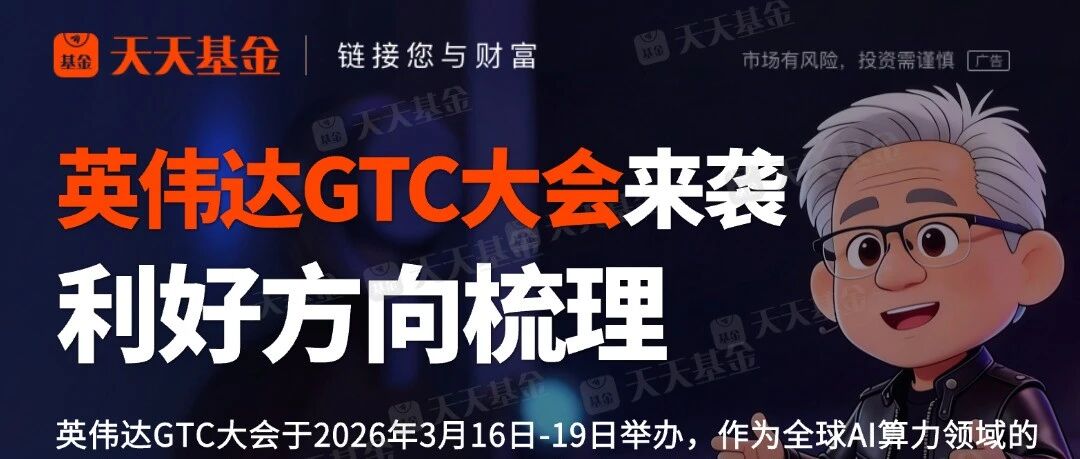
英伟达GTC大会来袭 利好哪些细分方向?
天天基金网· 2026-03-16 08:21
Core Insights - The Nvidia GTC conference will be held from March 16 to 19, 2026, and is expected to reveal new GPU core parameters and showcase advancements in CPO switches, power architecture, and liquid cooling technologies [1][4]. Industry Trends - Nvidia has established a global CPO core supply chain covering core chips, optoelectronic devices, materials, and packaging manufacturing, with a focus on the next-generation AI chip roadmap and network architecture solutions at the GTC [4][6]. - The market trend is expected to continue emphasizing "speed + power," with recommendations to focus on industries related to PCB, CPO, storage, power, and cooling [4][5]. Investment Opportunities - Analysts suggest paying attention to CPO, LPU, AI liquid cooling, AI power, orthogonal backplane, and Feynman architecture at the GTC 2026 [5][6]. - The demand for computing power remains strong due to the continuous upgrade of large models and the rise of AI applications, indicating a positive outlook for AI core computing hardware [6][7]. - The introduction of the Vera Rubin platform and the next-generation Feynman architecture is anticipated, which may enhance liquid cooling system value and create opportunities for domestic suppliers entering overseas supply chains [6][7]. Company Developments - Nvidia is expected to expand its chip product matrix, potentially unveiling the Rubin Ultra chip and more details about its cabinet design, which could lead to innovations in data interconnectivity and power supply [7]. - The GTC 2026 is seen as a pivotal moment for Nvidia to transition the industry from merely purchasing GPUs to deploying AI factories, reinforcing confidence in the sustained growth of the AI industry [6][7].
行业周报:GTC、OFC或催化光、液冷、电源等板块
KAIYUAN SECURITIES· 2026-03-15 07:30
Investment Rating - The industry investment rating is "Positive" (maintained) [1] Core Insights - The upcoming GTC conference is expected to showcase advancements in GPU architecture, power supply upgrades, and liquid cooling technologies, which will further solidify the global computing ecosystem and accelerate the commercialization of core components and supporting infrastructure [3][12] - The OFC conference is anticipated to highlight the ongoing upward trend in the optical communication sector, with significant developments in high-speed optical modules and advanced packaging technologies [4][15] - The report emphasizes the resonance of the global AI industry, recommending investment in four main areas: optical communication, liquid cooling, domestic computing power, and satellite technology [5][13] Summary by Sections GTC and OFC Insights - The GTC conference will take place from March 16 to 19, 2026, focusing on new GPU architectures and related technologies [11] - The OFC conference will occur from March 15 to 19, 2026, showcasing advancements in high-speed optical modules and related technologies [15] Investment Recommendations - Recommended stocks in the optical communication sector include: Zhongji Xuchuang, Xinyi Sheng, Tianfu Communication, and Yuanjie Technology [13][17] - Beneficiary stocks include: Longfly Optical Fiber, Robot Technology, and others [13][16] - In the liquid cooling and power supply sectors, recommended stocks include: Yingweike and others [20][18] Market Review - The communication index experienced a slight decline of 0.12% during the week of March 9 to March 13, 2026 [25] 5G Infrastructure Data - By December 2025, the total number of 5G base stations in China reached 4.84 million, with a net increase of 588,000 stations from the previous year [27] - The number of 5G mobile phone users reached 1.204 billion, reflecting a year-on-year growth of 18.74% [27][29]


