eSSD(企业级固态硬盘)

Search documents
AI推理刚需,NAND“周期更长更稳”!摩根大通:本轮主角是eSSD,铠侠成为首选
Hua Er Jie Jian Wen· 2026-01-26 03:34
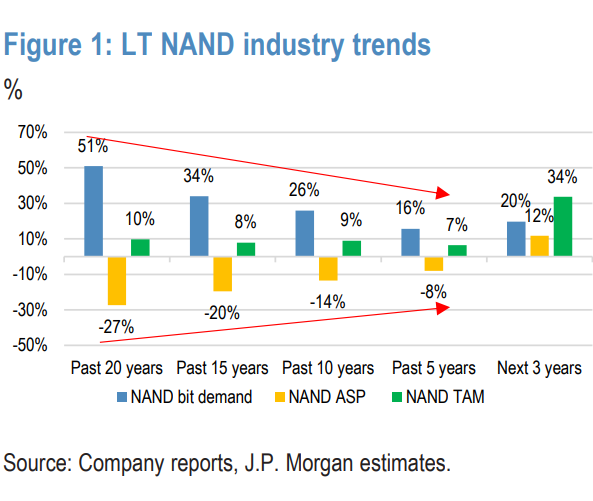
Core Insights - The NAND flash memory industry is entering a new super cycle driven by AI inference, moving away from its previous reliance on smartphone and PC shipments as the main growth driver [1][3] - The market is expected to see a significant increase in the Total Addressable Market (TAM) growth rate, projected to rise to 34% from the historical range of 7%-12% [3][6] - The average selling price (ASP) of NAND is predicted to increase by 40% in 2026, marking a shift where ASP becomes a positive growth driver rather than a negative one [3][24] Industry Dynamics - The NAND market is experiencing structural growth due to the transition of AI workloads from training to inference, alongside supply bottlenecks in HDDs [1][15] - The demand for enterprise SSDs (eSSD) is expected to surge, with eSSD projected to account for 48% of global NAND bit demand by 2027, surpassing smartphones and PCs [11][14] - The supply chain crisis in HDDs, exacerbated by reduced capital expenditures from manufacturers, is forcing data centers to shift towards NAND solutions [15][19] Technological Advancements - The introduction of KV Cache Offloading technology is enhancing the role of eSSD in AI inference, allowing for faster data retrieval and processing [8][9] - The report highlights the limitations faced by NAND manufacturers in scaling production due to technical challenges, leading to a predicted 3% growth in wafer output by 2026 [24][23] Market Valuation - The valuation of storage stocks is shifting from a purely cyclical perspective to one that incorporates AI growth attributes, with a 242% increase in market capitalization since January 2025 [6][35] - Companies like Kioxia are positioned as top picks due to their focus on NAND technology, while SK Hynix and Samsung are also highlighted for their competitive advantages in the market [26][27][28] Competitive Landscape - Kioxia is identified as a leading player in the NAND cycle, while SK Hynix is recognized for its long-term potential due to its successful subsidiary, Solidigm [26][27] - Samsung is expected to experience short-term gains, while Micron is adopting a differentiated strategy to compete in the eSSD market [28][29]


HBM被抢疯了
半导体行业观察· 2025-10-02 01:18
Core Viewpoint - The article discusses the significant price increases in memory storage driven by the demand from artificial intelligence (AI) applications, highlighting the collaboration between OpenAI and major memory manufacturers like Samsung and SK Hynix for a $500 billion project aimed at building next-generation AI infrastructure [4][19]. Memory Price Trends - The average spot price of general DRAM (DDR4 8Gb) reached $5.868 in September, nearly five times the low of $1 in Q1 [2] - The average spot price of mainstream memory semiconductor DDR5 16Gb increased by over 40% from $4.70 at the beginning of the year to $6.927 [2] - Predictions indicate that various DRAM products will continue to rise in price in Q4 due to supply constraints [2] OpenAI Collaboration - OpenAI has entered into a partnership with Samsung and SK Hynix, focusing on the "Stargate" project, which aims to invest approximately $500 billion by 2029 to build a large data center [4][19] - The project requires high-performance memory, including enterprise-grade NAND, server DRAM, and HBM (High Bandwidth Memory) [4] HBM Demand and Supply - OpenAI's CEO requested a monthly supply of 900,000 DRAM wafers from Samsung and SK Hynix, which exceeds the combined monthly production capacity of both companies [5][6] - SK Hynix's HBM monthly production capacity is estimated at 160,000 wafers, indicating a significant gap between demand and supply [6] Market Growth Projections - The global HBM market is expected to grow at a compound annual growth rate (CAGR) of 50% from 2024 to 2028, driven by increasing demand from AI applications [18][19] - Analysts predict that DRAM operating profit margins will rise from the current 40-50% range to nearly 70% by 2026, nearing the peak levels seen during previous super cycles [20] Impact on Other Memory Types - The demand for memory is expected to increase across various segments, including enterprise SSDs and traditional DRAM, with prices projected to rise by 8-13% for DRAM and over 10% for LPDDR4X memory due to supply constraints [22][24] - The article notes that the memory market is experiencing a "super cycle" driven by AI, with significant implications for pricing and supply dynamics [20][22]