mBridge(多边央行数字货币桥)

Search documents
2026全球数字货币新格局:三极分化与秩序重构丨未来实验室
Di Yi Cai Jing· 2026-01-12 12:40
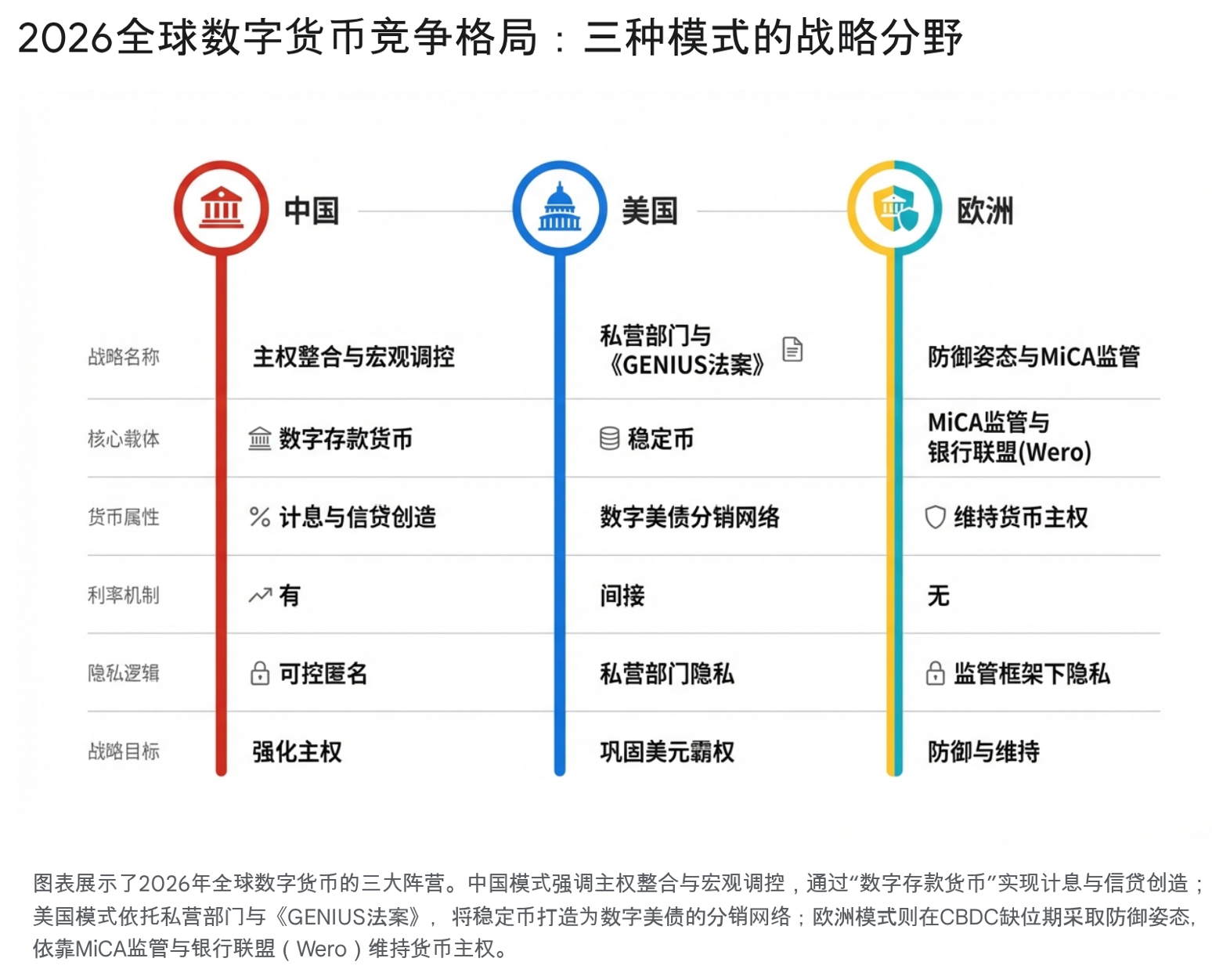
Core Viewpoint - The global monetary financial system has entered a new phase of "triple differentiation" as of January 2026, driven by the implementation of China's digital yuan (e-CNY), the U.S. GENIUS Act, and Europe's defensive alliances, marking a shift from mere payment efficiency improvements to a profound restructuring of the post-World War II Bretton Woods system [1] Group 1: China's Paradigm - The new digital yuan framework effective from January 1, 2026, signifies an expansion of monetary banking theory, transitioning from "M0 replacement" to a more financially expansive "digital deposit currency" paradigm [4] - The new framework introduces a dual balance sheet structure, where e-CNY balances are legally defined as commercial bank liabilities, allowing digital currency to participate in the fractional reserve system and enabling banks to use e-CNY as a stable source of liabilities for credit issuance [5] - The introduction of a market-based interest rate mechanism allows commercial banks to pay interest on e-CNY wallets, transforming e-CNY into a high-liquidity interest-bearing asset, enhancing its appeal for global trade partners seeking asset preservation [6] Group 2: U.S. Strategy - The U.S. GENIUS Act establishes a unique digital currency strategy by abandoning retail CBDC development and instead regulating private digital currencies to serve as digital extensions of U.S. dollar hegemony [8] - The Act mandates that compliant digital currencies maintain a 1:1 liquidity asset reserve, effectively converting global demand for liquidity into a rigid demand for U.S. Treasury securities, creating a decentralized "digital treasury bond" distribution network [8][9] - The U.S. retains control through stringent regulations on centralized issuers, allowing for immediate and irreversible actions against specific blockchain addresses, enhancing its regulatory reach [9] Group 3: Europe's Dilemma - Europe is in a defensive phase, delaying the digital euro until 2029 due to privacy concerns and legislative challenges, adopting a mixed strategy of regulatory barriers and banking alliances [10] - The MiCA regulation establishes strict localization requirements for digital currencies, driving out non-compliant offshore entities while creating space for compliant institutions [10] - The digital euro's legislative focus has shifted towards a conservative "offline-first" principle, limiting its programmability and online compatibility, while public debates continue regarding the necessity of a robust public digital euro [11] Group 4: Core Variables Reshaping Competition - Interest rate competition is emerging as a key variable, with the introduction of interest-bearing e-CNY challenging the traditional dominance of non-interest-bearing digital dollars [12] - Infrastructure is critical, with China's mBridge creating a decentralized network that bypasses traditional SWIFT structures, while the U.S. attempts to upgrade existing systems [12] - The rise of smart contracts is leading to a contest over the definition of rules, with China promoting state-defined codes and the U.S. favoring private sector standards [12] Conclusion - The year 2026 marks a significant differentiation in global digital currencies, where currency transcends mere value measurement to become an extension of state will, necessitating adaptation to these profound changes for future survival and development [13]

美元霸权遭挑战,美国财长见证7800亿美债以人民币结算,中国按规则逐步拆解
Sou Hu Cai Jing· 2026-01-01 20:08
Core Viewpoint - The perception of U.S. Treasury bonds has shifted from being seen as a safe asset to a potential liability, raising concerns about their future value and implications for ordinary citizens [1][14]. Group 1: Changing Perception of U.S. Treasury Bonds - U.S. Treasury bonds, once considered a stable investment, are now viewed as a "hot potato" that could lose value, impacting the financial security of individuals [1]. - The transition from viewing U.S. Treasury bonds as a savings account to seeing them as a means to acquire tangible resources reflects a significant shift in financial strategy [3]. Group 2: Asset Diversification and Resource Acquisition - The strategy of converting financial assets into physical assets, such as cobalt for electric vehicle batteries, highlights a proactive approach to securing essential resources [3]. - Continuous accumulation of gold by the central bank over 18 months indicates a shift towards hard assets as a hedge against financial instability [5]. Group 3: Global Financial Dynamics - The emergence of a "hard currency" era suggests a growing skepticism towards fiat currencies, with a preference for gold and minerals as reliable assets [6]. - The establishment of alternative financial channels, such as the mBridge for digital currency transactions, signifies a move away from reliance on traditional systems like SWIFT [10]. Group 4: International Trade and Currency Trends - The increasing use of the Chinese yuan in international transactions, including agreements with countries like Brazil and Saudi Arabia, reflects a diversification away from the U.S. dollar [12][18]. - The shift in global trade dynamics, with major economies seeking alternatives to the dollar, indicates a potential decline in the dollar's dominance [12][18]. Group 5: U.S. Economic Challenges - The U.S. federal debt surpassing $38 trillion and the rising interest payments exceeding military spending illustrate a concerning fiscal situation [14][15]. - The cycle of borrowing to pay off existing debt raises questions about the sustainability of U.S. Treasury bonds as a safe investment [15][17].

专访香港证监会前主席梁定邦:重构数字金融基础设施是"必答题"
2 1 Shi Ji Jing Ji Bao Dao· 2025-11-12 23:39
Core Insights - Hong Kong's IPO financing has regained the top position globally in the first three quarters of the year, but it faces significant challenges from global financial technology advancements, particularly from the US, India, and Singapore [2] - The future development of Hong Kong's financial sector hinges on three strategic opportunities: the internationalization of the Renminbi, financial technology innovation, and the integration of the Guangdong-Hong Kong-Macao Greater Bay Area [2][17] - The current financial landscape necessitates immediate action, as delays could result in missed opportunities for Hong Kong to maintain its status as an international financial center [2][17] Financial Market Foundations - Hong Kong's financial market success is built on three pillars: the rule of law, high professional standards, and capital freedom [3][4] - The total assets of Hong Kong's banking sector are approximately ten times its GDP, with a GDP of around $400 billion and banking assets reaching $4 trillion [4] - Hong Kong is the largest offshore Renminbi center, handling about 80% of global offshore Renminbi transactions, and has a stable currency system with the Hong Kong dollar pegged to the US dollar [4] Capital Inflows and Economic Structure - Current capital inflows into Hong Kong are primarily concentrated in the stock market, with limited impact on the real estate sector [5] - The service sector constitutes over 93% of Hong Kong's GDP, indicating that capital should ideally flow into this area to benefit the real economy [5][6] - Hong Kong's GDP growth is close to 4% this year, reflecting positive trends in consumption and services, although some sectors like dining still face challenges [6] Commodity Market Development - Hong Kong has the potential to develop a commodities market, particularly in gold, due to changing dynamics in mainland Chinese enterprises and their need for an offshore trading hub [7][8] - The establishment of a gold trading infrastructure, including expanded storage facilities, positions Hong Kong as a key player in the region [7] Renminbi Internationalization - The internationalization of the Renminbi requires integration into payment systems and trade financing, with projects like mBridge facilitating cross-border payments using digital currencies [10][11] - mBridge has demonstrated economic benefits by reducing costs and increasing efficiency in commodity trading, highlighting the need for further development in trade financing systems [11] Asset Tokenization - Asset tokenization aims to streamline financial transactions by merging trading, clearing, and settlement processes into a single system, enhancing efficiency [12][13] - The successful implementation of asset tokenization in Hong Kong could position it as a leader in financial innovation, especially with the support of central bank digital currencies [12][14] Regulatory Framework and Innovation - Hong Kong's regulatory approach is characterized by a "sandbox" model, allowing for controlled experimentation with new financial technologies [15][16] - The need for a flexible regulatory framework is emphasized to balance innovation and risk management, ensuring that Hong Kong remains competitive in the fintech space [15][16] Future Opportunities and Challenges - The primary opportunity for Hong Kong lies in building a new digital capital market infrastructure through asset tokenization and central bank digital currencies [22] - Major challenges include geopolitical risks, talent competition, and the urgency to innovate in response to global advancements in financial technology [22]