
openEuler系操作系统

Search documents
华为鸿蒙生态提速,HarmonyOS 5.0 以上终端设备超过 3600 万
Xin Lang Cai Jing· 2025-12-30 11:09
Core Viewpoint - Huawei's 2026 strategy focuses on enabling intelligent transformation across various industries, building an open-source ecosystem, and enhancing AI capabilities, with key areas including the development of the Kunpeng and Ascend ecosystems, and advancements in AI data centers and fast charging technologies [12][19]. Achievements in 2025 - Huawei assisted operators in building 5G-A networks, providing high-speed connectivity to 60 million users [11][15]. - The HarmonyOS ecosystem improved user experience, with over 36 million devices running HarmonyOS 5.0 and above [11][15]. - The QianKun Intelligent Driving system equipped over 1.4 million passenger cars, accumulating nearly 7 billion kilometers of assisted driving mileage [11][15]. - The Kunpeng ecosystem expanded to over 6,800 partners and 3.8 million developers, with the openEuler operating system installed on over 16 million devices [11][15]. - The Ascend ecosystem grew to over 3,000 partners and 4 million developers, with Atlas 900 supernodes serving various industries [11][15]. - AI applications were explored in sectors such as medical pathology, steel furnace temperature prediction, and oil and gas exploration, creating new industry value [11][15]. - Collaborating with green energy clients, Huawei produced over 2 trillion kWh of green electricity, saved 150 billion kWh, and reduced emissions by 1.06 billion tons, equivalent to planting 1.45 billion trees [11][15]. Future Strategic Focus - The company aims to deepen industry verticals and leverage its diverse capabilities to enable intelligent transformation across various sectors [18]. - Building an open-source Kunpeng and Ascend ecosystem will facilitate partners in developing products that meet diverse industry needs [18]. - The integration of AI into communication networks will transition from connectivity to intelligent connectivity [18]. - The focus will remain on enhancing consumer experiences within the Harmony ecosystem, providing more surprises for end-users [18]. - The company plans to reconstruct AI data centers to maximize output efficiency and implement liquid cooling for fast charging solutions [18].

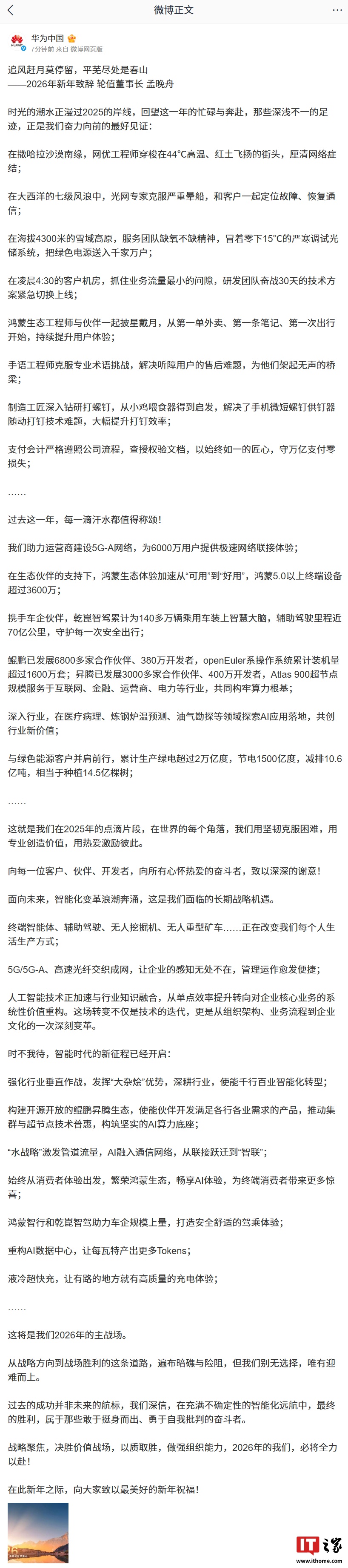
孟晚舟发布新年致辞,阐述华为战略方向
Shang Hai Zheng Quan Bao· 2025-12-30 04:39
Core Insights - The core message emphasizes the long-term strategic opportunity presented by the wave of intelligent transformation, with a focus on overcoming challenges to achieve success in the smart era [1][9]. Group 1: Strategic Focus - The company aims to strengthen vertical industry operations and deepen its involvement in various sectors for intelligent transformation [6][12]. - The strategy includes building an open-source ecosystem around Kunpeng and Ascend to enable partners to develop products that meet diverse industry needs [6][12]. - The "water strategy" will be employed to enhance pipeline flow, integrating AI into communication networks to transition from connectivity to "smart connectivity" [12]. Group 2: Product Quality and Ecosystem Development - The company will prioritize consumer experience, enhancing the HarmonyOS ecosystem and upgrading AI experiences [6][12]. - The goal is to scale up the deployment of HarmonyOS and QianKun intelligent driving solutions in collaboration with automotive partners [6][12]. - Plans include restructuring AI data centers and developing liquid-cooled ultra-fast charging networks to improve efficiency and user experience [12]. Group 3: Achievements and Future Goals - By 2025, the company aims to assist operators in building 5G-A networks for 60 million users and has already achieved over 36 million devices running HarmonyOS 5.0 [3][8]. - The QianKun intelligent driving system has been installed in over 1.4 million vehicles, with nearly 7 billion kilometers of assisted driving recorded [3][8]. - The company has developed over 6,800 partners and 3.8 million developers for the Kunpeng ecosystem, with over 16 million installations of the openEuler operating system [3][8]. Group 4: Environmental Impact - The company has produced over 2 trillion kilowatt-hours of green electricity, saved 150 billion kilowatt-hours, and reduced emissions by 1.06 billion tons, equivalent to planting 1.45 billion trees [3][8]. Group 5: Industry Transformation - Intelligent technologies are rapidly integrating with industry knowledge, shifting from isolated efficiency improvements to systemic value reconstruction in core business operations [11]. - The transformation is not just technological but also involves profound changes in organizational structure, business processes, and corporate culture [11].

华为轮值董事长孟晚舟新年致辞——划重点
Sou Hu Cai Jing· 2025-12-30 03:38
Core Insights - Huawei's 2025 vision emphasizes its commitment to supporting operators in building 5G-A networks, aiming to provide high-speed connectivity for 60 million users [3][6] - The company has significantly expanded its ecosystem, with over 6,800 partners and 3.8 million developers for the Kunpeng platform, and over 3,000 partners and 4 million developers for the Ascend platform [4][8] - Huawei plans to leverage its "mixed-use" advantage to facilitate intelligent transformation across various industries in 2026 [5][10] Group 1: Strategic Developments - In 2025, Huawei will assist operators in constructing 5G-A networks, enhancing connectivity for 60 million users [3][6] - The Kunpeng ecosystem has grown to include over 6,800 partners and 3.8 million developers, while the Ascend ecosystem has over 3,000 partners and 4 million developers [4][8] - The company aims to create an open-source ecosystem for Kunpeng and Ascend, promoting technology accessibility and collaboration [5][10] Group 2: Technological Advancements - Huawei's HarmonyOS 5 and above have been installed on over 36 million devices, indicating a strong adoption rate [7] - The QianKun Intelligent Driving system has equipped over 1.4 million passenger vehicles, with nearly 7 billion kilometers of assisted driving mileage [7][8] - Future plans include restructuring AI data centers for greater efficiency and developing liquid-cooled ultra-fast charging solutions [7][10] Group 3: Environmental and Social Impact - Huawei has produced over 20 trillion kilowatt-hours of green electricity, saving 150 billion kilowatt-hours and reducing emissions by 1.06 billion tons, equivalent to planting 1.45 billion trees [8] - The company emphasizes the importance of user experience and aims to enhance the Harmony ecosystem to provide more surprises for end consumers [10]

华为轮值董事长孟晚舟发布新年致辞
Sou Hu Cai Jing· 2025-12-30 03:38
Core Insights - The company reflects on its achievements in 2025, highlighting significant contributions to various sectors, including telecommunications, AI, and green energy [3][4][5] - The company emphasizes the importance of intelligent transformation as a long-term strategic opportunity in the face of rapid technological advancements [5][6] Group 1: Achievements in 2025 - The company assisted operators in building 5G-A networks, providing high-speed connectivity to 60 million users [3] - Collaborations with automotive partners led to the installation of smart systems in over 1.4 million vehicles, with nearly 7 billion kilometers of assisted driving mileage [4] - The company developed a robust ecosystem with over 6,800 partners and 3.8 million developers for its computing platforms, achieving over 16 million installations of the openEuler operating system [4] Group 2: Environmental Impact - The company produced over 2 trillion kilowatt-hours of green electricity, saving 150 billion kilowatt-hours and reducing emissions by 1.06 billion tons, equivalent to planting 1.45 billion trees [4] Group 3: Future Strategic Directions - The company plans to enhance vertical industry operations, leveraging its diverse capabilities to facilitate intelligent transformation across various sectors [6][7] - The focus will be on building an open ecosystem for its computing platforms, enabling partners to develop products that meet diverse industry needs [7] - The company aims to improve consumer experiences through the HarmonyOS ecosystem and enhance safety and comfort in automotive experiences [7][8]

华为发布2026年新年致辞!华为副董事长孟晚舟:鸿蒙5.0以上终端设备超过3600万,鲲鹏已发展380万开发者
Ge Long Hui· 2025-12-30 02:38
Core Viewpoint - Huawei's New Year address highlights significant advancements in 5G-A network construction and ecosystem development, showcasing the company's commitment to enhancing user experience and expanding its partnerships in various sectors [1] Group 1: 5G Network Development - Huawei has assisted operators in building 5G-A networks, providing high-speed network connectivity to 60 million users [1] Group 2: Ecosystem Growth - The HarmonyOS ecosystem has progressed from "usable" to "user-friendly," with over 36 million devices running HarmonyOS 5.0 and above [1] Group 3: Partnerships and Developer Engagement - The Kunpeng platform has developed over 6,800 partners and 3.8 million developers, while the openEuler operating system has achieved a cumulative installation of over 16 million units [1] - The Ascend platform has established over 3,000 partners and 4 million developers, with the Atlas 900 super node serving various industries including internet, finance, telecommunications, and electricity [1]
国产超节点操作系统将于2025年底正式上线
Zhong Guo Xin Wen Wang· 2025-11-14 16:18
Core Viewpoint - The development and deployment of supernodes have become the mainstream form of computing infrastructure, with the openEuler community set to launch an operating system tailored for supernodes by the end of 2025 [1][2]. Group 1: Supernode Operating System Features - The operating system for supernodes should possess three key characteristics: global resource abstraction, unified memory addressing, and pooled device management; heterogeneous resource integration with high bandwidth and low latency communication; and a global resource view with compatibility interfaces and native interfaces to fully unleash the computing potential of supernodes [1]. - The operating system will serve as a core foundation for releasing computing potential and facilitating the intelligent transformation across various industries [1]. Group 2: openEuler Community Growth - Over six years, the openEuler community has grown to include over 2,100 member organizations, with more than 23,000 global contributors and over 5.5 million users [2]. - The cumulative installation of openEuler operating systems is expected to exceed 16 million sets by the end of 2025, establishing it as the preferred operating system for digital transformation in China [2]. Group 3: Industry Partnerships - Major chip companies such as Intel, Arm, and AMD have become donors to the openEuler community, indicating strong industry support [2]. - Huawei has announced the opening of the Lingqu Interconnection Protocol 2.0 to support industry partners in building supernode-based solutions and will contribute code for operating system plugins to the openEuler community [2].