
Zhong Guo Fa Zhan Wang

Search documents
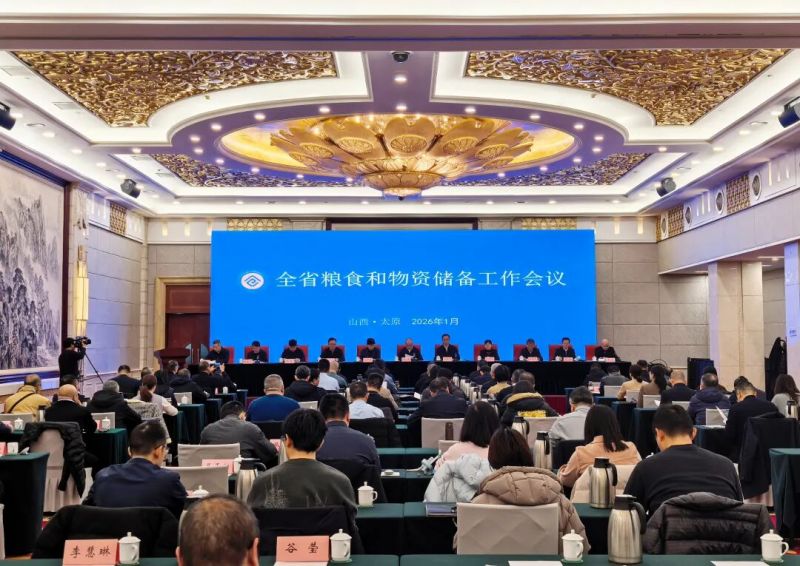
2026年山西全省粮食和物资储备工作会议在太原召开
Zhong Guo Fa Zhan Wang· 2026-01-16 07:13
Core Viewpoint - The meeting emphasized the importance of enhancing grain and material reserve work in Shanxi Province, focusing on the achievements of 2025 and setting priorities for 2026 to ensure a strong start for the "14th Five-Year Plan" [3][4]. Group 1: 2025 Achievements - In 2025, under the leadership of the provincial government, the grain circulation capacity improved, the grain industry developed effectively, and significant progress was made in reserve system reforms, contributing to the completion of annual goals [3]. - The meeting highlighted that the grain and material reserve work is at a critical stage of improvement and efficiency, requiring a forward-looking and targeted approach [3]. Group 2: 2026 Key Tasks - The overall requirement for 2026 is to adhere to Xi Jinping's thoughts, implement the spirit of the 20th National Congress, and focus on enhancing grain circulation capacity and reserve strength [4]. - Seven key tasks for 2026 were outlined, including: 1. Strengthening policy services to ensure stable grain market operations and sufficient supply [5]. 2. Improving grain reserve management and enhancing regulatory effectiveness [5]. 3. Focusing on strategic development to improve the quality and efficiency of the grain industry [5]. 4. Promoting project construction to enhance safety capabilities in grain and material reserves [5]. 5. Strengthening material reserve management and emergency response capabilities [6]. 6. Improving legal frameworks and regulatory levels for grain management [6]. 7. Emphasizing safety production and enhancing safety management capabilities [6]. Group 3: Organizational and Operational Focus - The meeting stressed the need for strong political responsibility in party governance and the importance of high-quality party building to support the development of grain and material reserves [6]. - It was also noted that optimizing services for farmers and enterprises is crucial, along with monitoring market dynamics to ensure stable grain supply and prices [6].

天津市出台措施促进高质量充分就业
Zhong Guo Fa Zhan Wang· 2026-01-16 06:53
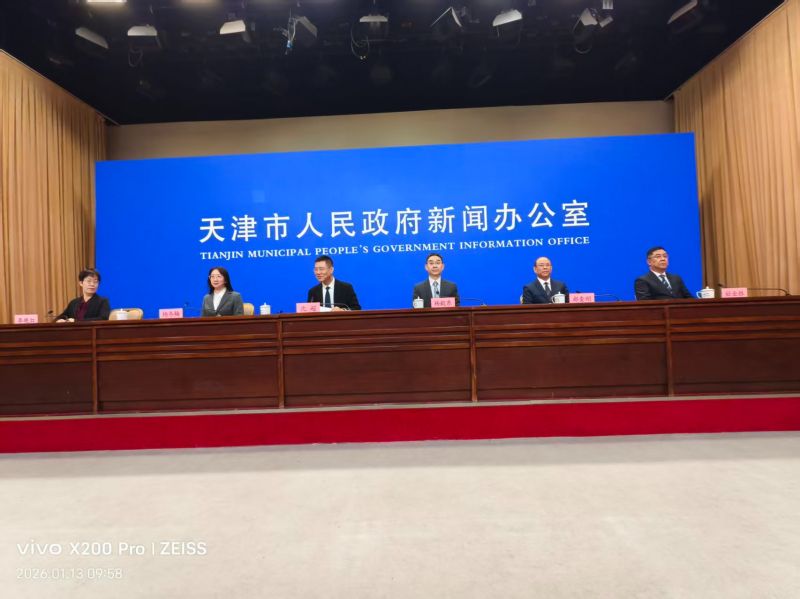
Core Viewpoint - The Tianjin Municipal Government has introduced the "Implementation Opinions on Promoting High-Quality Full Employment" to enhance employment opportunities and address structural employment issues in the region [1][3]. Group 1: Policy Framework - The "Implementation Opinions" consist of 6 areas and 22 specific measures aimed at promoting employment [5]. - The first area focuses on coordinating economic and social development with employment promotion, emphasizing job priority and supporting industries to stabilize and expand jobs [7]. Group 2: Addressing Structural Employment Issues - The second area aims to resolve structural employment contradictions by enhancing the alignment between education and job market needs, including lifelong vocational training and expanding pathways for skilled talent [9]. Group 3: Support for Key Groups - The third area emphasizes support for key demographics, including college graduates and veterans, by expanding market employment opportunities and enhancing rural labor force income [11]. Group 4: Entrepreneurship and Flexible Employment - The fourth area focuses on strengthening support for entrepreneurship and flexible employment, proposing to optimize the entrepreneurial policy environment and enhance guidance services [13]. Group 5: Employment Public Service System - The fifth area aims to improve the employment public service system, ensuring it is inclusive and accessible, with a focus on integrating services into grassroots governance [13]. Group 6: Labor Rights Protection - The sixth area emphasizes the protection of workers' employment rights, including equal employment opportunities and expanding social security coverage [13].
甘肃宕昌哈达铺:实干践初心 实事暖民心 绘就民生幸福新答卷
Zhong Guo Fa Zhan Wang· 2026-01-16 06:39
2025年以来,甘肃宕昌县哈达铺镇始终锚定"以人民为中心"的发展航向,紧扣群众急难愁盼的"心头 事",笃行"民生为本、实干为要"的工作理念,以基础设施提质、民生保障兜底、产业增收赋能、基层 治理增效、文明新风培育五大行动为抓手,用心用情用力把惠民实事办到群众心坎上,让群众的获得感 更充实、幸福感更持久、安全感更牢靠。全镇通过入户走访察实情、群众大会集民智、接待来访听民意 的多元渠道,累计收集民生诉求1527件,高效办结道路硬化、养老服务、矛盾纠纷等群众关切问题1486 件,以实打实的成效赢得了全镇群众的广泛赞誉与衷心认可。 筑基强本:基础设施焕新颜 乡村图景展新卷 筑牢发展根基,基础设施建设实现质的跃升,累计为民办实事56件。高标准农田田间道路硬化与砂化改 建工程稳步推进,村内破损道路修缮、错车道及进地盖板增设工作全面收官,让群众生产运输"路路 通"、日常出行"步步顺";老化供水管网改造逾6千米,5座蓄水池完成加固升级,水源地清理整治落地 见效,全镇安全饮水实现无死角覆盖,清甜活水润民心;村庄道路绿化面积突破7000平方米,787平方 米墙面彩绘勾勒乡村新韵,200余盏太阳能路灯照亮夜间归途,1000米残垣断 ...
济宁:本周肉禽蛋价格整体上涨,菜价延续降势
Zhong Guo Fa Zhan Wang· 2026-01-16 06:38
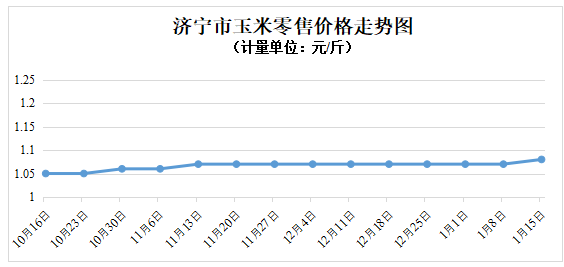
Group 1 - The core observation indicates that the prices of major commodities in Jining, Shandong Province, are showing mixed trends, with grain and oil prices stable with slight increases, meat and poultry prices overall rising, and vegetable prices continuing to decline [1][3][5] Group 2 - Grain and oil prices are stable with slight increases; the average price of wheat and corn is 1.22 yuan/kg and 1.08 yuan/kg, respectively, with month-on-month increases of 0.83% and 0.93%; flour and japonica rice prices remain unchanged at 1.92 yuan/kg and 2.52 yuan/kg [1] - Meat and poultry prices are generally rising; the average price of lean pork and pork belly is 11.86 yuan/kg and 10.71 yuan/kg, with month-on-month increases of 1.28% and 1.32%; the average price of white-cut chicken and eggs is 8.17 yuan/kg and 3.71 yuan/kg, with increases of 1.11% and 9.44% [3] - Vegetable prices are continuing to decline; the average price of 17 monitored vegetables is 3.36 yuan/kg, showing a month-on-month decrease of 2.99%, with significant declines in cucumber and eggplant prices, which fell by 8.89% and 7.50%, respectively [5]
山东博兴:2025年猪肉和鸡蛋价格波动下降
Zhong Guo Fa Zhan Wang· 2026-01-16 06:36
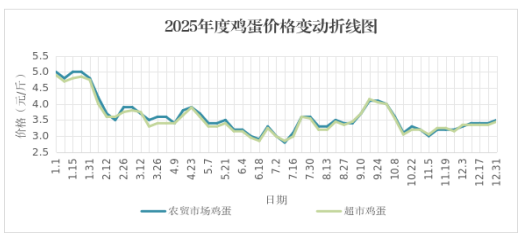
Core Insights - The price fluctuations of pork and eggs in Boxing County, Shandong Province, are expected to decline by 2025, indicating a stabilization in the market for these commodities [1]. Pork Price Fluctuations - Fresh pork prices in the agricultural market have shown a steady decline, with prices for lean meat, pork belly, and boneless hind leg meat decreasing from 17 CNY/kg, 15 CNY/kg, and 15 CNY/kg at the beginning of the year to 13 CNY/kg, 12 CNY/kg, and 12 CNY/kg by year-end, representing decreases of 23.53%, 20%, and 20% respectively [2]. - In supermarkets, the prices for lean meat, pork belly, and boneless hind leg meat have also decreased from 17.5 CNY/kg, 15 CNY/kg, and 15 CNY/kg to 13.9 CNY/kg, 11.9 CNY/kg, and 11.9 CNY/kg, with reductions of 20.57%, 20.67%, and 20.67% respectively [2]. Egg Price Fluctuations - The price of eggs in the agricultural market started at 5 CNY/kg in early January 2025, declining to a low of 2.8 CNY/kg by early July, then rebounding to a high of 4.1 CNY/kg in mid-September before falling back to 3.5 CNY/kg by year-end, marking a 30% decrease from the beginning of the year [3]. - In supermarkets, egg prices decreased from 4.9 CNY/kg in early January to a low of 2.85 CNY/kg in early July, then increased to a high of 4.15 CNY/kg in mid-September before settling at 3.45 CNY/kg by year-end, reflecting a decline of 29.59% from the start of the year [5].
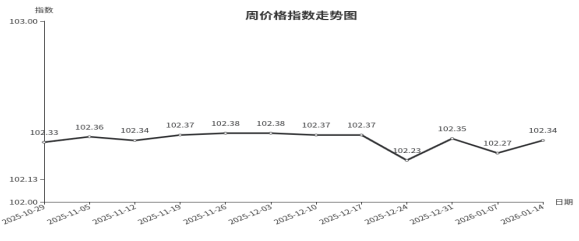
临沂商城周价格总指数为102.34点,环比上涨0.07点
Zhong Guo Fa Zhan Wang· 2026-01-16 06:33
Core Insights - The overall price index of Linyi Mall increased to 102.34 points this week, reflecting a slight week-on-week rise of 0.07 points, but a year-on-year decline of 1.50 points [1] Price Index Summary - Among 14 categories of goods, 5 categories saw price increases, 7 remained stable, and 2 categories experienced price declines. The top three categories with price increases were building decoration materials, steel, and household appliances and audio-visual equipment [3] Building Decoration Materials - The weekly price index for building decoration materials reached 107.49 points, with a week-on-week increase of 0.81 points. The largest increase was in the decorative materials subcategory, driven by rising aluminum prices, which increased production costs [5][7] Steel - The weekly price index for steel rose to 95.25 points, with a week-on-week increase of 0.18 points. Various subcategories, including profiles, pipes, and construction steel, saw price increases, while plate prices slightly declined. The market remains in a seasonal downturn with limited demand [8] Household Appliances and Audio-Visual Equipment - The weekly price index for household appliances and audio-visual equipment increased to 103.03 points, with a week-on-week rise of 0.07 points. The price of audio-visual equipment and refrigeration appliances increased, while prices for water heaters and purification appliances saw minor declines [10] Daily Necessities - The weekly price index for daily necessities decreased to 102.68 points, with a week-on-week decline of 0.02 points. Prices for bags, crafts, toys, and beauty products fell, influenced by seasonal demand reduction and e-commerce price competition [13] Clothing and Accessories - The weekly price index for clothing and accessories fell to 103.51 points, with a week-on-week decrease of 0.02 points. The decline was driven by clearance promotions for winter inventory, particularly in footwear, while clothing prices remained stable overall [16] Price Index Table - A detailed table shows the price index changes for various categories, highlighting the overall index increase and specific category movements [17]
超级工程重塑四川经济地理
Zhong Guo Fa Zhan Wang· 2026-01-16 06:26
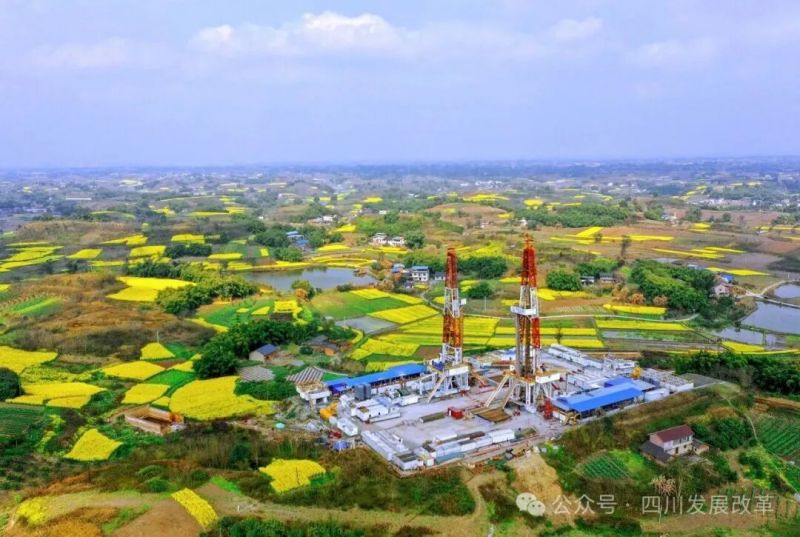
Core Viewpoint - The completion of several major infrastructure projects in Sichuan by the end of 2025 marks a significant advancement in the region's transportation and energy capabilities, enhancing its economic geography and strategic importance in national development [5][20]. Infrastructure Development - The Jinshang-Hubei ±800 kV UHVDC project, completed on December 18, 2025, enables clean electricity to be transmitted 1,900 kilometers to East China in just 6 milliseconds, setting a record for the highest altitude UHV project [1]. - The Leshan-Xichang Expressway, which opened on December 31, 2025, features a high bridge-tunnel ratio of 82% and incorporates innovative heating systems to address winter snow challenges [3]. - Sichuan has invested nearly 8.8 trillion yuan in over 1,600 key provincial projects during the 14th Five-Year Plan, with over 4 trillion yuan already completed, focusing on transportation, energy, water resources, and new infrastructure [5]. Energy Sector Advancements - By December 19, 2025, Sichuan's hydropower installed capacity surpassed 100 million kilowatts, making it the first province in China to reach this milestone, capable of supplying electricity for approximately 500 million people annually [17]. - The province's total power generation capacity exceeded 150 million kilowatts by the end of 2025, marking significant progress in transitioning to a clean energy structure [18]. Transportation Network Expansion - The completion of the Chengdu-Yibin high-speed railway and the operation of the Yuxi-Kunming high-speed railway have significantly improved connectivity in the region, with the Chengdu-Yibin line alone transporting over 29 million passengers in two years [9][11]. - Sichuan's highway network has expanded by over 3,000 kilometers in five years, connecting 15 previously isolated counties to national transportation arteries [12]. Economic Impact - The development of these infrastructure projects is expected to stimulate local economies, with increased tourism evidenced by over 7 million visitors to Jiuzhaigou in 2025, a 27% increase year-on-year [14]. - The establishment of the Chengdu-Europe Railway Express has facilitated the export of various goods, including agricultural products, to over a hundred cities globally, enhancing Sichuan's role in international trade [15]. Environmental Considerations - Infrastructure projects in Sichuan are increasingly incorporating green development principles, such as the relocation of power lines to protect migratory bird pathways and the successful transplantation of endangered plant species [22].
北京大学深圳研究院高质量户外运动目的地建设研修班在上海青浦区圆满结束
Zhong Guo Fa Zhan Wang· 2026-01-16 05:07
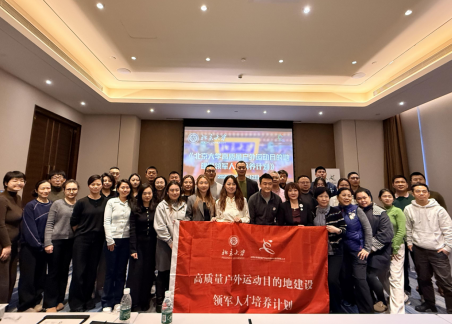
Core Insights - The training program aims to implement the guidelines for building high-quality outdoor sports destinations as outlined by the State Council and relevant national authorities [1][3] Group 1: Training Program Overview - The training took place on January 11-12, 2026, in Shanghai, organized by Peking University Shenzhen Research Institute, featuring experts from various national agencies [1] - This program follows a previous course held in December 2025, focusing on cultivating leadership talent in high-quality outdoor sports destination development [3] Group 2: Course Content and Structure - The course consists of seven modules covering policy interpretation, implementation paths, top-level design, natural resource protection, water sports project layout, sports event marketing, and management empowerment [4] - The curriculum aims to address operational management bottlenecks and technical support shortcomings in the process of establishing high-quality outdoor sports destinations [4] Group 3: Support and Collaboration - The training received support from various local government bodies and organizations, including the Shanghai Sports Bureau and the National Sports Administration [4] - The program encourages the formation of ecological alliance groups for ongoing interaction and collaboration among participants [4]
山东省地矿局鲁南院召开2026年社保公积金基数调整政策宣讲会
Zhong Guo Fa Zhan Wang· 2026-01-15 10:07
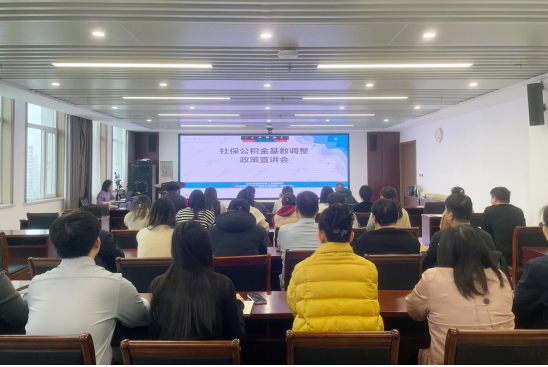
Group 1 - The core viewpoint of the article emphasizes the importance of transparency in the adjustment of social security and housing fund contribution bases to protect employees' rights [1] - A policy briefing was held on January 14, 2026, by the Shandong Provincial Geological Bureau's Lunan Institute, attended by over 70 employee representatives [1][3] - The meeting focused on key issues such as changes in social security and housing fund contribution bases, the impact on individual monthly wage income, and the relationship between retirement benefits and contribution bases [3] Group 2 - Detailed explanations were provided regarding the composition of contribution bases to ensure comprehensive and understandable policy interpretation [3] - The Human Resources Department will distribute the "Social Insurance and Housing Fund Contribution Base Confirmation Form" to current employees to safeguard their right to be informed [3]
广东省湖北阳新商会在惠州市举行“年会”
Zhong Guo Fa Zhan Wang· 2026-01-15 07:37
中国发展网讯向能来记者李宏伟报道1月10日,广东省湖北阳新商会在惠州市金海湾嘉华度假酒店举 行"年会"。 李冠男主持招商引资项目签约活动,石顺发作招商引资推介,系统阐述了阳新经济发展的得天独厚优势 与广阔前景。 此次"年会"别具一格,亮点频频。短短半天时间,既举行了阳新县招商引资项目签约活动,又召开了广 东省湖北阳新商会第五届第三次会员大会,同时还召开了在粤阳新籍企业家座谈会。晚上的迎新春文艺 晚会异彩纷呈,燃烧激情,奏响了"阳商同心,惠聚共赢"的最强音。 仙岛湖长寿苏打水项目等7个重点项目集中签约,覆盖新材料、智能制造、食品加工等重点产业,在活 动现场,黄石国家农业科技园区阳新核心区(军垦农场)、湖北申宇生态农业发展有限公司、阳新县农发 茶叶公司等7家阳新本土企业的优质产品进行了展览和集中推介。 广东省湖北阳新商会会员、阳新县相关镇区、县直单位负责人、广东省湖北大冶商会等部分兄弟商会代 表、阳新县相关企业负责人等1100多人参加活动。广东省民政厅社会组织管理局原副局长、广东省地名 促进会会长徐祖平,湖北省人民政府驻深圳办事处副主任罗云国出席会员代表大会并致辞。 创新是引领发展的第一动力,是建设现代化经济体系 ...