
家用电器和音像器材

Search documents
去年规上轻工业增加值增长5.3%
Ren Min Ri Bao· 2026-02-03 22:55
Core Insights - The overall economic operation of China's light industry is expected to remain stable in 2025, with a year-on-year growth of 5.3% in the added value of large-scale light industry [1] - Light industry accounts for 13% of national industrial assets, contributing to 16.5% of national industrial revenue and 18.8% of profits [1] Group 1: Industry Growth - The added value growth rate of the electric vehicle, battery, and plastic furniture manufacturing sectors is projected to exceed 20% [1] - The agricultural and sideline food processing industry and food manufacturing industry are expected to see year-on-year growth rates of 5.6% and 5.3%, respectively [1] - Among 90 major light industrial products, 35 products are expected to see an increase in output, with electric bicycle output growing by 21.6% and solar cell output increasing by 7.6% [1] Group 2: Consumer Demand - Domestic consumption demand is continuously being released due to a series of policies aimed at expanding domestic demand and promoting consumption [1] - The retail sales of 11 categories of light industry goods are projected to reach 86,719 billion yuan, reflecting a year-on-year growth of 7.8% [1] - Retail sales of household appliances and audio-visual equipment are expected to grow by 11%, furniture retail sales by 14.6%, and cultural and office supplies retail sales by 17.3% [1]
2025年我国规上轻工业增加值同比增长5.3%
Xin Hua Wang· 2026-02-03 12:35
Core Insights - The light industry in China is expected to maintain a stable economic operation in 2025, with a year-on-year growth of 5.3% in added value for large-scale light industry [1] - The light industry accounts for 13% of national industrial assets, contributing to 16.5% of national industrial revenue and 18.8% of profits [1] Group 1: Economic Performance - In 2025, the added value growth rates for certain sectors are projected to exceed 20%, including electric vehicles, batteries, and plastic furniture manufacturing [1] - The agricultural and food processing industries are expected to see added value growth of 5.6% and 5.3% respectively [1] - Among 90 major light industrial products, 35 are expected to see production increases, with electric bicycle production growing by 21.6% and solar cell production by 7.6% [1] Group 2: Domestic Consumption - Retail sales of 11 categories of light industrial goods are projected to reach 86,719 billion yuan, reflecting a year-on-year growth of 7.8% [1] - Specific categories such as home appliances and audio-visual equipment are expected to see retail sales growth of 11%, while furniture sales are projected to grow by 14.6% and cultural office supplies by 17.3% [1] Group 3: Export Performance - Among 22 major export categories in the light industry, 11 are expected to see year-on-year growth in export value [1] - Exports of batteries and battery parts are projected to reach 84.73 billion USD, with a growth of 22.3%, while daily chemical products and light machinery are expected to grow by 10.9% and 11.6% respectively [1] Group 4: Future Outlook - The President of the China Light Industry Federation, Zhang Chonghe, indicates that in 2026, the light industry will continue to show resilience and stable development due to ongoing economic stabilization and consumption promotion policies [2] - The light industry is expected to exhibit overall stability and differentiated growth characteristics, maintaining a medium-speed growth trend [2]
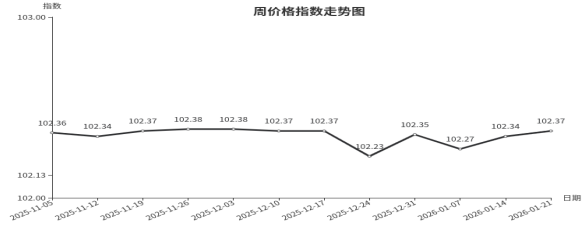
本周临沂商城周价格总指数为102.37点,环比上涨0.03点(1月15日—1月21日)
Zhong Guo Fa Zhan Wang· 2026-01-23 08:46
Core Insights - The overall price index for Linyi Mall increased to 102.37 points this week, reflecting a slight week-on-week rise of 0.03 points, but a year-on-year decline of 1.46 points [1] Price Index Summary - In the 14 categories of goods, 5 categories saw price increases, 3 remained stable, and 6 experienced declines. The top three categories with price increases were construction and decoration materials, steel, and hardware and electrical materials [3] Construction and Decoration Materials - The price index for construction and decoration materials reached 107.82 points, with a week-on-week increase of 0.33 points. The largest contributor to this increase was the rise in decorative materials, while structural installation materials and specialized materials saw slight increases. However, overall market transactions remained sluggish, with no significant growth in sales volume [5] Steel - The steel price index rose to 95.31 points, marking a week-on-week increase of 0.06 points. Most subcategories saw price increases, particularly pipes, construction steel, and profiles, while plate prices experienced a slight decline. The steel market is currently in a demand lull, with insufficient construction project starts leading to a noticeable decrease in downstream demand [8] Hardware and Electrical Materials - The price index for hardware and electrical materials increased to 119.97 points, with a week-on-week rise of 0.07 points. This increase was primarily driven by higher prices for wires and cables, as well as instruments and meters. Rising copper prices have pushed up costs, leading to continued price adjustments for wires, while demand remains sensitive to price changes [11] Home Appliances and Audio-Visual Equipment - The price index for home appliances and audio-visual equipment fell to 102.78 points, reflecting a week-on-week decrease of 0.25 points. The largest declines were seen in kitchen appliances, purification equipment, and water heaters, with overall weak demand leading to lower sales volumes [14] Grain, Oil, and Food - The price index for grain, oil, and food decreased to 95.27 points, with a week-on-week decline of 0.01 points. The performance varied across subcategories, with spices and tea experiencing price drops, while dried fruits saw price increases. The approaching year-end has led to increased wholesale purchasing of spices and tea, despite lower wholesale prices [17] Daily Necessities - The price index for daily necessities fell to 102.67 points, with a week-on-week decrease of 0.01 points. Prices for bags, toys, textiles, jewelry, and home goods all declined, continuing the downward trend in a sluggish market [20] Summary Table - The overall price index increased from 102.34 to 102.37 points, a change of 0.03 points. Specific category changes include: - Construction and Decoration Materials: 107.49 to 107.82 points, +0.33 - Steel: 95.25 to 95.31 points, +0.06 - Hardware and Electrical Materials: 119.90 to 119.97 points, +0.07 - Home Appliances: 88.52 to 88.52 points, 0 - Grain, Oil, and Food: 95.28 to 95.27 points, -0.01 - Daily Necessities: 102.68 to 102.67 points, -0.01 - Home Appliances and Audio-Visual Equipment: 103.03 to 102.78 points, -0.25 [21]

国家统计局:2025年限上家用电器和音像器材类商品零售额同比增11%
Zhong Guo Xin Wen Wang· 2026-01-20 03:14
Core Viewpoint - The press conference held by the State Council Information Office on January 19 provided insights into the economic performance of the country in 2025, highlighting significant growth in retail sales across various categories [1]. Group 1: Economic Performance - In 2025, retail sales of cultural office supplies, furniture, household appliances, and audio-visual equipment increased by 17.3%, 14.6%, and 11% respectively, all achieving double-digit growth [1].
国家统计局:2025年社会消费品零售总额501202亿元 比上年增长3.7%
Zheng Quan Shi Bao Wang· 2026-01-19 02:08
Group 1 - The total retail sales of consumer goods in 2025 reached 50,120.2 billion yuan, an increase of 3.7% compared to the previous year [1] - Urban retail sales amounted to 43,297.2 billion yuan, growing by 3.6%, while rural retail sales were 6,823.0 billion yuan, with a growth of 4.1% [1] - Retail sales of goods reached 44,322.0 billion yuan, increasing by 3.8%, and catering revenue was 57,982.0 billion yuan, growing by 3.2% [1] Group 2 - Sales of basic living goods and certain upgraded products showed strong growth, with categories such as communication equipment, cultural and office supplies, sports and entertainment products, home appliances, and food retailing increasing by 20.9%, 17.3%, 15.7%, 11.0%, and 9.3% respectively [1] - The national online retail sales reached 15,972.2 billion yuan, an increase of 8.6% year-on-year, with physical goods online retail sales at 13,092.3 billion yuan, growing by 5.2%, accounting for 26.1% of total retail sales [1] Group 3 - In December, the total retail sales of consumer goods increased by 0.9% year-on-year but decreased by 0.12% month-on-month [1] - Annual service retail sales grew by 5.5%, with significant growth in categories such as cultural and recreational services, communication information services, tourism consulting and leasing services, and transportation services [1]
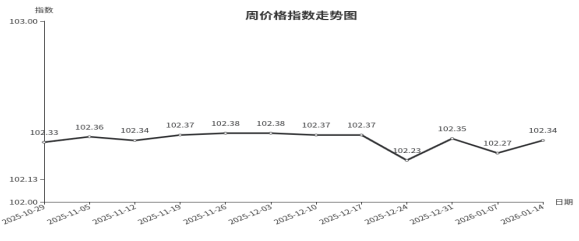
临沂商城周价格总指数为102.34点,环比上涨0.07点
Zhong Guo Fa Zhan Wang· 2026-01-16 06:33
Core Insights - The overall price index of Linyi Mall increased to 102.34 points this week, reflecting a slight week-on-week rise of 0.07 points, but a year-on-year decline of 1.50 points [1] Price Index Summary - Among 14 categories of goods, 5 categories saw price increases, 7 remained stable, and 2 categories experienced price declines. The top three categories with price increases were building decoration materials, steel, and household appliances and audio-visual equipment [3] Building Decoration Materials - The weekly price index for building decoration materials reached 107.49 points, with a week-on-week increase of 0.81 points. The largest increase was in the decorative materials subcategory, driven by rising aluminum prices, which increased production costs [5][7] Steel - The weekly price index for steel rose to 95.25 points, with a week-on-week increase of 0.18 points. Various subcategories, including profiles, pipes, and construction steel, saw price increases, while plate prices slightly declined. The market remains in a seasonal downturn with limited demand [8] Household Appliances and Audio-Visual Equipment - The weekly price index for household appliances and audio-visual equipment increased to 103.03 points, with a week-on-week rise of 0.07 points. The price of audio-visual equipment and refrigeration appliances increased, while prices for water heaters and purification appliances saw minor declines [10] Daily Necessities - The weekly price index for daily necessities decreased to 102.68 points, with a week-on-week decline of 0.02 points. Prices for bags, crafts, toys, and beauty products fell, influenced by seasonal demand reduction and e-commerce price competition [13] Clothing and Accessories - The weekly price index for clothing and accessories fell to 103.51 points, with a week-on-week decrease of 0.02 points. The decline was driven by clearance promotions for winter inventory, particularly in footwear, while clothing prices remained stable overall [16] Price Index Table - A detailed table shows the price index changes for various categories, highlighting the overall index increase and specific category movements [17]
11月经济数据点评:增量政策效果有待显现
Orient Securities· 2025-12-16 01:35
Economic Overview - November economic data shows a consistent trend with previous periods, indicating weakness in real estate, infrastructure, and manufacturing investments, while consumer confidence remains low[7] - Fixed asset investment cumulative year-on-year decreased from -1.7% to -2.6%, reflecting a significant fluctuation and pointing towards a need for improved supply-demand structure[7] - Retail sales growth in November dropped to 1.3%, influenced by previous high base effects and a decline in consumer confidence post "Double Eleven" promotions[7] Policy and Investment Insights - The introduction of 500 billion yuan in new policy financial tools has been fully deployed, but the impact on investment growth may take time to materialize[7] - The focus on effective industrial investment is emphasized, with policies aiming for high-quality and sustainable growth rather than mere quantitative expansion[7] - Recent policies aimed at enhancing consumer goods supply-demand compatibility and promoting consumption are expected to gradually improve consumer sentiment[7] Production and Trade Dynamics - Industrial value-added output slightly decreased by 0.1 percentage points, but high-tech industries showed a robust growth of 8.4%, indicating technology's crucial role in overall economic growth[7] - Export delivery value improved slightly from -2.1% to -0.1%, suggesting a narrowing of production fluctuations due to external trade conditions[7] Future Outlook - The market anticipates weaker growth in Q4 compared to Q3, with the expectation that the effects of new policies will take time to manifest, leading to continued economic challenges until year-end[7] - Despite current weaknesses, China's economic momentum remains strong, supported by counter-cyclical policies and a focus on domestic demand, particularly consumption[7]
临沂商城价格指数分析(12月4日—12月10日)
Zhong Guo Fa Zhan Wang· 2025-12-12 05:00
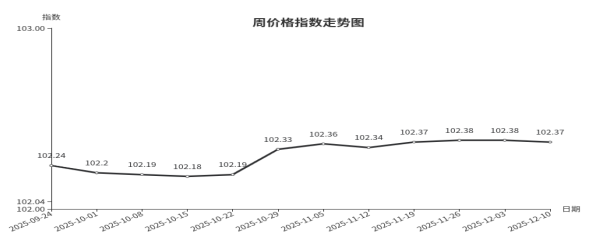
Core Viewpoint - The overall price index in Linyi Mall has shown a slight decline this week, indicating a trend of decreasing prices across various categories, with specific categories experiencing both increases and decreases in their respective indices [1][17]. Price Index Summary - The total price index for Linyi Mall this week is 102.37 points, down 0.01 points from the previous week, reflecting a decrease of 0.01% week-on-week and a year-on-year decrease of 1.56% [1]. - Among 14 categories of goods, 2 categories saw price increases, 6 remained stable, and 6 experienced price declines [3]. Category-Specific Price Movements - **Steel Products**: The weekly price index for steel products is 96.04 points, up 0.02 points from the previous week. The construction steel and profile steel categories saw increases, while pipe materials remained stable. The overall market is experiencing limited price increases due to seasonal factors and reduced construction activity [5][8]. - **Lighting Products**: The weekly price index for lighting products is 104.29 points, up 0.02 points. There was a slight increase in prices for lighting accessories and home lighting, driven by a slight recovery in sales due to upcoming festive activities [9][6]. - **Board Products**: The weekly price index for board products is 97.39 points, down 0.04 points. The market is entering a seasonal consumption lull, leading to decreased demand and lower average sales prices for main products like solid wood boards and woodworking boards [12][10]. - **Furniture**: The weekly price index for furniture is 88.54 points, down 0.02 points. The market is characterized by low customer traffic, with sales primarily driven by retail, leading to price reductions as merchants compress profits to stimulate transactions [15][13]. - **Home Appliances and Audio-Visual Equipment**: The weekly price index for this category is 103.01 points, down 0.02 points. Significant price drops were noted in refrigeration appliances, while some minor increases were observed in water heaters and personal electronics. Sales have slightly declined as the month progresses, contributing to downward price pressure [18][16].
前10月江苏经济成绩单出炉工业延续增长 消费持续回暖
Xin Hua Ri Bao· 2025-11-23 23:03
Economic Overview - The overall economic operation in the province has been stable and progressing steadily in the first ten months of the year, with key sectors such as industry, consumption, and services showing positive developments [1][2]. Industrial Performance - The industrial economy has maintained a robust growth trend, with the industrial added value of large-scale enterprises increasing by 6.8% year-on-year from January to October. In October alone, the growth rate was 5.8%, with high-end manufacturing sectors such as equipment manufacturing, high-tech manufacturing, and digital core product manufacturing growing by 8.0%, 11.7%, and 9.4% respectively, outpacing the overall growth [1]. Consumption Market - The consumption market has shown signs of recovery, with total retail sales of consumer goods reaching 38,816.8 billion yuan, a year-on-year increase of 4.0% from January to October. In October, retail sales of household appliances and audio-visual equipment rose by 7.4%, while sales of computers and related products surged by 48%, indicating strong demand for upgraded and digital products [2]. Service Sector - The service sector has maintained a stable development trend, with revenue from large-scale service industries increasing by 7.2% year-on-year from January to September. Notable growth was observed in residential services, repair and other services, rental and business services, and water, environment, and public facility management, with respective growth rates of 14.2%, 12.7%, and 9.7% [2]. Fixed Asset Investment - Fixed asset investment has seen a year-on-year decline of 8.7% from January to October; however, the investment structure has been optimizing. Significant growth was noted in infrastructure investments, particularly in the electricity and heat production and supply industry, which grew by 22.9%, and in loading, unloading, and warehousing, which increased by 27.2% [3].
一财社论:以富民扩消费
Di Yi Cai Jing· 2025-11-17 12:03
Core Insights - The article emphasizes the importance of enhancing supply-demand adaptability through proactive fiscal policies focused on "investing in people," which aims to unleash not only consumption potential but also the vitality of the economy and society [1][4] Group 1: Consumption and Economic Strategy - Recent government meetings have highlighted the need to enhance supply-demand adaptability as an effective measure to release consumption potential and facilitate economic circulation, aiming for a dynamic balance between supply and demand [1][2] - The focus on consumption is part of a broader strategy that includes fiscal and monetary policies designed to create a consumption-friendly environment, significantly reducing the costs and difficulties associated with supply-demand matching [1][2] Group 2: Long-term Consumption Capacity - The Minister of Finance has pointed out the dual focus on immediate consumption potential and long-term consumption capacity, advocating for the use of fiscal subsidies and other tools to expand consumption and create new growth points [2] - The emphasis on consumption reflects a recognition of existing supply-demand mismatches in the domestic market, with recent statistics showing a slight slowdown in retail sales growth, particularly in categories like home appliances and automobiles [2] Group 3: Effective Demand and Structural Issues - Insufficient effective demand is identified as a significant constraint on economic and social development, which is fundamentally a structural issue within the economy [3] - The article suggests that as fiscal policies focused on "investing in people" deepen, improvements in national income distribution among government, enterprises, and residents could lead to a quicker resolution of effective demand shortages [3] Group 4: Consumer Preferences and Market Dynamics - The article argues for the necessity of creating a new institutional framework that respects consumer preferences, which should be integral to market pricing signals and consumer rights protection [3] - It posits that recognizing and meeting individual consumer preferences will enhance market transactions and stimulate innovation across industries, leading to a more vibrant economic cycle [3]