
价格指数

Search documents
中国宏观周报(2026年3月第2周):出口集装箱运价上涨-20260316
Ping An Securities· 2026-03-16 01:13
Industrial Sector - Industrial production continues to recover, particularly in the textile and automotive sectors, with significant increases in operating rates[2] - Steel and building materials production has increased, with apparent demand recovering[2] - The operating rate for automotive tires has improved, with the full steel tire operating rate exceeding last year's levels[2] Real Estate Sector - New home sales in 30 major cities increased by 0.9% year-on-year, with a growth rate improvement of 24.2 percentage points compared to the previous week[2] - The second-hand housing listing price index decreased by 1.17% compared to the previous value[2] Domestic Demand - Retail sales of passenger cars in February fell by 25.4% year-on-year, with a cumulative decline of 18.9% for the year[2] - Major home appliance retail sales dropped by 31.1% year-on-year, a decrease of 19.2 percentage points from the previous value[2] - Domestic flight operations increased by 11.3% year-on-year, although the growth rate has slowed by 8.6 percentage points compared to the previous week[2] External Demand - Export container freight rates have risen, with the Shanghai and Ningbo export container freight rates increasing by 14.9% and 10.3%, respectively[2] - The port cargo throughput volume decreased by 6.2% year-on-year, while container throughput increased by 3.7%[2] Price Trends - The industrial product price index rose by 6.3%, with the black raw materials index increasing by 3.6%[2] - The futures price of rebar increased by 1.7%, while the spot price rose by 1.2%[2] - The agricultural product wholesale price index fell by 1.0% week-on-week, indicating seasonal declines[2]
中国宏观周报(2026年2月第4周):部分工业品生产恢复-20260302
Ping An Securities· 2026-03-02 03:46
Industrial Sector - After the Spring Festival, daily average pig iron production and float glass operating rates have increased, indicating a recovery in industrial production[2] - Cement clinker capacity utilization rate has decreased, while asphalt operating rates have also shown a decline[2] - The operating rate of polyester in the textile sector has improved, while weaving industry rates have seasonally weakened[2] Real Estate - New home sales in 30 major cities have seen a year-on-year decline of 24.6%, but this is an improvement of 2.1 percentage points compared to December 2025[2] - The second-hand housing listing price index has increased by 0.11% week-on-week as of February 16[2] Domestic Demand - Retail sales of home appliances have decreased by 12.3% year-on-year, but this represents a 10.1 percentage point improvement from previous values[2] - Domestic flight operations have increased by 17.8% year-on-year, with a growth rate improvement of 10.8 percentage points compared to the previous week[2] - National retail and catering sales during the Spring Festival have grown by 5.2% year-on-year, surpassing the 4.1% growth during the 2025 Spring Festival[2] External Demand - Port cargo throughput has increased by 15.1% year-on-year, with container throughput rising by 19.3%[2] - Exports to South Korea and Japan have grown by 23.5% year-on-year, with a significant acceleration of 25.8 percentage points compared to the previous month[2] Prices - The Nanhua Industrial Price Index has risen by 2.5%, with the non-ferrous metals index increasing by 4.5%[2] - The agricultural product wholesale price index has decreased by 3.1% week-on-week, reflecting seasonal declines[2]
广发宏观:高频数据下的2月经济:价格篇
GF SECURITIES· 2026-03-01 07:46
Price Index Trends - The Business Price Index (BPI) recorded 947 points as of February 27, down 1.0% from the end of January[3] - The energy index decreased by 0.1% month-on-month, while the non-ferrous index fell by 6.1%[4] - The global geopolitical threat index averaged 146.4 points, down 34.7% from the previous month[3] Commodity Price Movements - In the non-ferrous sector, 20 commodities saw price increases, with 9 commodities rising over 5%, including silver (15.24%), tin (14.02%), and dysprosium alloy (10.45%)[4] - The South China comprehensive index fell by 1.3% month-on-month, with a year-on-year average increase of 7.6%[5] - The average wholesale price of pork decreased by 4.9% month-on-month, while key vegetable prices fell by 5.7%[9] Real Estate and Housing Prices - Second-hand housing prices in major cities like Beijing, Shanghai, and Shenzhen showed slight increases, with indices recording changes of 0.9%, 0.3%, -0.8%, and 0.6% respectively[5] - The highest recorded prices for second-hand homes in major cities were 159.44 (Beijing), 192.67 (Shanghai), 181.71 (Guangzhou), and 251.13 (Shenzhen) in the past year[5] Emerging Industry Prices - The photovoltaic industry composite index fell by 1.7%, while lithium carbonate futures prices increased by 11.5%[7] - The DXI index for the DRAM memory industry rose by 6.0%, reaching a historical high[7] Shipping and Logistics - The China Container Freight Index (CCFI) decreased by 11.1% month-on-month, with specific routes like Shanghai to Los Angeles and Shanghai to New York dropping by 10.3% and 6.7% respectively[8] - The Baltic Dry Index (BDI) fell by 0.4% month-on-month, contrasting with a 14.4% increase in January[9]
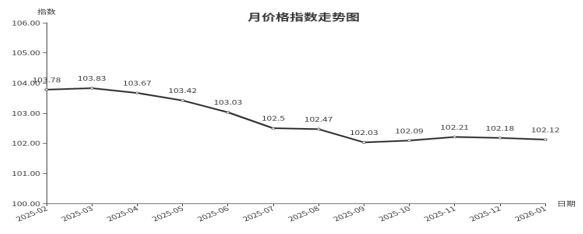
2026年1月临沂商城月价格总指数为102.12点,环比下跌0.06点
Zhong Guo Fa Zhan Wang· 2026-02-24 06:36
Core Viewpoint - The overall price index of Linyi Mall decreased slightly this month, indicating a mixed trend in various product categories with some experiencing price increases while others saw declines [1][13]. Price Index Summary - The total price index for Linyi Mall is 102.12 points, down 0.06 points month-on-month, a decrease of 0.06%, and down 1.72 points year-on-year, a decrease of 1.66% [1]. - Among 14 categories, 6 experienced price increases, 2 remained stable, and 6 saw price declines [3]. Category-Specific Price Changes Building and Decoration Materials - The price index for building and decoration materials rose to 107.90 points, an increase of 1.41 points month-on-month [5]. - The increase was driven primarily by the rise in prices of decorative materials, which increased by 1.50 points, while structural materials saw a slight decline [6]. Hardware and Electrical Materials - The price index for hardware and electrical materials reached 119.99 points, up 0.20 points month-on-month [9]. - The increase was influenced by a significant rise in copper prices, which raised production costs for electrical cables, leading to higher selling prices [9]. Educational and Office Supplies - The price index for educational and office supplies fell to 106.60 points, down 2.02 points month-on-month [10]. - The decline was mainly due to a significant drop in the prices of sports and entertainment products, which decreased by 5.09 points [10]. Steel Products - The price index for steel products decreased to 95.29 points, down 0.39 points month-on-month [12]. - The decline was attributed to weak demand in the real estate market, leading to reduced end-user demand and a cautious outlook among market participants [12].

美国2025年全年GDP增长2.2%
Yang Shi Xin Wen· 2026-02-20 14:40
Economic Growth - The U.S. real GDP is projected to grow by 2.2% in 2025, a decrease from 2.8% in 2024 [1] Price Indices - The overall price index for personal consumption expenditures (PCE) is expected to rise by 2.6% in 2025, up from 2.4% in 2024 [1] - The core PCE price index, excluding food and energy, is anticipated to increase by 2.8%, slightly lower than the 2.9% in 2024 [1] Quarterly Performance - Preliminary estimates indicate that the U.S. GDP will grow at an annual rate of 1.4% in the fourth quarter of 2025, a significant slowdown from 4.4% in the third quarter [1] - The growth in the fourth quarter is primarily driven by increased consumer spending and investment, although declines in government spending and exports partially offset this growth [1]
年初产需降温——1月PMI数据解读【陈兴团队·华福宏观】
陈兴宏观研究· 2026-01-31 10:27
Group 1 - The manufacturing PMI in January recorded a decline to 49.3%, which is 0.8 percentage points lower than the previous month and below the median level of the past five years [4][3] - Key sub-indices such as new orders, production, raw material inventory, and employment all showed a decrease, indicating a cooling in both supply and demand [4][2] - The new orders index fell to 49.2%, down 1.6 percentage points from the previous month, while the production index decreased to 50.6%, down 1.1 percentage points [6][4] Group 2 - The price index has risen significantly due to recent increases in commodity prices, with the raw material purchase price index at 56.1%, down 3.0 percentage points, and the factory price index at 50.6%, up 1.7 percentage points [8][3] - The construction industry has seen a notable decline, with the new orders index dropping significantly, leading to a business activity index of 48.8%, the lowest since April 2020 [9][3] - The non-manufacturing business activity index fell to 49.4%, with the service sector also experiencing a slight decline, indicating overall weak economic conditions [9][12]

制造业运行有所波动!统计局最新发布,重要经济数据出炉
证券时报· 2026-01-31 03:01
Core Viewpoint - The manufacturing sector in China is experiencing fluctuations, with the manufacturing PMI at 49.3%, indicating a decline in economic activity, while the prices of raw materials and finished goods are showing signs of recovery, with the producer price index rising above the critical point for the first time in 20 months [1][3][4]. Manufacturing Sector Analysis - The manufacturing PMI decreased by 0.8 percentage points from the previous month, reflecting seasonal slowdowns and insufficient market demand [3]. - Among 13 sub-indices, inventory, import, purchase price, and producer price indices increased, while production, new orders, and other indices saw declines [3]. - The purchase price index rose to 56.1%, marking a 3 percentage point increase, while the producer price index reached 50.6%, up 1.7 percentage points, indicating a return to expansion after 19 months below 50% [4]. New Growth Momentum - High-tech manufacturing PMI remained stable at 52.0%, indicating ongoing positive trends, while equipment manufacturing PMI was at 50.1%, also in the expansion zone [6]. - The production and business activity expectation index was at 52.6%, suggesting optimistic expectations among enterprises [7]. Financial Sector Performance - The non-manufacturing business activity index was at 49.4%, down 0.8 percentage points, primarily due to a slowdown in the construction sector [10]. - The financial sector showed significant improvement, with the business activity index exceeding 65%, indicating strong support for the real economy [11].

【联合发布】2025年12月价格/优惠指数走势报告
乘联分会· 2026-01-28 08:30
Core Viewpoint - The article provides an analysis of the December 2025 automotive market, highlighting price changes and discount trends across different vehicle segments, indicating a general upward trend in market prices and discounts. Overall Market Price Changes - The overall market price change index for December is 4.84, with an average transaction price of 166,200 yuan, reflecting an increase of 8,277 yuan or 5.24% month-on-month [4] - All market segments experienced price increases, with the sedan market showing the largest growth at 8.05% [4] Sedan Market Analysis - The sedan market price change index is -0.76, with an average transaction price of 132,500 yuan [3] - The overall transaction price for sedans increased by 9,872 yuan, or 8.05% month-on-month [5] - The A00 segment saw the largest price increase at 8.65%, while the B and C segments experienced declines of 1.52% and 2.29% respectively [5] SUV Market Analysis - The SUV market price change index is 8.13, with an average transaction price of 186,100 yuan, reflecting a month-on-month increase of 2,574 yuan or 1.4% [10] - The B segment within SUVs showed significant price growth, while the A0 segment experienced a decline of 1.43% [10] MPV Market Analysis - The MPV market price change index is -1.79, with an average transaction price of 269,100 yuan, which increased by 8,805 yuan or 3.38% month-on-month [10] - The market saw a notable increase in sales share for models priced above 200,000 yuan [10] Overall Market Discount Changes - The overall market discount change index for December is 0.45, with an average discount of 28,500 yuan, which increased by 2,775 yuan or 10.8% month-on-month [4] - Discounts increased across all segments, with the MPV market showing the largest growth at 21.7% [4] New Energy Market Overview - The overall new energy market price change index is 7.68, with an average transaction price of 175,500 yuan, reflecting an increase of 13,863 yuan or 8.58% month-on-month [10] - The new energy sedan market saw a price increase of 11,325 yuan, or 10.58%, with the A00 segment experiencing a significant rise of 8.7% [12] New Energy Market Discounts - The overall new energy market discount change index is 0.81, with an average discount of 11,300 yuan, which increased by 1,531 yuan or 15.74% month-on-month [12] - Discounts in the MPV segment increased significantly by 35.4% [12]

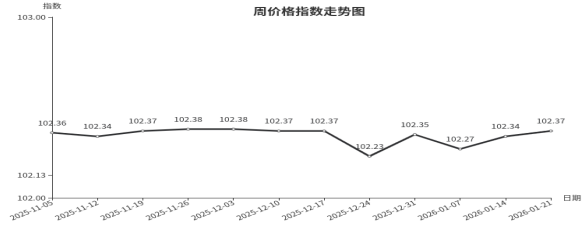
本周临沂商城周价格总指数为102.37点,环比上涨0.03点(1月15日—1月21日)
Zhong Guo Fa Zhan Wang· 2026-01-23 08:46
Core Insights - The overall price index for Linyi Mall increased to 102.37 points this week, reflecting a slight week-on-week rise of 0.03 points, but a year-on-year decline of 1.46 points [1] Price Index Summary - In the 14 categories of goods, 5 categories saw price increases, 3 remained stable, and 6 experienced declines. The top three categories with price increases were construction and decoration materials, steel, and hardware and electrical materials [3] Construction and Decoration Materials - The price index for construction and decoration materials reached 107.82 points, with a week-on-week increase of 0.33 points. The largest contributor to this increase was the rise in decorative materials, while structural installation materials and specialized materials saw slight increases. However, overall market transactions remained sluggish, with no significant growth in sales volume [5] Steel - The steel price index rose to 95.31 points, marking a week-on-week increase of 0.06 points. Most subcategories saw price increases, particularly pipes, construction steel, and profiles, while plate prices experienced a slight decline. The steel market is currently in a demand lull, with insufficient construction project starts leading to a noticeable decrease in downstream demand [8] Hardware and Electrical Materials - The price index for hardware and electrical materials increased to 119.97 points, with a week-on-week rise of 0.07 points. This increase was primarily driven by higher prices for wires and cables, as well as instruments and meters. Rising copper prices have pushed up costs, leading to continued price adjustments for wires, while demand remains sensitive to price changes [11] Home Appliances and Audio-Visual Equipment - The price index for home appliances and audio-visual equipment fell to 102.78 points, reflecting a week-on-week decrease of 0.25 points. The largest declines were seen in kitchen appliances, purification equipment, and water heaters, with overall weak demand leading to lower sales volumes [14] Grain, Oil, and Food - The price index for grain, oil, and food decreased to 95.27 points, with a week-on-week decline of 0.01 points. The performance varied across subcategories, with spices and tea experiencing price drops, while dried fruits saw price increases. The approaching year-end has led to increased wholesale purchasing of spices and tea, despite lower wholesale prices [17] Daily Necessities - The price index for daily necessities fell to 102.67 points, with a week-on-week decrease of 0.01 points. Prices for bags, toys, textiles, jewelry, and home goods all declined, continuing the downward trend in a sluggish market [20] Summary Table - The overall price index increased from 102.34 to 102.37 points, a change of 0.03 points. Specific category changes include: - Construction and Decoration Materials: 107.49 to 107.82 points, +0.33 - Steel: 95.25 to 95.31 points, +0.06 - Hardware and Electrical Materials: 119.90 to 119.97 points, +0.07 - Home Appliances: 88.52 to 88.52 points, 0 - Grain, Oil, and Food: 95.28 to 95.27 points, -0.01 - Daily Necessities: 102.68 to 102.67 points, -0.01 - Home Appliances and Audio-Visual Equipment: 103.03 to 102.78 points, -0.25 [21]
债市基本面高频数据跟踪:2026年1月第3周钢材累库较往年偏慢
SINOLINK SECURITIES· 2026-01-21 13:51
1. Report Industry Investment Rating - Not provided in the given content 2. Core Viewpoints - The economic growth is characterized by slower steel inventory accumulation compared to previous years, with power plant daily consumption fluctuating at a high level, while inflation shows a nationwide increase in pork prices and oil prices oscillating within a range [2][3] 3. Summary of Each Section 3.1 Economic Growth: Slower Steel Inventory Accumulation than Previous Years 3.1.1 Production: High - level Fluctuation of Power Plant Daily Consumption - Power plant daily consumption is fluctuating at a high level. On January 20, the average daily consumption of 6 major power - generating groups was 857,000 tons, a 3.8% increase from January 13. On January 16, the daily consumption of power plants in eight southern provinces was 2.152 million tons, a 5.3% decrease from January 8 [5][12] - The overall blast furnace operating rate has declined. On January 16, the national blast furnace operating rate was 78.8%, a 0.5 - percentage - point decrease from January 9, and the capacity utilization rate was 85.5%, a 0.6 - percentage - point decrease from January 9. However, the blast furnace operating rate of Tangshan steel mills increased by 0.8 percentage points to 90.8% on January 16 compared to January 9 [5][16] - The tire operating rate has significantly rebounded. On January 15, the operating rate of all - steel truck tires was 62.9%, a 4.9 - percentage - point increase from January 8, and the operating rate of semi - steel car tires was 73.4%, a 7.6 - percentage - point increase from January 8. Meanwhile, the operating rate of looms in the Jiangsu and Zhejiang regions has continued to decline [5][19] 3.1.2 Demand: Slower Steel Inventory Accumulation than Previous Years - The sales volume of new houses in 30 cities has weakened month - on - month. From January 1 - 20, the average daily sales area of commercial housing in 30 large and medium - sized cities was 160,000 square meters, a 48.0% decrease from the same period in December, a 39.5% decrease from the same period in January last year, and a 38.4% decrease from the same period in January 2024 [5][25] - The retail growth of the automotive market is weak. In January, retail sales decreased by 32% year - on - year, and wholesale sales decreased by 40% year - on - year [5][29] - Steel prices have declined weakly. On January 20, the prices of rebar, wire rod, hot - rolled coil, and cold - rolled coil decreased by 0.6%, 0.5%, 0.6%, and 0.3% respectively compared to January 13. The inventory accumulation of steel is slower than in previous years [5][34] - Cement prices have continued to break previous lows. On January 20, the national cement price index decreased by 0.6% compared to January 13, with prices in the East China and Yangtze River regions showing slightly weaker performance than the national average [5][37] - The glass price has ended its rebound. On January 20, the active glass futures contract price was 1,064 yuan/ton, a 4.9% decrease from January 13 [5][42] - The near - end decline of the container shipping freight rate index has widened. On January 16, the CCFI index increased by 4.2% compared to December 26, while the SCFI index decreased by 0.5% [5][46] 3.2 Inflation: Nationwide Increase in Pork Prices 3.2.1 CPI: Nationwide Increase in Pork Prices - Pork prices have increased nationwide. On January 20, the average wholesale price of pork was 18.5 yuan/kg, a 2.4% increase from January 13. The month - on - month price has turned upward [5][50] - The agricultural product price index has increased seasonally before the Spring Festival. On January 20, the agricultural product wholesale price index increased by 1.6% compared to January 13. By variety, the price increases are in the order of eggs (5.7%) > pork (2.4%) > vegetables (2.4%) > fruits (1.3%) > mutton (0.7%) > beef (0.4%) > chicken (- 1.3%) [5][54] 3.2.2 PPI: Oil Price Oscillation within a Range - Oil prices are oscillating within a range. On January 20, the spot prices of Brent and WTI crude oil were $68.1 and $60.4 per barrel respectively, a 0.9% and 1.3% decrease from January 13 [5][57] - Copper and aluminum prices have declined. On January 20, the prices of LME 3 - month copper and aluminum decreased by 2.3% and 1.5% respectively compared to January 13. The domestic commodity index has turned upward month - on - month [5][61] - Industrial product prices have shown mixed month - on - month changes. Since January, the prices of glass, coking coal, coke, and steam coal have increased month - on - month, while other industrial product prices have decreased month - on - month. Most of the year - on - year declines in industrial product prices have converged [64]