
Zhong Yang Ji Wei Guo Jia Jian Wei Wang Zhan

Search documents
压实责任深化国资国企改革推动发挥好经济“顶梁柱”作用
Zhong Yang Ji Wei Guo Jia Jian Wei Wang Zhan· 2026-01-12 00:18
中央纪委国家监委网站 张思诺 习近平总书记强调,国有企业是我们党执政兴国的重要支柱和依靠力量。各级纪检监察机关立足职能定 位,紧盯关键岗位、重点领域、突出问题,将正风肃纪反腐与深化改革、完善制度、促进治理、推动发 展贯通起来,为国资国企改革提供坚强纪法保障,推动发挥好经济"顶梁柱"作用。 聚焦改革目标,以监督促重点任务落实 2025年是国有企业改革深化提升行动收官之年。纪检监察机关围绕党中央重大决策部署做实政治监督, 聚焦提高国有企业核心竞争力、增强核心功能等重点工作,压实责任护航国企改革向纵深推进。 "平台集招标采购信息发布、全流程交易、数据服务和智能监督管理等功能于一体,帮助国资监管部门 实现对企业采购行为的智慧监督。"沈阳市纪委监委有关负责同志介绍,目前13家市属一级企业已全部 完成采购管理制度修订完善工作并备案,对采购权限、程序、职责以及进入平台的要求等作出明确,确 保采购活动有章可循、全程留痕。 强化以案促改促治,完善制度机制 近期,四川省南充市高坪区人民法院审理了南充高坪机场有限责任公司人力资源部原部长、安检站原站 长彭某涉嫌贪污、受贿案,该公司36名干部旁听庭审。 玉龙县纪委监委结合国企实际,找 ...
正风反腐可感可及·营商环境篇丨监督提质效 沃土育新机
Zhong Yang Ji Wei Guo Jia Jian Wei Wang Zhan· 2026-01-12 00:18
二十届中央纪委四次全会强调,促进保持公平公正的市场环境、风清气正的营商环境。正风反腐带来营商环 境之变,吸引企业投资落地,推动经济高质量发展。 沪渝蓉沿江高铁武宜段全长314公里,设计时速350公 里,是我国"八纵八横"高铁网沿江通道的重要组成部分。图为在湖北荆门钟祥市境内,列车行驶在沪渝蓉沿 江高铁钟祥汉江特大桥上。新华社发(金伟 摄) 1月4日,澳洲直航新航线首班船舶靠泊山东港口青岛港,标志着该港2026年首条外贸新航线正式开通。图为 澳洲直航新航线首班船舶——"地中海杰西尼亚"轮靠泊山东港口青岛港。新华社发(张进刚 摄) 习近平总书记强调,营商环境是企业生存发展的土壤。二十届中央纪委四次全会要求,聚焦吃拿卡要、冷硬 横推、违规收费、趋利性执法等严重影响市场秩序问题,督促纠治整改,促进保持公平公正的市场环境、风 清气正的营商环境。 一个地方公平可感、清风可见,自然就会成为投资热土。从"拿地即开工、交地即发证"的速度到"有事必应、 无事不扰"的温度,越来越多的投资建设项目选择落点时,会着重考虑当地的政商关系。营商环境如何聚焦企 业发展所需所盼?经营主体的获得感从何而来?让我们跟随企业的脚步,听听他们的声音— ...


纠风治乱 人民至上——评专题片《一步不停歇 半步不退让》第一集
Zhong Yang Ji Wei Guo Jia Jian Wei Wang Zhan· 2026-01-11 16:21
Core Viewpoint - The article emphasizes the importance of maintaining party integrity and combating corruption, highlighting the need for strict adherence to regulations and the consequences of misconduct among party officials [1][2][4]. Group 1: Party Integrity and Anti-Corruption Efforts - The documentary "Step Forward, No Retreat" showcases the consequences of misconduct among party officials, reinforcing public trust in the disciplinary mechanisms [1]. - The intertwining of misconduct and corruption is identified as a significant issue, with a call for simultaneous investigation and treatment of both [1][2]. - The Central Committee's commitment to long-term efforts in enforcing the Eight Regulations is reiterated, indicating a sustained approach to improving party conduct [2][4]. Group 2: Public Perception and Community Impact - Citizens express a strong desire for fair and just handling of corruption cases, emphasizing the need for consistent enforcement regardless of the individual's position [3][4]. - The documentary highlights the positive changes in community services, particularly in elderly care, as a result of anti-corruption measures, leading to increased public confidence [4][5]. - The focus on grassroots issues and the direct impact of corruption on people's lives is underscored, with a call for continued vigilance in addressing these concerns [5].
勇于自我革命 答好"窑洞之问"——写在二十届中央纪委五次全会召开之际
Zhong Yang Ji Wei Guo Jia Jian Wei Wang Zhan· 2026-01-11 15:46
Core Viewpoint - The Chinese Communist Party (CCP) emphasizes the importance of self-revolution and strict governance to maintain its leadership role in the modernization of socialism in China, particularly in response to historical challenges and contemporary issues [3][4][7]. Group 1: Self-Revolution and Governance - The CCP is committed to addressing the "Yaodong Question" posed 80 years ago, which focuses on the relationship between the party and the people, and emphasizes self-revolution as a key answer to historical cycles of rise and fall [3][4]. - The party's self-revolution is seen as essential for overcoming unique challenges faced by large political organizations, ensuring the CCP remains a strong leadership core for socialism with Chinese characteristics [2][3][4]. Group 2: Anti-Corruption Efforts - In 2025, the Central Commission for Discipline Inspection reported that 65 senior officials were investigated for serious violations of discipline and law, highlighting the ongoing commitment to anti-corruption efforts [8][9]. - The CCP has intensified its anti-corruption campaign, with significant numbers of cases being investigated and resolved, including 78.9 million cases nationwide, demonstrating a strong stance against corruption [9][10]. Group 3: Political Supervision and Public Engagement - Political supervision is being enhanced to ensure the implementation of major decisions made by the Central Committee, with a focus on addressing public concerns and improving governance [19][22]. - The party is actively engaging with the public to gather feedback on pressing issues, aiming to rectify problems that affect people's lives, such as food safety and rural development [19][21]. Group 4: Cultural and Institutional Reforms - The CCP is promoting a culture of integrity and accountability, with initiatives to enhance the awareness of anti-corruption and the importance of ethical governance among party members [14][15]. - Revisions to laws and regulations, such as the Anti-Waste Regulations and the Supervision Law, are being implemented to strengthen the framework for anti-corruption and improve the efficiency of governance [13][14].
坚持监督、问责、整改、治理相贯通拧紧安全生产“责任阀”
Zhong Yang Ji Wei Guo Jia Jian Wei Wang Zhan· 2026-01-11 02:56
Group 1 - The central government emphasizes the importance of safety production and the responsibilities of local party committees and governments to ensure public safety and stability [1][2] - Various local disciplinary inspection and supervision agencies are actively monitoring safety production responsibilities and management measures, focusing on risk identification and accountability [1][2] - The end of the year is a critical period for safety production, with increased risks, prompting intensified supervision to address issues like inadequate responsibility and superficial safety checks [1][2] Group 2 - Continuous supervision is essential for effective safety management, with the central disciplinary inspection group coordinating efforts to prevent major safety accidents [2][3] - Local agencies are implementing detailed safety management measures and enhancing daily supervision to ensure accountability in safety production [2][3] - The complexity of safety production increases with urbanization, necessitating a modernized governance approach to address safety issues effectively [3][4] Group 3 - Accountability is a crucial tool for enforcing safety production responsibilities, with specific focus on issues like electric bicycle safety hazards [4] - Investigations into safety incidents reveal deeper issues such as corruption and negligence, necessitating comprehensive accountability measures [4] - Local governments are establishing dynamic mechanisms for safety hazard rectification, ensuring a closed-loop system for monitoring and accountability [4]
广东省云浮市政协原党组书记、主席黄达辉接受纪律审查和监察调查
Zhong Yang Ji Wei Guo Jia Jian Wei Wang Zhan· 2026-01-11 02:56
Core Viewpoint - The former Secretary of the Party Leadership Group and Chairman of the Political Consultative Conference of Yunfu City, Guangdong Province, Huang Dahui, is under investigation for serious violations of discipline and law, currently undergoing disciplinary review and supervisory investigation by the Guangdong Provincial Commission for Discipline Inspection and Supervision [1]. Group 1 - Huang Dahui is suspected of serious disciplinary and legal violations [1] - The investigation is being conducted by the Guangdong Provincial Commission for Discipline Inspection and Supervision [1]
奋进开局之年丨驰而不息正风肃纪反腐
Zhong Yang Ji Wei Guo Jia Jian Wei Wang Zhan· 2026-01-11 02:56
Group 1 - The core mission of discipline inspection and supervision remains unchanged despite changes in job responsibilities, emphasizing the need for continuous learning and research to effectively address new and hidden corruption cases [1] - The importance of precise understanding of legal and political effects in case review is highlighted, ensuring that every case withstands scrutiny from practice, the public, and history [2] - The focus on grassroots supervision is essential, with an emphasis on engaging with the community to identify and address issues in public services such as education and healthcare [4] Group 2 - The role of discipline inspection in safeguarding public funds, particularly in healthcare, is underscored, with efforts to recover misappropriated funds and address urgent public concerns [3] - The commitment to enhancing the effectiveness of supervision through practical engagement and addressing community grievances is reiterated [4]
特别报道|2025:纪检监察工作高质量发展取得新进展新成效
Zhong Yang Ji Wei Guo Jia Jian Wei Wang Zhan· 2026-01-11 01:58
Core Viewpoint - The article emphasizes the importance of political supervision in ensuring the implementation of the Party's political line and maintaining a high-pressure stance against corruption and misconduct within the Party and government institutions [3][20]. Group 1: Political Supervision - Political supervision is crucial for maintaining the centralized leadership of the Party and ensuring that major decisions and directives from the Party are implemented effectively [3][4]. - The focus of political supervision should be on specific tasks and responsibilities, ensuring that the directives from the Party are translated into actionable plans [4][6]. - Various regions, such as Beijing and Zhejiang, have implemented targeted political supervision measures to ensure compliance with Party directives and enhance governance [5][6]. Group 2: Anti-Corruption Efforts - The article highlights the ongoing efforts to combat corruption, particularly in local governance, by addressing both minor and major corruption issues [20][28]. - There is a strong emphasis on the need for collaboration among different departments to effectively tackle corruption and misconduct [24][29]. - The article notes that significant progress has been made in addressing corruption linked to public services, with various regions reporting successful interventions [32][33]. Group 3: Integration of Supervision Mechanisms - The integration of various supervisory mechanisms is essential for enhancing the effectiveness of anti-corruption efforts, with a focus on collaboration between different supervisory bodies [39][40]. - The establishment of clear communication and coordination among supervisory entities is emphasized to ensure a unified approach to governance and oversight [41][42]. - The article discusses the importance of grassroots supervision in extending the reach of anti-corruption measures and ensuring accountability at all levels of government [43][44]. Group 4: Continuous Improvement and Education - Continuous education and training for supervisory personnel are highlighted as vital for maintaining high standards of governance and accountability [45][46]. - The article stresses the need for ongoing learning and adaptation of supervisory practices to meet the evolving challenges in governance and corruption prevention [47].
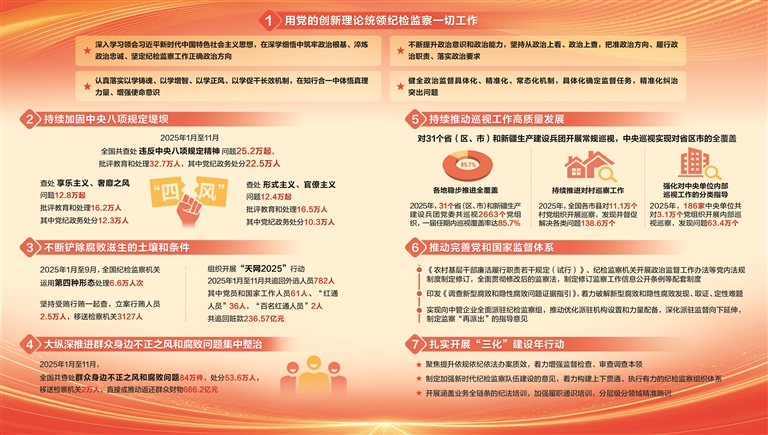
纪检监察机关明确监督重点、细化监督任务助力开好局起好步
Zhong Yang Ji Wei Guo Jia Jian Wei Wang Zhan· 2026-01-11 01:58
Group 1 - The focus of various regions in China is on improving the business environment as part of the "14th Five-Year Plan" initiatives, with clear commitments from provinces like Fujian and Liaoning to enhance their business climates [2][3][4] - Fujian's disciplinary inspection and supervision agencies are prioritizing the optimization of the business environment, employing targeted supervision strategies to address key issues affecting local enterprises [3][4] - Liaoning has established a closed-loop management mechanism for business environment supervision, addressing over 134,000 business-related issues and initiating more than 27,000 investigations into violations [4] Group 2 - Hainan is set to enhance its free trade port operations, with its disciplinary agencies focusing on the implementation of policies and projects that support economic growth and consumer confidence [5][6] - In Henan, the focus is on modernizing the industrial system, with local disciplinary agencies ensuring that supervision aligns with regional resources and industry characteristics [6] - Anhui's Bengbu city is addressing issues such as low-price competition and government procurement irregularities, aiming to improve operational efficiency and economic circulation [7] Group 3 - The central economic work meeting emphasizes innovation as a key driver for economic growth, with various provinces like Hubei and Jiangsu implementing strategies to foster innovation and technological advancement [8][9] - Hubei aims to become a hub for original innovation and talent, with its disciplinary agencies focusing on enhancing the supervision of technology transfer and talent services [8] - Suzhou is advancing its "AI + manufacturing" initiatives, with local disciplinary agencies embedding supervision into development strategies to optimize the innovation environment [9]
回眸2025 | 督在实处 查在要害 改在长效
Zhong Yang Ji Wei Guo Jia Jian Wei Wang Zhan· 2026-01-10 03:44
Core Viewpoint - Jiangsu Province is actively exploring and promoting the integration of inspection and supervision mechanisms to enhance the effectiveness of political inspections and ensure long-term rectification outcomes [1][2][12] Group 1: Inspection and Supervision Mechanism - The central government emphasizes the importance of rectification and the effective use of inspection results, requiring substantial improvements in rectification efforts [1][2] - Jiangsu has initiated a comprehensive inspection and rectification supervision system, aiming for full coverage and a closed-loop supervision structure to demonstrate the effectiveness of inspections [1][2][4] - The province has established a "five-in-one" work mechanism to enhance the systematic and collaborative nature of inspection and supervision tasks [4][11] Group 2: Challenges and Solutions - Existing challenges in rectification include diminishing responsibility pressure, inconsistent standards, and difficulties in sustaining results [2][14] - Jiangsu's approach includes targeted inspections of organizations that have not rectified issues for over a year, addressing the problem of declining accountability [14] - The province employs a combination of inspection and supervision to ensure continuous pressure and accountability, preventing superficial or false rectifications [3][14] Group 3: Evaluation and Assessment - Jiangsu has developed a unified evaluation system to assess rectification efforts, focusing on responsibility fulfillment, problem resolution, and public satisfaction [6][8] - The evaluation process includes various methods such as document review, on-site verification, and public surveys to gauge the effectiveness of rectification [5][8] - Results from evaluations are reported to higher authorities, ensuring accountability and prompting further actions for organizations with persistent issues [11][15] Group 4: Long-term Impact and Development - The rectification process is seen as a critical opportunity for reform and development, with a focus on addressing systemic issues that hinder high-quality growth [9][10][14] - Jiangsu's initiatives have led to significant improvements in local industries, such as the transformation of the lotus seed industry into a standardized and branded sector [9][10] - The province aims to integrate rectification efforts with practical work and deeper reforms, ensuring that issues are thoroughly resolved and not overlooked [16]