AI科技大本营

Search documents
对话阶跃星辰段楠:“我们可能正触及 Diffusion 能力上限”
AI科技大本营· 2025-05-20 01:02
Core Viewpoint - The article discusses the advancements and future potential of video generation models, emphasizing the need for deeper understanding capabilities in visual AI, moving beyond mere generation to true comprehension [1][5][4]. Group 1: Video Generation Models - The team at Jumpscale has open-sourced two significant video generation models: Step-Video-T2V and Step-Video-TI2V, both with 30 billion parameters, which have garnered considerable attention in the AI video generation field [1][12]. - Current diffusion video models, even at 30 billion parameters, show limited generalization capabilities compared to language models, but possess strong memory capabilities [5][26]. - The future of video generation models may involve a shift from mere generation to models that possess deep visual understanding, requiring a change in learning paradigms from mapping learning to causal prediction learning [5][20]. Group 2: Challenges and Innovations - The article outlines six major challenges in AI-generated content (AIGC), focusing on data quality, efficiency, controllability, and the need for high-quality data [39][32]. - The integration of autoregressive and diffusion models is seen as a promising direction for enhancing video generation and understanding capabilities [21][20]. - The importance of high-quality, diverse natural data is highlighted as a critical factor in building robust foundational models, rather than relying heavily on synthetic data [14][16]. Group 3: Future Predictions - Predictions indicate that foundational visual models with deeper understanding capabilities may emerge within the next 1-2 years, potentially leading to a "GPT-3 moment" in the visual domain [4][36]. - The convergence of video generation with embodied intelligence and robotics is anticipated, providing essential visual understanding capabilities for future AI applications [37][42]. - The article suggests that the future of AIGC will enable individuals to easily create high-quality content, democratizing content creation [38][48].


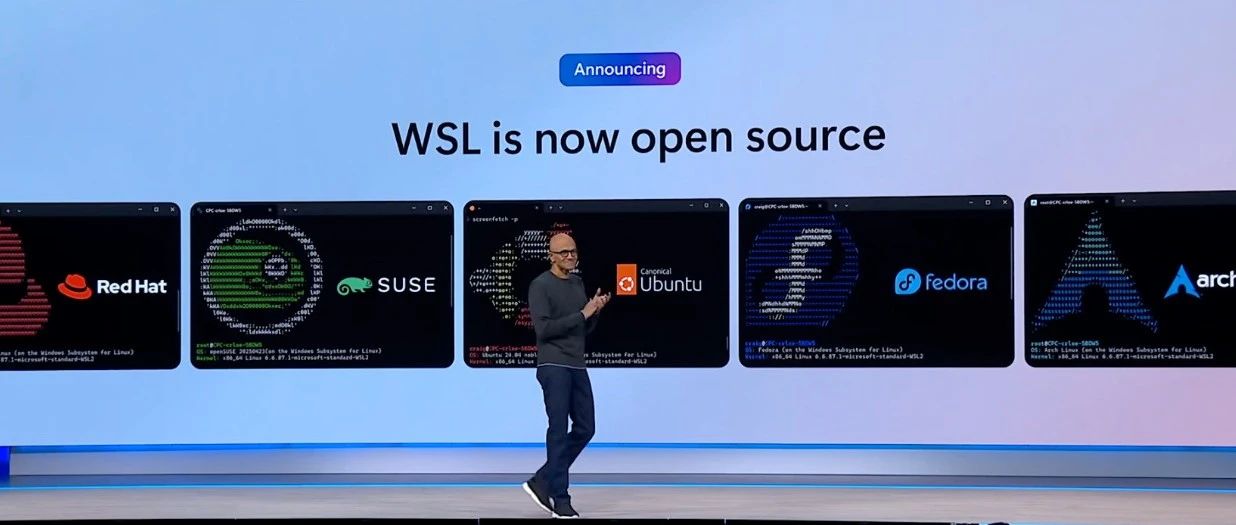
WSL、Copilot皆重磅开源,深夜炸场的微软给我们带来了哪些惊喜?
AI科技大本营· 2025-05-20 01:02
Core Viewpoint - Microsoft Build 2025 conference highlighted the company's strategic focus on AI and open-source technologies, showcasing significant advancements in developer tools and AI integration across its platforms [2][4][5]. Group 1: AI and Developer Tools - Microsoft emphasized AI as a crucial strategic direction, with significant updates to its developer tools, including Visual Studio and GitHub Copilot, which now has over 15 million users [6][10]. - The introduction of a new Coding Agent allows Copilot to evolve from a conversational assistant to a collaborative development partner, enabling developers to assign tasks directly to it [11][13]. - The Coding Agent can autonomously manage tasks such as opening pull requests and analyzing code, enhancing the development workflow [14][15]. Group 2: Microsoft 365 and Customization - Microsoft 365 platform received a comprehensive upgrade, introducing Microsoft 365 Copilot Tuning, which allows enterprises to customize AI agents based on their specific data and workflows [24][26]. - This customization aims to create tailored AI solutions that learn from company-specific communication styles and industry knowledge, streamlining the deployment process [27]. Group 3: AI Infrastructure and Performance - Microsoft is focusing on optimizing AI performance, efficiency, and cost across its infrastructure, with Azure becoming the first cloud platform to deploy NVIDIA's GB200 Grace Blackwell chips [59][62]. - The company is enhancing its AI capabilities by integrating various data services, allowing for more efficient data management and AI application development [55][56]. Group 4: Scientific Research and Discovery - Microsoft introduced the Microsoft Discovery platform, designed to revolutionize scientific research by providing AI-driven assistants that can conduct deep reasoning and hypothesis generation [65][66]. - This platform aims to significantly accelerate the discovery process in fields like materials science and pharmaceuticals, demonstrating the potential of AI in transforming traditional research methodologies [66].

图文跨模态“近视”问题破局:360开源新模型 FG-CLIP,实现细粒度图文对齐突破|ICML2025
AI科技大本营· 2025-05-19 08:05
Core Viewpoint - The article introduces the FG-CLIP model developed by 360 AI Research Institute, which significantly enhances fine-grained understanding in image-text alignment, overcoming limitations of the original CLIP model [4][10][40]. Group 1: FG-CLIP Model Overview - FG-CLIP can distinguish subtle differences in images, such as between "a man in a light blue jacket" and "a man in a grass green jacket," and can identify objects even when partially obscured [1][4]. - The model has been accepted at the AI conference ICML 2025 and is open-sourced [3][5]. - FG-CLIP addresses the core challenge of fine-grained alignment in image-text pairs, which was a limitation in previous models like CLIP [4][10]. Group 2: Technical Innovations - FG-CLIP employs an explicit dual-tower structure to achieve fine-grained alignment of image and text information [10]. - It utilizes a two-stage training strategy that includes global contrastive learning and regional contrastive learning, enhancing both overall and detailed understanding [16][18]. - The model innovatively constructs hard negative samples to improve its ability to discern subtle semantic differences [20]. Group 3: Performance Metrics - FG-CLIP outperforms existing models like CLIP and FineCLIP in various benchmarks, demonstrating superior local recognition and detail perception capabilities [10][29]. - In fine-grained understanding tasks, FG-CLIP achieved significant improvements, with scores of 46.4% in hard cases and 68.6% in easy cases, compared to lower scores from other models [30]. - The model also excelled in zero-shot testing on the COCO-val2017 dataset, showcasing its ability to classify objects based solely on text descriptions [31]. Group 4: Applications and Impact - FG-CLIP enhances various applications, including internet search, video recommendations, and office software, by improving the accuracy of image-text matching [11][12]. - The model's capabilities are crucial for advanced technologies such as multi-modal large language models and image generation models, which rely on effective image-text alignment [12][40]. - The open-source release of FG-CLIP aims to facilitate further research and industrial applications in the field of cross-modal understanding [10][40].


“图片秒生”,腾讯混元图像2.0模型正式发布,主打速度和真实感
AI科技大本营· 2025-05-16 08:16
Core Viewpoint - Tencent has launched the Hunyuan Image 2.0 model, which features real-time image generation and significantly improved image quality and interaction experience compared to its predecessor [1][3]. Group 1: Model Performance - The Hunyuan Image 2.0 model has increased its parameter count by an order of magnitude, utilizing a high-compression image codec and a new diffusion architecture, achieving millisecond-level response times for image generation [3]. - The model's image generation quality has improved, effectively avoiding the "AI flavor" commonly found in AIGC images, resulting in high realism and rich details [3][4]. - In the GenEval benchmark for complex text instruction understanding and generation, the model achieved an accuracy rate exceeding 95%, outperforming other similar models [4]. Group 2: User Experience - The model allows users to generate images while typing or speaking, transforming the traditional "draw-wait-draw" process into a more interactive experience [3][6]. - A real-time drawing board feature has been introduced, enabling users to see coloring effects as they sketch or adjust parameters, enhancing the creative process for professional designers [13]. Group 3: Future Developments - Tencent hinted at the upcoming release of a native multimodal image generation model, which will excel in multi-round image generation and real-time interaction [15].


“烧掉94亿个OpenAI Token后,这些经验帮我们省了43%的成本!”
AI科技大本营· 2025-05-16 01:33
Core Insights - The article discusses cost optimization strategies for developers using OpenAI API, highlighting a 43% reduction in costs after consuming 9.4 billion tokens in one month [1]. Group 1: Model Selection - Choosing the right model is crucial, as there are significant price differences between models. The company found a cost-effective combination by using GPT-4o-mini for simple tasks and GPT-4.1 for more complex ones, avoiding higher-priced models that were unnecessary for their needs [4][5]. Group 2: Prompt Caching - Utilizing prompt caching can lead to substantial cost savings and efficiency. The company observed an 80% reduction in latency and nearly 50% decrease in costs for long prompts by ensuring that variable parts of prompts are placed at the end [6]. Group 3: Budget Management - Setting up billing alerts is essential to avoid overspending. The company experienced a situation where they exhausted their monthly budget in just five days due to not having alerts in place [7]. Group 4: Output Token Optimization - The company optimized output token usage by changing the output format to return only position numbers and categories instead of full text, resulting in a 70% reduction in output tokens and decreased latency [8]. Group 5: Batch Processing - For non-real-time tasks, using Batch API is recommended. The company migrated some night processing tasks to Batch API, achieving a 50% cost reduction despite the 24-hour processing window being acceptable for their needs [8]. Group 6: Community Feedback - There were mixed reactions from the community regarding the strategies shared, with some questioning the necessity of consuming 9.4 billion tokens and suggesting that best practices should have been considered during the system design phase [9][10].

干货超标!腾讯混元3D负责人郭春超:真正的3D AIGC革命,还没开始!
AI科技大本营· 2025-05-16 01:33
Core Viewpoint - The article emphasizes that the true revolution of 3D AIGC (AI-Generated Content) has yet to begin, despite significant advancements in the technology [4][6]. Group 1: Current State of 3D AIGC - The current 3D AIGC technology has made notable progress, but it is still in its early stages compared to more mature text and image generation technologies [9][22]. - The development of 3D generation is rapidly evolving, with the industry only beginning to explore its potential in 2024 [22][20]. - The existing technology can generate static 3D models but faces challenges in integrating into professional-grade CG pipelines [9][12]. Group 2: Challenges in 3D Generation - There are significant challenges in data scarcity and utilization efficiency, as acquiring 3D data is much more difficult than images [9][32]. - The current 3D generation capabilities are limited, with a need for improvement in the efficiency and quality of generated assets [12][43]. - The industry must overcome hurdles related to the integration of AI into existing workflows, particularly in automating processes like topology and UV mapping [24][30]. Group 3: Technological Evolution and Future Directions - The evolution of technology is moving towards a combination of autoregressive models and diffusion models, which may enhance controllability and memory capabilities in 3D generation [9][36]. - The goal is to create a comprehensive 3D world model that can understand and generate complex scenes, requiring advancements in physical consistency modeling and spatial semantic coherence [19][40]. - By 2025, the aim is to achieve object-level generation that approaches the quality of manual modeling, with initial forms of scene generation [20][19]. Group 4: Open Source and Community Engagement - The open-source approach is seen as a critical catalyst for accelerating technological development and fostering a thriving ecosystem in the 3D AIGC space [9][28]. - Continuous model iteration and community feedback are essential for maintaining a competitive edge in the rapidly evolving field [33][34]. - The company plans to release more models and datasets to lower industry barriers and promote widespread adoption [19][20]. Group 5: Impact on Professionals and Industry - AI is positioned as a powerful productivity tool for 3D designers rather than a replacement, enabling faster realization of creative ideas [47][46]. - The integration of AI tools will likely transform the role of 3D designers into hybrid professionals who can effectively leverage AI alongside their creative skills [47][46]. - The potential for AI to democratize 3D content creation is acknowledged, but it is emphasized that professional expertise will still be valuable in high-stakes environments [26][47].

Visual Studio 重磅更新!擅长处理复杂任务的 GitHub Copilot “智能体模式”预览版上线
AI科技大本营· 2025-05-15 06:14
Core Viewpoint - GitHub Copilot's agent mode has officially launched in Visual Studio 17.14 preview, enabling developers to automate the entire development process from planning to testing and fixing with a single prompt [1][3]. Group 1: Features of Agent Mode - The agent mode allows Copilot to autonomously determine the context and files to edit without manual input [5]. - It generates terminal commands for user approval before execution [5]. - The mode continuously iterates until tasks are completed, checking for errors and validating results through builds and tests [5]. - It can call trusted tools in the development environment, such as linters, test runners, and static analyzers [5]. Group 2: User Experience and Interaction - Developers can switch to the "Agent" tab in the Copilot Chat window to provide high-level instructions [6]. - The agent mode is designed to handle complex tasks beyond simple code editing, making it suitable for intricate projects [9]. - The response time may be longer due to the detailed nature of the tasks, which involve multiple steps and context determination [9]. Group 3: Integration and Updates - The introduction of the Model Context Protocol (MCP) server allows Copilot to connect with external tools and data sources, enhancing its capabilities in complex scenarios [7]. - Microsoft plans to shift to a monthly release schedule for Copilot updates, ensuring more frequent and agile feature iterations [7].

破解百年数学难题,刷新算法认知!DeepMind 发布超级编码智能体 AlphaEvolve
AI科技大本营· 2025-05-15 06:14
【编者按】继 AlphaGo、AlphaFold 之后,谷歌 DeepMind 带来的全新 AI 编程智能体 AlphaEvolve 横空出世,它巧妙地结合了大型语言模型(LLM)的创 造力与自动化评估机制,不仅在矩阵乘法等经典数学问题上取得新突破,更在谷歌数据中心优化、芯片设计乃至 AI 自身训练等实际应用中展现出惊人实 力,为我们揭示了 AI 驱动算法发现的广阔前景。 整理| 梦依丹 出品丨AI 科技大本营(ID:rgznai100) 不仅是直接写代码,而是进化出的「解决方案」 与传统的代码生成工具不同,AlphaEvolve 并不追求"直接产出答案",而是像演化生物一样迭代出越来越优秀的解决策略。它的背后是 Google DeepMind 最新的大语言模型家族 Gemini——其中 Gemini 2.0 Flash 负责高效率生成大量思路,Gemini 2.0 Pro 则在关键节点提供更深层的方案优 化。 其核心能力有: 5 月 14 日,Google DeepMind 正式官宣推出 AlphaEvolve——一款由 Gemini 强力驱动、专注于算法发现的编码智能体。 这款全新的 AI 智能体, 堪称 ...


完全开源的7B模型,性能比肩主流LLM,训练成本仅16万美元,复现DeepSeek的强化学习!
AI科技大本营· 2025-05-14 09:31
Core Viewpoint - Moxin-7B represents a significant advancement in open-source AI, providing full transparency in its development process and outperforming many existing models in various tasks [2][23]. Group 1: Open Source Contribution - Moxin-7B is developed under the principle of "open-source science," offering complete transparency from data cleaning to reinforcement learning [2][5]. - The model includes publicly available weights, pre-training data, and code, enhancing accessibility for researchers and developers [7][23]. Group 2: Performance and Cost Efficiency - Moxin-7B achieved a zero-shot accuracy of 58.64% on the ARC-C challenge, surpassing LLaMA 3.1-8B (53.67%) and Qwen2-7B (50.09%) [9]. - The training cost for Moxin-7B was approximately $160,000, significantly lower than GPT-3's estimated $4.6 million [15]. Group 3: Technical Innovations - The model employs a three-stage pre-training strategy, enhancing its multi-task capabilities through instruction fine-tuning on 939K instruction data [10][19]. - Moxin-7B utilizes advanced techniques such as Grouped Query Attention (GQA) and Sliding Window Attention (SWA) to efficiently handle long contexts of up to 32K tokens [17]. Group 4: Comparative Performance - In various benchmarks, Moxin-7B-Enhanced demonstrated superior performance compared to other base models, achieving an average score of 75.44% across multiple tasks [20]. - The reasoning capabilities of Moxin-7B were highlighted, with a performance of 68.6% on MATH 500, outperforming several other models [21]. Group 5: Conclusion on Open Source Impact - Moxin-7B exemplifies the potential of open-source AI, providing a transparent and controllable AI solution for small and medium enterprises [22][23].

Ruby on Rails 之父 DHH 预言:未来“写代码”会变成不合时宜的念头!
AI科技大本营· 2025-05-14 09:31
Core Viewpoint - The article discusses the emerging concept of "Vibe Coding," which allows individuals to create software applications using AI tools without extensive programming knowledge, highlighting its potential to democratize software development and enhance productivity [1][9]. Group 1: Concept of Vibe Coding - "Vibe Coding" is introduced as a method where AI assists in coding, enabling users to develop applications quickly, as demonstrated by Andrej Karpathy's example of creating an iOS app in one hour without prior knowledge of Swift [1][3]. - The rise of AI-assisted coding tools, such as Cursor and Tencent's CodeBuddy, indicates a competitive landscape in the AI programming assistant market, enhancing developers' capabilities [3][4]. Group 2: Success Stories and Frameworks - Developers are sharing their success stories using Vibe Coding, with one user reporting a monthly recurring revenue (MRR) of $7,000 within 30 days of launching an AI product solely using AI tools [5][7]. - The "Vibe Coding entrepreneurial framework" is outlined as a simple process involving one AI tool for building, another for email outreach, and ChatGPT for market insights, showcasing a streamlined approach to product development [7][8]. Group 3: Perspectives on AI in Coding - David Heinemeier Hansson (DHH) emphasizes the importance of maintaining a human touch in coding, arguing that while AI can assist, it should not replace the joy of programming [11][15]. - The article presents contrasting views from developers, with some appreciating AI for alleviating repetitive coding tasks, while others express concern about losing the essence of coding as a creative endeavor [18][21]. Group 4: Market Implications and Future of Coding - The discussion highlights that AI is not just a tool but a new layer of abstraction in programming, suggesting that the future of coding may involve a blend of human creativity and AI efficiency [22]. - The potential of Vibe Coding to lower barriers for non-programmers to engage in software development is noted, indicating a shift towards a more inclusive tech landscape [24].