QYResearch

Search documents
我们坚信:每一个数据背后,都是一个待解的商业谜题
QYResearch· 2025-12-29 08:18
Core Viewpoint - Data is not merely for recording the past but serves as a key to understanding supply and demand changes, industry structure, and technology diffusion [1] Group 1: Market Research and Insights - The company provides standardized research and customized projects across multiple industries, continuously publishing structured insights and report highlights for easy reference [3] - A reusable path identified in past research involves reading demand direction from data slopes and adjusting rhythm and risk boundaries based on industry structure and technology diffusion speed [3] - The consumer-grade NAS market is expected to grow from $3.1 billion to $7.4 billion from 2023 to 2030, with a CAGR of 12.8%, indicating a high slope market suitable for expansion-driven investment [3] Group 2: Industry Trends and Recommendations - The ion liquid sector shows a "highly concentrated, steadily strengthening" structural characteristic, with a projected CAGR of 9.1% from 2025 to 2031, suggesting a focus on differentiated scenarios and localized services [4] - For sectors in the "S-curve acceleration phase," such as PAA negative electrode glue, a high-frequency monitoring approach is recommended to mitigate disturbances from technology and supply sides, with a CAGR of 26% from 2025 to 2031 [4] Group 3: Strategic Approaches - The company identifies three strategic prototypes: scaling, efficiency, and acceleration, with technology factors being crucial in reading market patterns [5] - The IoT operating system is projected to grow at a CAGR of 33.3% from 2024 to 2031, driven by the resonance of application readiness and ecosystem maturity, indicating a shift from pilot projects to scalable replication [5] Group 4: Service Offerings - The company offers a full-chain service from "problem to value," providing standardized industry reports that support rapid decision-making on market size, structure, competitive landscape, pricing, and risks [6] - Customized research, due diligence, feasibility studies, and IPO support are provided for various scenarios, ensuring actionable recommendations and templates for clients [6] Group 5: Research Methodology - The company emphasizes starting all analyses from business problems and falsifiable hypotheses, using multi-source evidence to stabilize conclusions and integrate them into business processes [7] - The approach includes causal identification and quasi-experimental design to elevate observable correlations to executable causations, ensuring consistency and comparability across industries [7] Group 6: Client Feedback and Practices - The company archives client feedback and service improvement mechanisms on its website, facilitating standardized citation and reference for enterprises in their reports [8] - A "Q&A case" section showcases systematic answers to typical industry questions, allowing clients to track long-term issues using the same metrics and assumptions [8] Group 7: Expert Insights - Analysts emphasize that data serves as clues rather than answers, with the responsibility to transform clues into evidence and actions, subject to market validation [9] - Observing data slopes, identifying concentration patterns, and assessing technology diffusion speeds are fundamental methods for translating data into market rules [9]


行业洞察:全球通用任务车(UTV)市场生产商排名及市场占有率
QYResearch· 2025-12-29 08:18
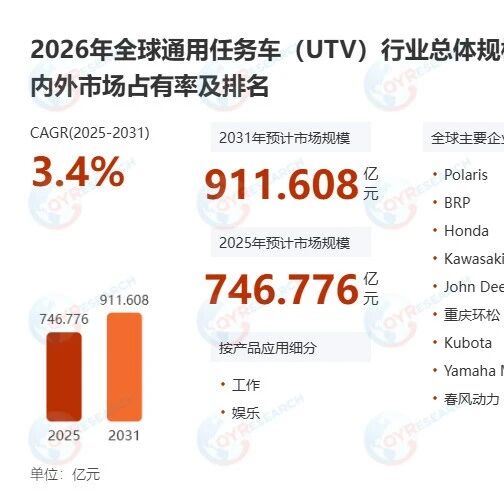
Core Viewpoint - The global Utility Task Vehicle (UTV) market is projected to reach $13.41 billion by 2031, with a compound annual growth rate (CAGR) of 3.4% in the coming years [4]. Market Size and Competitive Landscape - The UTV market is expected to grow significantly, with major manufacturers including Polaris, BRP, Honda, Kawasaki, John Deere, and others, where the top five companies hold approximately 75.0% of the market share by 2024 [9]. - Gasoline-powered UTVs dominate the market, accounting for about 85.4% of the product type share [11]. - The primary application for UTVs is in work-related tasks, which represent around 55.3% of the demand [13]. Market Drivers - The growth of the UTV market is driven by increasing demand for high-mobility, multifunctional transport tools in agriculture, construction, forestry, and industrial sectors [15]. - The popularity of outdoor recreational activities, such as off-roading, hunting, camping, and adventure tourism, is contributing to the rapid growth of leisure UTVs [15]. - Technological advancements, including improved suspension systems, enhanced safety features, smart connectivity, and the introduction of electric and hybrid models, are enhancing user experience and stimulating replacement demand [15]. - The acceleration of agricultural scaling and infrastructure development in emerging markets is further increasing the demand for durable and efficient work vehicles [15]. Major Barriers to Entry - The UTV industry has significant structural entry barriers, including high capital and technical thresholds for establishing compliant production lines and R&D systems, requiring initial investments in the hundreds of millions [16]. - Strict regulatory certification systems create entry obstacles, with varying safety standards and tightening emission regulations increasing compliance costs [16]. - Building a distribution network and brand recognition requires long-term investment, often taking 3-5 years, while existing brands have established user loyalty in specialized fields [16]. - The scale effect disadvantage is challenging to overcome, as mature manufacturers benefit from economies of scale, leading to sustained competitive advantages in cost control and product iteration speed [16]. Industry Development Opportunities - The UTV industry is experiencing multidimensional development opportunities, particularly with the electrification transition opening new application scenarios [17]. - The demand for engineering auxiliary vehicles is surging due to infrastructure construction along the "Belt and Road" initiative and in Southeast Asia, providing an export window for Chinese manufacturers [18]. - Innovations in smart connectivity technology are creating differentiated advantages, evolving UTVs from mere utility vehicles to "smart mobile workstations" [18]. - Policy support, such as mechanization subsidies for agricultural and forestry operations, is promoting the adoption of professional-grade UTVs in these sectors [18]. Entry Barriers - The UTV industry presents notable entry barriers, including high upfront capital requirements for vehicle R&D and manufacturing, as well as compliance with various regulatory standards [19]. - Established companies typically have advantages in scale production and stable supply chain systems, making it difficult for new entrants to compete effectively [19]. - Brand influence and distribution channels are critical competitive factors, with leading companies having extensive sales networks and service systems that are hard to replicate [19]. - Consumer expectations for vehicle reliability, durability, and safety create additional challenges for new entrants lacking technical expertise and market recognition [19].
行业洞察:全球自动 FOUP 清洗机市场生产商排名及市场占有率
QYResearch· 2025-12-29 08:18
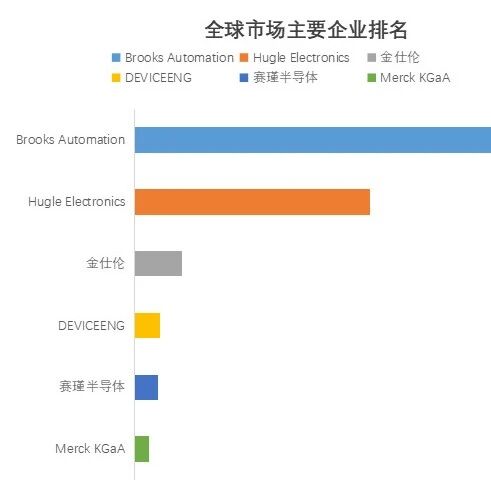
Core Viewpoint - The automatic FOUP cleaner is essential in the semiconductor manufacturing industry, ensuring the cleanliness of FOUPs to prevent contamination of wafers, thereby enhancing yield and reliability in semiconductor device production [2]. Market Overview - The global market for automatic FOUP cleaners is projected to reach $170 million by 2031, with a compound annual growth rate (CAGR) of 3.9% over the coming years [3]. - Major manufacturers in the global automatic FOUP cleaner market include Brooks Automation, Hugle Electronics, Jinsun, DEVICEENG, and Sijun Semiconductor, with the top four companies holding approximately 92.0% of the market share in 2024 [6]. - Fully automatic FOUP cleaners dominate the product segment, accounting for about 91.9% of the market [7]. - The Integrated Device Manufacturer (IDM) sector is the primary source of demand, representing approximately 71.4% of the market [10]. Market Drivers - The increasing stringent cleanliness requirements in semiconductor manufacturing are driving the demand for automatic FOUP cleaners, as even minor contaminants can lead to defects or failures in wafers [13]. - The trend towards automation and smart upgrades in semiconductor factories is propelling the need for automatic FOUP cleaners, which can seamlessly integrate with automated material handling systems [13]. - The expansion of semiconductor capacity and advancements in technology are necessitating high-performance cleaning equipment to support large-scale and precise wafer manufacturing [13]. - There is a growing emphasis on the lifecycle management of FOUPs, as their cleanliness directly impacts their lifespan and reliability, further driving the market for automatic FOUP cleaners [14]. Market Challenges - High technical barriers and complex R&D requirements pose significant challenges for companies in developing automatic FOUP cleaners, necessitating long-term investment and expertise [15]. - Compliance with stringent industry standards and the need for customized solutions increase the costs and complexity of product development and delivery [15]. - Supply chain risks and high cost pressures arise from reliance on specialized suppliers for critical components, which can be affected by geopolitical factors and material price fluctuations [16]. - The demand for rigorous after-sales service and technical support is high, but the shortage of professionals with cross-disciplinary knowledge in semiconductor processes and automation limits market expansion [16].
中国汽车ABS和ESC系统市场现状研究分析与发展前景预测报告
QYResearch· 2025-12-29 08:18
Core Viewpoint - The article discusses the current status and future trends of the automotive ABS (Antilock Brake System) and ESC (Electronic Stability Control) systems in the Chinese market, highlighting the transition from traditional mechanical braking to electronic and intelligent systems, driven by regulatory requirements and technological advancements [3][10][14]. Market Development Status and Future Trends - The revenue from the automotive ABS and ESC systems in China is projected to reach 12.31 billion yuan in 2024, with an expected decline to 6.022 billion yuan by 2031, indicating a compound annual growth rate (CAGR) of -10.10% from 2025 to 2031 [3]. - The market is experiencing a shift towards electronic hydraulic brake (EHB) systems, particularly the One-Box solution, which integrates multiple functions and is expected to penetrate the market significantly, with over 10 million units installed by 2024 [10][13]. Industry Concentration and Competition Analysis - Major players in the Chinese market include Bosch, Continental, ZF, Aisin, and others, with the top three companies holding approximately 65.25% of the market share in 2024 [7]. Technological Evolution - The transition from traditional hydraulic braking to ABS and ESC systems has been rapid, with ESC installation rates exceeding 90% in new passenger vehicles since 2020 [10]. - In the commercial vehicle sector, the market is primarily dominated by pneumatic braking systems, with a projected EBS penetration rate of 80% by 2025 for key models [11][12]. Driving Factors - Regulatory requirements are a significant driver, with ABS and ESC becoming mandatory for all new passenger and commercial vehicles in China [14]. - The growth in vehicle ownership and sales, particularly in the new energy vehicle segment, is expanding the market for ABS and ESC systems [15]. - The development of intelligent driving and ADAS (Advanced Driver Assistance Systems) is increasing the demand for enhanced vehicle dynamic control systems [16]. Constraints - The industry faces challenges such as reliance on imported high-end chips and core technologies, which creates barriers for domestic manufacturers [18]. - Intense price competition and the pressure on suppliers to reduce costs are compressing profit margins and limiting R&D investments [19]. - The lengthy certification process for new products poses significant entry barriers for new players in the market [20]. Supply Chain Analysis - The supply chain for automotive ABS and ESC systems includes upstream suppliers of raw materials, midstream manufacturers who integrate and assemble the systems, and downstream customers, primarily automotive OEMs [28][29]. - Key components of ABS and ESC systems include electronic control units (ECUs), hydraulic control units (HCUs), and various sensors, with a focus on technological integration and system performance [29][32].

行业洞察:全球旅行箱市场生产商排名及市场占有率
QYResearch· 2025-12-26 03:20
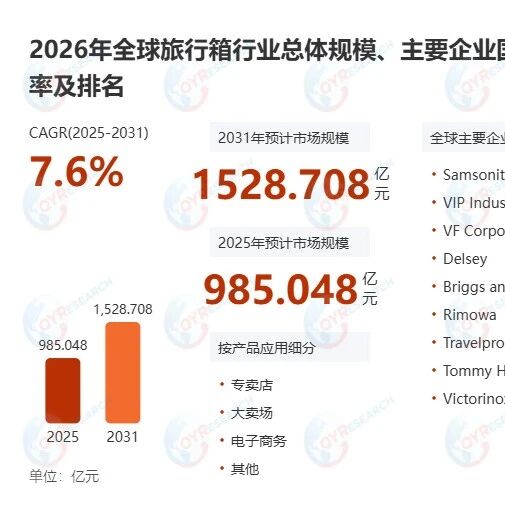
Core Viewpoint - The global suitcase market is projected to grow significantly, with a compound annual growth rate (CAGR) of 9.0%, reaching a market size of $19.93 billion by 2031, driven by factors such as the recovery of global travel and increasing consumer demand for quality and branded products [6][19][20]. Market Overview - In 2024, the global production of suitcases is estimated to be approximately 208.67 million units, with an average market price of $62.1 per unit [2]. - The top five manufacturers, including Samsonite, Rimowa, and Louis Vuitton, hold about 42.3% of the market share [8]. - Hard-shell suitcases dominate the product type segment, accounting for approximately 88.6% of the market share [10]. Application and Demand - Professional retailers are the primary source of demand, representing about 33.1% of the market [12]. Industry Trends - **Lightweight and Material Upgrades**: The industry is transitioning from traditional materials like ABS and PVC to advanced materials such as PC, aluminum-magnesium alloys, and composite materials, focusing on lightweight, high strength, and impact resistance [14]. - **Smart Features and Function Integration**: Features like smart locks, GPS tracking, and USB charging are becoming common, catering to frequent travelers' needs for security and convenience [15]. - **Design and Scenario Segmentation**: Products are evolving from generic suitcases to specialized designs for various scenarios, including business, long-distance travel, and outdoor use, with aesthetics becoming a key differentiator [17]. - **Sustainability and Environmental Trends**: The use of recyclable materials and eco-friendly manufacturing processes is increasing, with brands appealing to younger consumers through sustainability narratives [18]. Market Drivers - The recovery of international and domestic travel is driving demand for new and updated luggage, particularly in high-frequency travel scenarios [19]. - The expansion of the middle class is leading consumers to prioritize quality, design, and brand reputation, resulting in a willingness to pay a premium for durable and aesthetically pleasing products [20]. - The growth of e-commerce and cross-border channels is lowering entry barriers for brands and accelerating the time-to-market for new products [21]. - There is a noticeable demand for personalized and scenario-specific products, prompting manufacturers to diversify their product lines [22]. Market Challenges - **Raw Material and Cost Pressures**: Fluctuations in the prices of materials like PC resin and aluminum, along with rising labor and logistics costs, are compressing profit margins for manufacturers [23]. - **Product Homogeneity Competition**: The low entry barriers in the mid-to-low-end market lead to rapid imitation of designs and features, resulting in intense price competition [24]. - **Rising Channel and Marketing Costs**: Increasing online traffic costs and platform commissions are making customer acquisition and retention more challenging, particularly for smaller brands [25]. - **Compliance and Quality Risks**: Variations in safety and environmental regulations across countries increase quality control costs and risks associated with product recalls [26].
中国蛋白胨市场前景预测报告(产业链上下游分析)
QYResearch· 2025-12-26 03:20
Core Viewpoint - Peptone is widely used as a major nutrient component in culture media, promoting cell proliferation and production, with its raw materials including meat, casein, whey, gelatin, soy, yeast, and grains [2][4]. Summary by Sections 1. Peptone Market Overview - The Chinese peptone market is projected to reach 411 million yuan in 2024 and 620 million yuan by 2031, with a compound annual growth rate (CAGR) of 4.98% [4]. - Peptone serves as an important nitrogen source in microbial culture, with applications in antibiotics, vaccines, recombinant proteins, and fermentation products [8]. 2. Peptone Classification and Characteristics - Peptone is categorized into three types: animal peptone, plant peptone, and yeast peptone, each with unique properties based on the source and quality of the starting protein material [3][8]. - Animal peptone accounts for 37.01% of total consumption in 2024, with challenges in availability, cost fluctuations, and animal-source risks leading to a relative decline in demand [9]. 3. Industry Concentration Analysis - The Chinese peptone market is highly concentrated, with the top five suppliers accounting for 62.05% of sales in 2024. Angel Yeast is the largest supplier, offering a range of products across various applications [10]. 4. Peptone Industry Chain Analysis - The upstream of the peptone industry includes raw materials such as meat, casein, whey, gelatin, soy, yeast, and grains, with animal peptone being the most widely used [15][16]. - The midstream consists of manufacturing enterprises that prepare nitrogen sources from different origins, with a notable reliance on imported high-end peptone technologies [19][20]. 5. Downstream Applications - Downstream applications of peptone are concentrated in pharmaceuticals, food, cosmetics, and research, with high-end pharmaceutical companies requiring high quality and batch consistency [21]. - The market shows a diverse landscape with high-value products and a focus on process stability, indicating a robust demand across various sectors [21].


以多元团队驱动全球洞察,构建无国界的商业智慧生态
QYResearch· 2025-12-26 03:20
Core Viewpoint - QYResearch emphasizes the importance of a diverse and inclusive team structure as a competitive advantage in the global consulting industry, enabling the company to provide precise insights to clients across over 150 countries and regions [1][8]. Group 1: Diverse Team Composition - QYResearch is committed to building a diverse team, recognizing that employees from various cultural, gender, and professional backgrounds contribute to richer perspectives and creativity [3]. - The company has a female employee ratio of 55%, with over 40% of management positions held by women, significantly exceeding the industry average of approximately 28% [3]. - The team includes a mix of "Generation Z" digital natives (ages 25-35) and senior industry researchers (50+ years), fostering collaboration between experience and innovation [3]. Group 2: Inclusive Corporate Culture - QYResearch promotes an inclusive culture where every employee can find their place and achieve personal career development, emphasizing respect and recognition in a diverse environment [5]. - The company has implemented various inclusive policies, such as flexible working hours, remote work options, and diverse career development paths, supporting employees in balancing work and life [5]. Group 3: International Perspective - QYResearch has established a strong global business network, with regional centers in countries like the USA, Canada, Germany, Portugal, Japan, South Korea, and India, employing a mix of local talent (60%) and expatriate experts (40%) [7]. - The company regularly organizes cross-national team collaboration projects to enhance communication and cooperation among team members from different regions [7]. Group 4: Defining the Future of Research Institutions - QYResearch asserts that a diverse team is not merely a "politically correct" label but a "superconductor" for business insights, enabling the company to provide accurate market analysis and strategic advice in a complex market environment [8]. - The company fosters an open, respectful, and supportive work environment, allowing employees to leverage their strengths and achieve personal career goals [8]. Group 5: Future Commitment - QYResearch aims to continue promoting diversity and inclusion while expanding its international business to provide exceptional market research for global clients [9].

行业洞察:全球商用无人机市场生产商排名及市场占有率
QYResearch· 2025-12-26 03:20
Core Viewpoint - The commercial drone industry is characterized by its ability to perform specialized tasks efficiently and cost-effectively, making it a crucial component of the digital and intelligent industrial upgrade [2]. Global Market Size and Share - The global commercial drone market is projected to reach USD 1.62 billion by 2031, with a compound annual growth rate (CAGR) of 8.6% over the coming years [5]. - Major manufacturers in the global commercial drone market include DJI, Autel Robotics, Wingtra, Parrot, and Quantum-Systems, with the top four companies holding approximately 37% market share in 2024 [6]. Industry Chain Analysis - **Upstream**: Key components and raw materials include flight control systems, power systems, sensors, and communication modules, with flight control and power systems accounting for 30%-40% of the overall cost. Domestic companies are making progress in areas like flight control chips and composite materials, although high-performance sensors still rely on imports [7]. - **Midstream**: This segment involves the design, research, and production of various types of drones, with leading companies driving technological advancements. The production model shows a concentration of leading firms and regional clusters, particularly in Guangdong and Jiangsu [8]. - **Downstream**: Applications have expanded from traditional agriculture and surveying to include security, power inspection, emergency rescue, logistics, and aerial photography. The market is seeing a shift towards integrated solutions combining hardware, software, and data services [9]. Policy Analysis - **U.S. Policy**: The FAA is the primary regulatory body, focusing on easing restrictions for beyond visual line of sight (BVLOS) operations to unlock commercial potential. New regulations are expected to be fully implemented by 2026 [12]. - **EU Policy**: The EASA has established a risk-based regulatory framework, requiring CE certification for drones starting in 2024. The EU is also investing in technological innovation and data privacy protection [13]. Industry Development Trends - The integration of AI, 5G/6G communication, and high-precision sensors is enhancing drone capabilities, while breakthroughs in hydrogen fuel cells and lightweight materials are addressing limitations in endurance and payload [14]. - The market is shifting from traditional applications to high-value areas like low-altitude logistics and urban air mobility, transforming the industry from a tool-based to an infrastructure-based model [15]. Development Opportunities - Upstream advancements in power technologies and lightweight materials are expected to open up further opportunities for domestic component replacement. The low-altitude logistics sector is poised for significant growth, with new operational routes being established [16]. - Policy incentives and the establishment of low-altitude economic zones are facilitating commercial drone operations, while integrated service models are becoming the competitive core of the industry [17].

解密高客户忠诚度:为何90%的回头客选择持续购买QYResearch的研究服务?
QYResearch· 2025-12-25 10:07
Core Insights - The article emphasizes the importance of customer retention rate as a key indicator of service quality and core value, highlighting QYResearch's impressive 90% customer repurchase rate as a case study for understanding the underlying business logic [1]. Group 1: Excellent Research Service System - High customer retention is built on exceeding customer expectations through a robust service experience, characterized by a global service network, flexibility, and professionalism [3]. - QYResearch has established a global presence with offices in Los Angeles and Beijing, enabling a 7x24 hour service commitment that ensures timely responses for clients in critical situations [4]. - The company offers deep customization and flexible solutions tailored to specific client needs, allowing for in-depth market analysis and proactive insights that enhance client satisfaction [5]. - QYResearch's service philosophy prioritizes customer success, maintaining close communication throughout the research process to ensure that outcomes effectively address client challenges [6]. Group 2: High-Value Data - High-quality data is essential for empowering business decisions, with QYResearch implementing strict quality control measures to ensure data accuracy and reliability [7]. - The company boasts a vast database with over 90 million pieces of information and 500,000 company records, which supports its ability to deliver reliable data for strategic decision-making [8]. - QYResearch covers a wide range of industries while focusing on niche markets, providing detailed insights that are often overlooked by larger consulting firms, thus offering significant value to clients [9]. - The authority and practical application of QYResearch's reports are evidenced by their use in critical business decisions by well-known companies, demonstrating the tangible benefits of their data [10]. Conclusion - The combination of exceptional service and high-value data creates a strong barrier to entry, resulting in a 90% customer loyalty rate for QYResearch, driven by a customer-centric approach and a commitment to quality [11].

医疗润滑涂层市场展望:增长趋势、驱动因素与未来机遇(附主要厂商介绍)
QYResearch· 2025-12-25 10:07
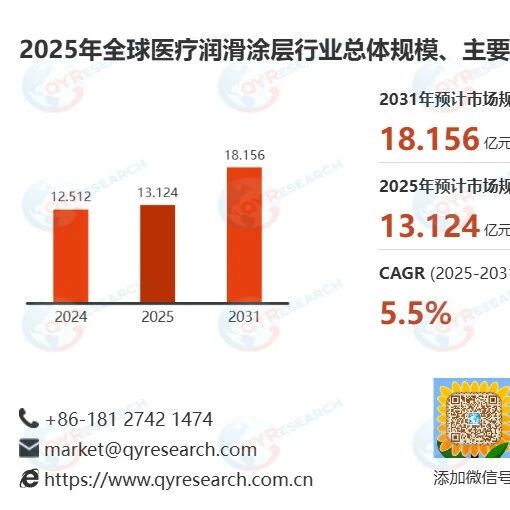
Global Market Overview - The global medical lubricating coatings market is projected to reach a capacity of approximately 520 tons and a production volume of about 400 tons by 2024, with an average market price of around $462 per kilogram and an industry gross margin of about 28% [1] - The market size is expected to grow to $280 million by 2031, with a compound annual growth rate (CAGR) of 5.53% over the coming years [1] Major Manufacturers - Key global manufacturers of medical lubricating coatings include DSM-Firmenich, Surmodics, Harland Medical Systems, Biocoat, and Teleflex Medical OEM, which together are expected to hold about 32% of the market share in 2024 [3][4] Industry Chain Analysis Upstream - The upstream segment involves the research and production of raw materials and core technologies, including coating material monomers, polymer resins, and functional additives, which must meet high biocompatibility and purity standards [10] Midstream - The midstream segment focuses on coating technology development, formulation design, and processing services, converting upstream raw materials into applicable coating solutions for medical devices [11] Downstream - The downstream segment consists of the final application and market endpoints for coating products, primarily involving various manufacturers of interventional medical devices, where coating performance directly impacts device safety and surgical success rates [12] Industry Trends - The trend towards functional integration and smart development in coatings is evident, with next-generation coatings combining therapeutic functions such as antibacterial and drug-eluting capabilities [13] - There is a focus on biomimetic and long-lasting breakthroughs to enhance biocompatibility and durability, mimicking natural tissue properties [13] - Coating technologies are adapting to new devices and precision medicine, particularly in minimally invasive surgeries and biodegradable implants [13] Opportunities - The rapid increase in the minimally invasive surgery market is driving demand for high-performance interventional devices, creating a core incremental market for lubricating coatings [14] - Policy support and a window for domestic substitution in high-growth markets like China present opportunities for local companies to develop proprietary lubricating coatings [14] - Continuous expansion into emerging application areas such as ophthalmology, aesthetics, and orthopedics is opening new high-value niche markets for lubricating coatings [14] Challenges - Stringent regulations and lengthy clinical validation cycles pose significant challenges, as lubricating coatings must undergo rigorous registration processes [15] - Long-term stability and performance evaluation of coatings in complex biological environments remain critical issues [15] - Supply chain pressures and production cost control are significant challenges, especially with high material costs and the need for specialized manufacturing environments [15] Barriers to Entry - Regulatory and certification barriers require companies to establish comprehensive quality management systems compliant with international standards [16] - Core technology patents and process know-how create significant barriers, as leading companies protect their innovations through extensive patent networks [16] - Customer loyalty and supply chain access barriers exist, as large medical device companies tend to maintain deep, long-term relationships with their coating suppliers [16]