QYResearch

Search documents
英伟达统治AI时代:下游产业的算力革命与万亿机会
QYResearch· 2026-02-19 02:03
过去三年, 英伟达(NVIDIA)已成为全球科技产业的核心驱动力 。2025财年,公司全年营收突破约 1300 亿美元 ,数据中心业务占比接近 90% ,毛利率维持在 70%–75% 区间。Blackwell GPU 和相关平台成为推动这轮 AI 基础设施升级的主要引擎。 这意味着下游行业——从云服务到企业 IT、从软件平台到终端应用——正在围绕这股算力浪潮重新定义其架构、投资与商业模式。 一、英伟达营收与算力扩张的下游拉动机制 数据中心业务的爆发式增长 英伟达数据中心业务是其增长核心: 2025 财年数据中心营收约 115.2 亿美元 ,同比增长 142% 。 Blackwell 架构单季曾贡献约 110 亿美元营收 ,是公司历史上最快的产品销售增长纪录。 在多个季度中,数据中心收入占比一度超过 88%~90% 。 Blackwell GPU 贡献了数据中心业务约 70% 的计算收入 。 这些数字说明,英伟达的增长几乎完全由 AI 计算需求驱动,而这种需求本质上来自下游企业对大规模模型训练、实时推理、AI 工厂和智能应用的投 入。 下游需求爆发背后的三大趋势 1. 算力成为生产力基础设施 下游企业不再把 A ...



2026迎新展望:在产业的风浪里,把路走稳(QYResearch石家庄分部)
QYResearch· 2026-02-15 02:08
Group 1 - The article emphasizes the continuous evolution and rapid changes in various industries such as electronics, new energy vehicles, advanced materials, photovoltaics, medical devices, food and pharmaceuticals, and agriculture, highlighting the importance of adapting to these changes [4] - QYResearch conducts thorough research, including writing reports, data verification, and model simulations, to ensure reliable and accurate information for investment decisions and corporate strategies [4][5] - The company operates with teams across different countries and cities, facilitating discussions on market sizes, competitive dynamics, and potential risks, ultimately achieving consensus through collaborative efforts [4] Group 2 - As the year ends, the article reflects on the inevitability of market fluctuations and industry reshuffling, with a focus on deepening research and refining data accuracy to navigate future challenges [5] - QYResearch, established in 2007, has grown significantly over 19 years, with headquarters in Los Angeles and Beijing, indicating its long-term commitment to industry analysis and consulting [6]

AI 赋能药物研发:从“慢研发”到“快未来”
QYResearch· 2026-02-15 02:08
Core Viewpoint - AI is not a bystander in drug development but is reshaping the industry's rules as a core force, exemplified by Takeda's strategic partnership with Iambic Therapeutics worth up to $1.7 billion to accelerate small molecule drug discovery [2][10]. Group 1: Need for AI in Pharmaceutical R&D - Traditional drug development is one of the most expensive and slowest innovation tracks, with an average development cycle of 10-15 years and costs reaching $1.5-2 billion [4]. - Each stage of the process, from laboratory to clinical trials and regulatory approval, carries a high risk of failure, with 90% of candidate drugs ultimately failing to gain approval [4]. Group 2: Core Value of AI in Drug Discovery - AI significantly shortens the research and development timeline, reducing candidate molecule identification from years to months or even weeks [5]. - In certain optimization scenarios, AI can cut the time to develop a compound to the preclinical stage by 40-50% [5]. - Iambic claims that combining AI with automated laboratory processes can reduce the preclinical phase from approximately 6 years to less than 2 years, marking a shift from "slow R&D" to "fast innovation" [5]. Group 3: Cost Reduction through AI - AI-driven research platforms can lower R&D costs by 30-50% [6]. - By 2030, the overall cost of new drug development is expected to decrease from about $2.6 billion to $1.2 billion [6]. - 65% of pharmaceutical companies report direct cost savings from AI implementation [6]. Group 4: Improved Success Rates and Predictive Capabilities - AI-driven candidate drugs have a 25% higher success rate in the preclinical phase [7]. - The success rate for AI-designed drugs in Phase I clinical trials can reach 80-90%, compared to the traditional rate of about 50% [7]. - AI's predictive capabilities cover over 200 million known proteins, significantly reducing the difficulty of target identification [7]. Group 5: Market Trends and Digital Transformation - The global AI drug discovery market is projected to grow from approximately $4 billion in 2022 to over $36 billion by 2030, with a compound annual growth rate of about 32% [9]. - By 2025, around 70% of drug discovery processes are expected to utilize AI tools [9]. - Over 90% of pharmaceutical companies have developed AI strategies, a significant increase from 55% a few years ago [9]. Group 6: Leading Companies in AI and Pharmaceutical R&D - Takeda Pharmaceutical is actively transforming through AI, having signed a $1.7 billion partnership with Iambic Therapeutics to accelerate small molecule drug discovery [10]. - Eli Lilly, with projected revenues of approximately $65.2 billion in 2025, integrates AI with extensive clinical and drug property data through its internal TuneLab platform [11]. Group 7: Transformation of Traditional Enterprises - The collaboration between Takeda and Iambic is indicative of a broader trend where large pharmaceutical companies are enhancing AI capabilities and training employees in AI skills [12]. - AI drug design companies are receiving substantial capital support to deepen the integration of algorithms and laboratory processes [12]. Group 8: AI Leading a New Era in Drug Development - AI is transforming pharmaceutical R&D from lengthy cycles to efficient processes, from high investment to intelligent cost reduction, and from experience-driven to data-driven approaches [13]. - The $1.7 billion partnership is part of a larger trend in the global pharmaceutical industry, where digital transformation is becoming essential for survival and innovation [13].



立足南宁,展望世界——QYResearch南宁组办公室展望2026年发展新机遇
QYResearch· 2026-02-14 00:48
Core Insights - The article discusses the profound changes in the global economic landscape by 2026, highlighting the growth of emerging market demand and the deepening of regional economic cooperation, while companies face challenges such as supply chain regionalization, accelerated technological iteration, and intense market competition [1]. Group 1: QYResearch's Strategic Focus - QYResearch aims to enhance its regional research capabilities and international market service capabilities, with the Nanning office playing a crucial role in the overall strategic layout of enterprises [1][3]. - The Nanning office has established a stable network of industrial information sources through collaboration with local manufacturing enterprises, industrial parks, research institutions, and industry associations, providing essential data support for global research projects [3][4]. Group 2: Development Plans for 2026 - In 2026, QYResearch will continue to promote the "global research network + regional in-depth research" development model, focusing on three key areas: ASEAN market research capability building, regional industrial research capability enhancement, and cross-border research collaboration and service capability construction [4][5]. - The Nanning office will strengthen its tracking of Southeast Asian manufacturing, energy equipment, infrastructure equipment, consumer electronics, and new materials industries, gradually forming a specialized research system for the ASEAN industrial chain [4]. Group 3: Talent Development and Long-term Vision - The Nanning office will continue to promote local team building and talent cultivation, leveraging local university resources and regional talent advantages to enhance researchers' comprehensive capabilities in industry analysis, data modeling, and international market research [5]. - Nanning is positioned to become a research and information hub connecting the ASEAN market, playing a more significant regional support role in the company's global research system as regional economic cooperation deepens [6].

凝心聚力共筑梦,策马扬鞭启新程——QYResearch大同组
QYResearch· 2026-02-14 00:48
Group 1 - The core theme of the 2026 Spring Festival activities organized by QYResearch Datong Group is "Reunion and Growth, Moving Forward Together" [4] - The activities included office decoration and a hot pot gathering, aimed at fostering team spirit and reflecting on past achievements while looking forward to future goals [4][6] - The office decoration involved collaborative efforts from all team members, creating a festive atmosphere that symbolizes unity and teamwork [4][6] Group 2 - The hot pot gathering served as a platform for team members to share experiences, discuss challenges, and celebrate their collective achievements over the past year [6] - Notable accomplishments included the promotion of two team members to C5 analysts and the division manager to C9 analyst, highlighting the effectiveness of teamwork and individual dedication [6][7] - The division manager emphasized the importance of maintaining a collaborative spirit and supporting each other in the upcoming year to achieve further success [7] Group 3 - The activities not only conveyed New Year wishes but also strengthened team bonds and clarified future directions for the QYResearch Datong Group [7] - The company aims to continue fostering unity and mutual support as it moves forward, with aspirations for greater achievements in the new year [7] - QYResearch, established in 2007, has grown significantly over 19 years, with headquarters in Los Angeles and Beijing, indicating its strong presence in the consulting industry [8]

全球制造的隐形命脉:关键矿产谁主沉浮?
QYResearch· 2026-02-14 00:48
Group 1 - Critical minerals are essential for new energy, high-end manufacturing, and strategic industries, including lithium, cobalt, nickel, tungsten, and rare earth elements [1] - The global critical minerals market is projected to reach approximately $142 billion by 2025 and $213 billion by 2030, with a CAGR of about 8.5% from 2025 to 2030 [3] - Lithium, cobalt, and nickel account for 55% of the market, driven mainly by the demand from electric vehicle batteries and energy storage [3] Group 2 - China is the most complete supply chain country for critical minerals, with lithium production expected to reach 280,000 tons (lithium carbonate equivalent) by 2025, accounting for about 50% of global production [4] - The demand for critical minerals in downstream applications such as new energy vehicles, energy storage, and smart manufacturing is increasing, leading to higher material content per vehicle or component [4][6] - The global sales of new energy vehicles are expected to reach approximately 22 million units by 2025, with energy storage systems projected to have an installed capacity of 200 GWh [6] Group 3 - The critical minerals industry chain consists of three core segments: upstream (mining and initial beneficiation), midstream (refining and alloying), and downstream (applications) [5] - China holds about 35-50% of global critical mineral reserves and 85-90% of rare earth separation capacity, making it a key processing center [5] - The refining cost of high-nickel battery materials accounts for about 15-20% of the total cost of electric vehicle batteries [5] Group 4 - Major companies in the critical minerals sector include China Northern Rare Earth Group, Rongjie Resources, Tianqi Lithium, and others, with projected revenues for 2025 ranging from approximately 45-48 billion RMB for China Northern Rare Earth Group to 2-3 billion USD for MP Materials [7] - Global efforts are underway to localize critical mineral supply chains, with initiatives from the US, EU, and India to enhance midstream refining and downstream processing capabilities [7] Group 5 - Future industry trends include breakthroughs in high-purity material technology, scaling up critical mineral recycling, and increasing the value of mid-heavy rare earths and high-nickel materials [8] - The strategic importance of critical minerals in high-end manufacturing and new energy industries positions supply chain leaders for competitive advantages in the global market [9] - Companies should focus on enhancing midstream refining technology, developing high-value downstream applications, and exploring recycling and value extraction of mid-heavy minerals for sustainable supply chains [9]



白酒稳基盘、低度酒寻增量:中国酒类市场的结构分化与投资机会
QYResearch· 2026-02-14 00:48
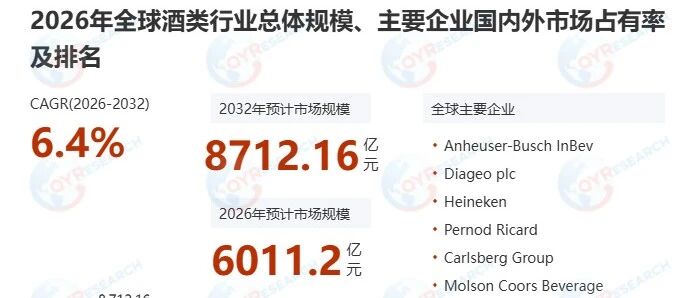
Core Insights - The Chinese alcoholic beverage market is projected to reach USD 254.1 billion by 2032, with a CAGR of 6.63% during the forecast period [2] - The market is highly concentrated, with baijiu (Chinese liquor) expected to account for 78.57% of revenue by 2025, significantly higher than beer (11.22%) and other categories [2] Market Structure - Baijiu dominates the market, while beer is experiencing a shift towards premiumization and craft options, and low-alcohol/no-alcohol products are gaining traction among new consumer demographics [2] - The structure indicates that the base of the market is determined by baijiu, but growth and structural changes are driven by the premiumization of beer and the penetration of low-alcohol products [2] Technical Features and Product Classification - The alcoholic beverage industry is characterized by a combination of raw material systems, fermentation/distillation processes, aging systems, blending capabilities, and packaging/channel adaptation, which ultimately contribute to brand premium and price segmentation [5] - Baijiu is defined by solid-state fermentation and aging techniques, leading to high margins and strong brand characteristics, but also slower capacity ramp-up and sensitivity to inventory and pricing [5] - Beer is the most industrialized, focusing on scale and channel efficiency, with recent competition shifting towards high-end and craft products [5] Competitive Landscape - The Chinese market shows a concentration in baijiu, with leading companies like Kweichow Moutai and Wuliangye dominating the high-end segment, while regional players seek growth through local market penetration [7] - The beer market is characterized by competition among major players like Tsingtao Brewery and China Resources Snow Breweries, focusing on product upgrades and channel penetration [8] - The wine and yellow wine markets are smaller, where brand and channel efficiency are more critical than scale [9] Future Trends and Challenges - Over the next 3-5 years, the market is expected to stabilize with baijiu, while beer will focus on premiumization and low-alcohol/no-alcohol products will drive growth [17] - Challenges include consumer segmentation, price pressure, raw material cost fluctuations, and stricter regulatory requirements [20]
北京总部发布年终总结:协同共进、互助同行,携手全球团队迈向新征程
QYResearch· 2026-02-13 09:30
Core Viewpoint - The company emphasizes the importance of collaboration and strategic alignment between its Beijing headquarters and global offices, which has led to significant progress in project execution and market positioning [4][6][9]. Group 1: Collaboration and Coordination - The Beijing headquarters has established a regular communication mechanism with overseas offices and domestic teams, facilitating joint research, local interviews, and cross-border project collaboration [4]. - A mature collaboration model has emerged between headquarters and regional offices, enhancing the company's global operational capabilities [6]. - Key initiatives include joint research, project co-construction, and experience sharing to improve insights and operational efficiency [7]. Group 2: Achievements and Development Foundation - The company has achieved positive progress in core business expansion, key client services, and strategic project advancement while maintaining a focus on steady development and long-termism [8]. - Continuous optimization of process systems, enhanced digital tool application, and strengthened risk management capabilities have provided reliable operational support for global and regional teams [8]. Group 3: Future Outlook - In 2026, the company plans to further strengthen the collaborative mechanisms between headquarters and global offices, focusing on agile global operations, high-quality project delivery, talent development, and digital transformation [11]. - The company aims to expand its growth space through prudent decision-making while continuing to build a foundation for international team development [11].

算力为王:AI数据中心万亿赛道的产业链争霸与投资风暴
QYResearch· 2026-02-13 09:30
Core Insights - The article emphasizes the accelerated global construction of AI-driven data centers, highlighting significant investments from major tech companies like Meta and Mistral AI, which reflect the strategic importance of AI computing power deployment [2][3] - Data centers are not only foundational for AI applications but also serve as critical support for profit growth and technological competition across the industry [4] Market Size and Policy Environment by Region - North America: Projected market size of approximately $95-100 billion by 2026 and $300-350 billion by 2030, with a CAGR of ~28%. The region benefits from supportive AI innovation policies and strict data privacy regulations [6] - Europe: Expected market size of around $40-45 billion by 2026 and $120-150 billion by 2030, with a CAGR of ~25%. The region faces strict GDPR compliance and has a strong demand for localized data centers [6] - China: Anticipated market size of about $50-55 billion by 2026 and $160-200 billion by 2030, with a CAGR of ~27%. The government encourages AI and computing infrastructure development [6] - South Korea: Estimated market size of $5-6 billion by 2026 and $20-25 billion by 2030, with a CAGR of ~30%. The government promotes AI strategies and local semiconductor advantages [6] - Japan: Projected market size of $6-7 billion by 2026 and $18-22 billion by 2030, with a CAGR of ~23%. The region's stable demand comes from high-end manufacturing and finance sectors [6] - India: Expected market size of $3-4 billion by 2026 and $12-15 billion by 2030, with a CAGR of ~28-30%. The region shows rapid growth in cloud computing and AI applications [6] Key Industry Chain and Leading Companies - AI Chips/Accelerators: Key players include NVIDIA, AMD, Intel, and Google, focusing on high-performance AI training and inference [8] - Data Center Infrastructure: Major operators like Equinix and Digital Realty, along with self-built centers from Meta, AWS, and Microsoft, dominate the market [8] - Cloud Services/AI Platforms: AWS, Microsoft Azure, and Google Cloud are leading providers of AI services and solutions [8] - Storage/Memory: Companies like Samsung and SK Hynix are crucial for high-speed storage demands [9] - Network Equipment: Cisco and Arista Networks are essential for data center connectivity [9] - Energy and Cooling: Schneider Electric and Vertiv lead in providing reliable power and cooling solutions [9] - Data Center Software: VMware and HashiCorp/Red Hat offer critical management tools for data centers [9] Investment Opportunities - Upstream Chips: Investment in GPU/TPU/accelerators offers high margins and long-term contracts [10] - Data Center Operations: Focus on self-built or managed centers in high-demand regions like North America, China, and South Korea for stable rental income [10] - Cloud Service Platforms: High-growth subscription revenue opportunities in AI SaaS/IaaS [10] - Storage/Memory: Long-term supply agreements with major operators for HBM/SSD [10] - Network Equipment: Targeting AI-optimized and low-latency products for mid to long-term replacement [10] - Energy/Cooling: Building green data centers to leverage policy benefits [10] - Software/Operations: Providing intelligent operation and monitoring services for high profit margins [10] Conclusion and Strategic Recommendations - AI data centers are positioned as the core hub of the global tech industry over the next decade, with understanding technology trends and market opportunities being crucial for competitive advantage and long-term returns [12][14] - Regional market differences indicate that North America and China have large, stable markets, while South Korea and Southeast Asia show rapid growth [14] - Investment strategies should focus on leveraging these regional insights for optimal positioning in the evolving landscape [14]






全球与中国数据中心冷却设备行业市场调研及趋势分析报告
QYResearch· 2026-02-13 09:30
Core Viewpoint - The data center cooling equipment market is experiencing significant growth driven by advancements in AI, cloud computing, and the increasing demand for energy efficiency, with a projected compound annual growth rate (CAGR) of 13.50% from 2021 to 2025 and 12.97% from 2026 to 2032 [3][6]. Industry Overview - In 2021, the global data center cooling equipment market size was $6.257 billion, expected to reach $10.385 billion by 2025, and $24.408 billion by 2032 [3][6]. - The Chinese market for data center cooling equipment is rapidly developing, projected to reach $1.761 billion by 2025, with intense competition among local brands such as Infinera, Yimikang, and Shenliang [6]. Market Dynamics - The market is influenced by the rapid development of AI, the internet, cloud computing, and big data, leading to increased demand for cooling solutions [6]. - Major global brands in the data center cooling equipment market include Vertiv, Schneider, and Mitsubishi Electric, with the top ten manufacturers holding a 43.08% market share by 2025 [7][8]. Product Types and Trends - The cooling equipment includes precision air conditioning, liquid cooling systems, and chillers, with a trend towards modular and compact designs to save space and enhance efficiency [2][8]. - The industry is shifting from traditional air cooling to more efficient liquid cooling solutions, particularly in high-density computing environments [11]. Competitive Landscape - The competitive landscape is characterized by a mix of foreign and domestic brands, with domestic brands rapidly innovating to reclaim market share through energy-efficient technologies [10][12]. - The leading domestic brand, Shenliang, holds approximately 14.21% market share, indicating a strong presence in the local market [10]. Growth Drivers - The continuous growth of the digital economy and computing power demand is providing a stable and sustainable market for cooling equipment [12]. - The trend towards higher power density in servers necessitates advanced cooling solutions, increasing the importance of cooling systems in overall data center investments [12]. Challenges - High initial investment costs and long payback periods for advanced cooling solutions can deter adoption, particularly among smaller data centers [13]. - The complexity of liquid cooling technologies and the need for mature operational frameworks pose challenges for widespread implementation [13].