QYResearch

Search documents
中国境外本地卡市场规模现状及未来趋势
QYResearch· 2025-06-10 08:13
Core Viewpoint - The article discusses the evolving demand for overseas local SIM cards and eSIM technology driven by the rebound in outbound travel from China, highlighting the structural changes in consumer behavior and the technological advancements in communication services [2][5][6]. Group 1: Market Opportunities and Drivers - The outbound travel demand from China is rebounding post-pandemic, with outbound trips expected to reach over 150 million by 2025, recovering to 80%-90% of 2019 levels [2]. - There is a rising trend of independent travel, with younger travelers increasingly adopting eSIM technology for communication needs [2]. - The "mobile middle class," including cross-border e-commerce workers and expatriates, represents a high-potential user base for flexible and cost-effective communication solutions [2]. Group 2: Current Market Size and Future Trends - The article indicates a significant growth potential for the overseas local card market, driven by the increasing number of outbound travelers and the adoption of eSIM technology [3]. Group 3: eSIM Adoption and Technological Advancements - By 2025, it is projected that 350 million devices in China will support eSIM, creating a robust foundation for its usage [5]. - Major smartphone manufacturers like Apple, Huawei, and Xiaomi have integrated eSIM capabilities, enhancing consumer acceptance and driving sales through platforms like Ctrip and Fliggy [5]. Group 4: Policy Environment and Industry Support - The regulatory environment for eSIM in China is shifting from cautious to more supportive, with government initiatives promoting its application across various devices [6]. - Industry organizations are actively developing eSIM standards, and major telecom operators are establishing dedicated eSIM divisions to facilitate its growth [6]. Group 5: Distribution Efficiency and Digital Ecosystem - The digital infrastructure in China enhances the distribution efficiency of overseas communication cards, allowing for online purchasing and activation without physical SIM cards [7][8]. - Platforms like Ctrip and Fliggy enable seamless transactions, while e-commerce sites offer bundled SIM and eSIM products, catering to the needs of outbound travelers [7]. Group 6: Industry Chain Overview - The SIM card industry chain includes upstream wafer manufacturers, chip designers, and downstream operators who play a crucial role in the distribution and activation of SIM cards [9][10]. - Operators are key stakeholders in the SIM card industry, driving the adoption of 5G networks and expanding new consumption models [10][11].


全球及中国自主旋转导向系统行业研究及十五五规划分析报告
QYResearch· 2025-06-10 08:13
Core Viewpoint - The article discusses the advancements and market potential of the Rotary Steerable System (RSS) in directional drilling, highlighting its significance in modern oil drilling technology and its expected growth in the global market [1][5][6]. Industry Overview - The global RSS market is projected to reach $388.87 million in 2024 and $544.34 million by 2031, with a compound annual growth rate (CAGR) of 4.48% [5]. - The Chinese market is expected to grow from $32.40 million in 2024 (8.33% of the global market) to $47.69 million by 2031 (8.76% of the global market) [5]. - The top three global manufacturers are expected to hold over 55% market share in 2024, indicating increasing competition, especially in China [5][7]. Technological Development - The RSS technology is characterized by low friction and torque, high drilling speed, short construction cycles, smooth wellbore trajectories, and ease of control, making it a key tool for achieving geological targets and improving drilling efficiency [6][7]. - The industry is experiencing a dual growth phase driven by technological iteration and policy support, with a focus on smart and green transitions [6][8]. Market Drivers - National strategic support, such as the "863 Program," is accelerating the localization of core technologies [13]. - The increasing dependence on foreign oil and gas supplies is prompting policies that encourage exploration and development to ensure energy security [15]. - The demand for unconventional oil and gas resources is rising, with RSS technology being a critical alternative to traditional sliding steerable systems [16]. Future Trends - The integration of artificial intelligence and digital twin technologies is expected to enhance real-time trajectory prediction and decision-making in drilling operations [8]. - The RSS market is anticipated to expand into unconventional resource development, such as deep-sea oil and gas and shale gas, as well as cross-industry applications like marine engineering and tunnel drilling [10][11]. - The industry is moving towards digital transformation, with high-tech integration improving exploration and extraction levels [12]. Competitive Landscape - Domestic companies like CNOOC Services and Zhongman Petroleum are gaining market share, while international giants like Schlumberger and Baker Hughes dominate the high-end service market [7]. - The competition is expected to intensify, particularly in the Chinese market, as companies focus on technological innovation and meeting regional demands [7][19].

QYResearch | 半导体业务介绍
QYResearch· 2025-06-09 08:31
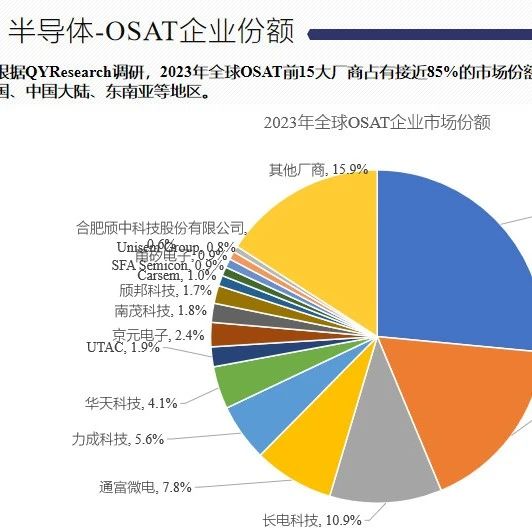
e 半导体产业链 上游:半导体支撑产业 下游:半导体产品终端应用 中游:半导体制造产业 ------ ------- 集 成 电 路 设 计 技术服务 软件工具 移动 通信 个人电脑 半导体设备 半导体材料 封装设计 逻辑设计 电 路 设 计 输出版图 云计算 大 数 据 硅片 单晶炉 集 成 电 路 制 造 光 刻 胶 刻 蚀 机 物 联 网 人工智能 气相 沉积 扩散、离子植入 光罩、护膜 光 掩 模 设备 切面、研磨、清洗 气相沉积 氧化 光罩校准 工业电子 电子特种 汽车电子 晶圆测试 蚀刻 光 刻 机 气体 涂 胶 集 成 电 路 封 测 抛 光 材 料 显 影 机 虚 拟 现 实 军事太空 注塑 晶圆切割 溅 射 靶 材 检测设备 打码 芯片粘接 电性测试 引线焊接 LED OLED 封装材料 清 洗 机 老化测试 光梭 ----- ---- 半导体市场规模 根据世界半导体贸易统计组织(WSTS),2024年全球半导体规模达到了6275亿美元。根据QYResearch预测, 2030年全球半导体规模将达到8678亿美元。 Global Semiconductor Sales ($ Million) ...
QYResearch | 医疗器械业务介绍
QYResearch· 2025-06-09 08:31
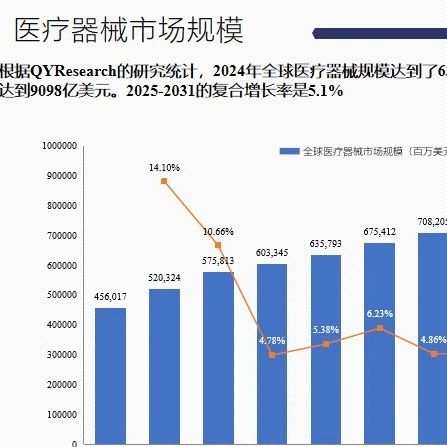
Core Viewpoint - The global medical device market is projected to grow significantly, reaching $635.8 billion in 2024 and expected to hit $909.8 billion by 2031, with a compound annual growth rate (CAGR) of 5.1% from 2025 to 2031 [2][3]. Medical Device Market Size - The global medical device market is estimated to reach $6,358 billion in 2024 and $9,098 billion by 2031, indicating a CAGR of 5.1% from 2025 to 2031 [2][3]. - The market has shown consistent growth from $575.8 billion in 2020 to $635.8 billion in 2024, with a notable increase in revenue year-on-year [3]. Market Segmentation - High-value consumables and in-vitro diagnostics represent the largest segments in the medical device market, with the highest profit margins [4]. - The global high-value consumables market is projected to grow from $196.9 billion in 2024 to $332.2 billion by 2031 [15]. - The in-vitro diagnostics market is expected to reach $83.5 billion in 2024 and $110.6 billion by 2031 [19]. Market Drivers - Key drivers for market growth include an aging population, rising chronic disease prevalence, advancements in medical technology, supportive policies, and improvements in healthcare systems [6][7]. - The aging population is a significant factor, particularly in countries like China, Japan, and Germany, where the demand for medical devices is increasing [6]. - The rise in chronic diseases such as diabetes and cardiovascular conditions is driving demand for long-term treatment and monitoring devices [6]. Market Challenges - The medical device market faces challenges such as stricter regulations, high technological barriers, severe product homogeneity, and intense competition from foreign brands [9][10]. - Regulatory pressures are increasing compliance costs for companies, while the lack of core technology and innovation hampers the development of domestic brands in high-end markets [9]. - The market is characterized by fierce competition, particularly in low-end products, leading to reduced profit margins for many companies [9]. Market Trends - The global medical device market is undergoing a transformation towards high-end, intelligent, personalized, and international collaborative development [11][12]. - Technological innovations such as AI, big data, and robotics are driving product upgrades and creating new market segments [11]. - Emerging markets, particularly in Asia and Latin America, are becoming focal points for growth as healthcare spending increases [11]. - The restructuring of global supply chains is a key trend, with a shift towards local production and global collaboration [11]. Company Rankings - In 2023, Medtronic leads the medical device market with revenues of $31.2 billion, followed by Johnson & Johnson and Abbott [14]. - The high-value consumables market is also dominated by major players like Medtronic and Johnson & Johnson, with significant market shares [18]. In-Vitro Diagnostics Company Rankings - Roche is the leading company in the in-vitro diagnostics market with revenues of $14.4 billion in 2023, followed by Abbott and Danaher [22].
QYResearch | 工程机械业务介绍
QYResearch· 2025-06-09 08:31
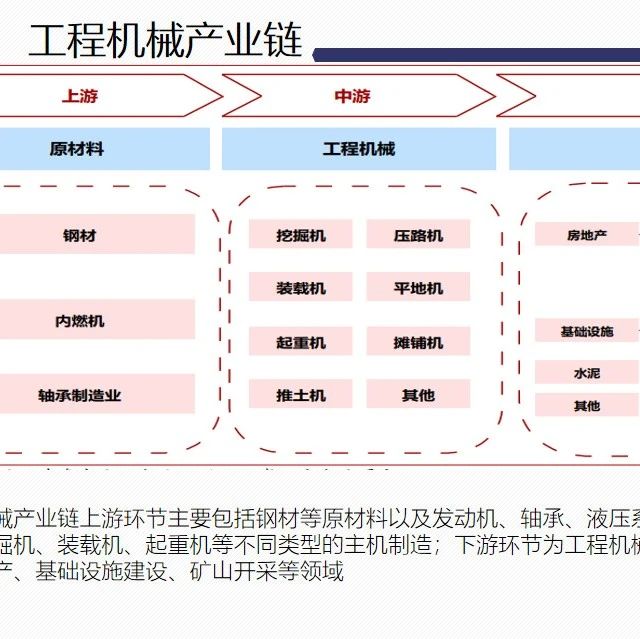
Industry Overview - The engineering machinery industry chain consists of upstream raw materials, midstream machinery manufacturing, and downstream application scenarios, including real estate and infrastructure construction [1]. - The global engineering machinery market is projected to reach $129.6 billion by 2024, with China's market expected to reach $47.8 billion [17][19]. Upstream Products - Key upstream products include engines, hydraulic cylinders, and tires, with a significant reliance on imported brands for high-performance components [2][3][4]. - The global market for upstream raw materials is dominated by European and American companies, although domestic replacements are accelerating [5]. Major Companies - Caterpillar is the largest engineering machinery manufacturer globally, with projected sales of $42 billion in 2024 [9]. - Komatsu, a prominent Japanese company, is expected to achieve sales of $26 billion in 2024 [11]. - XCMG, the largest Chinese manufacturer, is projected to reach $12.9 billion in sales in 2024 [13]. Market Segmentation - Excavators and concrete machinery are expected to maintain significant market shares, with other machinery types also experiencing growth [21]. - The market for electric engineering machinery is rapidly growing, with a projected compound annual growth rate (CAGR) of 148.6% from 2018 to 2024 [32]. Export Trends - China's engineering machinery exports reached $44.3 billion in 2022, with a year-on-year growth of 30.2%, and are expected to grow to $48.6 billion in 2023 [28]. - ASEAN has become the largest region for China's engineering machinery exports, driven by policies like the Belt and Road Initiative [30]. Electric Machinery Market - The electric machinery segment is expected to see significant growth, with electric excavators and loaders projected to have high sales volumes by 2030 [34][35]. - The penetration rate of electric machinery is anticipated to exceed 30% by 2030, driven by advancements in battery technology and increasing market demand [34].
QYResearch | 半导体系列报告(半导体芯片和器件篇)
QYResearch· 2025-06-09 08:31
Core Insights - The semiconductor market is projected to grow significantly, with various segments such as integrated circuits, power devices, and sensors showing distinct revenue shares and growth rates [2][3][5]. Group 1: Semiconductor Device Classification - The global revenue share of semiconductor devices in 2024 indicates that logic ICs will dominate with 33.30%, followed by memory devices at 28.85%, microprocessors at 12.65%, and sensors at 2.09% [1]. - Integrated circuits are the largest segment within semiconductor devices, highlighting their critical role in the industry [2]. Group 2: Market Size and Growth - The global microcontroller market is expected to reach $22.4 billion in 2024, with the automotive sector being the largest application market, accounting for approximately 33% [7]. - The global DRAM market is projected to reach $95.863 billion in 2024, while the NOR Flash market is expected to be $3.1 billion [16]. Group 3: Market Share Analysis - In the microprocessor market, Intel leads with a 50.74% share, followed by Apple at 12.10% and AMD at 9.63% [10][12]. - The global analog chip market is dominated by Texas Instruments with a 19% share, followed by Analog Devices at 9% and Skyworks at 7% [13]. Group 4: Automotive Semiconductor Market - The automotive memory chip market is projected to reach $4.267 billion in 2024, with a significant concentration among major players like Samsung, SK Hynix, and Micron [20][21]. - The market for automotive microcontrollers is also growing rapidly, driven by the electrification of vehicles [7]. Group 5: Specialized Semiconductor Devices - The global market for Hall effect sensors is expected to reach $2.334 billion in 2024, with a compound annual growth rate (CAGR) of 5.08% [29]. - The IGCT market is highly monopolized, with Hitachi Energy holding an 83.66% share, indicating significant barriers to entry [22][24]. Group 6: Research and Reports - QYResearch provides comprehensive reports covering various segments of the semiconductor industry, including market size, growth potential, and competitive analysis [32].

半导体温控设备市场调研报告:全球市场总体规模
QYResearch· 2025-06-06 06:15
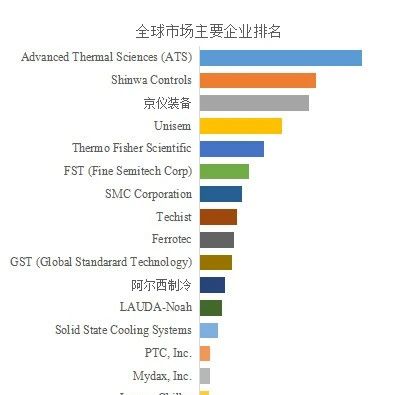
半导体温控设备,也叫半导体专用温控设备( Chiller ),主要用于半导体制造过程中精确控制反应室的温度。半导体专用温控设 备利用制冷循环和工艺冷却水的热交换原理通过对半导体工艺设备使用的循环液的温度、流量和压力进行高精密控制,以实现半导 体工艺制程的控温需求,是集成电路制造过程中不可或缺的关键设备。依据不同工艺制程要求控制给定温度的循环液流经半导体工 艺设备反应腔内的电极或其壁面,将热量带入半导体专用温控设备,半导体专用温控设备通过热交换器将热量传递给制冷剂,再通 过制冷剂将热量释放给工艺冷却水,从而实现对工艺制程的温度控制。 据 QYResearch 调研团队最新报告"全球半导体温控设备市场报告 2025-2031 "显示,预计 2031 年全球半导体温控设备市场规模将达 到 12.3 亿美元,未来几年年复合增长率 CAGR 为 5.9% 。 半导体温控设备 ,全球市场总体规模 如上图表 / 数据,摘自 QYResearch 半导体研究中心最新报告"全球 半导体温控设备 市场研究报告 2025-2031 " . 全球 半导体温控设备 市场前 25 强生产商排名及市场占有率(基于 2025 年调研数据;目 ...
市场调查:全球宠物烘焙粮市场生产商排名及市场占有率
QYResearch· 2025-06-06 06:15
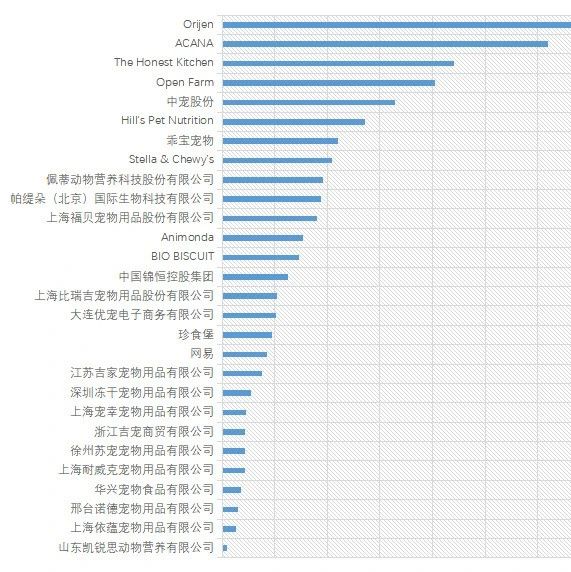
Core Viewpoint - The pet baking food market is expected to reach a size of 1,109.4 million USD by 2030, with a compound annual growth rate (CAGR) of 8.42% in the coming years [2][4]. Group 1: Product Characteristics - Pet baking food is made using a low-temperature slow baking process (typically 90℃-150℃), which retains the natural nutrition and flavor of ingredients, reduces protein denaturation, and minimizes the loss of heat-sensitive nutrients [1]. - Compared to traditional high-temperature puffed food, baking food has a higher fresh meat content, lower starch formulation, and does not contain meat meal, making it easier for pets to digest and absorb [1]. - The production process is complex and time-consuming, resulting in higher costs and prices compared to traditional puffed food, with a relatively short shelf life of about 12 months [1]. Group 2: Market Segmentation - By product type, cat food dominates the market due to cats' lower starch tolerance and the health premium associated with the "cat economy" [5][7]. - In terms of application, household purchases represent the largest downstream market, accounting for approximately 68.41% of the total demand [8][10]. Group 3: Market Drivers - The shift in the role of pets from "guardians" to "family members" has led to increased consumer demand for high-quality pet food, with baking food meeting the modern pet owner's desire for "pure formulas" [14]. - The new generation of pet owners (aged 25-35) exhibits "parenting-style pet care" characteristics, seeking customized solutions for different life stages and health needs, which baking food can more easily provide due to its flexible production process [14]. Group 4: Development Opportunities - Growing societal concern for pet health drives consumers to prefer nutritious, natural, and additive-free pet food, which baking food can fulfill [15]. - The rise of content e-commerce has transformed pet food consumption decision-making, enhancing market awareness and interest in baking food through visual education [15]. Group 5: Challenges - The complex production process of baking food increases energy consumption and production cycles, leading to higher production costs [17]. - The shorter shelf life of baking food compared to traditional dry food poses challenges for inventory management and logistics, potentially affecting consumer purchasing behavior [17]. - The pet food market is highly competitive, with numerous product types and brands, requiring new baking food brands to invest significantly in marketing and market penetration to establish a foothold [17].
全球与中国家电彩涂板市场现状及未来发展趋势
QYResearch· 2025-06-06 06:15
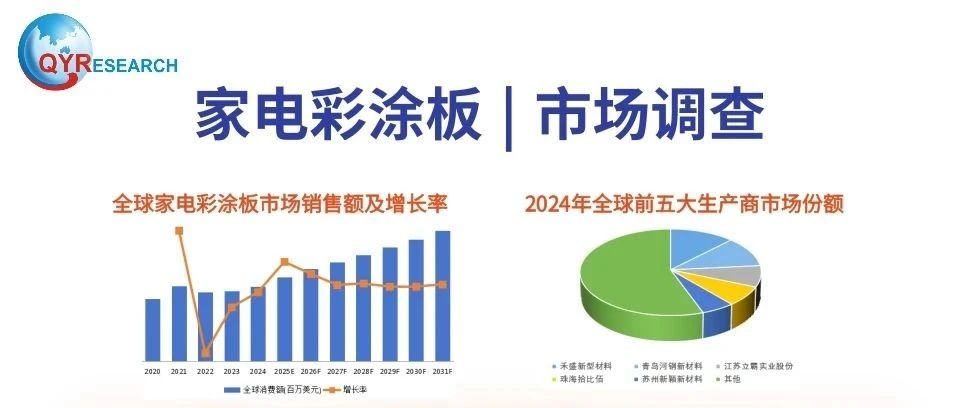
Core Viewpoint - The home appliance color-coated board industry is experiencing significant growth driven by advancements in technology, increasing consumer demand for aesthetic and functional materials, and a shift towards environmentally friendly manufacturing practices [3][4][7]. Industry Current Status Analysis - The home appliance color-coated board industry has evolved since the 1960s, initially using ordinary steel or aluminum for appliance exteriors, which had limitations in corrosion resistance and aesthetics [3]. - By the 1970s, color-coated boards began to be widely adopted in appliances like refrigerators and washing machines due to their superior corrosion resistance and plasticity [3]. - The industry saw rapid growth in the 1980s and 1990s, with a diversification of color-coated board types and a shift towards more environmentally friendly production processes [3][4]. Global Market Scale Analysis - The global market for home appliance color-coated boards is projected to reach $2.898 billion in sales by 2024 and $5.088 billion by 2031, with a compound annual growth rate (CAGR) of 7.68% from 2025 to 2031 [7]. - The Chinese market is expected to account for approximately 61.62% of the global market by 2024, growing to 67.42% by 2031, with a market size of $1.786 billion in 2024 [7]. - The primary applications of color-coated boards are in major appliances, with 51.46% used in refrigerators and 23.83% in washing machines [7]. Industry Development Opportunities and Key Drivers - The upgrade of the home appliance industry and changes in consumer structure are driving demand for aesthetically pleasing and smart appliances, leading to increased use of high-end color-coated board materials [8]. - Environmental regulations are pushing manufacturers towards green production methods, such as using water-based coatings and low-energy processes, to comply with stricter standards [8]. - Innovations in materials and functional coatings are enhancing the performance of color-coated boards, making them more competitive in extreme environments [8]. - The trend towards flexible and customized production is reshaping the supply chain, with companies focusing on regional processing centers to meet diverse customer needs [8]. - The growth of China's home appliance exports is expanding the market for color-coated boards internationally, particularly in regions like Southeast Asia and South America [8].
行业洞察:欧洲市场研究进入定制化和技术集成时代
QYResearch· 2025-06-06 06:15
行业格局:成熟但竞争激烈,专业化需求持续增强 欧 洲 是 全 球 最 成 熟 的 市 场 调 研 区 域 之 一 , 聚 集 了 GfK 、 Ipsos 、 Kantar 、 Statista 、 Euromonitor等一批国际知名研究机构。与此同时,也存在大量印度背景的咨询公司在英国 设立挂名办公室,参与欧洲市场竞争。在报告需求方面,制药、机械、新能源和B2B制造等 产业成为调研关注重点,尤其在技术革新与政策变化频繁的背景下,对数据与趋势的实时掌 握需求尤为迫切。 在市场竞争日益激烈、客户需求不断演进的背景下,QYResearch(恒州博智)发布最新 公司动态,深入剖析欧洲市场调查报告行业的发展现状与趋势,以便更好服务全球客户, 提供更具前瞻性与实用性的研究解决方案。 QYResearch(恒州博智)将继续深耕欧洲市场,发挥我们在行业洞察、跨国研究与合规 运营方面的优势,为客户在多变环境中提供清晰路径与可行建议。 精准回应客户痛点,QYResearch(恒州博智)打造更有价值的研究服务体系 在与欧洲客户长期合作中, QYResearch(恒州博智)深刻理解当前企业在获取市场调 研服务时所面临的共性难题:通 ...