中关村储能产业技术联盟

Search documents
独立储能现货收益低时可获差额补偿!河南电力现货市场首次结算试运行,报价0.05~1.2元/kWh
中关村储能产业技术联盟· 2025-06-18 03:59
Core Viewpoint - The article discusses the initiation of the first settlement trial run for the Henan electricity spot market in 2025, highlighting the operational timeline, participant scope, and settlement mechanisms [1][11]. Group 1: Trial Run Details - The trial run will take place from June 19 to June 27, 2025, with market declarations starting on June 18 [1][11]. - The trial includes a two-day adjustment operation on June 19 and 20, followed by settlement from June 21 to 27 [1][11]. - During the adjustment period, the peak-shaving auxiliary service market will operate normally, requiring participants to declare their peak-shaving market intentions [1][11]. Group 2: Participant Scope - Participants include all regulated coal-fired power generation enterprises involved in existing medium- and long-term transactions, centralized renewable energy stations, and ordinary market electricity users [1][12]. - Independent storage facilities and virtual power plants are also included as new operational entities [1][12]. Group 3: Independent Storage Participation - A total of 12 independent storage stations will participate in the trial run, with specific capacities and energy storage details provided [3][4]. - Independent storage stations will participate in the spot market with a "report quantity, no price" approach, accepting local generation prices for incoming energy and a weighted average price for outgoing energy [2][26]. Group 4: Settlement Mechanism - The settlement during the trial run will follow a deviation settlement method, compensating independent storage for any costs incurred due to grid adjustments if total expenses fall below prior earnings [5][37]. - The minimum and maximum price limits for the spot energy market are set at 50 yuan/MWh and 1200 yuan/MWh, respectively, with future adjustments based on national requirements [2][27]. Group 5: Risk Control Measures - Independent storage will receive compensation if daily average energy earnings fall below 0.765 million yuan per 10,000 kW capacity during the trial run [6][43]. - The trial run includes measures to control profit and loss risks, with a limit set at ±0.02 yuan/kWh for both coal-fired power enterprises and user-side participants [52].


日内紧急削峰补偿上限2元/kWh!海南省电力需求响应实施细则征求意见
中关村储能产业技术联盟· 2025-06-18 03:59
Core Viewpoint - The article discusses the implementation details of the "Hainan Province Electricity Demand Response Implementation Rules," highlighting the participation of various entities, including virtual power plants and energy storage facilities, in demand response programs to enhance electricity system flexibility and stability [1][11]. Group 1: Market Participants - The demand response market participants include three categories: grid enterprises, market operation organizations, and operating entities. Grid enterprises refer to Hainan Electric Power Co., Ltd. and local power supply companies, while market operation organizations include electricity load management centers and trading centers [1][13]. - Operating entities consist of electricity users, load aggregators, and virtual power plants [1][13]. Group 2: Demand Response Resources - Demand response resources encompass various electricity loads from industrial production, centralized and decentralized air conditioning systems, ice storage, energy storage facilities, and smart electricity facilities like electric vehicle charging stations [2][17]. - Projects with high energy consumption are encouraged to register and participate in demand response [2][17]. Group 3: Virtual Power Plant Admission Criteria - Virtual power plants must have legal status, independent financial accounting, good credit, and the ability to bear civil liability. They can aggregate and coordinate adjustable loads, new energy storage, distributed power sources, and electric vehicles [3][8]. - The total adjustable capacity of a virtual power plant should not be less than 1,000 kW [3][8]. Group 4: Compensation Standards - The compensation for demand response varies by type, with fixed compensation prices set at 1.0 yuan/kWh for agreed peak shaving responses and 0.3 yuan/kW/month for standby capacity [5][23]. - For pre-invited peak shaving responses, the compensation price can reach up to 1.5 yuan/kWh, while emergency responses can go up to 2 yuan/kWh [6][23]. Group 5: Implementation Procedures - The demand response execution process includes response initiation, invitation confirmation, execution, monitoring, evaluation, and fund distribution [11][24]. - The initiation conditions for peak shaving responses require a power supply-demand balance gap, while valley filling responses are initiated when the load level is low [24][25]. Group 6: Evaluation and Settlement - The evaluation of demand response effectiveness is based on the difference between baseline load and actual measured load, with specific calculations for peak shaving and valley filling responses [36][37]. - Compensation funds are distributed transparently, with the grid enterprise responsible for calculating and distributing compensation based on participation results [41][43].
全球储能三大梯队格局:中美超10GW断层领先,沙特首入前十
中关村储能产业技术联盟· 2025-06-17 11:01
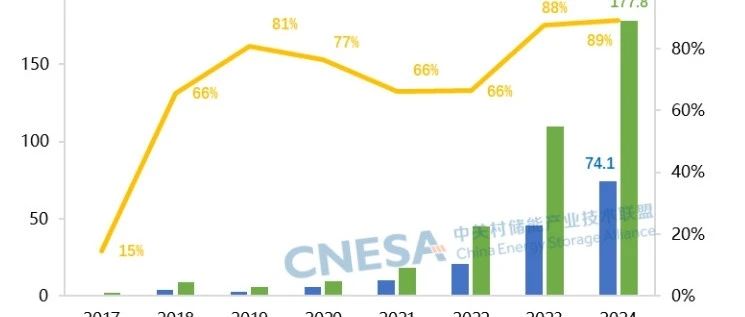
Core Insights - The global energy storage market is experiencing rapid growth, with new installations expected to reach 74.1GW/177.8GWh in 2024, marking a historical high of 89% in the share of new power storage installations [1][4] - Chinese companies are actively expanding into international markets, with overseas storage orders exceeding 120GWh in the first five months of 2025, a year-on-year increase of 399.74% [1] Group 1: Global Market Overview - By the end of 2024, the cumulative installed capacity of new energy storage will surpass 100GW for the first time, reaching 165.4GW/381.7GWh, representing a year-on-year growth of 81.1%/87.3% [2] - The compound annual growth rate (CAGR) from 2014 to 2024 is projected at 68.6% in terms of power capacity [2] - The lithium-ion battery technology's share of cumulative installed capacity continues to increase, up by 0.6 percentage points compared to the same period in 2023 [2] Group 2: Regional Market Dynamics - The market concentration in the global energy storage sector is rising, with China, the U.S., and Europe accounting for over 90% of new installations in 2024 [6] - China has maintained its position as the leader in new installations for three consecutive years, with the top ten countries in new energy storage installations collectively accounting for 91.1% of the global market [6][8] - The Asia-Pacific region holds seven out of the top ten positions in new installations, contributing 71.0% of the total new capacity among these countries [6] Group 3: Competitive Landscape - The first tier of the market includes China and the U.S., both exceeding 10GW in new installations, with China nearly doubling the combined new capacity of countries ranked 2nd to 10th [9] - The second tier includes Japan and South Korea, which are experiencing a market recovery, with South Korea returning to the top ten due to rapid industrial storage demand [10][14] - Emerging markets, particularly in the Middle East, are beginning to fill gaps in energy storage distribution, with Saudi Arabia making its debut in the rankings [11] Group 4: Future Outlook - The energy storage market is expected to transition from being policy-driven to value-driven as market mechanisms and business models diversify [12] - Emerging regions such as the Middle East, Southeast Asia, and Africa are anticipated to become significant growth markets for global energy storage [12]

河南已发十批次478个源网荷储一体化项目,计划实施1000个
中关村储能产业技术联盟· 2025-06-17 11:01
文 | 中关村储能产业技术联盟 近日 ,河南省发展改革委发布《关于实施第十批源网荷储一体化项目的通知》,本次共63个项目纳入 实施范围,其中,工业企业类35个、增量配电网类1个、农村地区类8个、其他类19个。总规模 360.65MW,其中风电项目120MW、光伏240.65MW。 河南 发展 新能源主要 通过 源网荷储一体化 来做 , 同时 源网荷储一体化项目推动 了 新型储能的发 展。河南 率先 在全国推出三个类型的源网荷储一体化项目。 包括 工业 企业 、 农村地区 、 增量配 网 等场景,现在已 进一步拓展 至 基础设施、公共机构、学校、医院、算力等 应用 。 在这些源网荷储一体化 项目 当中, 对储能的规模给予了一定的规定 。 工业企业类项目(含基础设 施、公共机构等)新能源自发自用,不向大电网反送电,可按照自建新能源的规模,灵活配置储能,不 做具体要求。农村地区类项目,根据自发自用比例、建设成本等因素测算,农村生产类企业配储不低于 新能源规模的 20%,整村开发类不低于50%。增量配电网类项目,网内自平衡供电能力应不少于两小 时,自建新能源消纳比例达到全省平均水平, 据此测算,储能配置比例原则上不低 ...

浪潮2025年度储能电池单体框架采购
中关村储能产业技术联盟· 2025-06-17 11:01
文 | 中关村储能产业技术联盟 6月16日,浪潮智能终端有限公司发布25年度 储能 电池单体框架采购项目 竞争性谈判公告,要求投标人必须为储能电池单体生产制造商,且需要提供25 年5月之前,能证明储能电池单体出货总额不低于1GWh业绩要求的合同以及发票。详情如下: 5.报价人资格要求 (4)最近三年内没有骗取成交和严重违约等重大违法记录。(自拟格式进行承诺说明)并提 供 通 过" 信 用 中 国 " 网 站(www.creditchina.gov.cn)查 (5)不接受联合体响应; (6)响应人须提供截止25年5月之前,能证明储能电池单体出货总额不低于1GWh业绩要求的合同以及发票,合同扫描件须至少包含:合同买卖双方盖章页 1.项目名称: 浪潮25年度储能电池单体框架采购项目 2.项目编号: ESTPFQ2025053000019 3.采购人 浪潮智能终端有限公司 4.标的 (7)未尽事宜,遵照法律法规及其他相关规定执行。 说明:单位负责人为同一人或者存在控股、管理关系的不同单位,不得参加同一标段或者未划分标段的同一采购项目。 6.竞争性谈判文件的获取 凡有意参加报价者,请于2025-06-03 10:00: ...


仅限15家!第二期储能电站用锂离子电池健康评估活动已启动
中关村储能产业技术联盟· 2025-06-17 11:01
关于开展第二期储能电站用锂离子电池健康评估活动的通知 中关村储能产业技术联盟基于行业自主需求,于2024年12月31日启动面向投运后的储能电站电池健康 评估工作。首期联合专业机构为多家储能电站提供安全评估,获得参与单位高度认可。为进一步提升锂 离子电池储能电站安全运行水平,积极响应电力行业"安全生产月"活动要求,现组织开展第二期锂离子 电池健康评估活动,有关事项通知如下。 文 | 中关村储能产业技术联盟 一、适用范围 已投入运行的发电侧、电网侧储能电站以及工商业储能项目。 二、数据要求 1. 数据规模:不超过1个电池舱; 2. 运行数据类型:簇电流、电池单体电压、电池温度; 3. 数据时间颗粒度:≤5s; 4. 电压采样分辨率:≤5mV; 5. 数据长度:近半年内连续30天的运行数据; 6. 电池相关参数:电池额定容量、电池安全电压上下限、电池SOC-OCV曲线、电池组串拓扑结构、 电芯厂家及电芯型号; 7. 数据文件格式要求:可正常解码的csv文件。 三、评估流程 分析锂离子电池历史运行数据,评估电池健康状态及安全风险,形成储能电站用锂离子电池健康状态评 估报告,给出相应的电池系统运维措施建议。 四、资质要 ...

湖南136号文配套细则讨论稿:存量机制电价0.45元/kWh,增量竞价0.26-0.38元/kWh
中关村储能产业技术联盟· 2025-06-17 01:53
文 | 中关村储能产业技术联盟 5月份以来,各地陆续下发136号文的省级承接文件。目前,蒙东的文件正式下发(详见《 蒙东136号 文配套细则正式方案:存量项目机制电价为煤电基准价,新增项目暂不安排机制电量 》),山东、广东 出台征求意见稿(详见《 山东:136号文后首个省级配套细则出台,531前投产项目机制电价0.3949 元/度! 》、《 广东136号文配套细则:机制电量≤90%,机制电价最长执行14年 》) 近日,湖南省发改委关于印发《湖南省深化新能源上网电价市场化改革实施细则(暂行)》的通知文件 流出(详细内容参考附件)。该文件为相关部门内部讨论稿,仅供参考。 2025年6月1日前全容量并网的存量项目: 电量规模: 光伏扶贫项目扶贫容量对应的上网电量 全部纳入 机制电量规模;扶贫容量以外的其他分 布式光伏项目、接入电压等级35千伏及以下风电和集中式光伏项目纳入机制电量的规模 按照其上网电 量的80%确定 。 机制电价: 纳入机制电量的机制电价为 0.45元/千瓦时 。 执行期限: 按2025年5月底项目剩余全生命周期合理利用小时数对应年份与投产满 20年 对应年份较 早者确定。 2025年6月1日后全容 ...

天合光能8亿增资天合储能,最新估值40亿
中关村储能产业技术联盟· 2025-06-16 10:57
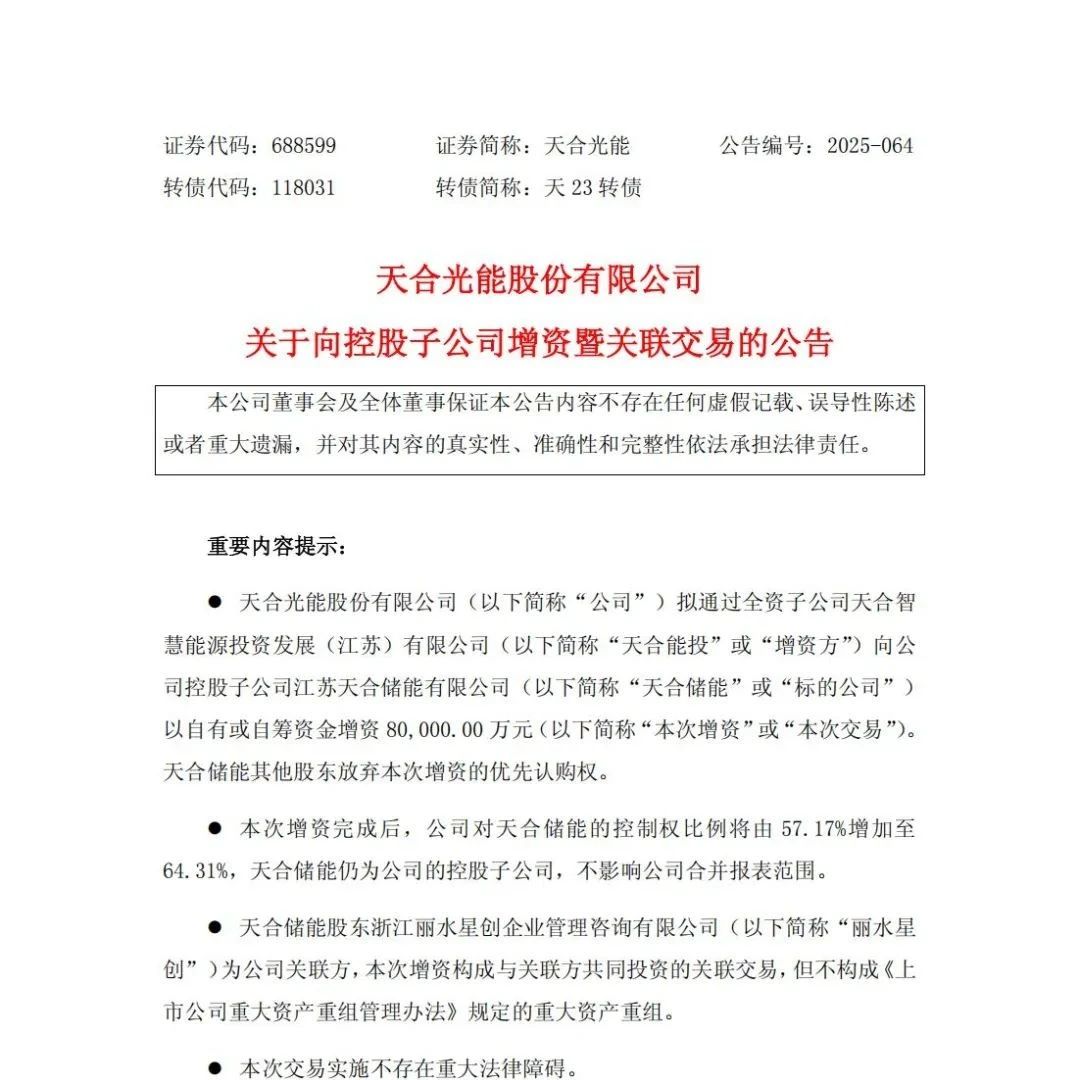
Core Viewpoint - The company plans to increase its stake in its subsidiary, Trina Storage, through a capital increase of 800 million yuan, enhancing its control from 57.17% to 64.31%, which is aimed at promoting the development of its energy storage business and improving overall competitiveness [10][34]. Group 1: Capital Increase Details - The capital increase will involve Trina Energy Investment, a wholly-owned subsidiary of the company, investing 800 million yuan into Trina Storage, which will result in an additional registered capital of 187.19 million yuan for Trina Storage [10][13]. - Other shareholders of Trina Storage have waived their preemptive rights for this capital increase [10][13]. - Following the completion of this capital increase, Trina Storage will remain a controlled subsidiary of the company, and this will not affect the company's consolidated financial statements [10][34]. Group 2: Financial Performance - Trina Storage is projected to have an annual revenue of 2.937 billion yuan and a net loss of 345 million yuan for the year 2024 [3]. - In the first quarter of 2025, Trina Storage achieved a revenue of 269 million yuan with a net loss of approximately 77.16 million yuan [3]. Group 3: Valuation and Assessment - The total equity value of Trina Storage was assessed at 4.025 billion yuan, with an increase of 2.4 billion yuan, resulting in a growth rate of 163.87% [6][26]. - The assessment utilized both market and income approaches, with the income approach deemed more reliable due to the quality and quantity of data used [7][26]. - As of the assessment date, Trina Storage's total assets were valued at 646.01 million yuan, with total liabilities of 476.91 million yuan, leading to an owner's equity of 169.10 million yuan [6][25]. Group 4: Transaction Necessity and Impact - The capital increase is expected to enhance the company's financial strength and promote the development of its energy storage business, thereby increasing Trina Storage's overall competitiveness [34]. - The transaction is not expected to adversely affect the company's financial condition, operating results, or ongoing profitability [34]. - The transaction will not negatively impact the company's independence, and the main business will not become dependent on related parties due to this transaction [34]. Group 5: Approval Process - The transaction has been approved by the company's board of directors and the supervisory board, with independent directors affirming its necessity and rationality for the company's operational development [35][36]. - The proposal will be submitted for approval at the shareholders' meeting, with related parties waiving their voting rights [36][37].

全球储能巨头“真机燃烧”大比拼
中关村储能产业技术联盟· 2025-06-16 10:57
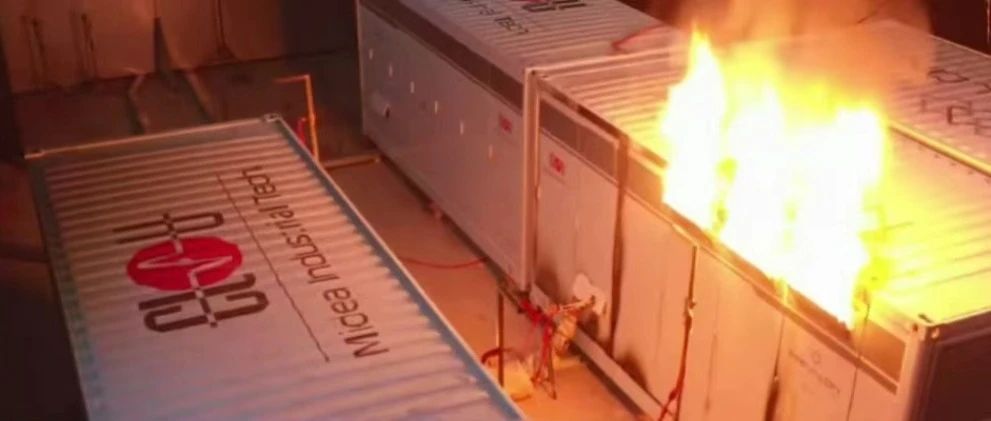
Core Viewpoint - The article emphasizes the importance of safety in the rapidly growing global energy storage industry, highlighting the extreme testing conducted by leading companies to validate the safety performance of their energy storage systems under severe conditions [1]. Group 1: Sunlight Power - Sunlight Power conducted the world's first large-scale combustion test of its PowerTitan1.0 system in June 2024, followed by a significant investment of 30 million for the PowerTitan2.0 test in November 2024 [1]. - The PowerTitan2.0 system withstood 25 hours and 43 minutes of continuous burning, demonstrating its robust protective capabilities and preventing fire spread [2]. - During extreme conditions, the system maintained structural integrity and prevented heat propagation, showcasing its excellent fire resistance and impact performance [3]. Group 2: BYD Energy Storage - BYD's MC Cube energy storage system underwent testing in December 2024, adhering to CSA TS-800 large-scale fire testing standards [6]. - The test revealed that while the internal temperature exceeded 1000℃, adjacent battery cabinets remained below 60℃, confirming the system's effective fire isolation design [6]. - The MC Cube demonstrated outstanding fire resistance and structural integrity, preventing fire spread and ensuring safety for personnel and the environment [6]. Group 3: Huawei Digital Energy - Huawei's intelligent string-type energy storage system was tested in December 2025, following international UL9540A standards with increased thermal runaway cell counts [7]. - The system effectively managed a scenario with 12 cells experiencing thermal runaway, utilizing innovative pressure and smoke management mechanisms to prevent combustion [8]. - The test confirmed the system's ability to maintain low temperatures in adjacent units, demonstrating its safety under extreme conditions [8]. Group 4: Hichain Energy Storage - Hichain's ∞Block 5MWh system was tested in June 2025 under UL9540A and NFPA855 standards, with open cabinet conditions to simulate extreme fire scenarios [9]. - The system successfully prevented heat propagation between cabinets even at temperatures exceeding 1300℃, validating its thermal isolation capabilities [10]. - The test confirmed the system's reliability and high safety standards without external fire protection [11]. Group 5: Canadian Solar - Canadian Solar's SolBank 3.0 system was tested in June 2025, adhering to CSA TS-800 standards for large-scale fire testing [12]. - The test demonstrated that the SolBank 3.0 effectively contained fire within the target unit, showcasing its superior passive fire protection design [13]. Group 6: Kelu - Kelu's Aqua C2.5 5MWh liquid-cooled energy storage system was tested in June 2025, following CSA TS-800 standards [14]. - The test involved a 59-hour continuous burn, with the internal temperature reaching 1300℃, yet the system maintained structural integrity and functionality [17]. - The Aqua C2.5 effectively prevented thermal runaway between units, proving its scalability for large energy storage stations [17]. Group 7: Ruipu Lanjun - Ruipu Lanjun's Powtrix® battery cabin was tested in June 2025 under CSA TS-800 extreme safety testing [18]. - The system endured approximately 14 hours of burning under severe conditions, demonstrating exceptional safety and reliability [18]. Group 8: Trina Storage - Trina's Elementa energy storage cabinet was tested in September 2024, following guidelines from the China Academy of Building Research [19]. - The test validated the effectiveness of the fire suppression systems and the overall safety of the energy storage design, with no signs of re-ignition after 24 hours [21].



我国首个“沙戈荒”新能源外送基地首批机组投产发电,配套储能1.2GW/4.8GWh
中关村储能产业技术联盟· 2025-06-16 10:57
Core Viewpoint - The Xinjiang Tianshan North Gobi Energy Base, developed by China Huadian and China Resources Group, has successfully completed the trial operation of its first two 1 million kilowatt coal power units, marking the production of China's first "desert-gobi" renewable energy export base [1][9]. Group 1: Project Overview - The Xinjiang Tianshan North Gobi Energy Base is located in the Hami Santanghu Gobi area and is a key project under the "14th Five-Year Plan" for the "Xinjiang Electricity into Chongqing" ultra-high voltage transmission project [1][4]. - The total investment for the base is 54.7 billion yuan, with a total power generation capacity of 14.2 million kilowatts, including 4 million kilowatts of coal power, 7 million kilowatts of wind power, 3 million kilowatts of solar power, and 200,000 kilowatts of thermal power [5][7]. Group 2: Strategic Importance - The construction of the "desert-gobi" base is aimed at enhancing renewable energy supply capacity, reducing construction costs, restoring ecological environments, and promoting local economic development [2][3]. - Xinjiang is recognized as a strategic energy resource base, with significant coal reserves of 5.708 billion tons, accounting for 31.7% of the region and 12.5% of the national total [3]. Group 3: Energy Supply and Demand - The energy base is expected to deliver over 36 billion kilowatt-hours of electricity annually to Chongqing, which will account for nearly one-quarter of the city's electricity supply by 2025 [4][9]. - The project aligns with the national strategy to meet the increasing electricity demand in Chongqing, which is projected to reach 162 billion kilowatt-hours by 2025 [4]. Group 4: Technological Innovations - The project has overcome significant technical challenges, including the construction of the world's largest hyperbolic steel structure cooling tower and the first asynchronous motor bidirectional control pump group [6]. - The energy base features a high proportion of renewable energy, with 71.8% of its installed capacity coming from renewable sources, exceeding the "14th Five-Year" renewable energy planning target of 50% [7]. Group 5: Environmental and Economic Impact - The project is expected to reduce coal consumption by approximately 6 million tons and carbon dioxide emissions by about 16 million tons annually [7]. - The construction has created 23,000 job opportunities and incorporates ecological restoration measures to enhance the overall benefits of the clean energy base [8].