WitsView睿智显示

Search documents
深天马:2026年将成Micro LED发展关键点
WitsView睿智显示· 2025-11-22 02:07
Core Viewpoint - The article emphasizes the significant potential of Micro-LED technology in the display industry, highlighting its advancements and the collaborative efforts of companies like Tianma Microelectronics to drive its commercialization and application across various sectors [2][6][16]. Group 1: Micro-LED Technology Development - Micro-LED is regarded as the ultimate display technology, with Tianma leading the charge in its development for large-size displays, automotive displays, transparent displays, wearables, and AR applications [2][5]. - At the TIC 2025 conference, Tianma unveiled the world's first 108-inch 4K Micro-LED seamless display, showcasing its high brightness, contrast, low reflectivity, and seamless splicing capabilities [5][8]. - The cost reduction and yield improvement of Micro-LED technology are critical for its market expansion, with a reported price drop of over 50% for 6-inch RGB Micro-LED chips in the past two to three years [6][9]. Group 2: Technical Challenges and Solutions - Despite the advancements, challenges such as reduced external quantum efficiency (EQE) and lower yield due to chip size reduction persist, but upstream companies are actively addressing these issues [9][10]. - Tianma is developing technologies like mixed BIN and De-mura algorithms to enhance chip uniformity to over 90%, thereby reducing costs [9][10]. - Various manufacturing techniques, including laser mass transfer and high-precision seamless splicing, are being optimized to improve the cost and yield of Micro-LED displays [10][12]. Group 3: Automotive Display Opportunities - Tianma is focusing on automotive displays as a key area for Micro-LED technology, having already developed several transparent display products tailored for automotive environments [12][13]. - The compatibility of Micro-LED technology with automotive displays is highlighted by its deformability, efficiency, and durability, which opens up numerous application opportunities [13][15]. - Tianma successfully demonstrated a 7-inch Micro-LED automotive standard product, accelerating the penetration of Micro-LED technology in the automotive sector [15][16]. Group 4: Future Prospects and Investments - The potential applications of Micro-LED technology are vast, extending to smartwatches, AR glasses, automotive headlights, and optical communications, which could significantly enhance its market value [16][17]. - Tianma has invested 1.1 billion yuan to establish a fully automated G3.5 generation mass transfer production line, expected to achieve full-process integration by the end of 2024 and begin small-scale production in 2025 [16][17]. - The company is optimistic about the future of Micro-LED technology, viewing 2026 as a pivotal year for its development and mass production [17].


AR智能眼镜商用化加速:从B端大步走向C端
WitsView睿智显示· 2025-11-21 08:00
Core Insights - The article highlights the transition of AR/AI glasses from being perceived as mere technological toys to becoming practical productivity tools that address real-world problems [3][4]. Industry Trends - The near-eye display industry is shifting focus from entertainment applications like gaming and movie-watching to practical applications in B2B verticals and high-frequency consumer tools [5][12]. - Recent deployments, such as the UK's defense cloud infrastructure utilizing AR remote support systems, demonstrate the growing utility of AR technology in industrial and defense sectors [5][7]. Technological Developments - The design consensus for AR glasses is moving towards lightweight and practical solutions, with a target weight of under 60 grams to ensure comfort for all-day wear [13][22]. - The field of optical technology is evolving, with light guide technology, particularly diffractive and SiC light guides, being identified as key enablers for achieving lightweight and effective AR glasses [16][19]. Market Dynamics - The global supply chain for advanced optical materials is shifting towards China, with local manufacturers forming alliances to reduce costs and enhance production capabilities [19][22]. - A significant investment in the production of optical-grade silicon carbide materials is underway, with a project in Huizhou aiming for an annual output value exceeding 3.6 billion yuan [19]. Future Outlook - By 2025, the industry consensus is expected to prioritize extreme lightweight design and practical applications, with advancements in optical supply chain technologies playing a crucial role in overcoming physical limitations and reducing costs [22].

Q4需求不减反增,电视面板价格涨还是跌?
WitsView睿智显示· 2025-11-21 08:00
Core Viewpoint - TrendForce reported a decline in TV panel prices in November, while monitor panel prices remained stable compared to the previous month, and some laptop panel prices decreased for certain sizes [1][3][5]. TV Panels - Despite entering the traditional off-season for TV panel demand in Q4, some brand clients are actively pushing to meet year-end targets, leading to an increase in demand for TV panels [3]. - Panel manufacturers are fulfilling orders but are adopting a low pricing stance to encourage clients to increase orders, with expected price drops of $1 for 32" and 43" panels, $2 for 50" and 55" panels, and $3 for 65" and 75" panels in November [3][4]. Monitor Panels - The demand for monitor panels has shown signs of weakness in Q4, with manufacturers facing ongoing losses on mainstream monitor panels, limiting their ability to lower prices [5]. - In November, only the 23.8" Open Cell panel is expected to see a price drop of $0.2, while other mainstream sizes are anticipated to remain stable [5]. Laptop Panels - In November, despite a significant rise in memory prices, brand clients' purchasing momentum for panels remains in line with expectations, although they continue to request price reductions [6]. - Only TN panels are expected to remain stable in price, while other IPS mainstream sizes are projected to decrease by $0.1 to $0.2 [6].

电子纸大厂元太科技:明年多条新产线将满载
WitsView睿智显示· 2025-11-21 08:00
Core Viewpoint - E Ink is actively expanding into the large-size digital signage market, which is seen as having significant growth potential due to its currently low base [1]. Group 1: Company Expansion and Production Capacity - E Ink is expanding its large-size production lines, with the H5 line entering trial production and expected to contribute revenue next year, while the H6 line is set to launch in the same timeframe [1]. - The company has invested approximately 748 million RMB in land acquisition and leasing existing factories in Taoyuan, preparing for larger production lines post-2028 [1]. - The expansion, cost optimization, and technology upgrades are expected to significantly enhance the company's competitiveness and drive performance growth over the next 3-5 years [1]. Group 2: Market Demand and Partnerships - There is strong market demand for large-size electronic paper, prompting E Ink to continuously establish new production lines to meet this demand [1]. - E Ink has formed a joint venture with AUO's subsidiary to create a large electronic paper module production line, which has passed key customer certifications and is expected to enter mass production by the end of this year [3]. - The joint venture aims to actively explore business opportunities in large-size electronic paper display applications [3]. Group 3: Financial Performance - In Q3 2025, E Ink reported revenues of 10.415 billion NTD (approximately 2.359 billion RMB), a year-on-year increase of 13%, with net profit reaching 4.238 billion NTD (approximately 960 million RMB), up 110% [4]. - Cumulatively, for the first three quarters, the company achieved revenues of 29.1 billion NTD (approximately 6.591 billion RMB), a 29% increase, with operating profit of 9.99 billion NTD (approximately 2.265 billion RMB) and net profit of 9.4 billion NTD (approximately 2.129 billion RMB), surpassing last year's total [4].
获1.91亿预付款,JDI茂原工厂停产前加速备货
WitsView睿智显示· 2025-11-21 08:00
日本显示公司(JDI)近日宣布,已从一名核心客户处收到预付款项,用于支持其位于茂原工厂的 加速生产与库存建立工作。JDI表示,该工厂预计将在今年内结束生产,因此公司正与客户合作, 在停产前确保相关产品的稳定供应。 随着 茂原工厂 之后全面停厂,JDI工厂数量将从 高峰期的6座缩减至仅剩1座石川 工厂,成为 JDI在日本 的 最后一家面板生产基地 。 而未来, JDI 也 将把石川工厂的发展重心转向汽车显示面板,并拓展传感器、半导体等新兴技术 领域,逐步转向无晶圆厂(fabless)运营模式,专注于研发与设计,以提升整体经营效率。 近日,JDI公布最新财报业绩显示,受产线关闭与业务调整影响,2026年财年上半年公司的销售 额为664亿日元(约合人民币30.54亿元),同比下降35.5%。另一方面,在结构改革和成本削减 推动下,公司经营亏损较上年同期缩小至144亿日元,净亏损收窄至113亿日元。(集邦Display 整理) 【集邦Display显示产业交流群】 根据公告,JDI正为这名主要客户加快生产节奏,并提前建立额外库存。为采购所需材料,JDI已 与该客户及两家为客户供货的一线供应商签署资金协议。根据协议安排 ...

惠科首款自研OLED产品量产订单落地
WitsView睿智显示· 2025-11-20 12:30
Core Viewpoint - Huike has successfully transitioned from "technical catch-up" to "market breakthrough" in the OLED display sector, marking a significant milestone with the launch of its first OLED product that has passed customer testing and secured initial mass production orders [1][2]. Group 1: Product Development and Technology - The newly developed OLED display product features ultra-low leakage oxide backplane technology and a lightweight hybrid architecture, achieving industry-leading levels in key visual performance metrics such as refresh rate, brightness, color saturation, and contrast [1]. - Compared to LCD displays, OLED products significantly reduce module thickness and extend the application range of oxide technology, providing users with an enhanced visual experience [1]. Group 2: Market Position and Future Plans - The successful acquisition of mass production orders validates Huike's independent R&D and precision manufacturing capabilities in the OLED field, reflecting market recognition of its product competitiveness [2]. - Since entering the OLED industry, Huike has established a comprehensive technology roadmap covering LCD, MLED, and OLED, along with a diverse product system ranging from 1.54 inches to 116 inches [2]. - In the context of the global OLED market's deep penetration into consumer electronics and the rising market share of domestic AMOLED, Huike's breakthrough injects new development momentum into the domestic display industry chain [2]. - Looking ahead, Huike plans to continuously optimize production processes, enhance core product competitiveness, and actively explore the medium and large-sized OLED application markets, including laptops and tablets, while also preparing for next-generation display technologies like Micro OLED [2].
2025年11月面板最新价格
WitsView睿智显示· 2025-11-20 09:08
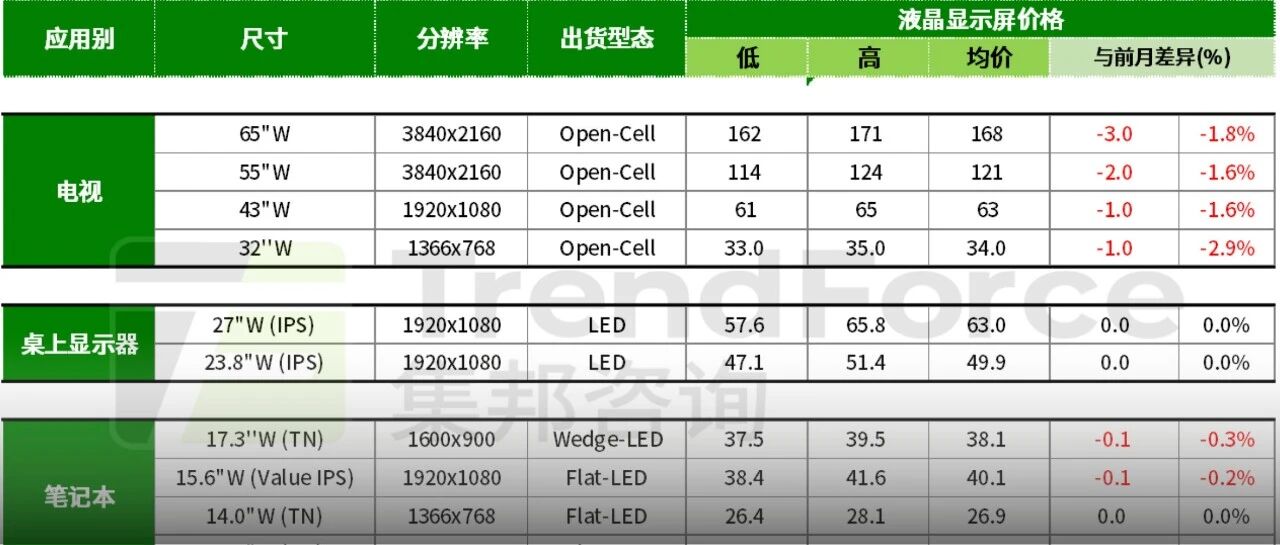
Core Viewpoint - TrendForce's latest report indicates a comprehensive decline in television panel prices, while monitor panel prices remain stable, and slight decreases are observed in certain laptop panel prices [2][5][6]. Television Panels - The average price of 65-inch television panels is $168, down $3 from the previous month, a decrease of 1.8% [5]. - The average price of 55-inch television panels is $121, down $2 from the previous month, a decrease of 1.6% [5]. - The average price of 43-inch television panels is $63, down $1 from the previous month, a decrease of 1.6% [5]. - The average price of 32-inch television panels is $34, down $1 from the previous month, a decrease of 2.9% [5]. Monitor Panels - In November, monitor panel prices remained stable, with the average price of 27-inch IPS panels at $63 [6]. - The average price of 23.8-inch IPS panels is $49.9, with no change from the previous month [6]. Laptop Panels - The average price of 17.3-inch TN panels is $38.1, down $0.1 from the previous month, a decrease of 0.3% [8]. - The average price of 15.6-inch Value IPS panels is $40.1, down $0.1 from the previous month, a decrease of 0.2% [8]. - The average price of 14.0-inch TN panels has stabilized at $26.9 since July 2024 [8]. - The average price of 11.6-inch TN panels has also stabilized at $25.1 since July 2024 [8].
14.2亿,韩国LCD材料商转让10家在华工厂
WitsView睿智显示· 2025-11-20 09:08
Group 1 - Dongjin Semichem, a leading company in the semiconductor and LCD chemical materials sector in South Korea, announced a large-scale exit from the Chinese market by planning to sell its 10 subsidiaries in China [1][3] - The subsidiaries being sold include companies located in Beijing, Ordos, Sichuan, Wuhan, Qidong, Chengdu, Hefei, Chongqing, Huizhou, and Fuzhou, which primarily produce chemical materials used for cleaning glass substrates in the LCD exposure process [3] - The transaction is expected to be completed by May 31, 2026, with Dongjin Semichem anticipating to receive approximately 273.5 billion KRW (around 1.42 billion RMB) [3] Group 2 - The main reasons for this divestment include the increasing localization rate of the semiconductor and display materials industry in China and the shift of Chinese panel manufacturers from LCD to OLED, which is reducing the market share for traditional LCD chemical materials [3] - The sale will not be a simple asset transfer but will involve a complex structure through the establishment of a Special Purpose Vehicle (SPV), where Dongjin Semichem will transfer 70% of the shares to Chinese buyers while retaining 30% for continued cooperation or revenue rights [3][4] - In terms of financial recovery, Dongjin Semichem expects to gain 94 billion KRW from the sale, which includes 62.1 billion KRW from the sale price, 11.1 billion KRW from technical support fees, and 20.8 billion KRW from production technology localization support [4] Group 3 - Dongjin Semichem was established in 1973 and its main business includes electronic materials such as photoresists for semiconductor and TFT-LCD exposure processes, with major clients including Samsung Electronics, SK Hynix, and LG Display [4] - In 2004, Dongjin Semichem invested 2.9 billion KRW to establish Beijing Dongjin Semichem Technology, marking its entry into the Chinese market to supply products for JD Group's Beijing factory [5] - The latest financial report indicates that Dongjin Semichem achieved a cumulative sales revenue of 884.9 billion KRW and a quarterly net profit of 64.8 billion KRW in the third quarter of this year [5]

京东方设立新公司
WitsView睿智显示· 2025-11-20 09:08
Group 1 - The core point of the article is that Estun plans to establish a joint venture with Suzhou BOE Sensor Technology Co., Ltd. to develop servo-related businesses [1][5] - The joint venture is proposed to be named Suzhou BOE Drive Technology Co., Ltd., focusing on general servo products, linear drive products, and precision drive control products [4] - The registered capital of the joint venture is set at 150 million yuan, with BOE Sensor contributing 90 million yuan for a 60% stake, while Estun will contribute 60 million yuan for a 40% stake [4] Group 2 - Estun aims to sign a technical licensing and service agreement with the joint venture, providing necessary technology and services for production operations, valued at 50 million yuan [4] - Suzhou BOE Sensor, established in June 2022, has reported revenues of 31.92 million yuan, 126 million yuan, and 84.03 million yuan from 2022 to 2024, with net losses of 9.12 million yuan, 39.51 million yuan, and 57.80 million yuan during the same period [4] - Estun focuses on automation core components, motion control systems, industrial robots, and intelligent manufacturing systems, aiming to leverage both companies' strengths to enhance competitiveness in the semiconductor and display sectors [5]



总投资超40亿!宁波、佛山8.6代OLED掩膜版项目公布最新进展
WitsView睿智显示· 2025-11-20 09:08
Core Viewpoint - The article highlights the recent advancements in the G8.6 generation FMM project by Huancai Star and the mask production project by Qingyi Optoelectronics, with a total investment exceeding 4 billion RMB [1]. Group 1: Huancai Star's G8.6 Generation FMM Project - Huancai Star has completed the installation of the first G8.6 generation FMM manufacturing line in Ningbo, with a total investment of 580 million RMB [2]. - The production line features processing capabilities exceeding 700mm and is claimed to be the most integrated and automated FMM production line globally [2]. - The line integrates core processes such as high-precision lithography, electroforming, and laser cutting, meeting the mass production needs for 8.6 generation OLED panels, with a production efficiency improvement of over 40% compared to G6 generation lines [2]. - The pixel precision control is at the micron level, supporting the manufacturing of high-resolution OLED products like 4K and 8K [2]. - The Ningbo factory, as Huancai Star's core production base, already has the capacity for mass production of G6 generation FMM, and the new G8.6 line will further expand production capacity and enhance the product matrix [2][5]. Group 2: Qingyi Optoelectronics' Mask Production Base - Qingyi Optoelectronics held the inauguration ceremony for its flat panel display and semiconductor mask production base in Foshan on November 14 [6]. - The total investment for the two bases is 3.5 billion RMB, with the high-precision flat panel display mask base accounting for 2 billion RMB, constructed in three phases [8]. - The products from this base will cover a-Si, LTPS, and AMOLED technologies for flat panel displays, targeting 8.6 generation and below [8]. - In February 2025, Qingyi Optoelectronics received approval for a private placement plan to raise 1.2 billion RMB for the construction of the high-precision mask production base and the high-end semiconductor mask production base [8]. - The company specializes in the R&D, design, production, and sales of masks, serving various applications in flat panel displays and semiconductors, including power semiconductors and third-generation semiconductors [9].