WitsView睿智显示

Search documents
OLED/LCD设备企业科韵激光完成新一轮融资
WitsView睿智显示· 2025-11-11 09:40
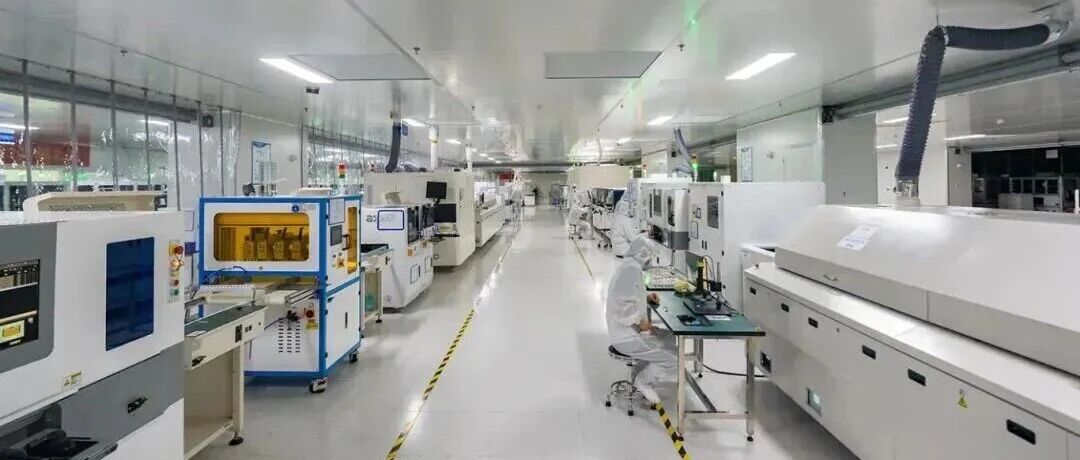
Core Viewpoint - The strategic investment by Sichuan Manufacturing Collaborative Development Fund in Suzhou Keyun Laser Technology Co., Ltd. aims to support the company's relocation to Danling, Sichuan, and the establishment of a laser industry technology research center and production line [1]. Group 1: Company Overview - Suzhou Keyun Laser was founded in 2018 and focuses on precision laser micro-nano processing automation equipment for the display, new energy, semiconductor, and 3C industry chains [1]. - The main products include laser repair equipment, laser cutting equipment, and LED equipment, applicable in LCD, OLED, and Mini LED fields [1]. Group 2: Financing and Investment - As of now, Keyun Laser has completed 9 rounds of financing, with participation from investment institutions such as TCL Capital and Xiaomi Industrial Investment [4]. - The recent investment will facilitate the company's strategic growth and technological advancements in the laser industry [1]. Group 3: Product Development - By July 2025, Keyun Laser's domestically produced G11 ultra-large size display panel laser graphic equipment has been shipped to leading domestic display panel manufacturers [4]. - This equipment is primarily used for laser precision graphic scribing of the film layer on G11 generation display panel glass substrates, previously supplied by Japanese and Korean manufacturers [4]. - The equipment features a footprint of over 30 square meters, weighs over 40 tons, and employs a large-size high-precision integrated gantry structure with a span exceeding 5 meters, achieving a repeat positioning accuracy of ±1 micron [4]. Group 4: Market Engagement - Keyun Laser's equipment has recently won bids for several significant projects, including BOE's silicon-based micro-display project and technology upgrades for BOE's Hefei 8.5 generation line, as well as projects for Shenzhen Huaxing and Huaxing Optoelectronics [4].


京东方控股公司完成A轮融资
WitsView睿智显示· 2025-11-11 09:40
Core Viewpoint - Suzhou BOE Sensor Technology Co., Ltd. has completed its Series A financing, with funds aimed at enhancing technology research and development, increasing production capacity, and expanding market reach, thereby strengthening its competitiveness in the sensor field [1]. Group 1: Financing Details - The financing round was led by Qingdao Yingshan Venture Capital Partnership, Suzhou Trend No.1 Venture Capital Partnership, and Suzhou Trend Phase II Venture Capital Partnership [1]. - The company plans to raise up to 80 million yuan, corresponding to a shareholding ratio of no more than 21.1% [1]. - Following the financing, the registered capital of Suzhou BOE Sensor increased from 120 million yuan to 152 million yuan [2]. Group 2: Shareholding Structure - After the financing, Beijing BOE Sensor's shareholding decreased from 66.67% to 52.63%, while Suzhou Yaguan Optoelectronics' stake fell from 33.33% to 26.32% [2]. - The new investors hold shares as follows: Qingdao Yingshan Venture Capital at 10.53%, Suzhou Trend No.1 at 5.26%, and Suzhou Trend Phase II at 5.26% [2]. Group 3: Company Overview - Suzhou BOE Sensor was established on June 9, 2022, and its main business includes IoT technology services, industrial design services, integrated circuit chip manufacturing, and communication equipment manufacturing [3]. - The actual controller of Suzhou BOE Sensor is BOE Technology Group, which holds full ownership of Beijing BOE Sensor [4]. Group 4: Financial Performance - From 2022 to 2024, Suzhou BOE Sensor reported revenues of 31.92 million yuan, 126 million yuan, and 84.03 million yuan, with net losses of 9.12 million yuan, 39.51 million yuan, and 57.80 million yuan respectively [4].

HBM、晶圆代工、机器人...谁将是2026年科技产业“黑马”?TrendForce将发布十大趋势预测
WitsView睿智显示· 2025-11-11 09:40
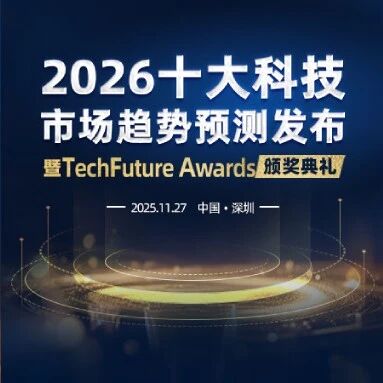
Core Insights - The article emphasizes the transformative impact of AI on the global technology industry, suggesting that it is not merely an iterative process but a complete "script rewrite" of the future landscape [2][3]. - The upcoming "2026 Top Technology Market Trends Forecast" event by TrendForce aims to unveil key insights into industry dynamics and hidden opportunities [4][9]. Group 1: AI and Technology Trends - AI computing is experiencing explosive growth in data volume and memory bandwidth requirements, leading to challenges in transmission speed and energy consumption [2]. - The next-generation AI architecture will focus on overcoming limitations in memory bandwidth and data transmission rates [2]. Group 2: Semiconductor Industry Developments - The semiconductor foundry sector is entering a competitive phase with the production of 2nm technology, where the competition will involve multi-dimensional systemic challenges rather than just single technology contests [2]. - Major players like TSMC, Intel, and Samsung are competing with advanced packaging solutions, indicating that the decisive factors in this race are more complex than anticipated [2]. Group 3: Robotics and Automation - Humanoid robots are expected to transition from laboratory settings to industrial applications, with projected explosive growth in shipments by 2026, potentially disrupting the global labor market [3]. Group 4: Upcoming Event and Awards - The "2026 Top Technology Market Trends Forecast" event will focus on ten core sectors, including semiconductor foundries, HBM, NAND Flash, AI servers, third-generation semiconductors, energy storage, display panels, near-eye displays, humanoid robots, and autonomous driving [9][10]. - The event will also feature the TechFuture Awards, recognizing outstanding achievements in technology innovation, commercial implementation, market promotion, and ecosystem development [10].
杉杉股份重整生变,重新招募意向投资人
WitsView睿智显示· 2025-11-10 09:46
Group 1 - The core point of the article is that Ningbo Shanshan Co., Ltd. has faced a setback in its restructuring process as the draft restructuring plan was not approved by the creditors' meeting, leading to the termination of the restructuring investment agreement with its controlling shareholder, Shanshan Group, and its wholly-owned subsidiary, Pengze Trading [1][3] - Shanshan Group and Pengze Trading hold a combined 23.37% stake in Shanshan Co., with a significant portion of these shares being pledged, judicially frozen, or marked for pending freezing [3] - The uncertainty surrounding the successful restructuring of Shanshan Group and Pengze Trading may lead to adjustments in shareholder equity, potentially affecting the control of the company [3] Group 2 - Shanshan Co. specializes in lithium battery anode materials and polarizers, including the R&D, production, and sales of LCD and OLED polarizers [3] - In the first half of 2025, Shanshan Co. achieved a revenue of 9.858 billion yuan, representing a year-on-year growth of 11.78%, and a net profit attributable to shareholders of 207 million yuan, reflecting a remarkable year-on-year increase of 1,079.59% [3] - In September, TCL Technology announced plans to invest up to 500 million yuan to acquire 43.709 million shares of Shanshan Co., which would represent 1.94% of the total share capital, with voting rights to be entrusted to an investment platform [3]


友达、群创等6家台湾地区面板厂公布10月营收
WitsView睿智显示· 2025-11-10 09:46
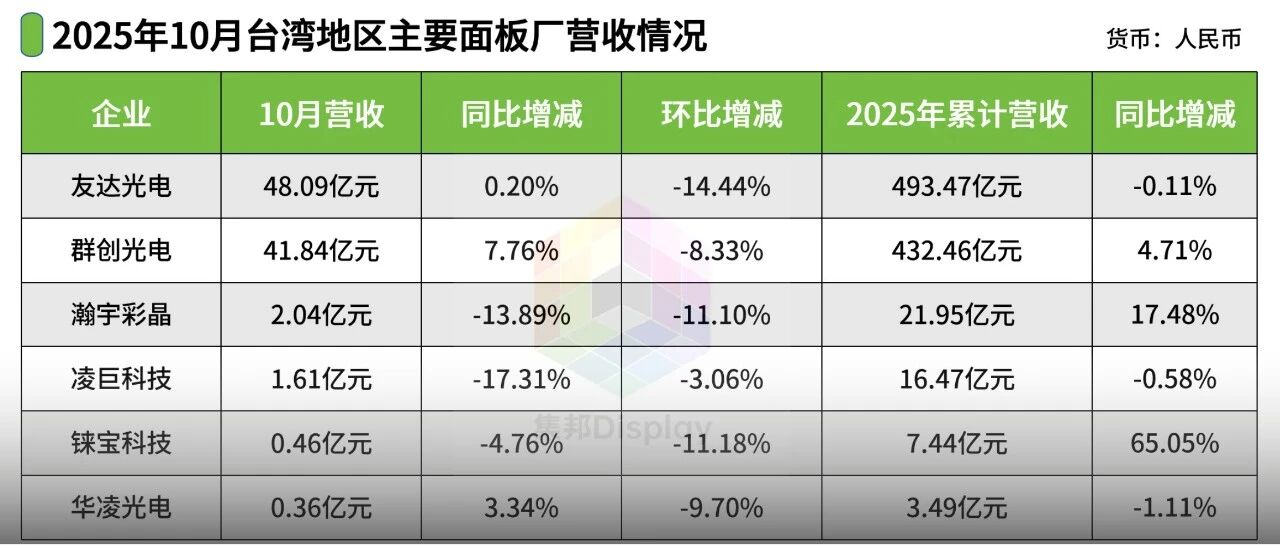
Core Viewpoint - The revenue performance of six Taiwanese panel manufacturers in October 2025 shows a mixed trend, with a general decline in month-over-month revenue, indicating a slowdown in market demand and shipment pace at the beginning of the fourth quarter [1][2][3]. Revenue Performance Summary - **AU Optronics**: October revenue was 4.809 billion RMB, a slight year-over-year increase of 0.20%, but a significant month-over-month decline of 14.44%. Cumulative revenue for 2025 reached 49.347 billion RMB, showing a minor decrease of 0.11% compared to the previous year [1][2]. - **Innolux**: Reported October revenue of 4.184 billion RMB, with a year-over-year growth of 7.76%, but a month-over-month decline of 8.33%. Cumulative revenue for 2025 was 43.246 billion RMB, reflecting a stable growth of 4.71% [1][2]. - **HannStar Display**: October revenue was 204 million RMB, down 13.89% month-over-month but up 17.48% year-over-year, with cumulative revenue of 2.195 billion RMB [1][3]. - **Lianjia Technology**: Recorded 161 million RMB in October revenue, a month-over-month decrease of 17.31% and a slight year-over-year decline of 0.58%, with cumulative revenue of 1.647 billion RMB [1][3]. - **Rohm Technology**: October revenue was 46 million RMB, showing a month-over-month increase of 91.18% but a year-over-year decline of 4.76%. Cumulative revenue reached 744 million RMB, with a significant year-over-year growth of 65.05% [1][3]. - **Hua Ling Optoelectronics**: Reported 36 million RMB in October revenue, a month-over-month decline of 9.70% and a year-over-year decrease of 1.11%, with cumulative revenue of 349 million RMB [1][3]. Market Dynamics - The overall market showed signs of cooling in October, with all six manufacturers experiencing month-over-month revenue declines, reflecting a potential slowdown in market demand and shipment pace [1][3]. - Despite the single-month performance downturn, cumulative revenue growth rates for the first ten months of 2025 varied significantly among manufacturers, with Rohm Technology leading at 65.05% and HannStar Display at 17.48% [3]. Strategic Developments - **AU Optronics**: Announced a new capital expenditure plan for its Mexico facility, expected to start production in 2027, aimed at meeting the growing demand in the automotive market and enhancing its supply chain for North American clients [5]. - **Lianjia Technology**: Plans to acquire usage rights for production assets in Japan to enhance its color filter production capabilities [5]. - **Rohm Technology**: Entering the medical contract development and manufacturing services (CDMO) sector, collaborating with UK-based Adtec Healthcare to develop a low-temperature plasma medical platform, marking a strategic shift towards the medical field [5].
传三星显示开始量产硅基OLED
WitsView睿智显示· 2025-11-10 09:46
Core Insights - Samsung Display has officially commenced mass production of silicon-based OLED (OLEDoS) panels, which will be used in Samsung Electronics' XR headset "Galaxy XR" that was launched in October [1][2] - The Galaxy XR features two OLEDoS panels with a 4K resolution (3552×3840) and a high pixel density of 4032 PPI, achieving a color gamut coverage of 95% of the DCI-P3 standard [2][4] - This marks Samsung Display's first entry into the OLEDoS market, indicating a growing competitive landscape as companies like Meta, Apple, and Samsung Electronics invest in XR device development [2][4] Product Specifications - The OLEDoS panels in the Galaxy XR utilize a white backlight design with color filters to produce RGB colors, and have a base refresh rate of 72Hz [2] - Samsung Display has demonstrated prototype products with a maximum resolution of 5000 PPI and brightness levels reaching 20,000 nits, although the RGB OLEDoS technology is still in the R&D phase and not yet commercially available [4] Future Plans - Samsung Display plans to expand its OLEDoS business and is pursuing collaboration opportunities with Apple [2] - The company has established a new department focused on the R&D and commercialization of next-generation core technology, specifically RGB OLEDoS, following its acquisition of the American company eMagin in 2023 [2]

全球第一!京东方Q3手机面板出货1.45亿片
WitsView睿智显示· 2025-11-10 09:46
Core Insights - The global smartphone panel shipment is projected to reach 586 million units in Q3 2025, with a quarter-on-quarter increase of 8.1% and a year-on-year increase of 5.3% driven by the iPhone 17 series and other major brands' new releases [2] - The total smartphone panel shipment for 2025 is expected to be 2.243 billion units, marking a year-on-year growth of 3.4%, representing a recent peak [2] AMOLED Panel Insights - Q3 2025 AMOLED smartphone panel shipments reached 246 million units, reflecting a quarter-on-quarter increase of 9.9% [3] - The increasing adoption of AMOLED panels in mid-range models is expected to enhance overall penetration rates [3] - Samsung Display maintains a 40% market share in the high-end segment, while BOE continues to supply iPhone and other major brands [4] LCD Panel Insights - Q3 2025 LCD smartphone panel shipments increased by 6.9% to 340 million units [4] - BOE leads the market with over 30% shipment share, while HKC and TCL Huaxing are also increasing their a-Si LCD shipments [4] - The low-end a-Si LCD market is supported by cost advantages and demand from the after-sales repair market, while LTPS LCD demand continues to decline [4] Market Trends and Future Outlook - The growth momentum for the smartphone panel market in 2025 is primarily driven by the rising penetration of AMOLED technology and close collaboration between Chinese panel manufacturers and brands [6] - Despite limited overall smartphone demand growth, AMOLED panels are expected to expand steadily due to technological upgrades and cost reductions, while LCD will continue to support the entry-level market [6] - By 2026, it is anticipated that AMOLED panel shipments will exceed 45% of the market, with LCD maintaining around 55% [6]

重磅!合肥国资拟29.37亿控股维信诺
WitsView睿智显示· 2025-11-09 13:00
Core Viewpoint - The company, Visionox, plans to issue A-shares to a specific investor, Hefei Jianshu Investment Co., Ltd., to raise up to 2.93 billion yuan, primarily for working capital and debt repayment [1][4]. Group 1: Stock Issuance Details - Visionox intends to issue no more than 419,036,598 shares, which does not exceed 30% of the total shares before the issuance [1]. - The pricing for the new shares is set at 7.01 yuan per share, with total fundraising expected to be no more than 293,744.66 thousand yuan (29.37 billion yuan) [1]. Group 2: Related Party Transactions - Hefei Jianshu, as a related party, will subscribe to the shares in cash, constituting a related party transaction [4]. - The issuance requires several approvals, including shareholder meeting approval, government authority consent, and regulatory approvals from the Shenzhen Stock Exchange and the China Securities Regulatory Commission [4]. Group 3: Control Changes - Before the issuance, Visionox has no controlling shareholder or actual controller; if the issuance proceeds, Hefei Jianshu will become the controlling shareholder [4]. - Hefei Jianshu was established in 2021 and is controlled by the Hefei Shushan District People's Government [5]. Group 4: Company Background and Strategy - Visionox focuses on new display technologies, including the research, production, and sales of OLED and Micro LED displays, with applications in smartphones, wearables, tablets, laptops, automotive displays, and large-size displays [4]. - The company aims to enhance its strength and promote sustainable long-term development through this transaction, which will also help maintain the interests of minority shareholders and boost market confidence [7].


总投资10亿,年产1200万套柔性OLED模组项目落地江西
WitsView睿智显示· 2025-11-07 07:33
Group 1 - The core viewpoint of the article is that Chipview has established its K3 factory in Fengcheng, Jiangxi, with a total investment of 1 billion yuan, focusing on high-end OLED module manufacturing [1] - The K3 project will be implemented in two phases: Phase 1 aims for an annual production of 12 million flexible OLED modules with 2 fully automated production lines, while Phase 2 targets an annual production of 2.5 million silicon-based OLED display modules, also with 2 fully automated production lines [1] - The project is expected to achieve production in Phase 1 by the end of December 2025, with an estimated annual output value exceeding 1 billion yuan upon full production [1] Group 2 - Chipview specializes in silicon-based OLED microdisplay technology, providing silicon-based OLED microdisplay devices and flexible AMOLED display modules, which are widely used in VR/AR, electronic viewfinders, special applications, automotive, and mobile portable smart devices [4] - Since 2021, the company has completed 4 rounds of financing, with 3 rounds exceeding 100 million yuan, and the highest single financing amount reaching 600 million yuan [4] - The company has also established the K1 factory in Huainan, Anhui, with a total investment of 100 million yuan, which began production in April 2023, focusing on silicon-based OLED microdisplays and flexible OLED mobile screens, with an annual output value of 200 million yuan [4] - In June 2023, the K2 factory in Huainan, Anhui, with a total investment of 1.5 billion yuan, commenced construction, planning a monthly capacity of 4,000 pieces of 12-inch wafers, primarily for Micro OLED microdisplays used in AR/VR/MR applications, with production expected to be operational by the end of 2025 [4]

面向65至85英寸电视市场,创维光显背光灯板产线扩产
WitsView睿智显示· 2025-11-07 04:04
Group 1 - The core viewpoint of the article highlights recent developments in the display technology sector, specifically focusing on the new projects by Skyworth Optoelectronics and Yue Da Optoelectronics in the backlight and automotive display fields [1]. Group 2 - Skyworth Optoelectronics has successfully upgraded its backlight lamp production line, adding a new line that increases monthly capacity by over 6,000 TV backlight panels and reduces delivery time by approximately 20% [2]. - The new production line spans about 90 meters and achieves a product yield rate of 99.8%, utilizing embedded automated baking equipment to realize energy savings of around 40% [2]. - The expansion targets the large-size TV market, specifically for screens ranging from 65 to 85 inches, and aims to lower costs through enhanced panel area and improved splicing technology [3]. - Skyworth Optoelectronics plans to implement AGV logistics and smart warehousing systems within three years to advance its automation efforts [3]. - The production line collaborates with Skyworth's flat panel company, creating a regional industrial chain from backlight modules to complete machines, and interacts with local companies like BOE in the materials sector to enhance the Mini LED industry ecosystem [3]. Group 3 - Yue Da Optoelectronics has commenced construction on its advanced manufacturing base for automotive intelligent displays, with a total investment of 100 million yuan and a site area of 7,252.94 square meters [5]. - The project aims to produce central control screens and liquid crystal instruments, with an expected annual output value of 200 million yuan and the creation of approximately 30 jobs [5]. - Yue Da Optoelectronics specializes in providing core modules for intelligent cockpit optical displays for new energy vehicles, with its main products including central entertainment systems, liquid crystal instruments, electronic mirrors, and ceiling screens [5]. - The launch of the automotive project signifies a milestone for Yue Da, marking its transition to a higher-end and smarter manufacturing phase, and reflects the company's commitment to the future of intelligent mobility [5].