具身智能之心

Search documents
你的VLA太慢了!?算力不够也能提速:这篇综述教你打造高效VLA新范式
具身智能之心· 2025-10-24 16:03
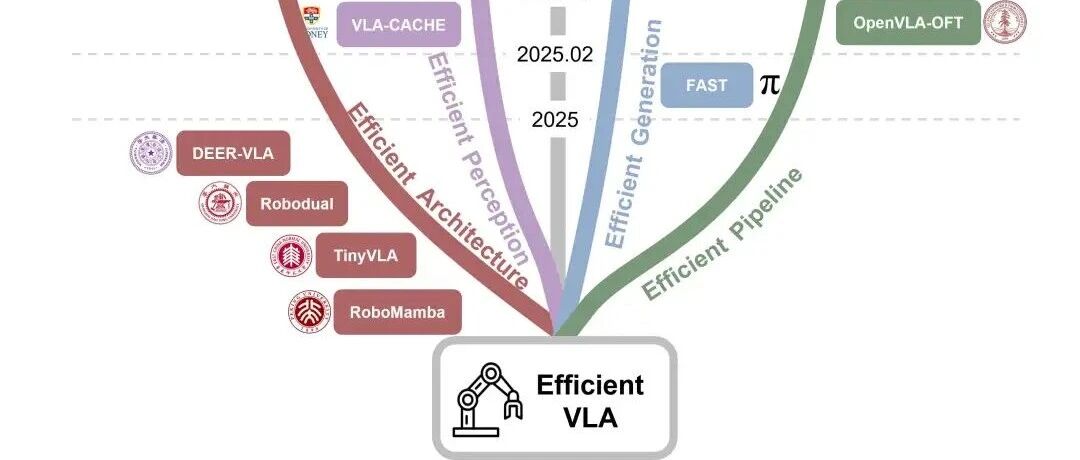
Core Insights - The article emphasizes the importance of efficiency in Vision-Language-Action (VLA) models, which are crucial for enabling robots to understand their environment and execute tasks effectively. It identifies efficiency as a key bottleneck that hinders the transition of VLA models from research to practical applications [3][4][7]. Background and Value - The rapid development of embodied intelligence has led to the emergence of VLA models as a core framework for robotic task execution. However, current VLA systems face significant challenges related to computational and storage demands, as well as high inference latency, which are critical for real-time applications [3][4][7]. Efficiency Bottlenecks - The review systematically analyzes the efficiency issues in VLA models across four dimensions: model architecture, perception features, action generation, and training/inference processes. It highlights that efficiency challenges are systemic and not limited to single-point optimizations [3][4][7]. Classification Framework - The article categorizes existing efficient VLA strategies into four complementary dimensions: efficient architecture design, perception feature compression, action generation acceleration, and training/inference optimization. This classification provides a comprehensive understanding of the design logic and trade-offs of current methods [4][6][7]. Future Trends and Directions - The review outlines future directions for VLA models, emphasizing the need for a balance between capability enhancement and computational cost. Key areas for efficiency optimization include data utilization, perception features, action generation, and learning strategies [4][25][26]. Efficient Perception Features - Optimizing visual input, which constitutes the largest computational overhead in VLA models, can be approached through selective processing of features and temporal feature reuse. These strategies aim to reduce redundant calculations while maintaining performance [13][15][16]. Efficient Action Generation - Action generation strategies focus on minimizing latency while ensuring task accuracy. Techniques include outputting low-dimensional continuous action vectors and introducing explicit reasoning to enhance interpretability and generalization across tasks [18][21]. Efficient Training and Inference - Training strategies aim to reduce adaptation costs for new tasks and environments through methods like parameter-efficient fine-tuning and knowledge distillation. Inference strategies focus on breaking the autoregressive bottleneck to enable parallelization and mixed decoding [22][24]. Future Outlook - The article suggests that future VLA models should prioritize collaborative design between models and data, efficient spatiotemporal perception, and robust action encoding. It also calls for a standardized evaluation framework to measure efficiency improvements [25][26][27].

浙大 | EMP框架让人形机器人“学动作不摔倒”!
具身智能之心· 2025-10-24 16:03
以下文章来源于具身智能研究室 ,作者小智 具身智能研究室 . 我们是一群AI探险家,聚焦智能体与具身智能的知识分享。在这里,您将获得:✓ 精选论文解读 ✓ 核心算法抽丝剥茧 ✓ 前沿技术动态速递 。期待与每 一位好奇的您,共同构建AI的未来图景。 作者丨 小智 编辑丨具身智能研究室 点击下方 卡片 ,关注" 具身智能之心 "公众号 >> 点击进入→ 具身 智能之心 技术交流群 更多干货,欢迎加入国内首个具身智能全栈学习社区 : 具身智能之心知识星球 (戳我) , 这里包含所有你想要的。 研究背景与核心创新点 EMP通过上半身模仿 + 下半身平衡 + 可执行修正,实现安全稳定的人形控制 项目主页 : https://anonymous.4open.science/w/EMP-project-page-4D58/ 小编观点 EMP 的亮点不只是控制策略本身,而是它代表了人形机器人强化学习的一个 新范式 不再让 RL 去"硬学全部物理",而是在 RL 前插入一个"动作可行性网络",帮它判断什么该做、什么不该做。 在未来,如果再结合 VLA(VLA-RL、Helix、ControlVLA),我们可能会看到——机器人在 ...

强化学习是怎么赋能人形/四足/机械臂等本体的?学术界是怎么展开的?
具身智能之心· 2025-10-24 10:00
Core Insights - Reinforcement Learning (RL) remains a significant field, with increasing applications in robotics, including humanoid and quadruped robots, as well as in product optimization across various industries [1][2][3] - The complexity of RL poses challenges for newcomers, making it difficult to produce publishable research papers without a structured learning system [5][9] - To address these challenges, a specialized 1v6 mentoring course in RL has been launched, aimed at helping students produce quality research papers [6][9] Group 1: Importance of Reinforcement Learning - RL is crucial for tasks such as gait control in embodied intelligent robots, which is essential for achieving general-purpose capabilities [2] - Companies like Yushun and Zhiyuan utilize RL for humanoid robots to perform complex actions like climbing stairs, running, and dancing, enabling applications in rescue and hazardous environments [2][8] Group 2: Challenges in Learning and Research - The vast and intricate nature of RL makes it difficult for beginners to enter the field, often leading to frustration and abandonment of studies [5][9] - Producing a research paper requires proficiency in methodology, experimental results, and writing, with any misstep potentially resulting in low scores from reviewers [5] Group 3: Course Offerings and Structure - The 1v6 mentoring course is designed for graduate students and others needing guidance on research papers, featuring small class sizes and weekly live sessions [7][9] - The course spans 14 weeks of intensive training followed by 8 weeks of maintenance support, focusing on various aspects of RL and robotics [9][15] - Participants will receive guidance on paper ideas, project implementation, experimental guidance, writing refinement, and initial draft formation for conferences like RAL, ICRA, IROS, and CoRL [7][9][15] Group 4: Course Content and Deliverables - The curriculum includes topics such as RL fundamentals, simulation environments, sim2real techniques, and writing guidance, with a focus on practical applications in quadruped, humanoid, and robotic arms [17][19][20] - Students will produce a research paper draft by the end of the course, with support for revisions and submission processes [23][28]
有的同学还没入门具身,有的已经CCF-A!?
具身智能之心· 2025-10-24 10:00
Group 1 - The article introduces a new paper tutoring service that offers one-on-one customized guidance in various advanced research areas such as multimodal models, reinforcement learning, and robotics simulation [1] - The tutoring service covers a wide range of academic levels, from CCF-A to CCF-C and SCI Zone 1 to Zone 4, including support for graduation theses and doctoral applications [1] - The team consists of experienced PhD mentors and researchers from top universities and leading companies, with expertise in reviewing papers for prestigious conferences like ICML, ICLR, and NeurIPS [1] Group 2 - The service emphasizes a dual perspective from both industry and academia, focusing not only on publishing papers but also on their practical value [2] - The first ten students who inquire will receive a free matching with a dedicated mentor for in-depth analysis and tailored publication strategy suggestions [3]
劲爆!3.99万起!高灵巧双臂机器人竟能拉小提琴,打羽毛球?正式亮相IROS'25
具身智能之心· 2025-10-24 04:00
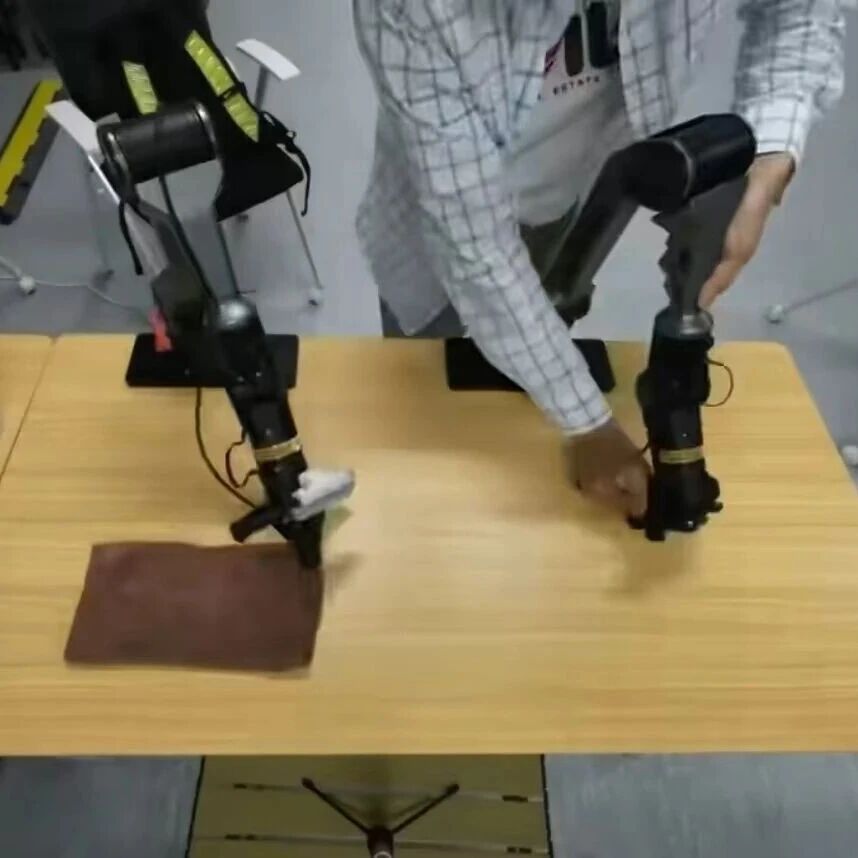
Core Viewpoint - VLAI Robotics has launched a cost-effective, high-load, and highly flexible humanoid robotic arm, addressing the high demands of research institutions and development teams while significantly lowering the entry barrier for scientific applications with a starting price of 39,900 yuan [1][10]. Group 1: Product Features - The robotic arm features a design that replicates human arm movement with 7 basic degrees of freedom plus 1 for the gripper, totaling 8 DOF per arm and 16 DOF for both arms, allowing it to perform high-precision tasks [6][4]. - It can handle a peak load of 6 kg per arm and 12 kg for both arms, making it suitable for various applications including research experiments, industrial assistance, and educational demonstrations [6][8]. - The arm utilizes biomimetic kinematics modeling and high compliance control strategies to closely mimic human movements, enhancing its ability to perform tasks that require natural motion [8][12]. Group 2: Development and Manufacturing - The development process involved collaboration with the Japanese OpenArm team, which provided open-source design standards and quality control, ensuring that the product meets international standards [2][10]. - The manufacturing team implemented systematic performance optimizations, including harness restructuring and lightweight design, to balance strength, flexibility, and energy efficiency [12][14]. - The use of high-strength materials in critical areas and lightweight engineering plastics in non-load-bearing parts contributes to the arm's stability and responsiveness [12][14]. Group 3: Market Positioning and Accessibility - The pricing strategy of 39,900 yuan significantly reduces the cost barrier for research-grade performance, making advanced robotics more accessible to a wider audience [10][14]. - The product is designed for an open ecosystem, allowing users to expand functionalities such as remote control and dual-arm collaboration without the need for expensive proprietary software [14][10]. - The company plans to adapt advanced algorithms for physical AI and intelligent agent training, further broadening the application scenarios and enhancing human-robot interaction capabilities [14][16]. Group 4: Future Plans and Engagement - VLAI Robotics and the OpenArm team will showcase the robotic arm at the IROS 2025 conference in Hangzhou, providing live demonstrations and technical explanations [17]. - The initial batch of 300 units is available for pre-order, with customization options for specific research and production needs [18][19].

VLA2:浙大x西湖大学提出智能体化VLA框架,操作泛化能力大幅提升
具身智能之心· 2025-10-24 00:40
Core Insights - The article presents VLA², a framework designed to enhance the capabilities of vision-language-action models, particularly in handling unseen concepts in robotic tasks [1][3][12] Method Overview - VLA² integrates three core modules: initial information processing, cognition and memory, and task execution [3][5] - The framework utilizes GLM-4V for task decomposition, MM-GroundingDINO for object detection, and incorporates web image retrieval for visual memory enhancement [4][7] Experimental Validation - VLA² was compared with state-of-the-art (SOTA) models on the LIBERO Benchmark, showing competitive results, particularly excelling in scenarios requiring strong generalization [6][9] - In hard scenarios, VLA² achieved a 44.2% improvement in success rate over simply fine-tuning OpenVLA [9][10] Key Mechanisms - The framework's performance is significantly influenced by three mechanisms: visual mask injection, semantic replacement, and web retrieval [7][11] - Ablation studies confirmed that each mechanism contributes notably to the model's performance, especially in challenging tasks [11] Conclusion and Future Directions - VLA² successfully expands the cognitive and operational capabilities of VLA models for unknown objects, providing a viable solution for robotic tasks in open-world settings [12] - Future work will focus on exploring its generalization capabilities in real-world applications and expanding support for more tools and tasks [12]

Meta AI大裁600人,亚历山大王操刀重点砍向LeCun团队
具身智能之心· 2025-10-24 00:40
Core Insights - Meta is undergoing significant layoffs in its AI division, with 600 employees expected to be affected, particularly in the FAIR lab and AI product departments, indicating a shift in strategy and focus within the company [2][6][9]. Group 1: Layoffs and Restructuring - The new Chief AI Officer, Alexander Wang, is leading the layoffs, citing the need to reduce bureaucracy and create a more agile operational model within Meta AI [6][8]. - Employees were informed about their job status on Wednesday morning, indicating a swift and decisive approach to the restructuring [7]. - The layoffs reflect CEO Mark Zuckerberg's growing anxiety over the lack of breakthroughs or performance improvements in Meta AI, suggesting a critical reassessment of the division's direction [9]. Group 2: Impact on Research and Development - The FAIR lab, led by Yann LeCun, is facing significant changes, including a new policy requiring external publication of research papers to undergo additional review by the newly established TBD Lab [10]. - This policy has been met with resistance from LeCun, who values academic freedom, and he has distanced himself from the Llama project, indicating potential dissatisfaction with the current direction of Meta's AI research [11][12]. - The TBD Lab, however, remains unaffected by the layoffs and is actively hiring, suggesting a strategic pivot towards new talent and projects [3].


你的第一套具身科研平台来了,高性价比+代码开发方便
具身智能之心· 2025-10-24 00:40
Core Viewpoint - Imeta-Y1 is a lightweight, cost-effective robotic arm designed specifically for beginners and researchers in the field of embodied intelligence, enabling low-cost and efficient algorithm validation and project development [2][5]. Group 1: Product Features - The robotic arm offers a complete open-source toolchain and code examples, facilitating a seamless process from data collection to model deployment [3][17]. - It supports dual-language interfaces (Python/C++) to cater to users' programming preferences, ensuring quick onboarding [3][18]. - Compatibility with ROS1 and ROS2 is provided, along with URDF models for smooth transitions between simulation and real-world applications [3][19]. - The arm features high-precision motion control, low power consumption, and an open hardware architecture, allowing for seamless integration from simulation to real machine [5][35]. Group 2: Technical Specifications - The robotic arm has a weight of 4.2 kg, a rated load of 3 kg, and 6 degrees of freedom, with a working radius of 612.5 mm and a repeat positioning accuracy of ±0.1 mm [8][19]. - It operates at a supply voltage of 24V and utilizes CAN communication, with external interfaces for power and CAN [8][19]. - The arm's joint motion range and maximum speeds are specified, ensuring versatility in various applications [8][19]. Group 3: Development and Support - A comprehensive open-source SDK is provided, including drivers, API interfaces, sample code, and documentation, supporting rapid application development [26][29]. - The product supports multi-modal data fusion, compatible with mainstream frameworks like TensorFlow and PyTorch, enabling end-to-end intelligent algorithm implementation [29][32]. - The company offers 24-hour quick response for after-sales support, ensuring users receive timely assistance [3][19]. Group 4: Testing and Reliability - Rigorous hardware testing processes, including precision calibration, durability, load performance, and stability verification, are conducted to ensure reliability and safety in various application scenarios [35][39].
宇树之外,这个狗子勇夺IROS 2025四足机器人挑战赛冠军
具身智能之心· 2025-10-24 00:40
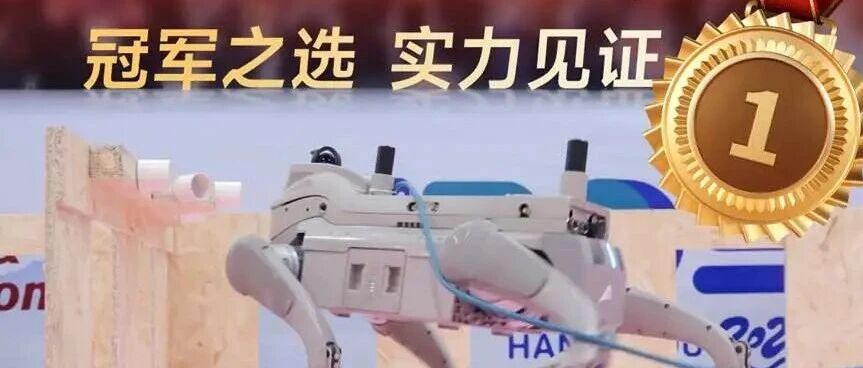
Core Insights - The article highlights the victory of the ZsiMan team from the University of Manchester at the IROS 2025 Quadruped Robot Challenge, marking a significant achievement as they won the championship in their first participation using the Steel Coin L1 robot platform [1][8]. Group 1: Competition Overview - The IROS Quadruped Robot Challenge is a prestigious event in the robotics field, known for its challenging course design and strict scoring criteria, often referred to as the "Olympics" of robotic dogs [4][6]. - The competition attracted top teams from renowned institutions, including MIT and ETH Zurich, with a history of using primarily overseas brands like Boston Dynamics in previous championships [6][8]. Group 2: Steel Coin L1 Robot Features - The Steel Coin L1 robot, developed by Zhishen Technology, stands out as the only non-YuTree machine in the competition, showcasing a peak torque of 48 N·m, which allows it to compete effectively against larger robots weighing up to 50 kg [3][11]. - The robot's advanced capabilities stem from its self-developed joint modules and the integration of high-performance components, including Intel RealSense cameras, Livox Mid360 LiDAR, and NVIDIA Orin NX computing units, enabling superior multi-modal perception and edge computing [11][15]. Group 3: Simulation and Training - Zhishen Technology's open-source high-fidelity research simulation environment, MATRiX, provides a virtual testing ground for various research tasks, significantly reducing the algorithm iteration cycle by 70% and allowing teams to prepare thoroughly for diverse terrains [13][15]. - The seamless transition from simulation to real-world deployment is facilitated by the comprehensive toolchain offered by MATRiX, enhancing the research and development capabilities of participating teams [13]. Group 4: Implications of the Victory - The championship win not only underscores the algorithm development prowess of Professor Pan's team from the University of Manchester but also validates the comprehensive technological advantages of the Steel Coin L1 robot in a highly competitive environment [15]. - This achievement signifies the emergence of a new innovative robotic platform that combines robust physical performance with advanced intelligence, showcasing its competitive edge in the field of robotics [15].
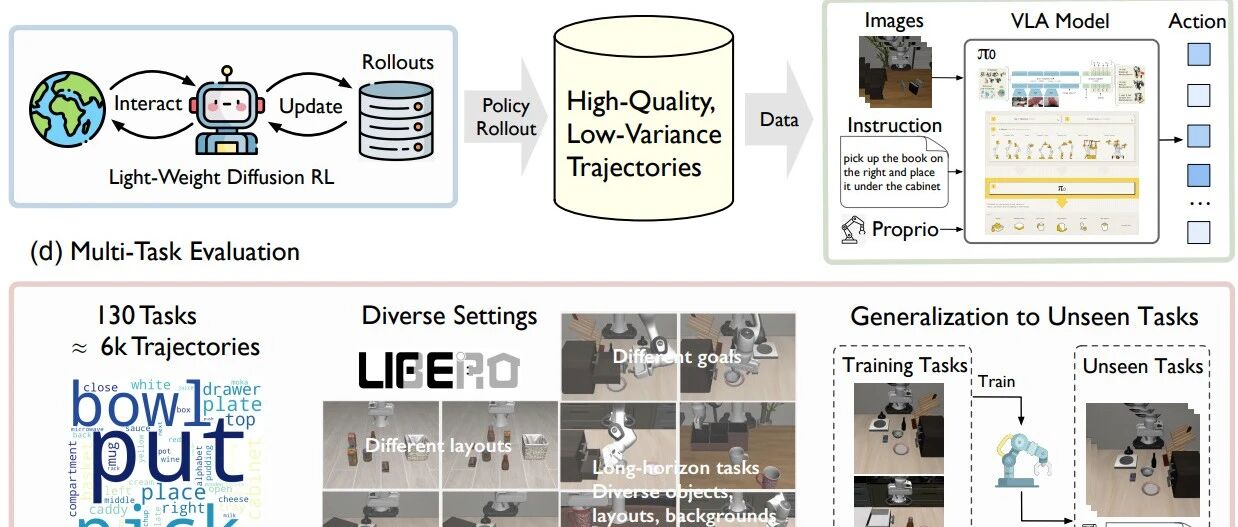
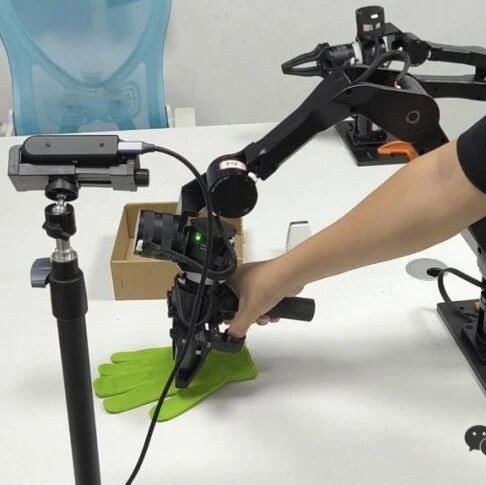
港科大最新!超越人类示范:基于扩散的强化学习为VLA训练生成 “高质量、低方差“ 数据
具身智能之心· 2025-10-23 04:00
Core Insights - The article discusses the limitations of traditional human demonstration data in training Visual-Language-Action (VLA) models and introduces a novel diffusion-based reinforcement learning (RL) approach to generate high-quality training data [2][5]. Group 1: VLA Model and Data Generation - VLA models integrate visual, language, and action information, but their performance is often constrained by the quality and scale of manually collected data [5]. - The proposed diffusion RL algorithm offers a semi-automated method for high-quality data collection suitable for VLA training, enhancing model performance [5]. Group 2: Methodology and Results - The study presents an improved diffusion strategy optimization algorithm that generates high-quality, low-variance trajectories for VLA training [2]. - Evaluation on the LIBERO benchmark, which includes 130 long-horizon tasks, shows that the generated trajectories are smoother and more consistent than human demonstration data and outperform standard Gaussian RL-generated trajectories [2]. - Training VLA models solely on data generated by diffusion RL achieves an average success rate of 81.9%, which is a 5.3 percentage point improvement over human data and a 12.6 percentage point improvement over Gaussian RL data [2]. Group 3: Key Highlights - The article emphasizes the potential of RL-driven robot trajectory generation and the adaptability of the general RL framework to any VLA architecture [6]. - It highlights the performance breakthroughs that exceed human demonstrations, showcasing the effectiveness of the proposed approach [6].