HSBC HOLDINGS(00005)

Search documents
智通ADR统计 | 12月27日





智通财经网· 2025-12-26 23:56
Group 1 - Major blue-chip stocks showed mixed performance, with HSBC Holdings closing at HKD 124.291, up 0.40% from the previous close; Tencent Holdings closed at HKD 606.769, up 0.63% [1] Group 2 - Tencent Holdings reported a latest price of HKD 603.000, with an increase of HKD 1.000, representing a rise of 0.17% [2] - Ctrip Group saw a decrease of HKD 4.500, down 0.79%, closing at HKD 563.500 [2] - Meituan-W remained unchanged at HKD 103.200, with no price change [2] - BYD Company Limited increased by HKD 0.500, up 0.54%, closing at HKD 93.600 [2]

代理顾问机构Glass Lewis及ISS呼吁股东支持恒生私有化方案
Ge Long Hui A P P· 2025-12-26 16:06
Core Viewpoint - HSBC Holdings has proposed to privatize Hang Seng Bank at a price of HKD 155 per share, with a court meeting and special shareholder meeting scheduled for January 8 next year [1] Group 1: Transaction Details - The transaction logic is straightforward, offering cash consideration that provides tangible value to Hang Seng shareholders [1] - The proposed price represents a significant premium over the net asset value and transaction model [1] Group 2: Support from Advisory Firms - Two independent voting advisory firms, Glass Lewis and ISS, have urged shareholders to support the proposal [1] - Glass Lewis emphasizes that HSBC, as the long-term controlling shareholder, is the most logical and realistic buyer [1] - ISS views the proposed consideration as highly favorable for shareholders, presenting an ideal opportunity for them to exit and realize their investment [1] Group 3: Strategic Alignment - The privatization proposal aligns with HSBC's overall strategic development and will aid in further expanding its business in Hong Kong [1]


深度|银行业“瘦身”
2 1 Shi Ji Jing Ji Bao Dao· 2025-12-26 13:02
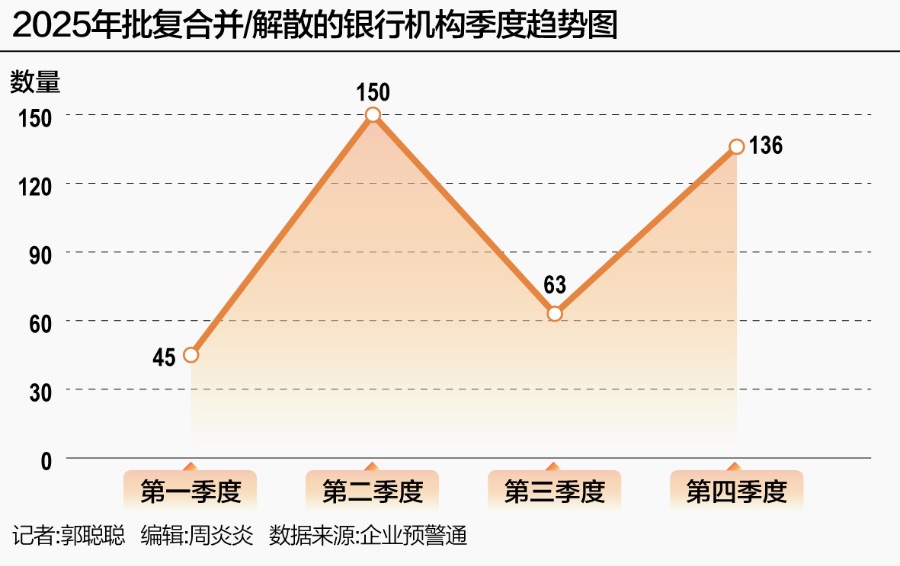
Core Insights - The wave of mergers and restructuring among China's small and medium-sized banks has progressed with unexpected intensity and speed, focusing on financial risk prevention and high-quality industry development as the core themes of the year [1][2]. Summary by Sections Mergers and Restructuring - As of December 26, 2025, a total of 394 banking institutions were approved to exit the market through mergers and dissolutions, doubling the total from 2024 [1][7]. - Between 2024 and 2025, nearly 550 banking institutions were reduced through mergers and restructuring, surpassing the total from the previous seven years [1]. - The restructuring involved 28 provinces, with Inner Mongolia leading by integrating 139 institutions, followed by Shandong (33), Henan (26), and others [1][9]. Characteristics of the Restructuring - The integration of small and medium-sized banks in 2025 is characterized by two significant trends: the involvement of state-owned banks in "village-to-branch" transformations and the acceleration of provincial-level reforms in the rural credit system [1][15]. - The core entities in the restructuring are village banks (231), followed by rural commercial banks (81) and rural credit cooperatives (71) [12]. Policy and Regulatory Framework - The central financial work conference in 2024 emphasized the need to "properly handle risks in small financial institutions," placing them alongside local debts and real estate as key areas for financial risk prevention [3]. - The regulatory focus during the "14th Five-Year Plan" period has been on risk prevention and resolution for small financial institutions, with a commitment to personalized reform strategies based on regional differences [4]. Achievements and Future Directions - Significant progress has been made in risk resolution, with over 40% more non-performing asset disposals compared to the previous five-year period, and the total capital and provisions in the industry exceeding 50 trillion yuan [5]. - The government work report for 2025 outlined a market-oriented and legal approach to risk resolution and transformation of local small financial institutions [5]. Service Upgrades and Market Dynamics - The restructuring is not merely a reduction in numbers but aims to enhance the quality and efficiency of financial services, particularly for rural and small enterprises [19][20]. - Merged institutions are expected to improve operational standards, risk resistance, and expand their service offerings through enhanced digital capabilities [19][20]. Long-term Outlook - The ongoing restructuring of small and medium-sized banks is anticipated to continue into 2026, with a focus on quality improvement and effective integration as the core theme [21].



2025年村镇银行大撤退
21世纪经济报道· 2025-12-25 16:08
Core Viewpoint - The year 2025 marks a significant retreat of village banks in China, with both domestic and foreign banks withdrawing from this sector due to various challenges and risks associated with village banking operations [1][2]. Group 1: Market Exit Trends - A total of 226 village banks have exited the market by December 25, 2024, with 93 banks exiting throughout the entire year [1]. - The trend of shrinking village banks was established early in 2024, with a focus on reform and restructuring as highlighted in the central government's directives [1]. Group 2: Reasons for Withdrawal - The primary reason for the exit of village banks, particularly foreign ones, is linked to the inherent risks associated with these institutions, as indicated by the People's Bank of China's Financial Stability Report, which identified 324 instances of risk warnings primarily involving village and rural commercial banks [2]. - Foreign banks, such as HSBC, faced challenges in brand recognition and integration into local economies, leading to their gradual withdrawal from the village banking sector [5]. Group 3: Financial Performance - HSBC's village banks in China have issued loans totaling approximately 39.788 billion yuan, with a loan balance of about 2.36 billion yuan as of 2024, where agricultural loans accounted for 65.3% and small business loans for 85.83% of the total [8]. - The Chongqing Rongchang HSBC Village Bank reported a total of 4,174 customers, with a loan balance of 60.1224 million yuan, reflecting a modest increase of 1.22% from the previous year [8]. - Other village banks, such as Dazhu HSBC Village Bank, reported a decrease in loan balances and customer numbers, indicating a broader trend of declining profitability across HSBC's village banking network [9]. Group 4: Future Outlook and Recommendations - Despite the exit of village banks, the financial needs in county areas remain unmet, suggesting a shift in service providers rather than a decrease in demand [11]. - Experts recommend structural reorganization of village banks to refocus on core services and risk management, emphasizing their role in supporting rural revitalization and small enterprises [11][12].

展业近20年,外资行也在撤出村镇银行
2 1 Shi Ji Jing Ji Bao Dao· 2025-12-25 10:48
Core Viewpoint - The year 2025 marks a significant retreat for village banks in China, with both domestic and foreign banks withdrawing from this sector due to various challenges and risks associated with village banking operations [1][2]. Group 1: Market Exit Trends - A total of 226 village banks have exited the market as of December 25, 2024, compared to 93 that exited throughout 2024 [1]. - The central government's focus on "orderly reform and restructuring of village banks" has been highlighted in recent policy documents, indicating a shift towards addressing the risks associated with these institutions [2]. Group 2: Foreign Bank Withdrawals - The exit of foreign banks from the village banking sector, such as HSBC, is not surprising due to challenges like low brand recognition and difficulty integrating into local economies [3]. - HSBC was one of the first foreign banks to enter the rural market in China, establishing multiple village banks since 2007, but has now decided to withdraw [3][4]. Group 3: Financial Performance Challenges - Village banks, including HSBC's, have struggled to achieve profitability, with HSBC's village banks reporting a total loan issuance of approximately 39.788 billion yuan and a loan balance of about 2.36 billion yuan as of 2024 [6]. - The Chongqing Rongchang HSBC Village Bank reported a total of 4,174 customers, with only 172 being loan customers, and a loan balance of 60.1224 million yuan, reflecting a modest increase of 1.22% from the previous year [6][7]. Group 4: Broader Implications for Financial Services - The exit of foreign banks indicates a failure to adapt international banking standards to the local credit culture, which relies heavily on personal relationships and informal information [8]. - Despite the withdrawal of village banks, the demand for financial services in rural areas remains, with state-owned banks and local commercial banks stepping in to fill the gap [8][9].
智通ADR统计 | 12月25日
智通财经网· 2025-12-24 22:22
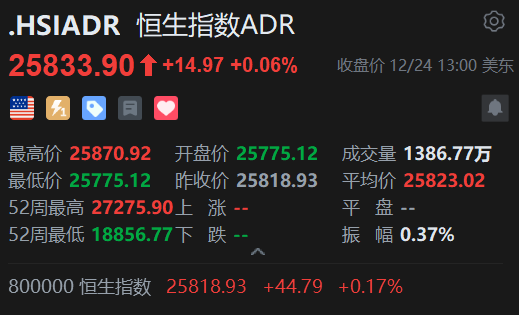
Market Overview - The Hang Seng Index (HSI) closed at 25,833.90, up by 14.97 points or 0.06% [1] - The index reached a high of 25,870.92 and a low of 25,775.12 during the trading session, with a trading volume of 13.8677 million [1] - The 52-week high for the index is 27,275.90, while the 52-week low is 18,856.77, indicating a fluctuation of 0.37% [1] Major Blue-Chip Stocks Performance - HSBC Holdings closed at 123.759 HKD, down 0.03% from the Hong Kong close [2] - Tencent Holdings closed at 602.001 HKD, down 0.17% from the Hong Kong close [2] - Alibaba Group (W) saw a decrease of 1.200 HKD, closing at 146.000 HKD, a drop of 0.82% [3] - China Construction Bank decreased by 0.050 HKD, closing at 7.560 HKD, a decline of 0.66% [3] - Xiaomi Group (W) increased slightly by 0.020 HKD, closing at 39.220 HKD, a rise of 0.05% [3] ADR Performance - Tencent's ADR closed at 602.001, down by 0.999 HKD or 0.17% compared to its Hong Kong stock price [3] - Alibaba's ADR closed at 145.796, down by 0.204 HKD or 0.14% compared to its Hong Kong stock price [3] - HSBC's ADR closed at 123.759, down by 0.041 HKD or 0.03% compared to its Hong Kong stock price [3] - AIA Group's ADR closed at 83.298, up by 0.048 HKD or 0.06% compared to its Hong Kong stock price [3]


港股市场2025年终盘点:IPO规模冠全球 多项指标创纪录
Zheng Quan Shi Bao· 2025-12-24 18:35
Core Viewpoint - The Hong Kong stock market is expected to fully recover in 2025 after experiencing a significant downturn from 2021 to 2024, with the Hang Seng Index dropping over 50% during that period. The market is now witnessing a resurgence driven by technological breakthroughs and strong IPO activity, leading to record levels in various capital market dimensions [1]. IPO Performance - The IPO scale in Hong Kong is projected to exceed 300 billion HKD in 2026, with 2025 expected to see an IPO scale of 286.3 billion HKD, reclaiming the title of the world's largest IPO market [2][3]. - Eight companies in the top ten IPOs of 2025 raised over 10 billion HKD each, with many being A-share companies listed in Hong Kong [3]. - The IPO failure rate has decreased significantly, reaching a low of 28.83% in 2025, attributed to market conditions and new pricing mechanisms implemented by the Hong Kong Stock Exchange [4]. New Share Subscription Records - The Hong Kong market has set multiple records in new share subscriptions, including a historic oversubscription of 11,465 times for the IPO of Jinye International Group, marking the highest oversubscription in Hong Kong's history [5]. Refinancing Market - The refinancing scale in Hong Kong surpassed 300 billion HKD in 2025, with a total of 3,166 billion HKD raised, significantly exceeding the total from the previous three years [6][7]. - Leading companies like Xiaomi and BYD are at the forefront of major refinancing projects, raising substantial amounts for business expansion and development [8]. Stock Index Performance - The Hang Seng Index recorded a year-to-date increase of 28.49% as of December 23, 2025, positioning it among the top global stock indices [9]. - Sectors such as innovative pharmaceuticals and non-ferrous metals have shown remarkable performance, with stocks like Yaojie Ankang experiencing a staggering increase of 950.95% [10]. Capital Inflows and Buybacks - Southbound capital inflows into the Hong Kong market reached a record high of approximately 1.41 trillion HKD in 2025, significantly enhancing market liquidity [11][12]. - Stock buybacks by listed companies totaled 1,759.36 billion HKD in 2025, with Tencent leading the buyback amounts [13][14]. - Dividends distributed by Hong Kong companies reached nearly 1.46 trillion HKD, surpassing the total for the entire year of 2024 [15]. Delisting Trends - The pace of delistings in Hong Kong accelerated in 2025, with 61 companies exiting the market, primarily due to privatization and forced delisting mechanisms [16].





智通港股52周新高、新低统计|12月24日


智通财经网· 2025-12-24 08:41
Group 1 - As of December 24, 49 stocks reached a 52-week high, with Shin-Etsu Holdings (06038), Gaoke Bridge (09963), and Easy Health (02661) leading the increase rates at 39.13%, 23.71%, and 16.39% respectively [1] - The closing prices and peak prices for the top three stocks are as follows: Shin-Etsu Holdings at 0.425 with a peak of 0.480, Gaoke Bridge at 1.040 with a peak of 1.200, and Easy Health at 66.800 with a peak of 69.600 [1] - Other notable stocks that reached new highs include Yijun Group Holdings (02442) at 14.060 (14.31% increase) and Jingxi International (02339) at 3.880 (13.78% increase) [1] Group 2 - The report also highlights 52-week lows, with Guanglian Technology Holdings (02531) experiencing the largest decline at -17.57%, closing at 4.760 with a low of 3.660 [2] - Other stocks that reached new lows include Caixing Toys (00869) at -8.51% and China Aoyuan (03883) at -8.00% [2] - The closing prices for the stocks at new lows include Guanglian Technology Holdings at 4.760, Caixing Toys at 0.435, and China Aoyuan at 0.076 [2]
3 Overseas Stocks to Buy for Portfolio Diversification in 2026
ZACKS· 2025-12-23 17:50
Core Insights - Investors are encouraged to diversify portfolios by adding international stocks alongside U.S. equities to enhance risk diversification as they approach 2026 [1] International Market Performance - The MSCI EAFE index has delivered a return of 30.48% year to date, outperforming the S&P 500, Nasdaq, and Dow Jones Industrial Average, which returned 17.2%, 21.5%, and 14.1% respectively [2] Earnings Growth and Valuation - A Charles Schwab report indicates that international stocks are expected to have a strong year in 2026, with double-digit earnings growth rates anticipated and these stocks currently attractively valued compared to the S&P 500 [3] Portfolio Recommendations - Adding overseas stocks can help investors tap into growth themes less correlated with U.S. markets, with Kinross Gold Corporation, Sony Group Corporation, and HSBC Holdings plc highlighted as strong additions for a resilient portfolio in 2026 [4] Kinross Gold Corporation (KGC) - Kinross Gold has diverse mining operations across several countries and reported third-quarter production of 504,000 ounces, with strong performance from high-quality assets [5][6] - The company has seen a 66% increase in free cash flow to $687 million and a net cash position of nearly $500 million, supporting development projects and shareholder returns [9] - KGC has an expected earnings growth of 147.1% for 2025, with shares up 211.5% year to date [10] Sony Group Corporation (SONY) - Sony has shifted towards an entertainment-focused strategy, with growth driven by PlayStation, which saw a 3% increase in monthly active users to 119 million [11][13] - The sales forecast for fiscal 2025 has been revised upward by 3%, supported by favorable forex movements and solid hardware sales [13] - SONY has a Zacks Rank of 2 (Buy) and shares have rallied 19.3% year to date [14] HSBC Holdings plc - HSBC is focusing on expanding operations in Asia and the Middle East, with net new invested assets in its Wealth business reaching $29 billion [15] - The bank's common equity tier 1 (CET1) ratio was 14.5% as of September 30, 2025, and it expects a dividend payout ratio of 50% for 2025 [17] - HSBC has an expected earnings growth of 14.92% for fiscal 2025, with shares surging 59.9% year to date [18]



HSBC vs. Barclays: Which Global Bank is Better Positioned for 2026?
ZACKS· 2025-12-23 14:01
Core Insights - HSBC and Barclays are restructuring to enhance operational efficiency and focus on core operations [1][2] HSBC Overview - HSBC is implementing a $1.5 billion cost-saving plan aimed at organizational simplification by 2026, with expected total severance and upfront charges of $1.8 billion [3] - The bank is divesting non-core operations in various regions, including the U.K., Europe, and the U.S., while concentrating on Asia and the Middle East [4] - HSBC is expanding its presence in Asia, proposing to privatize Hang Seng Bank and enhancing wealth operations in China and India [5] - Despite these initiatives, HSBC's revenue generation has been subdued due to a challenging macroeconomic environment and weak loan demand [6] Barclays Overview - Barclays is also simplifying operations, recently acquiring Best Egg for $800 million to strengthen its U.S. consumer finance capabilities [7] - The bank has divested its stake in Entercard Group for $273 million and its Germany-based consumer finance business, which is expected to improve profitability [8] - Barclays achieved gross savings of £1 billion in 2024 and anticipates total gross efficiency savings of £2 billion by the end of next year [9] Performance Comparison - Over the past six months, Barclays' shares increased by 43.9%, while HSBC's shares rose by 33.6%, outperforming the industry average of 26% [11] - In terms of valuation, HSBC has a price/tangible book (P/TB) ratio of 1.37X, while Barclays has a lower ratio of 0.96X, indicating that Barclays is relatively inexpensive [13] - Earnings estimates for HSBC suggest a 14.9% increase in 2025 and a 3.3% rise in 2026, while Barclays is projected to grow by 23.9% in 2025 and 21.3% in 2026 [15][17] Strategic Outlook - HSBC's strategic pivot towards high-growth Asian markets and comprehensive cost optimization positions it favorably for long-term gains despite near-term revenue pressures [19] - Barclays shows a stronger earnings outlook on paper, but its exposure to volatile capital markets raises concerns about consistent core income performance [20]