
SPC(00338)

Search documents
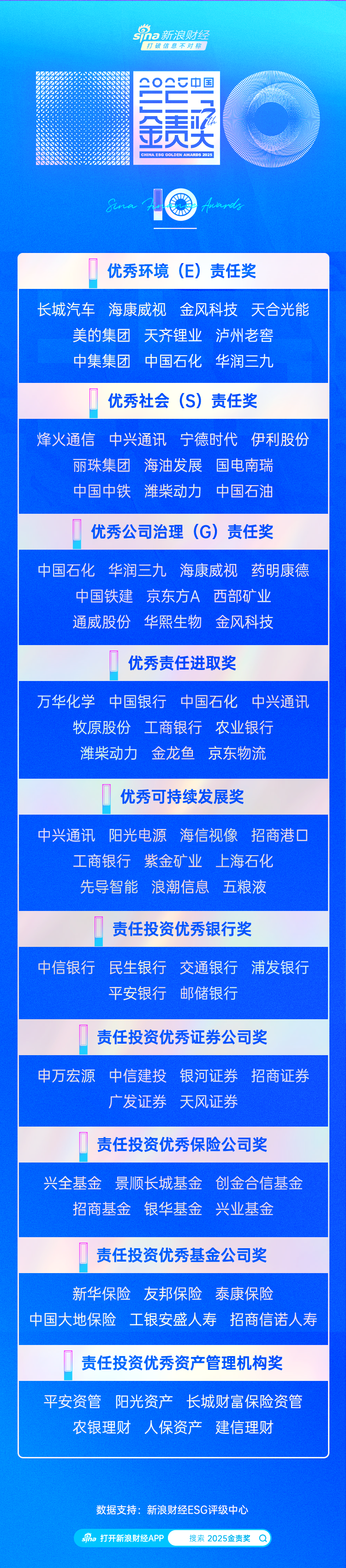
2025中国企业ESG“金责奖”优秀奖评选结果揭晓

Xin Lang Cai Jing· 2026-01-15 03:45
Core Viewpoint - The 2025 China Enterprise ESG "Golden Responsibility Award" aims to recognize companies and institutions that have made significant contributions to ESG initiatives in China, reflecting a shift from voluntary practices to compliance requirements in ESG performance [1][12]. Group 1: ESG Development and Awards Overview - By 2025, China's ESG development has transitioned from "setting standards" to "strengthening regulations," with a comprehensive disclosure standard system being established [1][12]. - The award selection attracted over 5,000 companies, with results based on ESG performance, online voting, and professional evaluations [2][12]. Group 2: Award Categories and Winners - The award categories include Excellent Environmental Responsibility Award, Excellent Social Responsibility Award, Excellent Corporate Governance Responsibility Award, Excellent Responsibility Initiative Award, Excellent Sustainable Development Award, and various responsibility investment awards [1][12]. - Notable winners of the Excellent Environmental Responsibility Award include Great Wall Motors, Hikvision, and China Petroleum [7][24]. - The Excellent Social Responsibility Award was awarded to companies such as YF Communication, ZTE, and Ningde Times [7][24]. - Winners of the Excellent Corporate Governance Responsibility Award include China Petroleum, Hikvision, and WuXi AppTec [7][24]. - The Excellent Responsibility Initiative Award was given to companies like ZTE, Sunlight Power, and Industrial and Commercial Bank of China [7][24]. - The Excellent Sustainable Development Award included companies such as WanHua Chemical, China Bank, and China Petroleum [7][24]. Group 3: Responsibility Investment Awards - The Responsibility Investment Excellent Bank Award was given to institutions like CITIC Bank and Minsheng Bank [5][21]. - The Responsibility Investment Excellent Securities Company Award included firms such as Shenwan Hongyuan and CITIC Securities [5][22]. - The Responsibility Investment Excellent Insurance Company Award recognized companies like New China Life and AIA [5][26]. - The Responsibility Investment Excellent Fund Company Award included firms such as Xinhua Fund and Harvest Fund [5][27]. - The Responsibility Investment Excellent Asset Management Institution Award recognized institutions like Ping An Asset Management and Sunshine Asset Management [5][28]. Group 4: Call to Action and Future Directions - The award committee encourages more Chinese enterprises to integrate ESG principles into their operations and strategic planning, emphasizing the importance of balancing commercial and social values [10][29].

ST开元(300338.SZ):目前暂未推广AI应用相关课程
Ge Long Hui· 2026-01-14 13:12
格隆汇1月14日丨ST开元(300338.SZ)在互动平台表示,公司目前暂未推广AI应用相关课程。公司将持续 关注人工智能等最新科技技术对教育内容,教育实现手段的创新影响。 ...

智通港股52周新高、新低统计|1月9日


智通财经网· 2026-01-09 08:48
Summary of Key Points Core Viewpoint - As of January 9, a total of 73 stocks reached their 52-week highs, with notable performances from Lingxiong Technology (02436), Delai Construction (01546), and Zhipu (02513) showing significant growth rates of 104.99%, 38.89%, and 22.22% respectively [1]. 52-Week Highs - Lingxiong Technology (02436) closed at 11.760, with a peak price of 15.600, achieving a high rate of 104.99% [1]. - Delai Construction (01546) closed at 0.161, reaching a maximum of 0.250, with a high rate of 38.89% [1]. - Zhipu (02513) had a closing price of 158.600 and a peak of 165.000, resulting in a high rate of 22.22% [1]. - Other notable stocks include Asia Pacific Satellite (01045) with a high rate of 20.64% and Rongda Technology (09881) at 12.87% [1]. 52-Week Lows - The stocks reaching their 52-week lows include Lishi International (00842) with a closing price of 0.850, marking a decline of 39.29% [2]. - Bokan Vision Cloud - B (02592) closed at 2.930, with a decrease of 16.90% [2]. - Lingzai Technology Finance (00093) reached a low of 0.485, reflecting a drop of 14.77% [2].
石油股早盘走高 国际油价反弹创两周新高 中国石化与中国航油官宣重组
Zhi Tong Cai Jing· 2026-01-09 04:14
Group 1 - Oil stocks rose in early trading, with Shanghai Petrochemical (00338) up 4.29% at HKD 1.46, CNOOC (00883) up 1.74% at HKD 21.04, PetroChina (00857) up 1.38% at HKD 8.08, CNOOC Services (601808) (02883) up 0.82% at HKD 7.38, and Sinopec (00386) up 0.43% at HKD 4.69 [1] - International oil prices rebounded on Thursday after two days of decline, with Brent crude oil rising by as much as 5%, reaching a two-week high [1] - A tanker heading to Russia was attacked by a drone in the Black Sea, and Iraq is moving towards nationalization of the West Qurna 2 oil field due to US sanctions on Russia's Lukoil [1] Group 2 - Iran is facing nationwide protests due to economic difficulties and has implemented internet restrictions [1] - On January 8, the State Council approved the restructuring of China National Petroleum Corporation (601857) and China Aviation Oil Group [1] - According to Everbright Securities, the merger between Sinopec Group (600028) and China Aviation Oil Group will enhance Sinopec's competitiveness in the refined oil business by integrating the entire industrial chain of aviation fuel production, sales, and refueling [1]


港股异动 | 石油股早盘走高 国际油价反弹创两周新高 中国石化与中国航油官宣重组
智通财经网· 2026-01-09 04:04
Core Viewpoint - Oil stocks experienced an upward trend in early trading, driven by a rebound in international oil prices following two days of decline, with Brent crude oil reaching a two-week high [1] Group 1: Stock Performance - Shanghai Petrochemical Co. (00338) rose by 4.29% to HKD 1.46 [1] - CNOOC (00883) increased by 1.74% to HKD 21.04 [1] - PetroChina (00857) gained 1.38% to HKD 8.08 [1] - CNOOC Services (02883) saw a rise of 0.82% to HKD 7.38 [1] - Sinopec (00386) climbed 0.43% to HKD 4.69 [1] Group 2: Market Influences - International oil prices rebounded, with Brent crude oil experiencing a peak increase of 5% [1] - A drone attack on an oil tanker heading to Russia in the Black Sea contributed to market volatility [1] - Iraq is advancing the nationalization of the West Qurna 2 oil field due to U.S. sanctions on Russia's Lukoil [1] - Iran is facing nationwide protests due to economic difficulties, leading to an internet blackout [1] Group 3: Corporate Developments - On January 8, the restructuring of China Petroleum & Chemical Corporation and China Aviation Oil Group was approved by the State Council [1] - According to Everbright Securities, this merger will enhance the competitiveness of China Petrochemical Group's refined oil business by integrating the entire industrial chain of aviation fuel production, sales, and refueling [1] - Listed companies under China Petrochemical Group are expected to benefit from the integrated advantages of the entire industrial chain [1]


中国石化取得均质化聚丙烯腈原丝及其制备方法专利
Sou Hu Cai Jing· 2026-01-09 02:36
Group 1 - The State Intellectual Property Office of China has granted a patent for "Homogenized Polyacrylonitrile Filament and Its Preparation Method" to China Petroleum & Chemical Corporation and Sinopec Shanghai Petrochemical Company Limited, with the announcement number CN116065254B and application date in October 2021 [1] - China Petroleum & Chemical Corporation, established in 2000 and based in Beijing, primarily engages in oil and gas extraction, with a registered capital of 121,739.6893 million RMB. The company has invested in 268 enterprises, participated in 5,000 bidding projects, holds 45 trademark records, 5,000 patent records, and possesses 41 administrative licenses [1] - Sinopec Shanghai Petrochemical Company Limited, founded in 1993 and located in Shanghai, focuses on oil, coal, and other fuel processing industries, with a registered capital of 105,426.175 million RMB. The company has invested in 21 enterprises, participated in 5,000 bidding projects, holds 51 trademark records, 1,352 patent records, and has 12,791 administrative licenses [1]

上海石化:第十一届董事会第二十四次会议决议公告
Zheng Quan Ri Bao· 2026-01-08 13:13
证券日报网讯 1月8日,上海石化发布公告称,公司第十一届董事会第二十四次会议审议通过《关于上 海石化并表巴陵新材料相关事项的议案》。 (文章来源:证券日报) ...
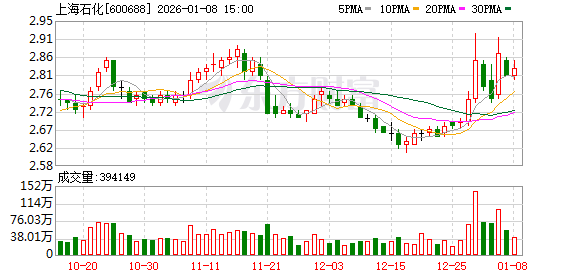
上海石油化工股份(00338)拟并表巴陵新材料
Xin Lang Cai Jing· 2026-01-08 12:49
Group 1 - The company Shanghai Petrochemical Co., Ltd. announced that its board approved the consolidation of Baling New Materials on January 8, 2026, which will enhance its voting rights and governance over Baling New Materials [1] - Following the consolidation, Baling New Materials will be included in the company's consolidated financial statements and will become a subsidiary, although the ownership structure remains unchanged [1] - The company plans to sign a new joint venture agreement with Hunan Petrochemical by March 31, 2026, after the temporary shareholders' meeting approves the consolidation [1] Group 2 - Baling New Materials is a developer and manufacturer of high-end new materials, including thermoplastic elastomers, and the consolidation will fill a strategic gap in the company's high-end materials layout [2] - The consolidation is expected to enhance the competitive advantage of both companies by leveraging synergies and optimizing the product structure [2] - Baling New Materials has been recognized as a major industrial project in Shanghai, indicating its significance in the industry [2]
上海石油化工股份拟并表巴陵新材料
Zhi Tong Cai Jing· 2026-01-08 12:44
Group 1 - The company announced that its board will review and approve the consolidation of Baling New Materials on January 8, 2026, which will enhance the company's voting rights and governance over Baling New Materials [1] - After the consolidation, Baling New Materials will be included in the company's consolidated financial statements and will become a subsidiary, although the equity structure remains unchanged [1] - The company plans to sign a new joint venture agreement with Hunan Petrochemical by March 31, 2026, following the approval of the consolidation at an extraordinary shareholders' meeting [1] Group 2 - Baling New Materials is a developer and manufacturer of high-end new materials, including thermoplastic elastomers, and the consolidation will fill a critical gap in the company's strategic layout in the high-end materials sector [2] - The consolidation is expected to optimize the company's product structure and enhance its competitive advantage by leveraging synergies between Baling New Materials and the company [2] - Baling New Materials has been recognized as a significant industrial project in Shanghai, indicating its importance in the local industry [2]
上海石油化工股份(00338) - 第十一届董事会第二十四次会议决议公告
2026-01-08 12:32
香港交易及結算所有限公司及香港聯合交易所有限公司對本公告的內容概不負責,對其 準確性或完整性亦不發表任何聲明,並明確表示,概不就因本公告全部或任何部分內容 而產生或因倚賴該等內容而引致的任何損失承擔任何責任。 中國石化上海石油化工股份有限公司 Sinopec Shanghai Petrochemical Company Limited 中國石化上海石油化工股份有限公司 (於中華人民共和國註冊成立之股份有限公司) (股份代號:00338) 海外監管公告 本公告乃依據《香港聯合交易所有限公司證券上市規則》第13.10B條的披露義務而作出。 茲載列本公司在上海證券交易所網站刊登的公告。 承董事會命 聯席公司秘書 劉剛 中國,上海,2026年1月8日 於本公告刊登日,本公司的執行董事為郭曉軍、鹿志勇、杜軍及黃翔宇;本公司的非執 行董事為解正林及秦朝暉;及本公司的獨立非執行董事為唐松、陳海峰、楊鈞、周穎及 黃江東。 证券代码:600688 证券简称:上海石化 公告编号:临 2026-001 中国石化上海石油化工股份有限公司 第十一届董事会第二十四次会议决议公告 本公司董事会及全体董事保证本公告内容不存在任何虚假记载、误 ...