
ZTE(00763)

Search documents
花旗集团对中兴通讯的多头持仓比例降至6.61%
Xin Lang Cai Jing· 2026-02-02 09:15
Group 1 - The core point of the article is that Citigroup's long position in ZTE Corporation's H-shares has decreased from 7.24% to 6.61% as of January 27, 2026 [1]

中兴通讯(000063) - 关于认购建兴湛卢基金份额的公告
2026-02-02 09:15
证券代码(A/H):000063/00763 证券简称(A/H):中兴通讯 公告编号:202604 中兴通讯股份有限公司 关于认购建兴湛卢基金份额的公告 本公司及董事会全体成员保证信息披露的内容真实、准确和完整,没有虚假记载、误导性陈述 或重大遗漏。 一、投资基本情况 1、中兴通讯股份有限公司(简称"中兴通讯"或"本公司")拟作为有限合伙人 出资 11,700 万元人民币认购陕西建兴湛卢股权投资合伙企业(有限合伙)(暂定名,以 工商登记部门最终核定为准,简称"建兴湛卢基金"或"基金")份额(简称"本次投 资")。 2、本公司于 2026 年 2 月 2 日召开了第十届董事会第十九次会议,审议通过了《关 于认购陕西建兴湛卢股权投资合伙企业(有限合伙)份额的议案》。根据《中兴通讯股 份有限公司章程》、《深圳证券交易所股票上市规则》及《深圳证券交易所上市公司自 律监管指引第 7 号——交易与关联交易》等相关制度规定,本次投资事项无需提交股东 会审议。本次投资事项不涉及关联交易,也不构成《上市公司重大资产重组管理办法》 规定的上市公司重大资产重组。 3、本公司控股股东、持股 5%以上的股东、董事、高级管理人员不参与认 ...
中兴通讯(000063) - 第十届董事会第十九次会议决议公告
2026-02-02 09:15
第十届董事会第十九次会议决议公告 证券代码(A/H):000063/00763 证券简称(A/H):中兴通讯 公告编号:202603 中兴通讯股份有限公司 3、同意授权中兴通讯股份有限公司法定代表人或其授权的有权签字人就开 展、调整、终止、退出本次投资依法签署相关法律合同及文件、配合办理工商登 记手续。 表决情况:同意 9 票,反对 0 票,弃权 0 票。 具体情况请见与本公告同日发布的《关于认购建兴湛卢基金份额的公告》。 1 特此公告。 中兴通讯股份有限公司董事会 本公司及董事会全体成员保证董事会决议公告的内容真实、准确和完整,没有虚假记 载、误导性陈述或重大遗漏。 中兴通讯股份有限公司(简称"公司")已于 2026 年 1 月 27 日以电子邮件 的方式向公司全体董事发出了《关于召开中兴通讯股份有限公司第十届董事会第 十九次会议的通知》。2026 年 2 月 2 日,公司第十届董事会第十九次会议(简称 "本次会议")以通讯表决方式召开。本次会议应表决董事 9 名,实际表决董事 9 名。本次会议的召开符合有关法律、行政法规、部门规章和《中兴通讯股份有 限公司章程》的有关规定,会议合法、有效。 本次会议审议通 ...
中兴通讯:拟作为有限合伙人出资1.17亿元认购建兴湛卢基金份额
Xin Lang Cai Jing· 2026-02-02 09:09
Group 1 - The company plans to invest 117 million RMB as a limited partner in Shaanxi Jianxing Zhanlu Equity Investment Partnership [1] - The investment aims to support the development of innovative businesses and enterprises within the industrial chain, reduce costs, and diversify risks [1] - The fund will primarily invest in sectors such as next-generation information technology, new energy, and artificial intelligence, with a duration of 7 years [1] - The profit distribution model will follow a "return of capital first, then dividends" approach [1]
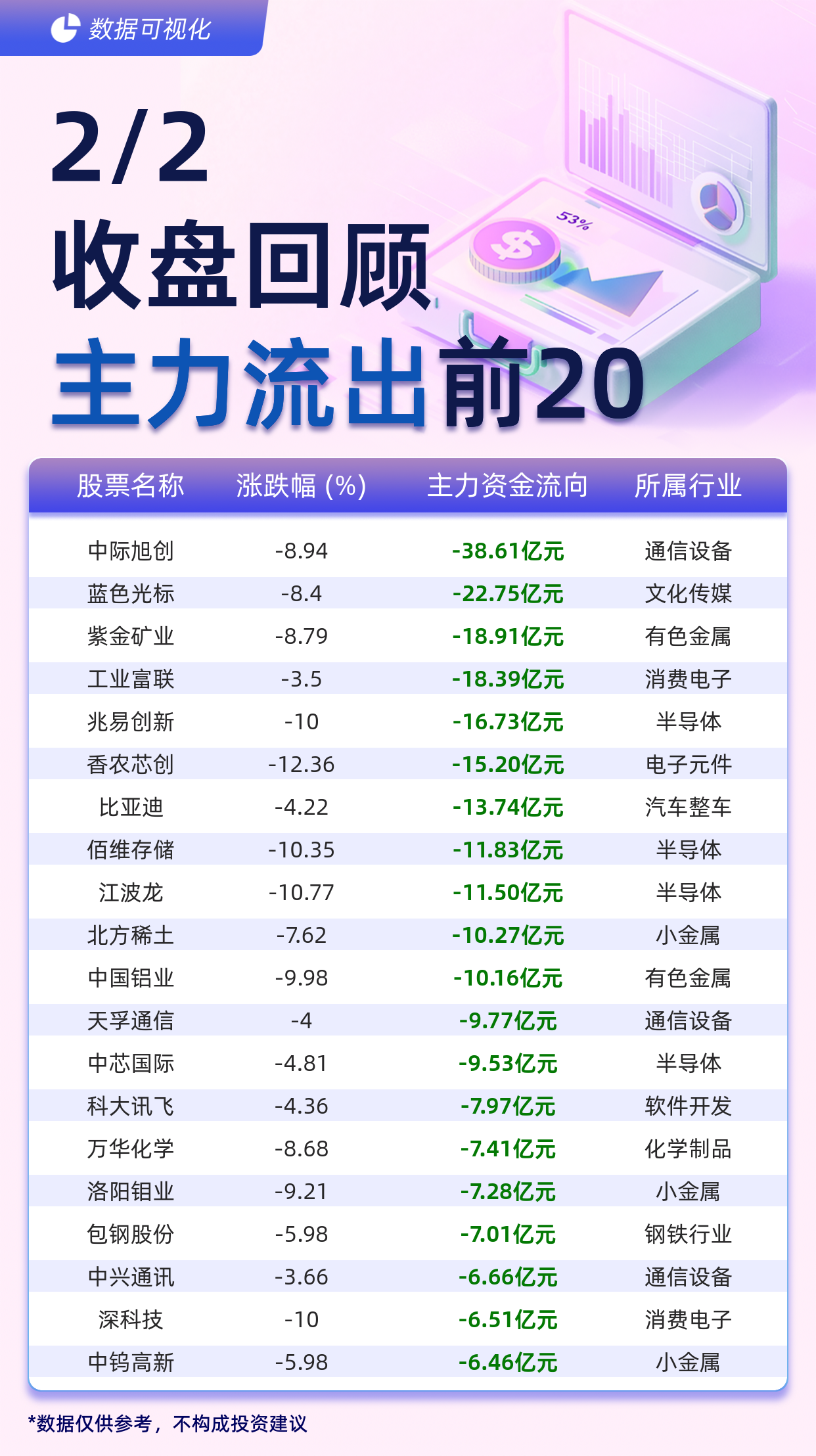
主力个股资金流出前20:中际旭创流出38.61亿元、蓝色光标流出22.75亿元
Jin Rong Jie· 2026-02-02 07:31
Core Viewpoint - The data indicates significant outflows of capital from various stocks, with notable declines in share prices across multiple sectors, suggesting a bearish sentiment in the market. Group 1: Major Stocks with Capital Outflows - Zhongji Xuchuang experienced the highest capital outflow of 3.861 billion, with a share price decline of 8.94% [1][2] - BlueFocus Media saw a capital outflow of 2.275 billion, with a decrease of 8.4% in its stock price [1][2] - Zijin Mining had an outflow of 1.891 billion, reflecting an 8.79% drop in its share price [1][2] - Industrial Fulian faced an outflow of 1.839 billion, with a 3.5% decline in stock value [1][2] - Zhaoyi Innovation reported a capital outflow of 1.673 billion, with a significant drop of 10% in its share price [1][2] Group 2: Additional Stocks with Notable Outflows - Shannon Microelectronics had an outflow of 1.520 billion, with a steep decline of 12.36% [1][2] - BYD experienced a capital outflow of 1.374 billion, with a 4.22% decrease in its stock price [1][2] - Baiwei Storage saw an outflow of 1.183 billion, with a decline of 10.35% [1][2] - Jiangbolong had an outflow of 1.150 billion, with a 10.77% drop in its share price [1][2] - Northern Rare Earth reported an outflow of 1.027 billion, with a 7.62% decline [1][2] Group 3: Other Stocks with Capital Outflows - China Aluminum faced an outflow of 1.016 billion, with a stock price decrease of 9.98% [1][2] - Tianfu Communication had an outflow of 0.977 billion, with a 4% decline in its share price [1][3] - SMIC reported an outflow of 0.953 billion, with a 4.81% drop [1][3] - iFlytek experienced an outflow of 0.797 billion, with a 4.36% decline [1][3] - Wanhua Chemical had an outflow of 0.741 billion, with an 8.68% decrease [1][3]






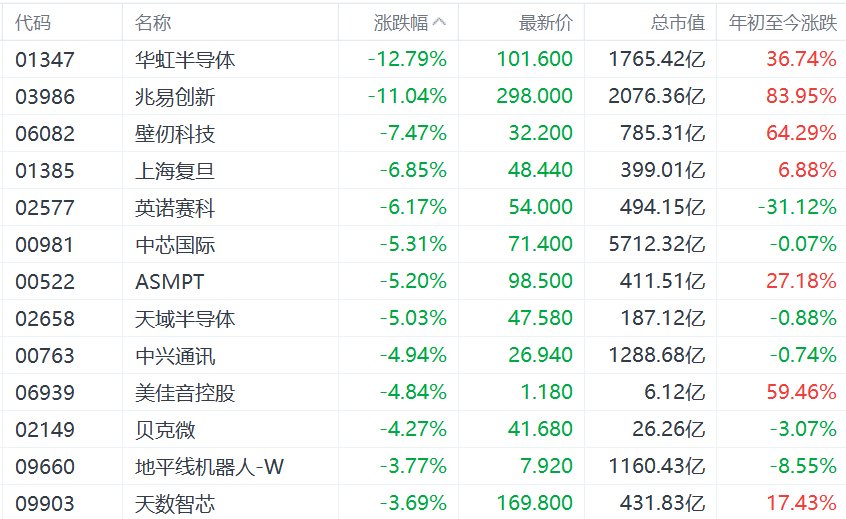
港股芯片股集体下挫,华虹半导体跌超12%,中芯国际跌超5%
Ge Long Hui A P P· 2026-02-02 07:05
Group 1 - The Hong Kong chip stocks experienced a collective decline, with notable drops in several companies' stock prices [1] - Hua Hong Semiconductor fell over 12%, while Zhaoyi Innovation dropped 11%, and Wallin Technology decreased by over 7% [1] - Other companies such as Shanghai Fudan and InnoCare also saw declines exceeding 6%, with SMIC, ASMPT, and Tianyu Semiconductor dropping more than 5% [1] Group 2 - Hua Hong Semiconductor's stock price decreased by 12.79%, reaching 101.600, with a total market capitalization of 176.54 billion and a year-to-date increase of 36.74% [2] - Zhaoyi Innovation's stock fell by 11.04% to 298.000, with a market cap of 207.64 billion and a year-to-date increase of 83.95% [2] - Wallin Technology's stock price dropped by 7.47% to 32.200, with a market cap of 78.53 billion and a year-to-date increase of 64.29% [2] - Shanghai Fudan's stock decreased by 6.85% to 48.440, with a market cap of 39.90 billion and a year-to-date increase of 6.88% [2] - InnoCare's stock fell by 6.17% to 54.000, with a market cap of 49.42 billion and a year-to-date decrease of 31.12% [2] - SMIC's stock price declined by 5.31% to 71.400, with a market cap of 571.23 billion and a year-to-date change of -0.07% [2] - ASMPT's stock decreased by 5.20% to 98.500, with a market cap of 411.51 billion and a year-to-date increase of 27.18% [2] - Tianyu Semiconductor's stock fell by 5.03% to 47.580, with a market cap of 18.71 billion and a year-to-date change of -0.88% [2]
电信ETF汇添富(560300)开盘跌0.47%,重仓股中国移动跌3.40%,中国联通跌2.35%
Xin Lang Cai Jing· 2026-02-02 04:56
Group 1 - The core viewpoint of the article highlights the performance of the Telecom ETF Huatai (560300), which opened down by 0.47% at 2.100 yuan on February 2 [1] - Major holdings within the ETF showed mixed performance, with China Mobile down 3.40%, China Unicom down 2.35%, and China Telecom down 3.33%, while China Satcom increased by 0.79% [1] - The ETF's performance benchmark is the CSI Telecom Theme Index return, managed by Huatai Fund Management Co., with a return of 110.98% since its inception on December 5, 2023, and a 3.69% return over the past month [1] Group 2 - The article provides specific stock performance details, indicating that Zhongji Xuchuang fell by 2.16%, Yinzhijie decreased by 0.70%, while Xinyi Sheng rose by 9.00%, ZTE Corporation fell by 0.73%, Tianfu Communication increased by 0.54%, and Zhongtian Technology rose by 0.67% [1] - The fund manager is identified as Wei Lizhu, emphasizing the management aspect of the ETF [1]




中兴通讯(000063):算力转型顺利 AI再造中兴
Xin Lang Cai Jing· 2026-02-01 00:32
Core Insights - The company has made significant progress in its "Connection + Computing Power" business transformation, focusing on three main sectors: operator networks, government and enterprise business, and consumer business [1][4] - The company's revenue for the first three quarters of 2025 reached 100.52 billion yuan, a year-on-year increase of 11.6%, primarily driven by the rapid growth of its computing power business, which saw a revenue increase of 180% [1] - The net profit attributable to shareholders was 5.322 billion yuan, a year-on-year decrease of 33%, mainly due to a slowdown in capital expenditure from operators, impacting the high-margin operator network business [1] Computing Power Business - The company has made major breakthroughs in self-developed chips, including CPU, DPU, and switching chips, benefiting from the development of domestic super node solutions [2] - The computing power business has become the core driver of revenue growth, with server and storage revenue increasing by 250% year-on-year and data center product revenue growing by 120% [1][2] - The company has launched a super node server solution featuring Baidu's Kunlun Heart P800, achieving GPU intercommunication bandwidth of 400GB/S to 1.6TB/S [2] Connection Business - The company maintains a leading position in the global telecommunications market, with an estimated market share of about 11% in 2024 [3] - The construction and user adoption of 5G networks are nearing completion, with 4.598 million 5G base stations built in China by July 2025, resulting in a 79% penetration rate [3] - Capital expenditure from domestic operators is expected to decline by 9.7% year-on-year in 2024, while 5G-A and 6G are emerging as new directions in the telecommunications market [3] Consumer Business - The consumer business encompasses a wide range of AI terminal products, including home terminals, mobile terminals, and cloud computers, with a revenue of 17.235 billion yuan in the first half of 2025, a year-on-year increase of 7.6% [4] - The company is collaborating with ByteDance's Doubao to launch a smartphone assistant, marking a significant step towards creating an "AI-native smartphone" [4] - The strategic transformation of "Connection + Computing Power" is showing initial success, with the server and storage business becoming a key growth engine [4]
中兴通讯公布国际专利申请:“信道传输方法、通信装置、存储介质及程序产品”
Sou Hu Cai Jing· 2026-01-30 23:00
Group 1 - The core point of the article is that ZTE Corporation has filed an international patent application for a channel transmission method, communication device, storage medium, and program product, with the application number PCT/CN2025/082289 and an international publication date of January 29, 2026 [1] - ZTE has announced a total of 132 international patent applications this year, which represents a decrease of 31.96% compared to the same period last year [1] - In the first half of 2025, ZTE invested 12.665 billion yuan in research and development, showing a slight decrease of 0.48% year-on-year [1]

中兴通讯公布国际专利申请:“移动性通信方法、网络节点及存储介质”
Sou Hu Cai Jing· 2026-01-30 23:00
证券之星消息,根据企查查数据显示中兴通讯(000063)公布了一项国际专利申请,专利名为"移动性 通信方法、网络节点及存储介质",专利申请号为PCT/CN2025/083966,国际公布日为2026年1月29日。 专利详情如下: 今年以来中兴通讯已公布的国际专利申请132个,较去年同期减少了31.96%。结合公司2025年中报财务 数据,2025上半年公司在研发方面投入了126.65亿元,同比减0.48%。 数据来源:企查查 以上内容为证券之星据公开信息整理,由AI算法生成(网信算备310104345710301240019号),不构成 投资建议。 图片来源:世界知识产权组织(WIPO) ...