CHINA MOBILE(00941)

Search documents
彩讯股份:在工业互联网领域,公司已有相关技术储备与业务布局,旗下智能渠道、数据中台、AI 智算等解决方案
Ge Long Hui· 2026-01-15 13:25
Core Viewpoint - The company, CaiXun Co., Ltd. (300634.SZ), maintains a deep and diverse partnership with China Mobile, focusing on various fields including collaborative office solutions, 5G messaging, AI applications, and intelligent computing [1] Group 1: Partnership and Collaboration - The collaboration with China Mobile encompasses multiple areas, indicating a strong strategic alliance [1] - The partnership is expected to leverage existing technological capabilities to explore opportunities in the industrial internet sector [1] Group 2: Technological Capabilities - The company has developed relevant technological reserves and business layouts in the industrial internet field [1] - Solutions such as intelligent channels, data platforms, and AI computing are well-aligned with the demands of "5G + industrial internet" integration [1] Group 3: Future Outlook - The company aims to actively seize opportunities in the industrial internet development by utilizing its technological strengths and the solid foundation of its cooperation with China Mobile [1]
智通港股通活跃成交|1月15日
智通财经网· 2026-01-15 11:03
Core Insights - On January 15, 2026, Alibaba-W (09988), Tencent Holdings (00700), and SMIC (00981) were the top three companies by trading volume in the Southbound Stock Connect, with trading amounts of 84.25 billion, 33.70 billion, and 28.12 billion respectively [1][2] - In the Shenzhen-Hong Kong Stock Connect, Alibaba-W (09988), Tencent Holdings (00700), and Xiaomi Group-W (01810) also ranked as the top three, with trading amounts of 44.51 billion, 17.26 billion, and 14.74 billion respectively [1][2] Southbound Stock Connect Trading Activity - The top three active companies in the Southbound Stock Connect by trading amount were: - Alibaba-W (09988): 84.25 billion with a net buy of +17.90 billion - Tencent Holdings (00700): 33.70 billion with a net buy of +6.63 billion - SMIC (00981): 28.12 billion with a net buy of +3.57 billion [2] - Other notable companies included: - China Mobile (00941): 17.74 billion with a net sell of -7.91 billion - China National Offshore Oil (00883): 14.80 billion with a net sell of -6.66 billion [2] Shenzhen-Hong Kong Stock Connect Trading Activity - The top three active companies in the Shenzhen-Hong Kong Stock Connect by trading amount were: - Alibaba-W (09988): 44.51 billion with a net buy of +1.86 billion - Tencent Holdings (00700): 17.26 billion with a net sell of -2042.91 million - Xiaomi Group-W (01810): 14.74 billion with a net sell of -4.91 billion [2] - Other notable companies included: - China National Offshore Oil (00883): 11.74 billion with a net buy of +3.00 billion - Meituan-W (03690): 7.07 billion with a net buy of +1.28 billion [2]

中国移动研究院邵春菊:低空、卫星是6G需要重点服务的场景
Xin Lang Cai Jing· 2026-01-15 10:18
Core Viewpoint - The "2025 Technology Wind List" annual event highlighted the vision of 6G technology, emphasizing its role in defining the future and the need for practical implementation to achieve this vision [1][3]. Group 1: 6G Technology Insights - 6G is described as "integrating perception, intelligence, computing, and space," focusing on diverse capabilities to support the future's intelligent and interconnected society [1][3]. - The industry perspective indicates that 6G will not only pursue extreme speed and performance but will also address the needs of a digitized society [1][3]. - The discussion included the importance of expanding coverage domains, particularly in low-altitude and satellite communications, which are seen as critical areas for future 6G services [4].


中国移动研究院邵春菊:5G实现了标准和产业最大限度的资源整合,商业部署得到最经济的成果
Xin Lang Cai Jing· 2026-01-15 10:07
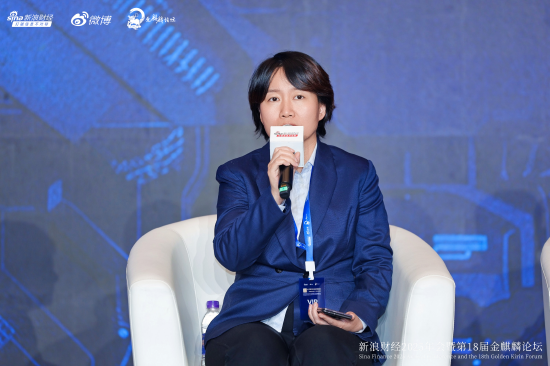
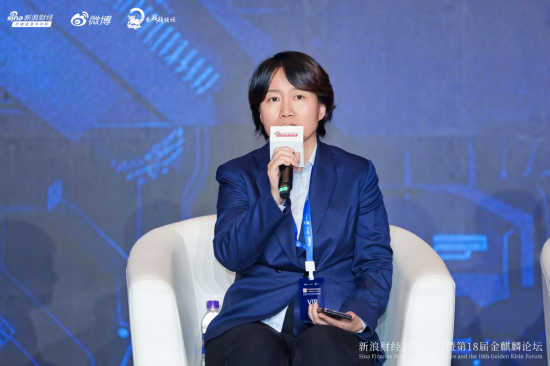
专题:2025科技风云榜 三是对于频段的选择,国外走毫米波,中国最后选择中频段的技术路线,最终从部署的成本和效果来看 都非常成功。 新浪声明:所有会议实录均为现场速记整理,未经演讲者审阅,新浪网登载此文出于传递更多信息之目 的,并不意味着赞同其观点或证实其描述。 责任编辑:李思阳 专题:2025科技风云榜 新浪科技讯 1月15日下午消息,"2025科技风云榜"年度盛典在北京举办。中国移动研究院未来研究院院 长邵春菊,中兴通讯战略和生态首席专家屠嘉顺,GSMA大中华区技术总经理刘鸿及紫光展锐前瞻标准 中心副主任徐志昆围绕 《6G融合创新之路》展开对话。 新浪科技讯 1月15日下午消息,"2025科技风云榜"年度盛典在北京举办。中国移动研究院未来研究院院 长邵春菊,中兴通讯战略和生态首席专家屠嘉顺,GSMA大中华区技术总经理刘鸿及紫光展锐前瞻标准 中心副主任徐志昆围绕 《6G融合创新之路》展开对话。 邵春菊表示,经过6年多的建设,中国建成了世界上最大的5G网络,有全球最多的5G用户,积累了非常 丰富的场景和经验。我个人觉得比较重要的是,一是在5G的时候实现了标准和产业最大限度的资源整 合,最大程度上从标准的层面, ...
南向资金今日净卖出约15亿港元 中国移动遭净卖出居前


Xin Lang Cai Jing· 2026-01-15 09:52
转自:智通财经 【南向资金今日净卖出约15亿港元 中国移动遭净卖出居前】智通财经1月15日电,南向资金今日净卖出 15.15亿港元。其中,中国移动、小米集团-W分别遭净卖出7.91亿港元、4.91亿港元;阿里巴巴-W获净 买入约19.76亿港元。 ...
2025年1-11月中国移动通信基站设备产量为475.5万射频模块 累计增长16.4%
Chan Ye Xin Xi Wang· 2026-01-15 03:42
Core Viewpoint - The report highlights the growth in China's mobile communication base station equipment production, indicating a positive trend in the telecommunications industry from 2025 to 2032 [1] Group 1: Industry Overview - In November 2025, the production of mobile communication base station equipment in China reached 530,000 RF modules, representing a year-on-year increase of 26.5% [1] - From January to November 2025, the cumulative production of mobile communication base station equipment totaled 4.755 million RF modules, showing a cumulative growth of 16.4% [1] Group 2: Companies Involved - Listed companies in the telecommunications sector include ZTE Corporation (000063), Datang Telecom (600198), Xinke Mobile (688387), FiberHome Technologies (600498), Shenglu Communications (002446), *ST Rihai (002313), and Chaoxun Communication (603322) [1] - The report is published by Zhiyan Consulting, a leading industry consulting firm in China, specializing in in-depth industry research and providing comprehensive consulting services [1]

智通港股通资金流向统计(T+2)|1月15日
智通财经网· 2026-01-14 23:37
Core Insights - The article highlights the net inflow and outflow of capital in the Hong Kong stock market, with Kuaishou-W, Tencent Holdings, and Southern Hang Seng Technology leading in net inflows, while China Mobile, Meituan-W, and the Tracker Fund of Hong Kong experienced the highest net outflows [1][2]. Group 1: Net Inflows - Kuaishou-W (01024) recorded a net inflow of 2.25 billion, representing a 33.62% increase in its closing price to 80.250, up by 7.43% [2]. - Tencent Holdings (00700) saw a net inflow of 2.00 billion, with a net inflow ratio of 11.73%, closing at 623.000, an increase of 1.96% [2]. - Southern Hang Seng Technology (03033) had a net inflow of 857 million, with a net inflow ratio of 12.00%, closing at 5.740, up by 3.14% [2]. Group 2: Net Outflows - China Mobile (00941) experienced the highest net outflow of -1.03 billion, with a net outflow ratio of -40.96%, closing at 81.150, up by 0.25% [2]. - Meituan-W (03690) had a net outflow of -488 million, with a net outflow ratio of -4.32%, closing at 105.000, an increase of 6.60% [2]. - The Tracker Fund of Hong Kong (02800) saw a net outflow of -425 million, with a net outflow ratio of -4.65%, closing at 26.800, up by 1.52% [2]. Group 3: Net Inflow Ratios - Qinhuangdao Port Co., Ltd. (03369) led with a net inflow ratio of 76.18%, with a net inflow of 1.0376 million, closing at 2.680, up by 0.37% [3]. - China Water Affairs Group (00855) followed with a net inflow ratio of 58.76%, net inflow of 16.8665 million, closing at 5.660, up by 2.35% [3]. - Uni-President China Holdings Ltd. (00220) had a net inflow ratio of 51.73%, with a net inflow of 45.0968 million, closing at 8.450, up by 5.23% [3]. Group 4: Net Outflow Ratios - Country Garden Services Holdings Company Limited (06098) had the highest net outflow ratio of -61.71%, with a net outflow of -29.9428 million, closing at 6.250, down by 0.48% [3]. - Zhiyuan Holdings Limited (00990) followed with a net outflow ratio of -60.45%, net outflow of -21.7419 million, closing at 0.730, up by 4.29% [3]. - Hong Kong Travel (00308) experienced a net outflow ratio of -55.01%, with a net outflow of -17.0295 million, closing at 1.360, unchanged [3].


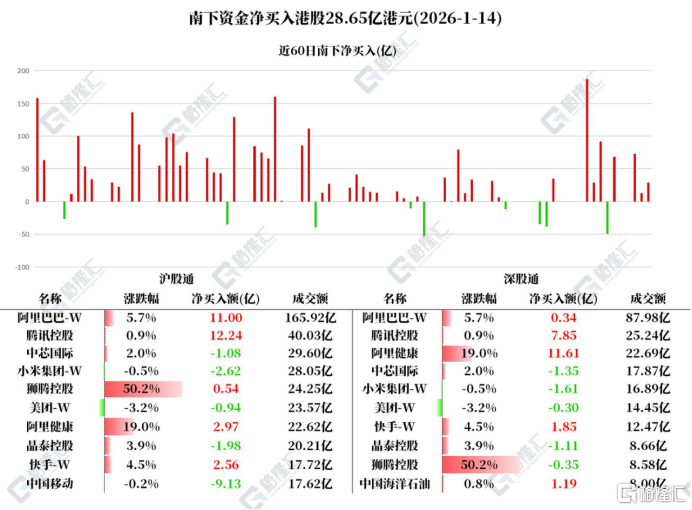
港股通净买入28.65亿港元
Zheng Quan Shi Bao Wang· 2026-01-14 14:17
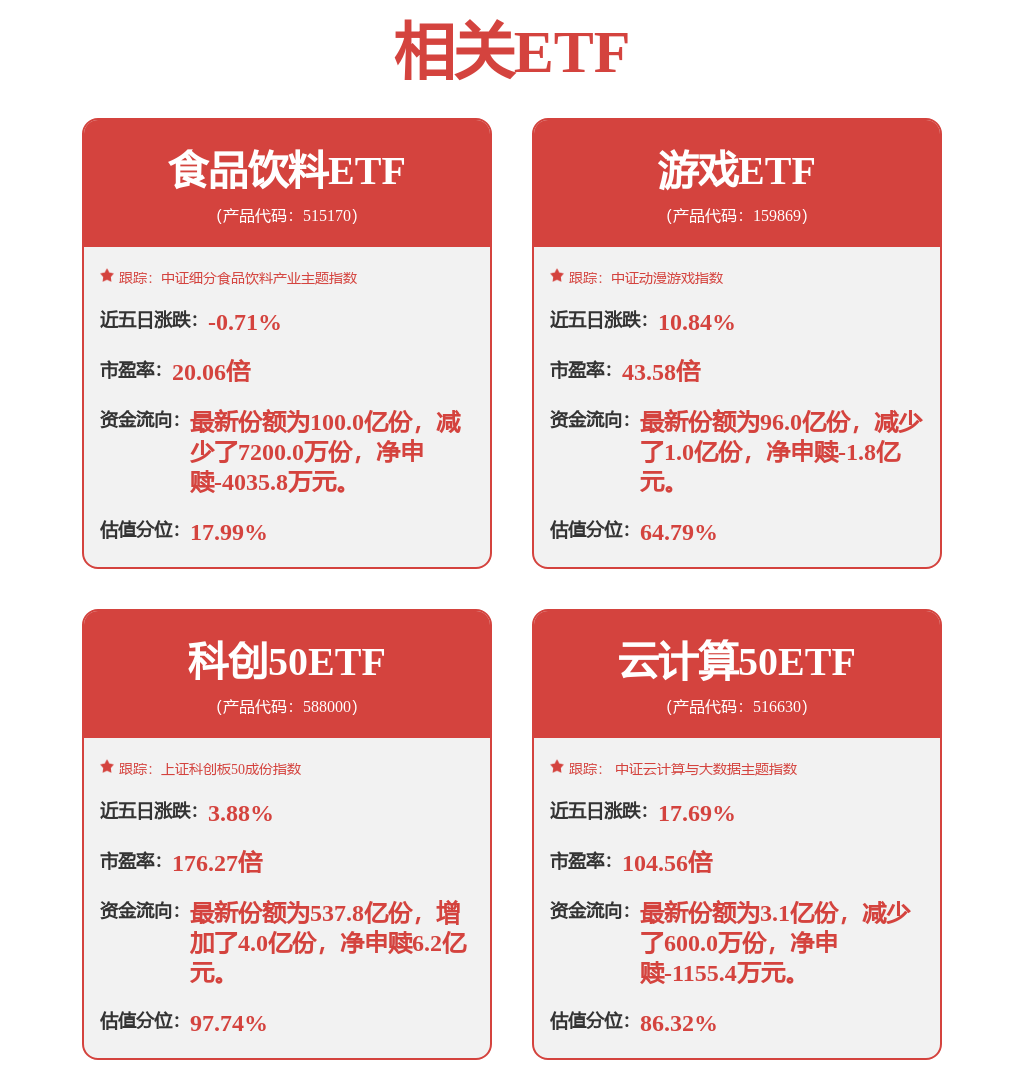
Market Performance - On January 14, the Hang Seng Index rose by 0.56%, closing at 26,999.81 points, with a net inflow of HKD 28.65 billion through the southbound trading channel [1] - The total trading volume for the southbound trading on January 14 was HKD 1,606.16 billion, with a net buying amount of HKD 28.65 billion [1] Stock Activity - In the Shanghai-Hong Kong Stock Connect, Alibaba-W had the highest trading volume at HKD 165.92 billion, followed by Tencent Holdings and SMIC with trading amounts of HKD 40.03 billion and HKD 29.60 billion, respectively [1] - Tencent Holdings recorded a net buying amount of HKD 12.24 billion, while China Mobile had the highest net selling amount of HKD 9.13 billion, closing down by 0.19% [1] Shenzhen-Hong Kong Stock Connect - In the Shenzhen-Hong Kong Stock Connect, Alibaba-W also led with a trading volume of HKD 87.98 billion, followed by Tencent Holdings and Alibaba Health with trading amounts of HKD 25.24 billion and HKD 22.69 billion, respectively [2] - Alibaba Health had the highest net buying amount of HKD 11.61 billion, with a closing increase of 18.96% [2] ETF Performance - The Food and Beverage ETF (Product Code: 515170) has seen a decrease of 0.71% over the past five days, with a price-to-earnings ratio of 20.06 times and a net redemption of HKD 40.35 million [4] - The Gaming ETF (Product Code: 159869) increased by 10.84% over the past five days, with a price-to-earnings ratio of 43.58 times and a net redemption of HKD 180 million [4] - The Sci-Tech 50 ETF (Product Code: 588000) rose by 3.88% over the past five days, with a price-to-earnings ratio of 176.27 times and a net subscription of HKD 620 million [4] - The Cloud Computing 50 ETF (Product Code: 516630) increased by 17.69% over the past five days, with a price-to-earnings ratio of 104.56 times and a net redemption of HKD 11.55 million [5]


【投融资动态】中科酷原D轮融资,融资额近亿人民币,投资方为中国移动
Sou Hu Cai Jing· 2026-01-14 11:35
Core Insights - Zhongke Kuyuan Technology (Wuhan) Co., Ltd. has completed a Series D financing round, raising nearly 100 million RMB, with China Mobile among the participating investors [1] - The company is the first in China to possess both atomic quantum computing and quantum precision measurement research and industrialization capabilities [1] - Zhongke Kuyuan is recognized as a "chain leader" in the quantum technology industry chain in Hubei Province, with a core team originating from the Chinese Academy of Sciences Precision Measurement Research Institute [1] - The team has over 20 years of experience in neutral atom quantum technology research, accumulating systematic technical capabilities in quantum computing and precision measurement applications [1]

资金动向 | 北水爆买腾讯超20亿港元,连续8日减持中国移动
Ge Long Hui· 2026-01-14 10:27
Group 1: Market Activity - Southbound funds net bought Hong Kong stocks worth 2.865 billion HKD on January 14, with significant purchases in Tencent Holdings (2.009 billion HKD), Alibaba Health (1.458 billion HKD), Alibaba Group-W (1.134 billion HKD), Kuaishou-W (441 million HKD), and China National Offshore Oil (119 million HKD) [1] - Notable net sales included China Mobile (913 million HKD), Xiaomi Group-W (423 million HKD), Crystal International (308 million HKD), SMIC (242 million HKD), and Meituan-W (123 million HKD) [1] Group 2: Stock Performance - Tencent Holdings saw a net buy of 12.24 billion HKD with a trading volume of 40.03 billion HKD, while Alibaba Group-W had a net buy of 11 billion HKD with a trading volume of 165.92 billion HKD [3] - China Mobile experienced a net sell of 9.13 billion HKD with a trading volume of 17.62 billion HKD, marking a continuous net sell for 8 days totaling 61.9702 billion HKD [3] Group 3: Company Announcements - Alibaba announced a product launch event for its AI model "Qianwen" on January 15, showcasing how AI can enhance operational efficiency [5] - Tencent repurchased 1 million shares for 636 million HKD and plans to introduce an AI mini-program growth initiative [5] - Kuaishou announced plans to issue USD and RMB senior notes, with net proceeds aimed at general corporate purposes, and projected an annual revenue run rate of 240 million USD by December 2025 [5] Group 4: Industry Insights - Citigroup reported that oil prices may soon exceed the previously predicted range of 55 to 65 USD per barrel due to rising supply disruption risks and geopolitical tensions involving Iran and Russia/Ukraine [6]