AGRICULTURAL BANK OF CHINA(01288)

Search documents
农业银行:金融活水精准滴灌 构筑产业兴旺新图景——“这五年,看山乡巨变”主题调研系列报道之二
Xin Hua Cai Jing· 2025-11-21 01:57
Core Viewpoint - The article emphasizes the critical role of financial support from Agricultural Bank in promoting rural revitalization and preventing large-scale poverty reoccurrence in China, particularly in poverty-stricken areas [1][7]. Financial Support and Impact - Agricultural Bank has provided significant financial assistance, with a loan balance of 5.17 trillion yuan in rural industries in poverty-stricken areas by the end of September 2025, supporting various agricultural projects [1]. - The bank's loans in 832 poverty-stricken counties reached 2.52 trillion yuan, reflecting a 10.66% increase from the beginning of the year, demonstrating its commitment to rural revitalization [4]. Case Studies of Successful Support - In Guizhou, Agricultural Bank's support helped a tea company increase its annual export volume to 1,500 tons, with 80% of sales going to Morocco, showcasing the bank's role in enhancing local agricultural exports [2][3]. - The bank's "Industrial Silver Insurance" policy provided 4.6 million yuan in credit to a struggling tea company, which helped resolve its financial crisis and enabled it to support local farmers [2][3]. - In Sichuan's Liangshan Prefecture, Agricultural Bank facilitated a transition from low-value crops to grape cultivation by providing 200,000 yuan in funding and technical support, transforming the local economy [4]. Innovation in Financial Services - Agricultural Bank introduced innovative financial products like "Scenic Area Operation Loans," which helped finance infrastructure improvements in the Xijiang Qianhu Miao Village, leading to a revitalization of the local tourism industry [6]. - The bank's focus on enhancing its workforce's understanding of agriculture and rural needs has strengthened its service capabilities in supporting rural development [3]. Overall Contribution to Rural Revitalization - Agricultural Bank's efforts are part of a broader strategy to ensure the effective connection between consolidating poverty alleviation achievements and advancing rural revitalization, particularly in key areas identified for support [7].
金融护航民营经济“枝繁叶茂”
Jin Rong Shi Bao· 2025-11-21 00:15
Core Insights - The article highlights the significant role of private enterprises in China's economic development, emphasizing their contribution to job creation, market prosperity, and improved living standards [1][2][3] - It discusses the financial support provided by banks to private enterprises, showcasing the growth in loans and the establishment of specialized financial services to meet the unique needs of these businesses [2][6] Group 1: Financial Support for Private Enterprises - As of September 2025, the balance of inclusive micro and small loans reached 36.1 trillion yuan, a year-on-year increase of 12.2%, while loans to the private economy totaled 71.1 trillion yuan, growing by 5.4% [1] - Major state-owned banks have significantly increased their lending to private enterprises, with Agricultural Bank of China reporting a loan balance of 7.51 trillion yuan, an increase of 973.6 billion yuan, reflecting a growth rate of 14.9% [2] - The banking sector is actively customizing financial products to address the diverse needs of private small and micro enterprises, moving away from traditional lending models [3][6] Group 2: Innovative Financial Solutions - Agricultural Bank of China has developed a "five-special" mechanism to enhance its service to private enterprises, optimizing the policy environment for their support [2] - Zhejiang Agricultural Bank utilized a "government-bank-guarantee" model to facilitate a 10 million yuan loan for a biotechnology company, aiding in prototype testing and platform development [4] - Zhejiang Merchants Bank has implemented a financial advisor system and "Zhejiang Silver Good Standard" to improve the quality and efficiency of services for private enterprises [5] Group 3: Addressing Financing Challenges - Despite improvements, challenges remain in financing for private enterprises, with issues such as high costs and mismatched repayment terms still prevalent [3][6] - The State Council has issued measures to promote private investment, emphasizing the need for banks to set annual service goals for private enterprises and to implement a system of due diligence exemption [6][7] - Financial management departments are encouraged to relax certain requirements for small and micro enterprises to facilitate better lending practices [8]


农业银行:350亿元二级资本债券发行完毕
Bei Jing Shang Bao· 2025-11-20 12:17
北京商报讯(记者宋亦桐)11月20日,农业银行(601288)发布公告指出,经相关监管机构批准,该行在 全国银行间债券市场发行"中国农业银行股份有限公司2025年二级资本债券(第四期)(债券通)"(以下简 称"本期债券")。 据悉,本期债券募集的资金将依据适用法律和监管批准,补充农业银行的二级资本。 本期债券于2025年11月18日簿记建档,于2025年11月20日发行完毕。本期债券发行总规模为人民币350 亿元,分为两个品种。其中品种一为10年期固定利率债券,发行规模为人民币320亿元,票面利率为 2.14%,在第5年末附有条件的发行人赎回权;品种二为15年期固定利率债券,发行规模为人民币30亿 元,票面利率为2.40%,在第10年末附有条件的发行人赎回权。 ...
农业银行(601288.SH):2025年二级资本债券(第四期)(债券通)发行完毕
Ge Long Hui A P P· 2025-11-20 11:04
本期债券募集的资金将依据适用法律和监管批准,补充本行的二级资本。 本期债券于2025年11月18日簿记建档,于2025年11月20日发行完毕。本期债券发行总规模为人民币350 亿元,分为两个品种。其中品种一为10年期固定利率债券,发行规模为人民币320亿元,票面利率为 2.14%,在第5年末附有条件的发行人赎回权;品种二为15年期固定利率债券,发行规模为人民币30亿 元,票面利率为2.40%,在第10年末附有条件的发行人赎回权。 格隆汇11月20日丨农业银行(601288.SH)公布,经相关监管机构批准,中国农业银行股份有限公司(以下 简称"本行")在全国银行间债券市场发行"中国农业银行股份有限公司2025年二级资本债券(第四期)(债券 通)"(以下简称"本期债券")。 ...
农业银行(01288.HK)完成发行350亿元二级资本债券
Ge Long Hui· 2025-11-20 10:00
格隆汇11月20日丨农业银行(01288.HK)公告,经相关监管机构批准,本行在全国银行间债券市场发行 「中国农业银行股份有限公司2025年二级资本债券(第四期)(债券通)」。 本期债券募集的资金将依据适用法律和监管批准,补充本行的二级资本。 本期债券于2025年11月18日簿记建档,于2025年11月20日发行完毕。本期债券发行总规模为人民币350 亿元,分为两个品种。其中品种一为10年期固定利率债券,发行规模为人民币320亿元,票面利率为 2.14%,在第5年末附有条件的发行人赎回权;品种二为15年期固定利率债券,发行规模为人民币30亿 元,票面利率为2.40%,在第10年末附有条件的发行人赎回权。 ...
农业银行(01288)完成发行2025年二级资本债券(第四期)(债券通)
智通财经网· 2025-11-20 09:58
智通财经APP讯,农业银行(01288)发布公告,经相关监管机构批准,本行在全国银行间债券市场发 行"中国农业银行股份有限公司2025年二级资本债券(第四期)(债券通)"(本期债券)。本期债券于2025年11 月18日簿记建档,于2025年11月20日发行完毕。本期债券发行总规模为人民币350亿元,分为两个品 种。其中品种一为10年期固定利率债券,发行规模为人民币320亿元,票面利率为2.14%,在第5年末附 有条件的发行人赎回权;品种二为15年期固定利率债券,发行规模为人民币30亿元,票面利率为2.40%, 在第10年末附有条件的发行人赎回权。 ...
港股央企红利ETF(513910)跌0.24%,成交额3.06亿元
Xin Lang Cai Jing· 2025-11-20 09:56
Core Points - The Huaxia CSI Hong Kong Stock Connect Central State-Owned Enterprises Dividend ETF (513910) closed down 0.24% on November 20, with a trading volume of 306 million yuan [1] - The fund was established on February 7, 2024, with an annual management fee of 0.50% and a custody fee of 0.10% [1] - As of November 19, 2024, the fund's latest share count was 2.775 billion shares, with a total size of 4.617 billion yuan, reflecting a 109.73% increase in shares and a 163.55% increase in size year-to-date [1] Fund Performance - The current fund manager, Lu Yayun, has managed the fund since its inception, achieving a return of 69.32% during the management period [2] - The fund's top holdings include COSCO Shipping Holdings, China Nonferrous Mining, China Ocean Shipping, Orient Overseas International, CITIC Bank, China Petroleum, China Shenhua Energy, People's Insurance Company of China, CNOOC, and Agricultural Bank of China, with respective holding percentages [2]

农业银行(01288) - 关於2025年二级资本债券(第四期)(债券通)发行完毕的公告
2025-11-20 09:53
香港交易及結算所有限公司及香港聯合交易所有限公司對本公告的內容概不負責,對其準確性或完整性亦不發表任 何聲明,並明確表示,概不對因本公告全部或任何部份內容而產生或因倚賴該等內容而引致的任何損失承擔任何責 任。 中國農業銀行股份有限公司 劉清 關於2025年二級資本債券(第四期)(債券通) 發行完畢的公告 中國農業銀行股份有限公司(「本行」)於2025年2月21日召開的2025年度第一次臨時股東大 會審議批准了資本工具和總損失吸收能力非資本債券計劃額度事宜的議案。 經相關監管機構批准,本行在全國銀行間債券市場發行「中國農業銀行股份有限公司2025 年二級資本債券(第四期)(債券通)」(「本期債券」)。 本期債券於2025年11月18日簿記建檔,於2025年11月20日發行完畢。本期債券發行總規 模為人民幣350億元,分為兩個品種。其中品種一為10年期固定利率債券,發行規模為人 民幣320億元,票面利率為2.14%,在第5年末附有條件的發行人贖回權;品種二為15年期 固定利率債券,發行規模為人民幣30億元,票面利率為2.40%,在第10年末附有條件的發 行人贖回權。 本期債券募集的資金將依據適用法律和監管批准,補 ...
农业银行(601288) - 农业银行关于2025年二级资本债券(第四期)(债券通)发行完毕的公告
2025-11-20 09:45
证券代码:601288 证券简称:农业银行 公告编号:临 2025-053 号 本期债券于 2025 年 11 月 18 日簿记建档,于 2025 年 11 月 20 日发行完毕。本期债券发行总规模为人民币 350 亿元,分为两 个品种。其中品种一为 10 年期固定利率债券,发行规模为人民 币 320 亿元,票面利率为 2.14%,在第 5 年末附有条件的发行人 赎回权;品种二为 15 年期固定利率债券,发行规模为人民币 30 亿元,票面利率为 2.40%,在第 10 年末附有条件的发行人赎回 权。 本期债券募集的资金将依据适用法律和监管批准,补充本行 的二级资本。 特此公告。 中国农业银行股份有限公司董事会 二〇二五年十一月二十日 1 中国农业银行股份有限公司 关于2025年二级资本债券(第四期)(债券通) 发行完毕的公告 中国农业银行股份有限公司董事会及全体董事保证本公告内容不存在任 何虚假记载、误导性陈述或者重大遗漏,并对其内容的真实性、准确性和完 整性承担法律责任。 经相关监管机构批准,中国农业银行股份有限公司(以下简 称"本行")在全国银行间债券市场发行"中国农业银行股份有 限公司 2025 年二级 ...
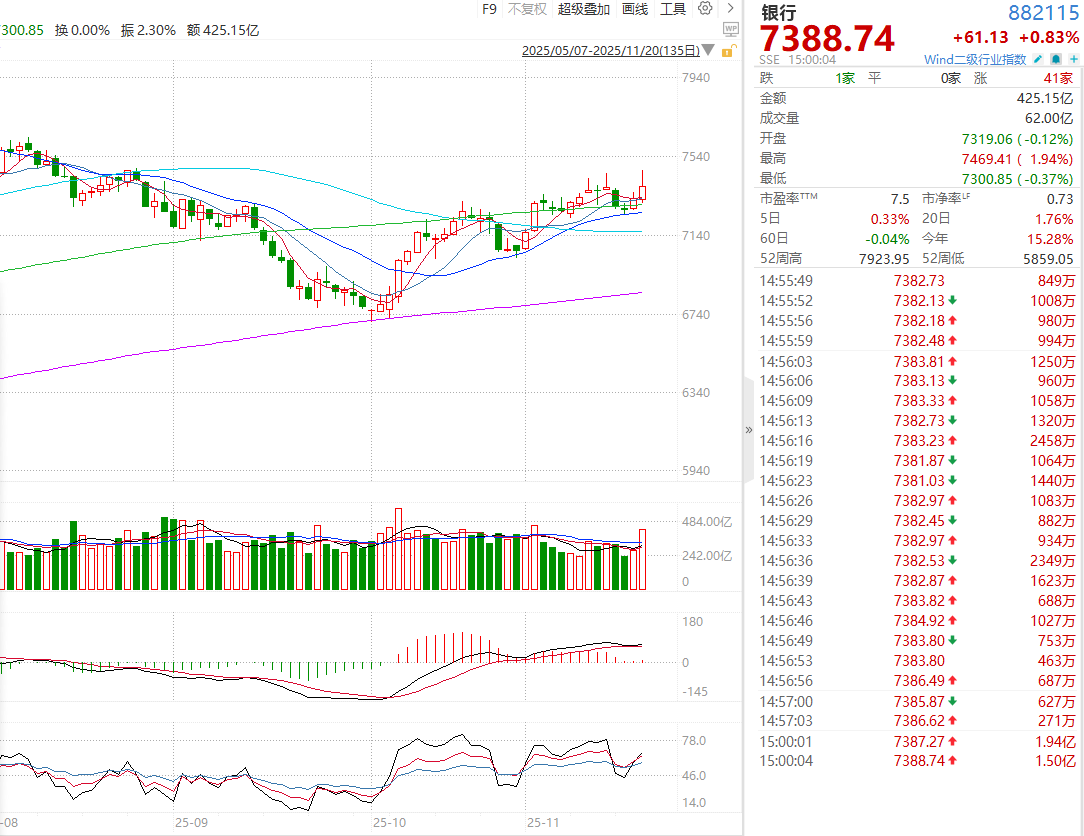
银行股年末行情可期,高股息成避风港
Huan Qiu Wang· 2025-11-20 08:57
Core Viewpoint - The strong performance of bank stocks in China is supported by improving fundamentals, with significant increases in stock prices and market capitalization, indicating investor confidence in the sector [1][3]. Group 1: Stock Performance - On November 20, Chinese bank stocks rose, with China Bank's stock price increasing by 4%, reaching a historical high and a total market capitalization of 1.84 trillion yuan [1]. - The banking sector index has seen a cumulative increase of 7.15% since the National Day holiday, with several banks, including Chongqing Bank and Agricultural Bank, experiencing over 20% growth during this period [1]. Group 2: Financial Performance - In the third quarter, 42 banks reported a total net profit attributable to shareholders of 1.68 trillion yuan, a year-on-year increase of 1.2%, with a 2.81% growth in the third quarter alone, reflecting steady improvement in profitability [3]. - High dividend yields are a key attraction for investors, with 34 out of 42 banks having a dividend yield exceeding 3%, and 13 banks exceeding 5%, while the median dividend yield stands at 4.28% [3]. Group 3: Shareholder Activity - Significant shareholder buybacks have provided strong support for bank stock performance, with over 10.7 billion yuan in buybacks this year, leading the industry [4]. - Major shareholders have expressed confidence in the future growth prospects and long-term investment value of banks, with buybacks serving as a means to expand business scale and supplement capital [4]. Group 4: Market Trends and Outlook - Historical data indicates a 70% probability of absolute returns for bank stocks in November and December, with an 80% probability in January, suggesting a favorable seasonal trend for bank investments [4]. - In the current low-interest-rate environment, high-dividend bank stocks are seen as a safe haven for investors, especially as speculative trading decreases [4]. Group 5: Challenges Facing the Industry - The banking sector faces challenges, including a net interest margin of only 1.42% and a non-performing loan ratio of 1.52%, indicating potential profitability pressures if trends do not reverse [5]. - The investment focus is shifting from growth in scale to risk management, asset quality, and stable profitability, necessitating banks to enhance service efficiency and embrace digital transformation to remain competitive [5].