
AGRICULTURAL BANK OF CHINA(01288)

Search documents
农业银行苏州分行金融赋能吴江毛衫特色产业高质量发展
Jiang Nan Shi Bao· 2025-11-23 13:32
Group 1 - The demand for wool sweaters has surged due to the drop in temperature as winter approaches, with consumers actively purchasing winter clothing both in physical markets and online platforms [1] - Consumers now prioritize not only comfort and warmth but also high cost-performance and fashionable designs in their winter clothing choices, reflecting a shift in market demand [1] - Local wool sweater manufacturers in Wujiang District are enhancing product quality and aesthetics by hiring designers and using high-end yarns, aiming to strengthen their core competitiveness and brand influence [1] Group 2 - The wool sweater industry is experiencing a collaborative improvement in production capacity and quality, supported by financial institutions like Agricultural Bank of Suzhou Branch [2] - The bank offers tailored financial products such as "Tax e-loan" and "Micro-loan" to support small and micro enterprises in inventory preparation and expansion during peak seasons, facilitating efficient credit support [2] - As of now, the bank has served over 460 businesses in the wool sweater supply chain, with a total loan balance of 167 million yuan, contributing to a positive cycle of demand insight, product innovation, and consumer upgrade in the industry [2]

2025中国银行业竞争力100强出炉
2 1 Shi Ji Jing Ji Bao Dao· 2025-11-23 11:52
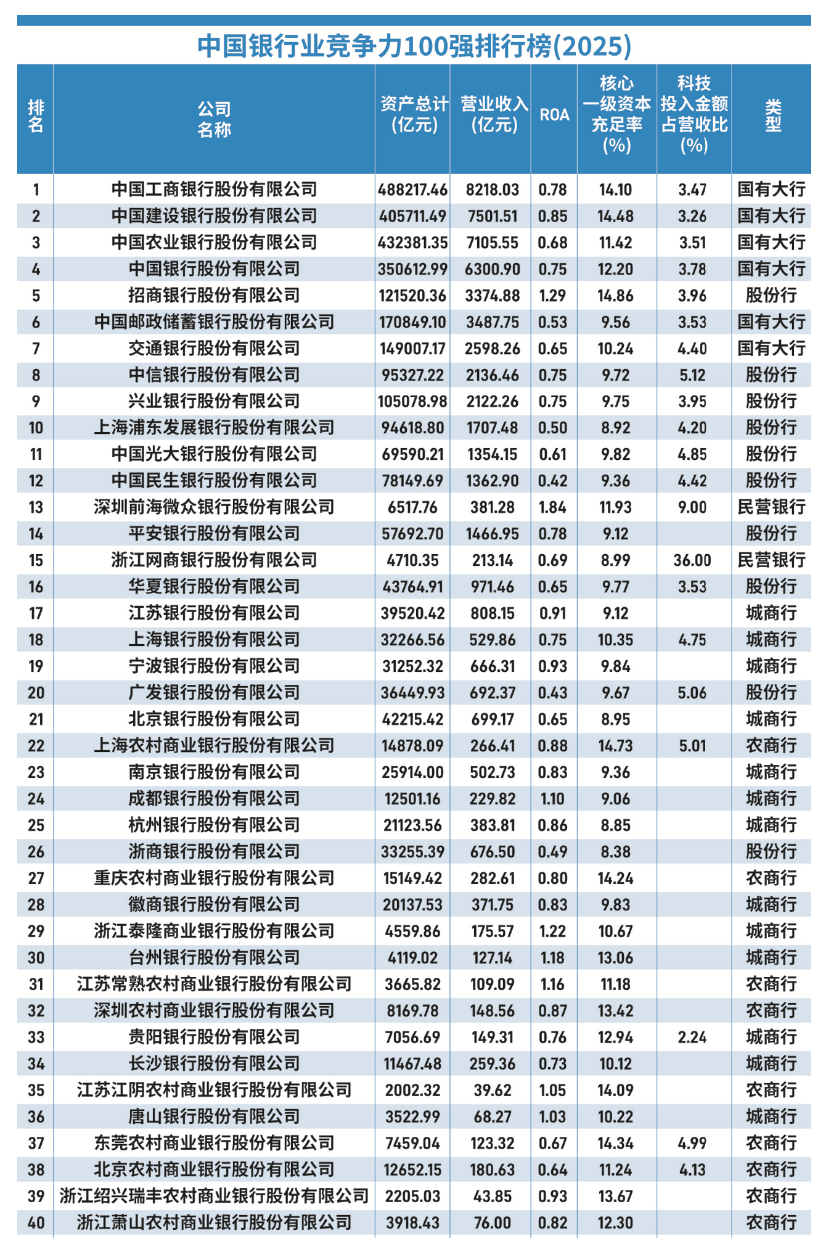
Core Insights - The "2025 China Banking Industry Competitiveness Report" was released, highlighting the evolving competitive landscape of the banking sector amid economic adjustments, fintech innovations, and regulatory improvements [1] - The report ranks the top 100 banks based on a comprehensive evaluation system focusing on four core indicators: scale, profitability, growth, and stability [1] - For the first time, the ranking separates domestic and foreign banks, enhancing the rigor and professionalism of the evaluation [1] Group 1: Overall Ranking and Key Players - The top four banks are dominated by state-owned banks, with Industrial and Commercial Bank of China leading in asset scale and profitability [6] - China Construction Bank ranks second, showcasing balanced development across various indicators [6] - Agricultural Bank of China and Bank of China follow in third and fourth places, respectively, with strengths in asset base and international operations [6] Group 2: National Joint-Stock Commercial Banks - Among the 12 national joint-stock commercial banks, 10 are ranked between 5th and 30th, with China Merchants Bank leading this group at 5th place [7] - CITIC Bank and Industrial Bank are positioned 8th and 9th, respectively, demonstrating strong performance [7] - The overall performance indicates a growing disparity between leading and trailing banks within this category [7] Group 3: City Commercial Banks - City commercial banks represent the largest group with 53 institutions, with Jiangsu Bank leading at 17th place [8] - Shanghai Bank and Ningbo Bank follow closely, benefiting from strong local market engagement [8] - The regional focus of city commercial banks has established them as vital financial support for local economies [8] Group 4: Rural Commercial Banks - Rural commercial banks, with 27 institutions on the list, show robust operational stability and growth potential [9] - Shanghai Rural Commercial Bank ranks 22nd, while Chongqing Rural Commercial Bank leads in the southwest region at 27th [9] - These banks are crucial in supporting local agricultural and small business needs [9] Group 5: Private and Foreign Banks - The two private banks listed, WeBank and Ant Bank, rank 13th and 15th, respectively, showcasing strong performance in profitability and growth [9] - The five foreign banks are ranked separately, with Citibank (China) leading, followed by MUFG Bank (China) and HSBC (China) [9] - Foreign banks leverage international service capabilities and global resource integration to maintain competitive advantages [9] Group 6: Industry Trends and Future Outlook - The report emphasizes the importance of differentiated competition and innovation in building a high-quality banking ecosystem [10] - Various banks are enhancing their core capabilities to support the real economy and provide robust financial services [10] - The rankings reflect the ongoing transformation and adaptation of the banking sector in response to market demands and regulatory changes [10]




银行股谁最牛?农业银行一年市值大增1.2万亿 股价猛涨78%
Ge Long Hui A P P· 2025-11-23 05:21
Core Insights - The implementation of the regulatory guideline "Guidance No. 10 on Market Value Management" marks a significant turning point for the A-share banking sector, emphasizing the need for value management among long-term undervalued companies [1] - The overall price-to-book ratio (P/B) of the banking industry has increased from 0.61 to 0.67 over the past year, reflecting a market capitalization growth of over 3.7 trillion yuan [1] - Agricultural Bank of China has emerged as a benchmark case for market value management, achieving a stock price increase of 78.08% and a P/B ratio of 1.09 [1] Market Capitalization Changes - The total market capitalization of A-share listed banks has risen by 3.725 trillion yuan compared to one year ago [1] - Agricultural Bank of China contributed over 1.193 trillion yuan to this increase, accounting for more than 30% of the new market value in the banking sector [1]
科技赋能艺术、生态邂逅人文,这台晚会奏响熊猫的“多元交响曲”
Zhong Guo Jin Rong Xin Xi Wang· 2025-11-23 03:12
Core Viewpoint - The 2025 Panda Carnival Gala, held in Chengdu, emphasizes the multi-dimensional value of giant pandas in cultural tourism integration, ecological protection, and international exchange, promoting a narrative of harmonious coexistence between humans and nature [1][23]. Group 1: Ecological Protection - China's giant panda conservation has shown significant progress, with the species' threat level reduced from "endangered" to "vulnerable," and the captive population reaching 808, indicating sustainable development [4]. - The gala featured caretakers sharing their meticulous efforts in panda care, highlighting the precision and warmth involved in the conservation work [4][5]. Group 2: Cultural Tourism Integration - The event showcased the integration of local culture and tourism, with performances like "Ancient Shu Journey" blending traditional Sichuan opera with modern dance, enhancing the region's cultural appeal [11]. - The "Panda Economy" has evolved beyond mere tourism, linking various sectors such as transportation, themed accommodations, and cultural products, creating a robust consumer attraction [11]. - Agricultural Bank of China is actively promoting local tourism through digital payment solutions and partnerships with popular attractions, aiming to enhance the experience for both domestic and international visitors [12]. Group 3: Cultural Exchange - The giant panda serves as a global cultural symbol, fostering international friendships, as evidenced by video presentations from overseas correspondents showcasing pandas in various countries [12][14]. - The gala featured stories from photographers and zoo directors, emphasizing the emotional connections formed through panda conservation efforts across borders [14][15]. - Cultural performances by artists from Taiwan and other regions highlighted the ongoing cultural exchange and the significance of pandas in bridging communities [14][17].


中国农业银行与山西省政府举行工作会谈
Ge Long Hui· 2025-11-22 13:13
格隆汇11月22日|11月20日,中国农业银行党委书记、董事长谷澍在山西太原拜会山西省委书记唐登 杰、省长卢东亮,就全方位深化金融合作,更好发挥金融服务山西转型发展作用等进行深入交流。20日 下午,谷澍与卢东亮举行工作会谈。谷澍表示,农业银行将加大对能源转型、产业升级等重点领域的金 融支持,强化综合金融服务。发挥农业银行在"三农"普惠领域的独特优势,助力山西特优农业发展和乡 村全面振兴。卢东亮表示,希望双方加强"十五五"谋划衔接,聚焦重点领域深化政银合作,打造央地合 作新典范,为山西高质量发展和现代化建设提供更加有力的金融服务支撑。 ...
农行上海市分行开启普惠数智新篇章
Zhong Guo Jin Rong Xin Xi Wang· 2025-11-22 03:33
近年来,农行上海市分行始终坚持科技赋能普惠金融,致力于破解小微企业融资中的"流程长、放款 慢"核心痛点。通过整合工商、纳税、征信等多维数据,打造普惠特色数据底座,构建小微企业专属模 型体系,实现对小微企业精准"画像"和风险智能识别。 转自:新华财经 "太不可思议了!刚刚在手机银行上提交申请,就立刻就收到了审批额度,还可根据需要选择不同产 品,资金实时到账。"深意信息科技负责人张鼎国在操作了农业银行小微融资产品后,发出了由衷的赞 叹。 张先生体验的正是农行上海市分行最新升级的"申担e贷"2.0和新推出的"申微e贷"1.0两款小微企业融资 产品。两款产品深度融合了大数据与人工智能技术,通过系统模型的自动化决策,对小微企业的贷款申 请进行智能审批,实现了从申请、审批、签约到提款的全流程线上化快速响应,将小微企业融资效率推 向了全新高度。 据悉,两款产品精准覆盖了不同小微企业客户的融资需求。其中,"申担e贷"由市融资担保中心提供担 保增信,面向融资需求稍高的小微企业,本次产品升级后大幅提升了客户体验。而"申微e贷"则主要服 务于融资需求更为灵活、用款更为频繁的小微企业,为客户提供纯信用的线上融资服务。 "我们园区里大 ...
银行们,正在批量撤回“免费午餐”
Sou Hu Cai Jing· 2025-11-21 08:03
Core Viewpoint - Banks are increasingly charging for services that were previously free, such as transaction SMS notifications, as they face declining profits and need to find new revenue sources [1][3][9]. Group 1: Changes in Banking Services - Users have reported that banks are inviting them to participate in activities that lead to charges for services that were once free, such as SMS notifications for account transactions [1]. - Many banks have raised the threshold for free SMS notifications, with China Bank increasing the trigger amount from 0 to 100 yuan, and Hunan Rural Credit raising it from 200 to 500 yuan [3]. - Some banks, like Guizhou Rural Credit, have started charging for SMS services, while Minsheng Bank has ended free SMS notifications for transactions over 300 yuan, now charging 2 yuan per month [3][6]. Group 2: Broader Trends in Banking Fees - The trend of banks withdrawing free services is not limited to SMS notifications; many banks are adjusting various service fees, including ATM withdrawal fees and card delivery fees [4][6]. - For example, China Agricultural Bank has canceled free cash withdrawal policies for certain credit cards and increased fees for cross-bank withdrawals [6]. - Local banks, such as Lujiang Rural Commercial Bank, have also begun charging for ATM withdrawals, previously free [8]. Group 3: Reasons Behind Fee Increases - The banking industry is facing pressure on profits due to reduced loan demand and lower interest rates, leading to a decline in net interest margins [9][11]. - The net interest margin for commercial banks dropped from 1.69% in Q1 2024 to 1.43% in Q1 2025, significantly below the historical average of 2.44% [11]. - As banks look to cut costs, they are reducing the number of physical branches and staff, which has led to a focus on previously overlooked fees like SMS and delivery charges [11][12]. Group 4: Financial Implications of Fee Changes - Charging for SMS notifications can provide significant profit margins for banks, with a potential net profit margin of 87.5% based on the cost of sending messages [13]. - The shift from free to paid services is seen as a necessary measure for banks to maintain profitability in a challenging economic environment [14]. Group 5: User Adaptation Strategies - Users are encouraged to adapt to these changes by utilizing remaining free services and considering alternative notification methods, such as app notifications instead of SMS [15]. - Planning transactions to maximize free services and opting for electronic statements can help users mitigate the impact of these fee increases [15].


金融助力中国企业“走出去”报告
第一财经研究院· 2025-11-21 05:51
Investment Rating - The report indicates a positive investment outlook for Chinese enterprises going global, with a projected increase in foreign direct investment (FDI) to 1.16 trillion RMB in 2024, reflecting an 11.30% year-on-year growth [8]. Core Insights - Chinese enterprises are actively exploring new pathways for international expansion, adapting strategies in response to geopolitical challenges and evolving market conditions [4][8]. - The ASEAN region has emerged as a key destination for Chinese investment, with its share of China's outbound investment rising from 6.34% in 2014 to 17.88% in 2024 [8]. - The structure of China's outbound investment is shifting, with significant increases in the wholesale, retail, and manufacturing sectors, indicating a deeper integration into global value chains [8][52]. Summary by Sections Part A: Challenges and Pathways for Chinese Enterprises Going Global - The Chinese government is committed to high-quality outbound investment, emphasizing the importance of maintaining a stable international economic environment despite rising geopolitical tensions [18][19]. - The share of China's exports in global trade is projected to reach 14.64% in 2024, maintaining its position as the world's largest exporter [19][23]. - Chinese enterprises are increasingly focusing on the ASEAN region for investment, with a notable rise in direct investment since the implementation of the RCEP [44][52]. Part B: Financial Support for Outbound Expansion - Chinese financial institutions are enhancing their overseas presence, with major banks establishing branches in numerous countries to support outbound enterprises [9]. - There is a strong emphasis on integrating domestic and international resources, with banks providing cross-border credit and financing solutions for projects under the Belt and Road Initiative [9][11]. - Innovative financial products and services are being developed to support overseas investments, including specialized loans for infrastructure projects and comprehensive solutions for cross-border e-commerce [9][11]. Part C: Future Outlook and Recommendations - Recommendations include optimizing overseas network construction, enhancing multi-tiered financial service systems, and expanding the use of cross-border RMB [12][13]. - A comprehensive risk management system is suggested to help enterprises navigate geopolitical uncertainties and market volatility [12][13]. - Strengthening collaboration between financial institutions and industries is crucial for supporting enterprises in their global expansion efforts [12][13].


中资离岸债每日总结(11.20) | 农业银行(01288.HK)、三峡国际等发行
Sou Hu Cai Jing· 2025-11-21 02:59
Group 1 - The Federal Reserve's October FOMC meeting minutes reveal significant internal divisions regarding future interest rate cuts, with discussions covering inflation risks, labor market cooling, and economic growth uncertainties [2] - The Fed ultimately voted 10 to 2 to lower the federal funds rate by 25 basis points, bringing the target range to 3.75% to 4%, but the decision was reached after intense debate [2] - There is a notable split among Fed officials regarding the appropriateness of further rate cuts in December, with some advocating for cuts if economic conditions align with expectations, while many prefer to maintain current rates [2] Group 2 - Following the release of the minutes, market expectations shifted significantly, with the probability of a December rate cut dropping from nearly 50% to around 30%, while the likelihood of no change rose to nearly 70% [2] - The swap market adjusted the expected cut magnitude for December from 11 basis points to just 6 basis points [2] Group 3 - In the primary market, four companies issued bonds today, including a merger agreement between CICC and two other securities firms, which requires board and regulatory approvals [4] - China Great Wall Asset Management announced plans to dispose of its debt claims against Evergrande Group, totaling approximately 1.09 billion yuan, with a principal amount of about 959 million yuan [4] - Zhongjun Group is seeking court approval for a creditor meeting to discuss a restructuring plan, with a hearing scheduled for March 24, 2026 [4]



监管数据显示商业银行净息差企稳,国企红利ETF(159515)高股息投资价值凸显
Sou Hu Cai Jing· 2025-11-21 02:44
Core Viewpoint - The performance of the China Securities State-Owned Enterprises Dividend Index has shown a decline, with a drop of 0.58% as of November 21, 2025, indicating potential challenges in the state-owned enterprise sector [1]. Group 1: Market Performance - The China Securities State-Owned Enterprises Dividend Index has seen a decline, with leading stocks including Jianfa Co., China Bank, and Nanjing Bank, while Lu Xi Chemical, Zhongwen Media, and Western Mining have lagged [1]. - The National State-Owned Enterprises Dividend ETF (159515) has undergone adjustments, reflecting changes in the underlying index [1]. - The average daily trading volume of the National State-Owned Enterprises Dividend ETF was 2.9372 million yuan over the past week as of November 20 [1]. Group 2: Banking Sector Insights - As of the end of Q3 2023, the total assets of China's banking financial institutions reached 474.3 trillion yuan, marking a year-on-year growth of 7.9% [1]. - The net interest margin for commercial banks stood at 1.42%, remaining stable quarter-on-quarter, with a slight increase of 0.01 percentage points for joint-stock commercial banks [1]. - The banking sector has shown signs of stability in net interest margins and asset quality, indicating strong resilience in the industry [1]. Group 3: Profitability and Future Outlook - Listed banks have experienced improved profit growth in Q3, driven by a decrease in provision for bad debts, stabilization of net interest margins, and improved wealth management-related income [2]. - The revenue growth for banks is expected to continue improving, enhancing the stability of their performance and highlighting the investment value of high dividend yields [2]. - The China Securities State-Owned Enterprises Dividend Index includes 100 listed companies with high and stable cash dividend yields, reflecting the overall performance of high-dividend securities among state-owned enterprises [2].