
AGRICULTURAL BANK OF CHINA(01288)

Search documents
12月10日港股通央企红利ETF(159266)遭净赎回100.28万元
Xin Lang Cai Jing· 2025-12-11 02:39
Core Viewpoint - The Hong Kong Stock Connect Central State-Owned Enterprises Dividend ETF (159266) experienced net redemptions of 1.0028 million yuan on December 10, ranking 26th out of 200 in cross-border ETF net outflows [1] Group 1: Fund Performance - As of December 10, the latest scale of the Hong Kong Stock Connect Central State-Owned Enterprises Dividend ETF (159266) is 685 million yuan, down from 689 million yuan the previous day, indicating a net outflow of 0.15% of the previous day's scale [1] - Over the past 5 days, the fund faced net redemptions of 1.004 million yuan, ranking 35th out of 200 in cross-border ETF net outflows [1] - In the last 10 days, the total net redemptions reached 24.6445 million yuan, ranking 17th out of 200 [1] - Over the past 20 days, net redemptions amounted to 30.8908 million yuan, ranking 26th out of 200 [1] Group 2: Fund Management and Holdings - The fund is managed by Liu Tingyu and Cai Leping, with Liu managing since July 23, 2025, achieving a return of 0.97%, while Cai has managed since November 5, 2025, with a return of -1.81% [2] - The latest report indicates that the top holdings of the fund include China COSCO Shipping, China Nonferrous Mining, China National Offshore Oil, and others, with respective holding percentages and market values detailed [2] Group 3: Comparative Analysis - The fund's scale and liquidity are compared with other ETFs tracking the same index, showing that the Hong Kong Stock Connect Central State-Owned Enterprises Dividend ETF (159266) has a scale of 6.85 billion yuan and a recent average daily trading volume of 0.20 million yuan [2] - Other ETFs in the same category include Huaxia, Wanji, and Tianhong, with varying scales and recent net subscription figures [2]

一场金融服务,如何盘活一个集市?
Jin Rong Shi Bao· 2025-12-11 02:34
Core Viewpoint - The article highlights the revitalization of the Cao Wa market in Linyi, Shandong Province, driven by local businesses supported by Agricultural Bank loans, leading to increased sales and employment opportunities in the community [1][2]. Group 1: Business Growth - Ronghua Cultural and Creative Co., Ltd. has successfully expanded its sales of willow weaving products, thanks to a 5 million yuan loan from Agricultural Bank, allowing them to reach a national market [1][2]. - The sales of lamb soup at Xiangcheng All Lamb Restaurant have surged, with daily sales reaching over 300 kilograms, quadrupling previous amounts, supported by a 300,000 yuan loan for new equipment [2]. Group 2: Employment and Community Impact - The growth of Ronghua Cultural and Creative has led to job creation for over 200 local villagers, enhancing the economic landscape of the surrounding area [2]. - The bustling atmosphere of the Cao Wa market has attracted more consumers and merchants, contributing to the local economy and community engagement [3][5]. Group 3: Financial Services and Consumer Experience - Agricultural Bank has implemented measures to improve payment convenience at the market, including distributing change wallets to address cash handling issues and enhance customer experience [3]. - The bank has also taken the opportunity to promote financial literacy and fraud prevention among market-goers, addressing common concerns about scams [3][4].

信用债异常成交跟踪:12月10日信用债异常成交跟踪
SINOLINK SECURITIES· 2025-12-10 15:27
Report Summary 1. Industry Investment Rating No information about the industry investment rating is provided in the report. 2. Core Viewpoints - Among the bonds with discounted transactions, "25 Yungang Y4" had a large deviation in the valuation price. Among the bonds with rising net prices, "25 Datong C3" had a relatively high deviation in the valuation price. Among the Tier 2 and perpetual bonds with rising net prices, "22 Bank of Communications Tier 2 Capital Bond 02B" had a large deviation in the valuation price; among the commercial financial bonds with rising net prices, "25 Agricultural Bank of China TLAC Non - capital Bond 02C(BC)" had a relatively high deviation in the valuation price. Among the bonds with a transaction yield higher than 5%, real - estate bonds ranked high [2]. - The changes in the valuation yield of credit bonds were mainly distributed in the [-5,0) interval. The transaction terms of non - financial credit bonds were mainly distributed between 2 and 3 years, with the highest proportion of discounted transactions for varieties within 0.5 years. The transaction terms of Tier 2 and perpetual bonds were mainly distributed between 4 and 5 years, with the highest proportion of discounted transactions for varieties within 1 year. In terms of industries, bonds in the national defense and military industry had the largest average deviation in valuation prices [2]. 3. Summary by Relevant Charts Chart 1: Discounted Transaction Tracking - The table listed 30 bonds with large discounts, including "25 Yungang Y4", "25 Dongfang K1", etc., with information on the remaining term, valuation price deviation, valuation net price, valuation yield deviation, and transaction scale. The industries involved included transportation, non - financial finance, and urban investment [4]. Chart 2: Tracking of Bonds with Rising Net Prices - The table showed 43 bonds with large positive deviations, such as "25 Datong C3", "25 Raofa 02", etc. It provided details on the remaining term, valuation price deviation, valuation net price, valuation yield deviation, and transaction scale. The industries included non - financial finance, comprehensive, and public utilities [6]. Chart 3: Tracking of Tier 2 and Perpetual Bond Transactions - The table presented 40 Tier 2 and perpetual bonds, including "22 Bank of Communications Tier 2 Capital Bond 02B", "22 Industrial and Commercial Bank of China Tier 2 Capital Bond 04B", etc., with information on the remaining term, valuation price deviation, valuation net price, valuation yield deviation, bank classification, and transaction scale [7]. Chart 4: Tracking of Commercial Financial Bond Transactions - The table listed 29 commercial financial bonds, such as "25 Agricultural Bank of China TLAC Non - capital Bond 02C(BC)", "24 Agricultural Bank of China TLAC Non - capital Bond 01B(BC)", etc., providing details on the remaining term, valuation price deviation, valuation net price, valuation yield deviation, bank classification, and transaction scale [8]. Chart 5: Bonds with a Transaction Yield Higher than 5% - The table showed 20 bonds with a high - yield transaction, including "21 Vanke 06", "23 Vanke 01", etc., with information on the remaining term, valuation price deviation, valuation net price, valuation yield deviation, and transaction scale. The industries involved included real estate, steel, and non - financial finance [10]. Chart 6: Distribution of Valuation Deviations in Credit Bond Transactions on the Day - The chart showed the distribution of changes in the valuation yield of credit bonds on the day, with the intervals [-10,-5), [-5,0), (0,5], and (5,10], and the number of bonds and transaction scale in each interval [13]. Chart 7: Distribution of Transaction Terms of Non - financial Credit Bonds on the Day - The chart presented the distribution of transaction terms of non - financial credit bonds on the day, including intervals such as within 0.5 years, 0.5 - 1 year, etc., and the corresponding transaction scale [15]. Chart 8: Distribution of Transaction Terms of Tier 2 and Perpetual Bonds on the Day - The chart showed the distribution of transaction terms of Tier 2 and perpetual bonds on the day, including intervals such as within 1 year, 1 - 1.5 years, etc., and the corresponding transaction scale [18]. Chart 9: Discounted Transaction Ratio and Transaction Scale of Non - financial Credit Bonds in Each Industry - The chart displayed the average valuation price deviation and transaction scale of non - financial credit bonds in various industries, including petroleum and petrochemicals, real estate, etc. The national defense and military industry had the largest average valuation price deviation [20].



资金动向 | 北水卖出腾讯逾6亿港元,连续9日加仓小米!
Ge Long Hui· 2025-12-10 13:21
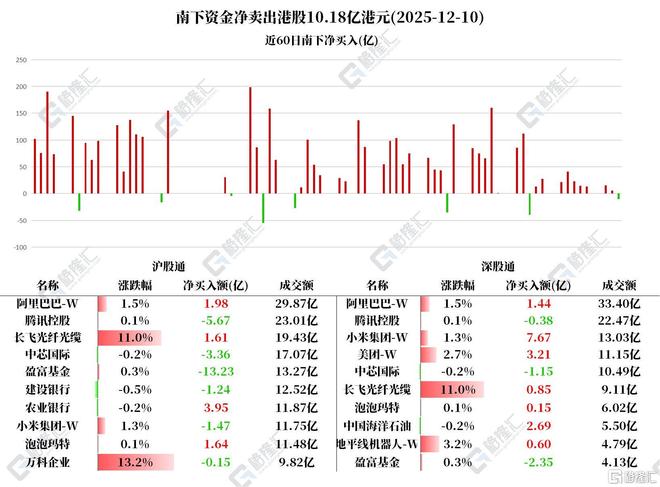
Group 1 - Southbound funds recorded a net sell of HKD 1.018 billion on December 10, with notable net buys in Xiaomi Group (HKD 619 million), Agricultural Bank (HKD 394 million), Alibaba (HKD 342 million), Meituan (HKD 320 million), China National Offshore Oil Corporation (HKD 269 million), and Pop Mart (HKD 179 million) [1] - The net sell included significant amounts in the Tracker Fund (HKD 1.559 billion), Tencent Holdings (HKD 605 million), China Construction Bank (HKD 123 million), and SMIC (HKD 118 million) [1] Group 2 - Southbound funds have continuously net bought Xiaomi for 9 days, totaling HKD 7.39843 billion, and Agricultural Bank for 3 days, totaling HKD 993.02 million [3] - In November, the sales volume of new energy passenger vehicles reached 1.321 million units, a year-on-year increase of 4.2% and a month-on-month increase of 3.0%; Xiaomi's automotive sales reached 46,249 units, with a year-on-year increase of 99.7% [4] - Morgan Stanley highlighted concerns regarding the asset quality risk related to Vanke's bond extension, noting that Vanke's bank loans account for only 0.10% of total loans in China's banking sector [4] Group 3 - Alibaba has established a new C-end business group, aiming to develop a super app as the primary entry point for users in the AI era [4] - Tencent repurchased approximately 1.06 million shares for about HKD 636 million, with repurchase prices ranging from HKD 595.5 to HKD 603 [4] - China Construction Bank announced a capital increase from RMB 250.011 billion to RMB 261.6 billion through a specific issuance of approximately 11.589 billion A-shares [5] - SMIC's monthly wafer production capacity is expected to exceed 1 million pieces by Q3 2025, with a utilization rate increase of 3.3 percentage points to 95.8%, indicating strong industry demand [5]

不良处置 “质量”赶考之路
Bei Jing Shang Bao· 2025-12-10 12:00
Core Viewpoint - The expansion of inclusive finance has led to increased pressure on asset quality, particularly for small and micro enterprises and individual borrowers, prompting banks and consumer finance institutions to focus on maintaining asset quality while ensuring sustainable development [1][3]. Group 1: Asset Quality Challenges - Small and micro enterprises face operational instability and lack effective collateral, making them vulnerable to economic fluctuations, which in turn affects the asset quality of consumer loans and business loans [3]. - The asset quality of inclusive finance is under pressure, with banks and consumer finance institutions actively engaging in an "asset quality defense war" to manage non-performing assets [3][4]. Group 2: Non-Performing Asset Disposal - Since 2025, there has been a notable increase in the transfer of non-performing assets related to small and micro enterprises and personal loans, with banks frequently listing these assets on platforms like the Silver Registration Center [3]. - Banks such as Ping An Bank and Zhongyuan Bank have announced significant non-performing asset transfer projects, with amounts reaching 7.62 billion yuan and 5.22 billion yuan respectively [3]. - Consumer finance institutions are also urgently addressing non-performing assets, with some assets being auctioned at extremely low starting prices, indicating a pressing need for risk resolution and asset optimization [4]. Group 3: Regulatory and Strategic Responses - Financial institutions are encouraged to enhance their asset disposal and capital replenishment efforts, as highlighted by regulatory authorities [7]. - Institutions are exploring innovative disposal methods, leveraging financial technology to improve risk management and operational efficiency [7][8]. - The emphasis on early identification and management of credit risks is becoming a priority for banks, with a focus on improving the efficiency of non-performing asset recovery [8]. Group 4: Long-term Sustainability - Effective management of non-performing assets is crucial for the sustainability of inclusive finance, as delays in disposal can erode profits and capital, limiting the ability to extend further inclusive credit [6]. - The relationship between the management of non-performing assets and the goals of inclusive finance is highlighted, with potential negative impacts on operational costs and credit pricing if not addressed properly [6]. - The need for collaboration between banks, consumer finance institutions, and asset management companies is emphasized to optimize resource allocation and enhance the recovery of non-performing assets [8].

探寻利率方向(4):从M2看2026年债市流动性
GF SECURITIES· 2025-12-10 11:48
Investment Rating - The report assigns a "Buy" rating for the banking sector, indicating an expectation that stock prices will outperform the market by more than 10% over the next 12 months [40]. Core Insights - The growth of M2 is primarily driven by government and corporate leverage, with government leverage's contribution increasing from 23.9% in 2015 to 45.5% in 2025, while corporate leverage is expected to contribute 63.6% to M2 growth in 2025 [5][14]. - The report highlights a divergence between the social financing (社融) and M2 growth rates, indicating a liquidity accumulation in the financial system when the demand for financing from the real economy is insufficient, which can lead to a decline in bond yields [5][19]. - The expected social financing-M2 differential for 2026 is projected to be 0.56%, with a quarter-on-quarter increase of 33 basis points [32]. Summary by Sections M2 and Liquidity Analysis - M2 includes cash, personal deposits, corporate deposits, non-bank deposits, and deposits from non-deposit financial institutions. The main contributors to M2 growth are government and corporate leverage [5][13]. - The report discusses the relationship between the social financing-M2 differential and bond market performance, noting a shift in correlation since the second half of 2022 [5][19]. Social Financing Projections - For 2026, the report forecasts a total of 16.3 trillion yuan in new loans under the social financing framework, with a growth rate of 8.11% [32][34]. - The report anticipates that the net issuance of government bonds will reach 14.8 trillion yuan in 2026, with a focus on maintaining a proactive fiscal policy [34]. M2 Growth Forecast - The M2 growth rate for 2026 is projected at 7.55%, influenced by factors such as net fiscal deposits, the strengthening of the equity market, and cross-border capital flows [32][36].



智通港股通活跃成交|12月10日





智通财经网· 2025-12-10 11:09
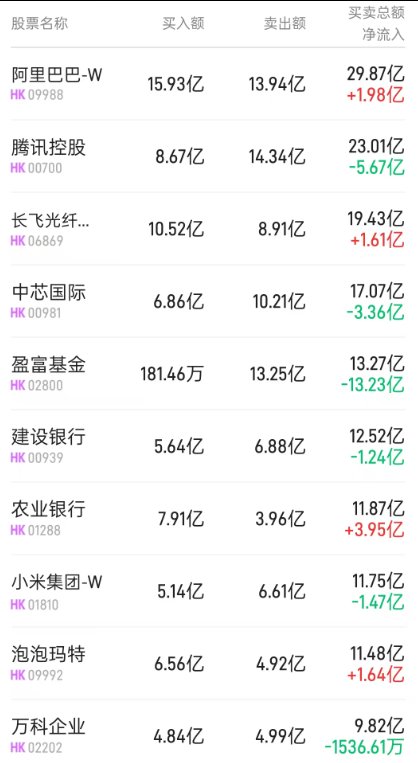
Group 1 - On December 10, 2025, Alibaba-W (09988), Tencent Holdings (00700), and Yangtze Optical Fibre and Cable (06869) were the top three companies by trading volume in the Southbound Stock Connect, with trading amounts of 2.987 billion, 2.301 billion, and 1.943 billion respectively [1] - In the Shenzhen-Hong Kong Stock Connect, Alibaba-W (09988), Tencent Holdings (00700), and Xiaomi Group-W (01810) also ranked as the top three companies by trading volume, with trading amounts of 3.340 billion, 2.247 billion, and 1.303 billion respectively [1] Group 2 - In the Southbound Stock Connect, the top ten active trading companies included Alibaba-W (09988) with a net buy of 0.198 billion, Tencent Holdings (00700) with a net sell of 0.567 billion, and Yangtze Optical Fibre and Cable (06869) with a net buy of 0.161 billion [2] - In the Shenzhen-Hong Kong Stock Connect, the top ten active trading companies included Alibaba-W (09988) with a net buy of 0.144 billion, Tencent Holdings (00700) with a net sell of 0.038 billion, and Xiaomi Group-W (01810) with a net buy of 0.767 billion [2]
港股通央企红利ETF天弘(159281)跌0.79%,成交额4334.07万元
Xin Lang Cai Jing· 2025-12-10 10:38
Core Points - The Tianhong CSI Hong Kong Stock Connect Central State-Owned Enterprises Dividend ETF (159281) closed down 0.79% on December 10, with a trading volume of 43.34 million yuan [1] - The fund was established on August 20, 2025, with an annual management fee of 0.50% and a custody fee of 0.10% [1] - As of December 9, the fund had a total of 310 million shares and a total size of 313 million yuan [1] - Over the past 20 trading days, the cumulative trading amount reached 778 million yuan, with an average daily trading amount of 38.91 million yuan [1] - The current fund manager is He Yuxuan, who has managed the fund since its inception, achieving a return of 4.01% during the tenure [1] Holdings Summary - The top holdings of the Tianhong CSI Hong Kong Stock Connect Central State-Owned Enterprises Dividend ETF include: - COSCO Shipping Holdings (0.85% holding, 218,000 shares, market value of 2.9175 million yuan) [2] - Orient Overseas International (0.40% holding, 10,500 shares, market value of 1.3717 million yuan) [2] - China Foreign Transport (0.33% holding, 270,000 shares, market value of 1.1396 million yuan) [2] - China Petroleum & Chemical Corporation (0.32% holding, 162,000 shares, market value of 1.0973 million yuan) [2] - CITIC Bank (0.32% holding, 175,000 shares, market value of 1.1136 million yuan) [2] - CNOOC (0.29% holding, 58,000 shares, market value of 1.0041 million yuan) [2] - China Shenhua Energy (0.29% holding, 30,500 shares, market value of 982,600 yuan) [2] - China People's Insurance Group (0.29% holding, 164,000 shares, market value of 1.0107 million yuan) [2] - China Unicom (0.28% holding, 104,000 shares, market value of 952,800 yuan) [2] - Agricultural Bank of China (0.27% holding, 189,000 shares, market value of 933,900 yuan) [2]


北水动向|北水成交净卖出10.18亿 北水继续加仓小米(01810) 抛售盈富基金(02800)超15亿港元
智通财经网· 2025-12-10 10:09
Core Viewpoint - The Hong Kong stock market experienced a net sell-off of 10.18 billion HKD from northbound trading, with significant movements in various stocks, indicating a mixed sentiment among investors [1]. Group 1: Stock Performance - Xiaomi Group-W (01810) saw a net buy of 6.19 billion HKD, with recent management changes aimed at enhancing operational efficiency and focusing on high-potential markets [4]. - Agricultural Bank (01288) received a net buy of 3.94 billion HKD, while China Construction Bank (00939) faced a net sell of 1.23 billion HKD, reflecting concerns over asset quality risks in the real estate sector [4]. - Alibaba Group-W (09988) had a net buy of 3.42 billion HKD, driven by the rapid growth of its AI application "Qianwen," which surpassed 30 million monthly active users shortly after launch [4][5]. - Longi Green Energy (06869) attracted a net buy of 2.46 billion HKD following its announcement of a share placement to enhance liquidity and fund overseas expansion [5]. - Meituan-W (03690), CNOOC (00883), and Pop Mart (09992) recorded net buys of 3.2 billion HKD, 2.69 billion HKD, and 1.79 billion HKD, respectively [6]. Group 2: Notable Sell-offs - The Tracker Fund of Hong Kong (02800) experienced a significant net sell of 15.58 billion HKD, indicating a shift in investor sentiment [6]. - Tencent Holdings (00700) faced a net sell of 6.05 billion HKD, reflecting ongoing market concerns [6]. - Semiconductor Manufacturing International Corporation (00981) saw a net sell of 4.5 billion HKD, influenced by recent developments in U.S. chip export policies to China [4].


国有大型银行板块12月10日跌2.16%,农业银行领跌,主力资金净流出15.21亿元
Zheng Xing Xing Ye Ri Bao· 2025-12-10 09:10
证券之星消息,12月10日国有大型银行板块较上一交易日下跌2.16%,农业银行领跌。当日上证指数报 收于3900.5,下跌0.23%。深证成指报收于13316.42,上涨0.29%。国有大型银行板块个股涨跌见下表: 从资金流向上来看,当日国有大型银行板块主力资金净流出15.21亿元,游资资金净流入5.02亿元,散户 资金净流入10.19亿元。国有大型银行板块个股资金流向见下表: 以上内容为证券之星据公开信息整理,由AI算法生成(网信算备310104345710301240019号),不构成投资建议。 ...
