
ICBC(01398)

Search documents
退休一年半主动投案!工行云南省分行原行长许海,被开除党籍
券商中国· 2025-12-29 23:31
Core Viewpoint - The article discusses the serious disciplinary violations and illegal activities of Xu Hai, the former Party Secretary and President of the Yunnan branch of the Industrial and Commercial Bank of China (ICBC), leading to his expulsion from the Party and legal consequences [2][5]. Group 1: Disciplinary Actions - Xu Hai has been expelled from the Party and his benefits have been revoked due to severe violations of Party discipline and suspected bribery, with his case being transferred to the prosecution [5]. - Multiple officials from state-owned banks, including ICBC and Agricultural Bank of China, have faced disciplinary actions, indicating a broader crackdown on corruption within the banking sector [3][6]. Group 2: Specific Violations - Xu Hai engaged in superstitious activities, accepted potentially compromising banquets and golf arrangements, misused public funds for personal gain, and failed to report personal matters [4]. - He was found to have received gifts and money that could influence his official duties, owned shares in unlisted companies, and misappropriated company assets [4][5]. Group 3: Broader Context - The article highlights a pattern of disciplinary actions against bank officials, with several cases reported in December, suggesting a systemic issue within the banking industry [6][7]. - The Central Commission for Discipline Inspection has been actively working to enforce stricter regulations and accountability measures within the banking sector, as evidenced by recent meetings and the establishment of new guidelines [8].


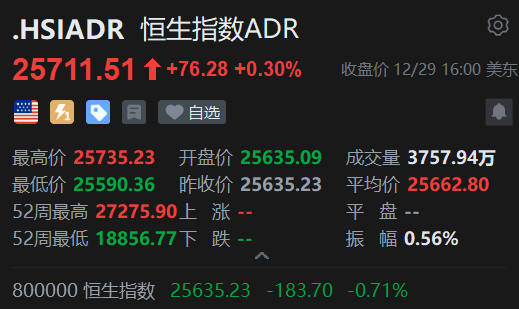
智通ADR统计 | 12月30日





智通财经网· 2025-12-29 22:58
Market Overview - The Hang Seng Index (HSI) closed at 25,711.51, up by 76.28 points or 0.30% from the previous close [1] - The index reached a high of 25,735.23 and a low of 25,590.36 during the trading session [1] - The trading volume was 37.5794 million shares, with an average price of 25,662.80 [1] Blue-Chip Stocks Performance - HSBC Holdings closed at HKD 122.589, an increase of 0.57% from the previous close [2] - Tencent Holdings closed at HKD 598.176, up by 0.28% from the previous close [2] Individual Stock Movements - Tencent Holdings (00700) reported a latest price of HKD 596.500, down by HKD 6.500 or 1.08% [3] - Alibaba Group (09988) closed at HKD 143.300, down by HKD 2.700 or 1.85% [3] - HSBC Holdings (00005) reported a price of HKD 121.900, down by HKD 1.900 or 1.53% [3] - China Construction Bank (00939) increased by HKD 0.060 or 0.79%, closing at HKD 7.620 [3] - Xiaomi Group (01810) decreased by HKD 0.640 or 1.63%, closing at HKD 38.580 [3] - AIA Group (01299) closed at HKD 82.200, down by HKD 1.050 or 1.26% [3] - NetEase (099999) increased by HKD 3.000 or 1.41%, closing at HKD 216.200 [3] - Meituan (03690) closed at HKD 104.200, up by HKD 1.000 or 0.97% [3] - Industrial and Commercial Bank of China (01398) increased by HKD 0.100 or 1.63%, closing at HKD 6.230 [3] - Hong Kong Exchanges and Clearing (00388) closed at HKD 408.200, down by HKD 1.800 or 0.44% [3] - Ping An Insurance (02318) increased by HKD 0.200 or 0.30%, closing at HKD 66.400 [3] - Bank of China (03988) closed at HKD 4.440, up by HKD 0.010 or 0.23% [3] - Ctrip Group (09961) decreased by HKD 4.000 or 0.71%, closing at HKD 559.500 [3] - BYD Company (01211) increased by HKD 3.500 or 3.74%, closing at HKD 97.100 [3] - CITIC Limited (00267) increased by HKD 0.060 or 0.50%, closing at HKD 12.050 [3] - Baidu (098888) closed at HKD 119.100, down by HKD 0.400 or 0.33% [3] - JD.com (09618) decreased by HKD 0.800 or 0.71%, closing at HKD 112.000 [3] - China Hongqiao Group (01378) decreased by HKD 0.560 or 1.73%, closing at HKD 31.760 [3] - Hang Seng Bank (00011) closed at HKD 153.600, down by HKD 0.300 or 0.19% [3] - Kuaishou Technology (01024) decreased by HKD 0.800 or 1.24%, closing at HKD 63.800 [3] - Sun Hung Kai Properties (00016) closed at HKD 94.900, down by HKD 1.700 or 1.76% [3] - Pop Mart International (09992) decreased by HKD 0.300 or 0.15%, closing at HKD 199.900 [3] - BeiGene (06160) increased by HKD 0.300 or 0.16%, closing at HKD 183.800 [3] - China Merchants Bank (03968) increased by HKD 0.550 or 1.07%, closing at HKD 52.150 [3]
中国贸促会:APEC“中国年”序幕已正式拉开
Xin Lang Cai Jing· 2025-12-29 15:11
Group 1 - The APEC 'China Year' has officially commenced, with the China Council for the Promotion of International Trade (CCPIT) taking over the hosting rights for the 2026 APEC Business Leaders Summit and the APEC Business Advisory Council (ABAC) from South Korea [1] - APEC is the highest-level economic cooperation mechanism in the Asia-Pacific region, focusing on trade and investment liberalization and regional economic integration [1] - The ABAC, consisting of 63 representatives from 21 economies, is the only permanent institution representing the business community within the APEC framework [1] Group 2 - The 2026 ABAC annual activity plan has been unanimously approved, with four meetings scheduled in Jakarta (February), Mexico City (April), Thailand (July), and Shenzhen (November) to formulate policy recommendations for the APEC leaders [2] - In addition to organizing ABAC activities, the CCPIT is also actively promoting the preparations for the 2026 APEC Business Leaders Summit [2]



工行郑州分行:深耕消保赋能民生 筑牢金融服务暖心防线
Xin Lang Cai Jing· 2025-12-29 13:44
Core Viewpoint - In 2025, the Industrial and Commercial Bank of China (ICBC) Zhengzhou Branch is committed to integrating consumer rights protection into its operational development, focusing on mechanism construction, risk prevention, problem resolution, and educational outreach to enhance the quality and effectiveness of consumer protection work [1][4]. Group 1: Mechanism and Risk Management - ICBC Zhengzhou Branch emphasizes the establishment of mechanisms, strong management, extensive education, and innovation as the main line of work, revising and improving multiple core systems to create a clear responsibility network [2][5]. - The bank has implemented a "big consumer protection" work pattern, ensuring that consumer protection responsibilities are integrated throughout the entire product and service process, leading to comprehensive efficiency improvements [2][5]. - The bank has introduced an "Inconvenience Award" to care for frontline employees and has promoted a smart consumer protection review system to eliminate issues like inappropriate sales and false advertising from the source [6]. Group 2: Dispute Resolution and Consumer Education - ICBC Zhengzhou Branch has adopted a layered and categorized handling mechanism to empower grassroots levels and improve processing efficiency, strictly implementing a "first inquiry responsibility system" to resolve issues promptly [3][7]. - The bank has conducted over a hundred unique educational activities targeting key groups such as the elderly, youth, and new citizens, reaching 2.84 million people through various channels [3][7]. - Future plans include enhancing the consumer protection governance system, focusing on systematic governance of key issues, and deepening the "consumer protection +" scenario-based education model to provide a more trustworthy financial environment for consumers [3][7].
严重职务违法、涉嫌受贿犯罪!许海,被开除党籍!
Zhong Guo Ji Jin Bao· 2025-12-29 12:06
Core Viewpoint - The former Party Secretary and President of the Yunnan Branch of the Industrial and Commercial Bank of China, Xu Hai, has been expelled from the Party due to serious violations of discipline and law [1][5]. Group 1: Investigation and Findings - Xu Hai was subjected to an investigation by the Central Commission for Discipline Inspection and the supervisory committee of Liupanshui City, Guizhou Province, for serious violations of discipline and law [3]. - The investigation revealed multiple issues, including loss of ideals, resistance to organizational review, acceptance of potentially compromising banquets and golf activities, misuse of public funds, and interference in major business activities [4]. Group 2: Disciplinary Actions - Based on the findings, Xu Hai was expelled from the Party, and his benefits were revoked. His case has been forwarded to the prosecutorial authorities for legal proceedings [5]. - Xu Hai has a long career in the Industrial and Commercial Bank of China, having held various positions for over 30 years, including roles in different branches and as a supervisor in the bank's wealth management subsidiary [5]. Group 3: Broader Context - This incident is part of a larger trend, as several officials from the Industrial and Commercial Bank of China have faced disciplinary actions this year, indicating ongoing scrutiny within the organization [6].
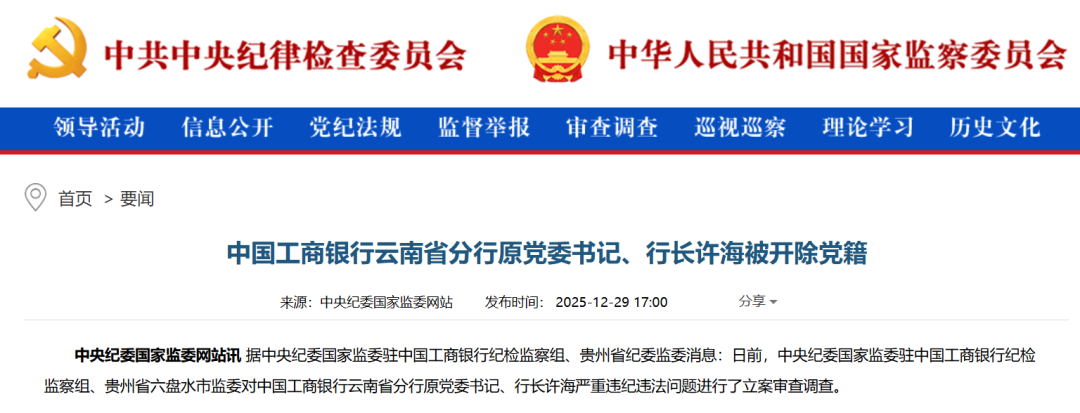
严重职务违法、涉嫌受贿犯罪!许海,被开除党籍!
中国基金报· 2025-12-29 11:53
Group 1 - The core point of the article is the expulsion of Xu Hai, the former Party Secretary and President of the Yunnan Branch of the Industrial and Commercial Bank of China (ICBC), from the Party due to serious violations of discipline and law [2][5]. - Xu Hai was found to have lost his ideals and beliefs, resisted organizational review, and engaged in superstitious activities [3]. - He ignored the central eight regulations, accepted invitations that could affect the impartial execution of his duties, and misused public funds for personal benefits [4]. Group 2 - Xu Hai concealed personal matters and used his position to benefit others in personnel recruitment and job adjustments [4]. - He accepted gifts and money that could influence his official duties, illegally owned shares in unlisted companies, and misappropriated unit property [4]. - The investigation revealed that Xu Hai intervened in major business activities and used his influence to illegally gain substantial financial benefits [4]. Group 3 - The decision to expel Xu Hai from the Party was made based on the Chinese Communist Party's disciplinary regulations and relevant laws [5]. - His case has been transferred to the judicial authorities for prosecution, along with the confiscation of his illegal gains [5]. - This incident is part of a broader trend, as multiple officials from ICBC have faced disciplinary actions this year [6].

麦加芯彩:为全资子公司麦加涂料(南通)有限公司提供1.92亿元担保

2 1 Shi Ji Jing Ji Bao Dao· 2025-12-29 11:12
南财智讯12月29日电,麦加芯彩公告,公司于2025年12月29日与中国工商银行股份有限公司南通经济技 术开发区支行签署《最高额保证合同》,为全资子公司麦加涂料(南通)有限公司提供连带责任保证, 担保最高本金限额为1.92亿元,担保期限自2025年12月29日起至2026年12月29日止。本次担保事项已经 公司第二届董事会第十三次会议、第二届监事会第十次会议及2024年年度股东大会审议通过,属于前期 预计担保额度范围内。截至公告日,公司对子公司提供的担保余额为8.42亿元,占公司2024年末经审计 净资产的40.87%。被担保人资信状况良好,公司对其经营风险可控,担保具有必要性和合理性。 ...
银行坐不住了:营业厅从人山人海到冷冷清清,储户们都去哪了?
Sou Hu Cai Jing· 2025-12-29 09:30
Core Viewpoint - The transition from crowded bank branches to a significant decline in foot traffic is attributed to the rise of mobile banking apps, which allow customers to perform various banking tasks without visiting physical locations [3][5][7]. Group 1: Changes in Customer Behavior - Bank branches have seen a drastic reduction in customer visits, leading to a decrease in the workload for bank staff [3]. - Customers are increasingly using mobile banking apps for transactions such as deposits, withdrawals, and transfers, reducing the need for in-person visits [3][5]. - The decline in branch visits has prompted banks to consider closing physical locations if customer numbers continue to drop [3]. Group 2: Demographics Still Visiting Branches - Certain demographics, particularly the elderly, still prefer visiting bank branches for cash transactions and other services [5]. - Some customers require in-person assistance for complex transactions that cannot be completed through mobile apps, such as large loans or significant cash deposits [5]. Group 3: Adaptation of Bank Branches - To survive, banks are repurposing parts of their branches into areas for financial education and fraud prevention workshops, transforming them into community knowledge centers [7]. - This adaptation reflects the necessity for physical branches to evolve in response to the shift towards online banking, allowing them to maintain relevance in a digital age [7].

工商银行青岛市分行科技金融贯通青岛科创大走廊
Huan Qiu Wang· 2025-12-29 09:25
Core Viewpoint - The Qingdao Innovation Corridor is rapidly taking shape as a key area for technological innovation and industrial transformation, integrating universities, national research platforms, and leading enterprises in strategic emerging industries [1] Group 1: Development of the Innovation Corridor - The Qingdao Innovation Corridor is positioned as the core of Qingdao's new round of technological innovation and industrial transformation, connecting major nodes like Laoshan Smart Industry City, Licang Youth Innovation City, and Blue Valley Marine Science City [1] - The corridor aims to create a collaborative development pattern focusing on marine technology innovation, smart industry, and achievement incubation, supporting Qingdao's goal of becoming a technology powerhouse by 2025 [1] Group 2: Financial Support from ICBC Qingdao Branch - ICBC Qingdao Branch has established six specialized branches in key areas of the Innovation Corridor, focusing on technology finance and creating a product matrix that integrates investment and loans [3] - The total asset scale of ICBC's specialized institutions in the corridor ranks among the top in the system, with technology loan balances exceeding 10 billion this year, demonstrating the bank's commitment to supporting regional innovation [3][4] Group 3: Focus on Key Industries - The bank's branches are focusing on cutting-edge digital industries such as artificial intelligence and virtual reality, as well as modern marine technology markets and semiconductor sectors [4] - ICBC Qingdao Branch is addressing the diverse and long-term financial needs of high-growth, asset-light technology companies through innovative policies and service mechanisms [4][5] Group 4: Policy Measures and Ecosystem Development - The bank is actively involved in formulating high-level service opinions for technology finance to support the development of the Innovation Corridor, enhancing the innovation ecosystem [5] - ICBC is introducing various financing products tailored for different stages of technology enterprises, including "Talent Loans" and "R&D Loans," to support the entire lifecycle from research to commercialization [5][6] Group 5: Future Outlook - As the strategic importance of the Qingdao Innovation Corridor continues to rise, ICBC Qingdao Branch will maintain its focus on serving the real economy and optimizing the allocation of technology finance resources [6]
工商银行云南省分行原党委书记、行长许海被开除党籍
Xin Lang Cai Jing· 2025-12-29 09:09
12月29日金融一线消息,据中央纪委国家监委驻中国工商银行纪检监察组、贵州省纪委监委消息:日 前,中央纪委国家监委驻中国工商银行纪检监察组、贵州省六盘水市监委对中国工商银行云南省分行原 党委书记、行长许海严重违纪违法问题进行了立案审查调查。 经查,许海丧失理想信念、背弃初心使命,对抗组织审查,搞迷信活动;漠视中央八项规定精神,接受 可能影响公正执行公务的宴请及高尔夫球活动安排,违规出入具有私人会所性质的场所,公款吃喝,公 款旅游,公车私用,利用职务上的影响无偿接受服务,将应由本人支付的费用交由他人支付;无视组织 原则,隐瞒不报个人有关事项,利用职务影响为他人在干部职工录用和岗位调整等事项中谋取利益;毫 无廉洁底线,收受可能影响公正执行公务的礼品、礼金,违规拥有非上市公司股份,虚构租赁事项套取 租金,侵占单位财物,向从事公务人员赠送明显超出正常礼尚往来的礼品;不守规矩,干预和插手重大 经营活动;权力观异化,利用职务上的影响以及职权或者地位形成的便利条件为他人在项目承揽、贷款 融资等方面谋利并非法收受巨额财物。 许海严重违反党的政治纪律、组织纪律、廉洁纪律、工作纪律和生活纪律,构成严重职务违法并涉嫌受 贿犯罪,且 ...
