
养老金产品

Search documents
华源晨会精粹20260324-20260324
Hua Yuan Zheng Quan· 2026-03-24 12:08
Group 1: Fixed Income/Banking - The overall scale of corporate annuities in China continued to expand in Q4 2025, with a decrease in investment returns compared to the previous quarter [7][8] - The number of enterprises establishing annuity plans increased by 2,730 to 178,000, and the number of insured employees rose by 109,400 to 3,343,000, indicating steady growth in scale metrics [8][9] - The average management scale of insurance funds is higher than that of public funds, with several institutions showing significant growth in both scale and percentage increase [7][11] Group 2: Robotics - Yushu Technology's IPO has been accepted, aiming to become the first humanoid robot company listed on A-shares, with over 5,500 humanoid robots shipped in 2025, ranking first globally [14][15] - The domestic humanoid robot industry is accelerating its capitalized process, with multiple companies completing significant financing rounds in 2026 [15][16] - The government is increasingly prioritizing the embodied intelligence industry, with new national standards being established to support the sector [16][17] Group 3: Construction/Building Materials - Infrastructure fixed asset investment reached 1.88 trillion yuan in January-February 2026, a year-on-year increase of 11.40%, with significant growth in energy and public facilities sectors [23][24] - The issuance of special bonds is accelerating, with a cumulative issuance of 1.048 trillion yuan as of March 22, 2026, reflecting a 50.82% year-on-year increase [24] - The construction investment logic is shifting towards structural investments that serve national strategies and security needs, particularly in energy and water resources [26][27] Group 4: Food and Beverage - China Resources Beer reported a total revenue of 37.985 billion yuan in 2025, a slight decrease of 1.68%, with a net profit of 3.371 billion yuan, down 28.87% due to goodwill impairment in its liquor business [28][30] - The beer segment showed resilience with a revenue of 36.49 billion yuan, maintaining stable performance despite a slight decline in sales volume [29][30] - Wanchen Group achieved a revenue of 51.459 billion yuan in 2025, a year-on-year increase of 59.17%, with a net profit of 1.345 billion yuan, reflecting a significant growth in its snack retail business [32][33] Group 5: Pharmaceuticals - Junshi Biosciences, established in December 2012, focuses on innovative therapies and reported a sales revenue of 2.068 billion yuan for its core product in 2025, a growth of 37.72% [36][37] - The company has multiple potential products in its pipeline that are expected to contribute to revenue growth, including a PD-1/VEGF dual antibody and a CLDN18.2 ADC [37][38] - The company is projected to have total revenues of 3.398 billion yuan in 2026, with a strong emphasis on innovation and clinical development [38]


——25年企业年金基金及养老金产品业务数据点评:业绩环比回落,年金规模稳步增长
Hua Yuan Zheng Quan· 2026-03-24 07:03
1. Report's Industry Investment Rating - No information about the industry investment rating is provided in the report. 2. Core Viewpoints of the Report - In Q4 2025, China's enterprise annuity showed the characteristics of continuous scale expansion and a decline in the investment return rate on a quarterly basis. The scale indicators such as the number of enterprises, the number of insured employees, and the accumulated funds increased steadily. The trustee market remained dominated by insurance funds, with a high concentration at the top. The bank - affiliated institutions rose rapidly but their share decreased slightly. The number of small and medium - sized enterprises establishing enterprise annuity plans may be increasing. The leading effect of investment management institutions was further strengthened, with the average management scale of insurance funds higher than that of public funds. The investment return rates of equity - containing annuity portfolios, fixed - income annuity portfolios, and pension products in Q4 2025 all declined significantly compared with Q3, but all types of investments achieved positive returns in 2025, and the annuity market maintained a stable development trend [2]. 3. Summary by Relevant Catalogs 3.1 Enterprise Annuity Coverage and Yield - As of Q4 2025, the number of established enterprises increased by 2,730 to 178,000, the number of participating employees increased by 109,400 to 33.43 million, and the accumulated funds increased by 0.12 trillion yuan to 4.21 trillion yuan. Only the number of single - plan (corporate entrustment) increased by 14, while other types remained stable. The investment - end scale increased steadily in Q4 2025, with the net value of investment assets increasing by 106.1 billion yuan and the number of portfolios increasing by 61. The cumulative return rate in the past three years rose slightly from 12.08% in Q3 2025 to 12.94%. On the benefit - receiving end, the number of recipients increased slightly by 266,400 to 3.6882 million in 2025, and the receiving amount increased by 7.164 billion yuan to 116.213 billion yuan. The per - capita receiving amount decreased from 31,900 yuan in 2024 to 31,500 yuan in 2025 [2]. 3.2 Trustee Market of Enterprise Annuity - **Trustee management asset amount**: The overall scale continued to rise, with a quarterly increase of 3.1% to 3.2 trillion yuan in Q4 2025. Institutions with relatively smaller trustee scales expanded relatively faster. China Life Pension (959.7 billion yuan), Ping An Pension (618.2 billion yuan), and Industrial and Commercial Bank of China (373.4 billion yuan) ranked in the top three in terms of trustee scale. The trustee asset scales of PICC Pension, CITIC Trust, and China Merchants Bank increased by 14.2%, 4.9%, and 4.8% respectively in Q4 2025. The share of bank - affiliated institutions decreased from 25.0% in Q3 2025 to 24.8% in Q4 2025 [2]. - **Number of enterprises managed by trustee institutions**: The total number of enterprises managed by enterprise annuity trustee institutions continued to grow, increasing by 2,223 to about 162,000 in Q4 2025 compared with Q3 2025, a quarterly increase of 1.4%. Insurance institutions continued to dominate the market, with the number of enterprises managed by insurance institutions accounting for 68.1% in Q4 2025, a decrease of 1.16 percentage points compared with Q3 2025. China Life Pension led with 43,000 managed enterprises, accounting for 26.7% of the whole market. In terms of quarterly growth rate, the number of enterprises managed by PICC Pension increased by 20.6% to 2,702 in Q4 2025, leading the industry. The number of enterprises managed by Industrial and Commercial Bank of China increased by 1,538 to 21,000 in Q4 2025, with rapid business growth [2]. - **Number of employees managed by trustee institutions**: The leading concentration effect was obvious, and the overall pattern was still dominated by insurance funds. The number of employees increased slightly by 0.6% to 27.59 million in Q4 2025. The number of small and medium - sized enterprises establishing enterprise annuity plans may be increasing. The number of employees managed by PICC Pension and CITIC Trust increased by 10.9% and 9.3% respectively to 495,000 and 222,000 in Q4 2025, much higher than their peers. Although the number of enterprises managed by Industrial and Commercial Bank of China and Bank of China increased significantly, the number of employees they managed increased by only 0.8% and 1.6% respectively, indicating that their new enterprise customers may be mostly small and medium - sized enterprises [2][3]. 3.3 Investment Management Institutions of Enterprise Annuity - In Q4 2025, the list of the top ten institutions in terms of portfolio asset amount was relatively stable. Taikang Asset, China Life Pension, and ICBC Credit Suisse ranked in the top three in terms of management scale with 715.4 billion yuan, 525.2 billion yuan, and 395.2 billion yuan respectively. The average management asset amount of public fund companies (153.6 billion yuan, an increase of 4.1 billion yuan compared with Q3 2025, a quarterly increase of 2.72%) was less than that of insurance institutions (an average of 291 billion yuan, an increase of 7.9 billion yuan compared with Q3 2025, a quarterly increase of 2.78%). In terms of scale changes, ICBC Credit Suisse, Taikang Asset, and Guotai Fund ranked in the top three in terms of increment, with increases of 24.8 billion yuan, 22 billion yuan, and 13.1 billion yuan respectively compared with Q3 2025. Guotai Fund, Xinhua Pension, and ICBC Credit Suisse ranked in the top three in terms of growth rate, with quarterly increases of 10.16%, 10.13%, and 6.7% respectively. ICBC Credit Suisse entered the top three in management scale (an increase of 1 place compared with Q3 2025) [3]. 3.4 Investment Performance - In Q4 2025, the investment return rates of equity - containing portfolios and fixed - income portfolios both declined compared with Q3 2025. The investment return rate of fixed - income portfolios decreased slightly by 0.29 percentage points (from 0.90% to 0.61%), mainly affected by the decline in the income of collective plans. The investment return rate of equity - containing portfolios declined significantly on a quarterly basis due to the high base in Q3 2025, with the single - quarter return rate falling from 4.82% to 0.8%. All plan types recorded a decline of more than 3.5 percentage points, which also drove the overall return rate to fall from 4.26% to 0.75%, with the single - quarter return rate of single - plans declining the most. In terms of the annual return rate in 2025, the return rates of fixed - income, equity - containing, and overall were 2.99%, 7.09%, and 6.51% respectively [3]. 3.5 Changes in Pension Products - Compared with Q3 2025, the scale of pension products decreased slightly and the overall return rate declined in Q4 2025. As of the end of 2025, there were 567 actually operating products, 1 less than in Q3 2025. The net asset value of equity products increased by 4.6% to 233.9 billion yuan on a quarterly basis, and the quarterly investment return rate fell from 22.9% in Q3 2025 to 2.0% in Q4 2025. The annual return rate in 2025 was 30.9%. The single - quarter return rates of ordinary stock - type and Hong Kong - stock - type products in Q4 2025 were 2.2% and 0.6% respectively, and the annual return rates were 29.5% and 44.9% respectively. The cumulative return rate of Hong Kong - stock products since their establishment recovered to - 9.6% in Q4 2025. The net asset value of fixed - income products decreased by 4.6% to 1,523.3 billion yuan on a quarterly basis, and the return rate in Q4 2025 slightly decreased to 0.5% (0.7% in Q3 2025). The annual return rate in 2025 was 2.7%. Overall, the total net asset value of pension products decreased slightly by 1.37% to 2,431 billion yuan on a quarterly basis, and the quarterly investment return rate fell from 3.1% in Q3 2025 to 0.7% in Q4 2025. The annual return rate in 2025 was 5.6% [3].

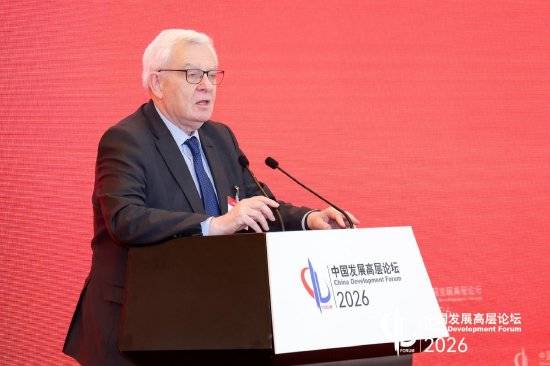
法国巴黎银行董事长:释放消费潜力关键在于改善储蓄配置,转向养老金等长期金融工具
Sou Hu Cai Jing· 2026-03-23 05:17
Group 1 - The core focus of the speech is on consumption in China, emphasizing it as a fundamental issue and a policy matter, with a dual approach on financing consumption and boosting consumer confidence [3][4] - Consumption finance has become a significant part of China's financial system, showing a 1% increase in 2025, indicating a solid foundation for consumer demand and a transition to a more mature phase of consumption finance [4] - The company believes in the necessity of expanding credit accessibility to support consumer spending and the real economy while maintaining strict risk control and compliance standards to ensure long-term stability in the consumption finance sector [4][5] Group 2 - The transformation of household savings is essential to unlock consumption potential, focusing on improving the allocation of savings towards long-term and diversified financial instruments, which can enhance family confidence [5][6] - Policy actions are crucial for establishing a robust pension system and appropriate incentives, with a call for collaboration between public policy and private sector investments to reshape consumer confidence and promote consumption potential in China [6]


平安养老受托资管部总经理罗庆忠:2026年权益配置聚焦三条主线
Xin Lang Cai Jing· 2026-02-01 13:08
Core Insights - The discussion focuses on the asset allocation strategies for 2026, emphasizing the importance of equity investments and the evolving landscape of pension funds in China [1][4][5]. Group 1: Asset Allocation Strategies - The current allocation for pension funds is approximately 25% to 30% in equity assets, with 70% to 80% in fixed income, reflecting a shift from the original 30% equity and 70% fixed income model established in 2005 [3][4]. - The equity market's performance is expected to be influenced by two key factors: the redefinition of the stock market by the government since the "924" policy and the potential for new stock issuances to impact market stability [4][5]. - Three main lines of focus for equity allocation in 2026 are identified: maintaining dividend assets, aligning with high-growth industries, and capitalizing on government policy initiatives [5][6][7]. Group 2: Risk Management and Performance - Effective risk management is crucial for large institutions, with a focus on understanding maximum drawdown (MDD) and its implications for investment strategies [8][9]. - The company has developed a four-variable function to assess maximum drawdown, which includes expected return, volatility, significant risk levels, and time [9]. - The introduction of a stop-loss framework based on Bayesian models aims to enhance risk management for pension funds, ensuring that investment strategies are resilient to market fluctuations [10].


易方达基金“养老金老将”荣退 高松凡卸任副总裁
Xin Lang Cai Jing· 2026-01-05 07:22
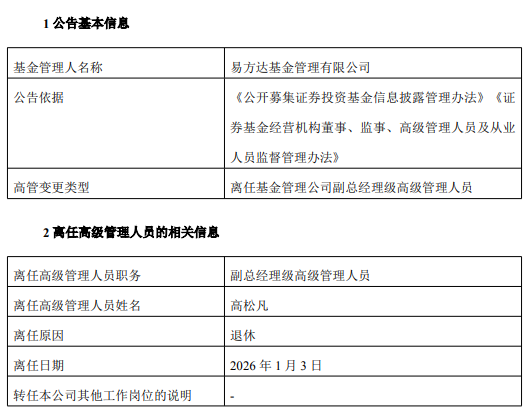
Core Viewpoint - E Fund Management announced the retirement of Gao Songfan, the Deputy General Manager and Chief Pension Business Officer, effective January 3, 2026, recognizing his significant contributions to the company's pension market business [1][8]. Group 1: Management Change - Gao Songfan is recognized as a key driver of the company's pension market business and has over 20 years of industry experience [3][10]. - He joined E Fund in February 2011 and has held various positions, including Director of Pension Business and Deputy General Manager since April 2017 [3][10]. Group 2: Pension Business Development - Under Gao's leadership, E Fund's pension business has achieved systematic development, becoming one of the few institutions with full qualifications for pension investment management since starting this business in 2004 [4][11]. - As of mid-2025, E Fund's corporate annuity management scale reached 318.783 billion yuan, managing 427 portfolios, and the company has won all 33 regional selection projects for pension fund managers [4][11]. Group 3: Insights on Pension Management - Gao has a deep understanding of the Chinese pension management system, emphasizing the balance of long-term investment, constraints, returns, and risk control [6][14]. - He highlighted the differences between the U.S. and Chinese pension systems, noting that China's model effectively mitigates risks faced by individual investors through professional management [14]. - Looking ahead, he proposed a development path of "productization first, then personalization" to enhance the diversity of pension products and improve individual investment experiences [14]. Group 4: Market Outlook - With Gao's retirement, there is increased market attention on E Fund's ongoing strategy in the pension business, especially as the public fund industry is poised for a comprehensive promotion of personal pension systems [7][15].
寻求差异化定位 券商发力养老金融空间广阔
Jing Ji Ri Bao· 2025-12-17 23:58
Core Viewpoint - The development of pension finance is a key focus of the Central Financial Work Conference, aiming to create a sustainable financial system that supports the aging population and enhances the growth of the silver economy [2][3]. Group 1: Policy and Market Environment - The Central Financial Work Conference highlighted the importance of establishing a pension finance system by 2028 and achieving a high-quality development cycle by 2035 [2]. - Current challenges in pension finance include the need for market-oriented investment management capabilities and the nascent state of related industries such as health care and elder care [2]. Group 2: Investment Opportunities - The aging population opens up investment opportunities for brokerages across the entire value chain of health care, pension services, long-term care, and elder-friendly products [3]. - Brokerages can leverage public and private funds to effectively integrate long-term investment opportunities into residents' asset allocations [3]. Group 3: Differentiation Strategies - Brokerages are seeking differentiation in pension management through product innovation, service upgrades, and cross-industry collaboration [4]. - The development of a layered product system is essential for balancing safety and returns in pension investments [4]. Group 4: Asset Management Services - Brokerages are providing comprehensive asset management services for various pension funds, including social security and enterprise annuities [5]. - The implementation of personal pension systems has significantly increased demand for pension wealth planning among individual clients [5]. Group 5: Client-Centric Approaches - The need for professional asset allocation advice is driving brokerages to adopt a client-centered "buy-side advisory" model [6]. - Brokerages are offering tailored pension advisory services to meet diverse client needs [6]. Group 6: Financing Innovations - Brokerages are transitioning towards modern investment banking by providing diversified financing solutions for the silver economy [7]. - Innovative financial tools such as private placement notes (PPN) and asset-backed securities (ABS) are being utilized to support the pension industry [7]. Group 7: Future Directions - Brokerages are encouraged to focus on high-growth segments of the silver economy, such as rehabilitation medical care and elder-friendly consumer products [8]. - There is potential for further innovation in pension financial tools, including real estate investment trusts (REITs) and pension ABS [8].
券商发力养老金融空间广阔
Jing Ji Ri Bao· 2025-12-17 20:08
Core Insights - The central financial work conference has identified pension finance as one of the key areas for development, aiming to establish a robust pension finance system by 2028 and achieve a high-quality development cycle by 2035 [1][2] Investment Opportunities - The aging population opens up investment opportunities for brokerages across the entire industry chain, including healthcare, pension services, long-term care, and elder-friendly technology [2][6] - Brokerages can leverage various financial products to effectively integrate long-term sectors into residents' asset allocation [2][5] Challenges in Pension Finance - The pension finance sector faces challenges such as the need for market-oriented and professional investment management capabilities, as well as the nascent development of elder care services and products [1][3] - There is a pressing need for diverse financing tools to support the light-asset and long-return-cycle characteristics of the elder care industry [1][6] Differentiation Strategies - Brokerages are seeking differentiation in pension management through product innovation, service upgrades, and cross-industry collaboration [3][4] - A multi-strategy research and investment system is essential for brokerages to achieve long-term stable returns while managing inflation and volatility [3][4] Asset Management Services - Brokerages are providing comprehensive asset management services for various pension funds, including social security and enterprise annuities, to promote stable development [4][5] - The implementation of personal pension systems has significantly increased demand for wealth planning among individual clients, creating opportunities for brokerages in account management and product distribution [4][5] Financial Innovation - Brokerages are expanding their service boundaries through financial innovation, utilizing tools like private placement notes (PPN) and asset-backed securities (ABS) to meet diverse financing needs [6][7] - The successful issuance of the first "support for the pension industry" bond demonstrates the potential for low-cost financing channels in the elder care sector [6][7] Future Directions - Brokerages are encouraged to focus on high-growth segments of the elder economy, innovate pension financial tools, and explore collaborative ecosystems with various partners [7]


25Q3企业年金基金及养老金产品业务数据点评:权益类收益跳涨带动业绩走强
Hua Yuan Zheng Quan· 2025-12-10 09:48
1. Report Industry Investment Rating No information provided in this report. 2. Core View of the Report In Q3 2025, enterprise annuities showed the characteristics of "scale expansion, high - growth investment income, and market pattern differentiation". The overall performance was significantly improved driven by the jump in equity investment income while the coverage and fund scale continued to expand. In the trustee market, insurance funds still dominated, and bank - affiliated institutions were growing, with different institutional competition strategies. The head - effect in the investment end was strengthened, and equity products became the core driving force for performance. The market conditions and product structure adjustment jointly drove the outstanding performance this quarter [2]. 3. Summary by Relevant Catalogs 3.1 Enterprise Annuity Scale and Yield - **Scale Expansion**: In Q3 2025, the number of enterprises with enterprise annuities increased by 2,770 to 175,000, the number of participating employees increased by 275,200 to 33.32 million, and the accumulated funds increased by 0.24 trillion yuan to 4.09 trillion yuan. The number of established plans only increased by 8 for single plans (corporate entrustment), and other types remained stable. The investment asset net value increased by 248.7 billion yuan, and the number of portfolios increased by 70. The cumulative yield rate in the past three years increased significantly from 6.27% to 12.08% [2]. - **Yield Growth**: The investment income growth was the core highlight. The number of recipients decreased slightly by 7,700 to 2.8538 million, the amount of benefits received decreased by 898 million yuan to 27.998 billion yuan, and the per - capita benefit received decreased from 10,098 yuan to 9,811 yuan [2]. 3.2 Enterprise Annuity Trustee Market - **Overall Pattern**: Insurance funds continued to dominate, and bank - affiliated institutions rose rapidly. The market had a significant head - gathering effect, and the competition strategy might be biased towards small and medium - sized enterprises. As of Q3 2025, China Life Pension and Ping An Pension almost occupied half of the market in terms of the number of managed enterprises, employees, and asset amounts, with the combined proportions being 44.3%, 49.4%, and 49.5% respectively, compared with - 1.38pct, - 0.11pct, and + 0.03pct in Q2 2025 [2]. - **Trustee Management Asset Amount**: The overall scale continued to rise, with a Q3 2025 quarter - on - quarter increase of 6.3% to 3.1 trillion yuan. Institutions with relatively smaller trustee scales expanded relatively faster. China Life Pension (934.5 billion yuan), Ping An Pension (598.7 billion yuan), and Industrial and Commercial Bank of China (369.7 billion yuan) ranked in the top three in terms of trustee scale. The trustee asset scales of China Construction Bank Pension, PICC Pension, and China Merchants Bank increased by 8.9%, 8.3%, and 8.1% quarter - on - quarter in Q3 2025. The proportion of bank - affiliated institutions in the trustee management asset amount increased from 24.8% in Q2 2025 to 25.0% in Q3 2025 [2]. - **Number of Managed Enterprises**: The total number of enterprises managed by enterprise annuity trustee institutions continued to grow, increasing by 6,826 to about 160,000 from Q2 2025 to Q3 2025, a quarter - on - quarter increase of 4.5%. Insurance institutions continued to dominate the market. In Q3 2025, the proportion of enterprises managed by insurance institutions was 73.9%, an increase of 3.3pct compared with Q2 2025. China Life Pension led with 43,000 managed enterprises, accounting for 27.1% of the whole market. In terms of quarter - on - quarter growth, the number of enterprises managed by Industrial and Commercial Bank of China increased by 16.6% to 20,000 in Q3 2025, leading the industry in both growth rate and increment. The number of enterprises managed by China Construction Bank Pension increased by 12.7% to 8,000 in Q3 2025, with relatively fast business growth [2]. - **Number of Managed Employees**: The head - gathering effect was obvious, and the overall pattern still showed insurance - fund dominance. The number of employees increased only slightly by 0.6% quarter - on - quarter to 27.44 million in Q3 2025, which might reflect that the enterprise annuity participation structure was tilted towards small and medium - sized enterprises. Among them, the number of employees managed by the trustee institution of China Merchants Bank increased by 6.1% quarter - on - quarter to 390,000, with a growth rate much higher than that of its peers. Although the number of enterprises managed by Industrial and Commercial Bank of China and China Construction Bank Pension increased significantly, the number of their managed employees increased only by 1.6% and 0.7% quarter - on - quarter respectively, which might indicate that their new enterprise customers were mostly scattered small and medium - sized customers [2]. 3.3 Investment Management Institutions of Enterprise Annuity - **Head - effect Strengthened**: In Q3 2025, the list of the top ten institutions in terms of portfolio asset amount was relatively stable. Three insurance - fund institutions, Taikang Asset, China Life Pension, and Ping An Pension, still ranked in the top three in terms of management scale with 693.3 billion yuan, 517.3 billion yuan, and 381.6 billion yuan respectively. The average managed asset amount of public - offering fund companies (149.5 billion yuan, an increase of 9.2 billion yuan compared with Q2 2025, a quarter - on - quarter increase of 6.54%) was less than that of insurance - fund institutions (an average of 283.1 billion yuan, an increase of 17.2 billion yuan compared with Q2 2025, a quarter - on - quarter increase of 6.48%). In terms of scale change, Taikang Asset, ICBC Credit Suisse, and Ping An Pension had the top three increments, with increases of 44.9 billion yuan, 37.9 billion yuan, and 26.0 billion yuan respectively compared with Q2 2025. Xinhua Pension, Guotai Fund, and Yin Hua Fund had the top three growth rates, with quarter - on - quarter increases of 25.9%, 17.1%, and 14.5% respectively. Guotai Fund entered the top 10 in terms of management scale (a rise of 4 places compared with Q2 2025) [3]. - **Performance**: The high - growth yield of equity - containing portfolios drove the overall investment yield to strengthen, while the investment yield of fixed - income portfolios fluctuated slightly and remained relatively stable. In Q3 2025, the investment yield of fixed - income portfolios decreased slightly by 0.03pct (from 0.93% to 0.90%), mainly affected by the decline in the income of single plans. The investment yield of equity - containing portfolios "jumped", with the single - quarter yield increasing significantly from 1.02% to 4.82%, and each plan type recorded an increase of about 3pct. This also drove the overall yield to increase from 1.00% to 4.26%, and single - plan and collective - plan types all achieved significant growth. From the yields in the first three quarters of this year, the yields of fixed - income, equity - containing, and overall were 2.37%, 6.24%, and 5.72% respectively [3]. 3.4 Changes in Annuity Pension Products - **Equity Products**: Compared with Q2 2025, in Q3 2025, the scale and yield of equity products increased significantly. As of Q3 2025, the number of actually operating products was 568, a decrease of 2 compared with Q2 2025. The net value of equity products at the end of the period increased by 42.8% quarter - on - quarter to 223.6 billion yuan, and the investment yield in this period increased from 2.3% in Q2 2025 to 22.9% in Q3 2025. Among them, the single - quarter yields of ordinary stock - type and Hong Kong - stock - type products reached 22.6% and 25.4% respectively, and the cumulative yield of Hong Kong - stock products since their establishment also improved from - 23.8% in Q2 2025 to - 7.3% in Q3 2025 [3]. - **Fixed - Income Products**: The net value of fixed - income products at the end of Q3 2025 decreased by 5.95% quarter - on - quarter to 1,596.1 billion yuan, and the yield in this period slightly decreased to 0.68% [3]. - **Overall Situation**: The total net value of pension products at the end of the period increased slightly by 0.58% quarter - on - quarter to 2,464.8 billion yuan, and the quarterly investment yield increased from 1.09% in Q2 2025 to 3.11% in Q3 2025. This change might be due to the inflow of funds into equity products driven by the equity market conditions in the third quarter, while the fixed - income products experienced capital outflows [3].

企业年金近三年赚12.08%!规模突破4万亿元,两家公募管理超3000亿元
Sou Hu Cai Jing· 2025-12-03 05:20
Core Insights - The national enterprise annuity fund investment assets net value has exceeded 4 trillion yuan, reaching approximately 4.06 trillion yuan by the end of Q3 2025, showing an increase from about 3.8 trillion yuan at the end of Q2 2025 [2][3] - The cumulative return rate for enterprise annuity funds over the past three years is 12.08% [3][4] - Pension products achieved a return of 3.11% in Q3 2025, with a year-to-date return of 4.66% [9] Enterprise Annuity Fund Data - As of the end of Q3 2025, the net value of enterprise annuity fund investment assets is 40,629.99 billion yuan, with 6,057 established portfolios [3][4] - The cumulative return rate for fixed income portfolios is 10.48%, while equity-inclusive portfolios have a cumulative return rate of 12.53% [3][4] - In single plans, there are 1,410 fixed income portfolios with assets of 3,365.64 billion yuan, and 4,289 equity-inclusive portfolios with approximately 33,253.83 billion yuan in assets [4][5] Fund Management Scale - Two fund companies manage over 300 billion yuan in assets: ICBC Credit Suisse Asset Management and E Fund Management, with their scales increasing from Q2 to Q3 2025 [6] - ICBC Credit Suisse Asset Management increased from 332.5 billion yuan to 370.4 billion yuan, while E Fund Management grew from 318.8 billion yuan to 332.6 billion yuan [6] - Other companies managing over 100 billion yuan include Southern Fund, Fortune Fund, Guotai Fund, and Huaxia Fund, all showing slight growth [6][7] Pension Product Performance - By the end of Q3 2025, there are 649 registered pension products, with 568 actively operating, and a net asset value of approximately 2.46 trillion yuan [9][10] - Ordinary stock-type products have a net asset value of 1,804.92 billion yuan, achieving a Q3 return of 22.56% and a year-to-date return of 27.24% [9][10] - Hong Kong stock-type products have a net asset value of 208.35 billion yuan, with a Q3 return of 25.41% and a year-to-date return of 43.97% [9][10]

转债投资机构行为分析手册:非公募篇
Tianfeng Securities· 2025-10-30 12:49
1. Report Industry Investment Rating No relevant content provided. 2. Core View of the Report The report focuses on non - public fund - type convertible bond investment institutions, aiming to analyze their convertible bond investment strategies and preferences to understand the pricing mechanism and investment strategies of the convertible bond market [10]. 3. Summary by Directory 3.1 Annuity - type Products 3.1.1 Annuity and Pension Product Investment Mechanisms - "Enterprise annuity" is a supplementary endowment insurance system established by enterprises and their employees on the basis of participating in the basic endowment insurance. It involves multiple institutions such as trustees, account managers, and investment managers [11]. - The investment scope of enterprise annuity funds includes various financial products, and pension products are standard investment portfolios for enterprise annuity funds. Small - scale investment portfolios should prioritize investing in pension products [16]. - By the end of 2024, the total number of enterprises with enterprise annuity reached 159,300, with 32.42 million insured employees and a cumulative fund of 3.6422 trillion yuan. The total convertible bond - holding scale of enterprise annuity was about 130 billion yuan, accounting for less than 5% of the direct investment scale [19][21]. - By the end of 2024, there were 649 registered pension products, with 578 in actual operation and a total net asset value of 2.434307 trillion yuan, accounting for about 70% of the enterprise annuity plan's end - of - period asset amount [25]. 3.1.2 Pension Product Convertible Bond Investment Analysis - Pension products are the second most frequently disclosed "top ten holders" of convertible bonds, but the average holding scale is not high. The holding scale reached a peak of 22.657 billion yuan at the end of 2023 and then declined [30]. - In terms of industry distribution, pension products mainly hold convertible bonds in industries such as power equipment, chemicals, medicine, and banks. Since 2022, they have stably over - allocated convertible bonds in industries such as coal, public utilities, transportation, and commercial retail [31]. - In terms of rating distribution, pension products under - allocated AAA convertible bonds from 2017 to 2022, over - allocated them from mid - 2023 to mid - 2024, and then under - allocated them again at the end of 2024. They have stably over - allocated AA convertible bonds and under - allocated A+ and below convertible bonds [33]. - In terms of price distribution, pension product holdings are mainly concentrated in the 100 - 120 yuan range, with a stable under - allocation of high - price convertible bonds above 130 yuan and a cautious attitude towards those in the 120 - 130 yuan range. Since mid - 2024, they have significantly under - allocated convertible bonds below 100 yuan [34]. 3.1.3 Differences among Different Pension Managers - Among fund companies, the convertible bond - holding scale of pension products managed by E Fund exceeded that of ICBC Credit Suisse Fund again in mid - 2023, reaching about 5.849 billion yuan at the end of 2024. The convertible bond - holding scale of pension products managed by ICBC Credit Suisse Fund has been stable above 4 billion yuan since the end of 2023 [37]. - Among insurance companies, the convertible bond - holding scale of pension products managed by Huatai Asset nearly doubled to 1.065 billion yuan at the end of 2024, while that of People's Pension Insurance decreased significantly from 1.51 billion yuan in mid - 2024 to 178 million yuan at the end of 2024. The convertible bond - holding scales of China Life Pension and Ping An Pension also increased significantly at the end of 2024 [37]. - Taking E Fund as an example, its pension products prefer convertible bonds in the power equipment industry. Since the end of 2020, they have continuously over - allocated convertible bonds in upstream resources, cyclical industries, and some consumer and financial industries, and under - allocated convertible bonds in machinery, TMT, and other industries. In terms of rating, they have continuously over - allocated AA convertible bonds, over - allocated AA - convertible bonds since mid - 2023, and under - allocated AAA convertible bonds since mid - 2024 [39]. 3.2 Social Security Fund (Council) - As of the end of 2024, the total assets under the trusteeship of the Social Security Fund Council were 2.84 trillion yuan for pension funds and 3.32 trillion yuan for social security funds, with a total direct investment scale of about 1.53 trillion yuan and a entrusted investment scale of about 4.12 trillion yuan. The total convertible bond - holding scale of the social security fund was about 1.6 billion yuan, accounting for about 1% of the direct investment scale [2]. - The social security fund significantly over - allocated bank convertible bonds at the end of 2023 and mid - 2024 (about 5pct) and stably under - allocated them at other times. It also significantly and stably over - allocated AA+ and AA convertible bonds [2]. 3.3 Insurance Companies and Insurance Asset Management 3.3.1 Investment Mechanisms of Insurance Companies and Insurance Asset Management - Insurance companies have both self - investment and entrusted investment by investment managers such as insurance asset management companies. Self - managed funds account for about 30% of the insurance company's fund utilization balance. Insurance asset management companies also accept entrusted investment funds from third - party customers such as enterprise annuities, social security funds, and bank wealth management, accounting for about 20% of their management scale [3]. - In 2023, the total investment asset scale of insurance asset management companies was 26.16 trillion yuan, mainly in bonds, insurance asset management products, and bank deposits. At the end of 2023, insurance - type institutions directly held convertible bonds worth about 5.5 billion yuan, accounting for less than 0.2% of the insurance company's fund utilization balance of 28 trillion yuan [3]. 3.3.2 Insurance Self - investment Convertible Bond Investment Analysis - Insurance companies continuously and stably under - allocate convertible bonds in the agriculture, forestry, animal husbandry, and fishery industries (under - allocation of about 5pct), overall stably over - allocate bank convertible bonds, with an over - allocation ratio of about 20pct at the end of 2023, and significantly over - allocate AAA convertible bonds at the same time. They also significantly under - allocate convertible bonds above 120 yuan [3]. 3.3.3 Insurance Asset Management Convertible Bond Investment Analysis - Since June 2022, insurance asset management products have stably over - allocated petrochemical convertible bonds. In mid - 2024 and at the end of 2024, they significantly over - allocated power equipment convertible bonds, stably over - allocated AA+ convertible bonds (with an over - allocation ratio of up to 50pct since the end of June 2024), stably under - allocated AA - and below convertible bonds, and stably under - allocated AAA convertible bonds since the end of 2021 [3]. 3.4 Securities Self - investment - Since the end of 2021, securities self - investment has stably over - allocated bank convertible bonds. Since June 2022 (except mid - 2024), it has overall stably and significantly over - allocated AAA convertible bonds and clearly prefers convertible bonds in the 100 - 110 yuan range [4]. 3.5 Private Asset Management 3.5.1 Asset Management Plan Convertible Bond Investment Analysis - Since the end of 2022, asset management plans have stably over - allocated power equipment convertible bonds and under - allocated AA - and below convertible bonds [4]. 3.5.2 Private Fund Convertible Bond Investment Analysis - Since the end of 2022, private funds have significantly over - allocated electronic convertible bonds, with higher investment scales from institutions such as Ruijun Asset [4]. 3.6 QFII - Many institutions have obtained QFII qualifications, but their investment scale in the convertible bond market is not high. Institutions such as Northwest Asset Management and UBS AG often appear on the "top ten holders" list, and the convertible bond investment of Northwest Asset Management is highly analyzable [4].