
ICBC(01398)

Search documents
工商银行取得硬币计数装置专利
Sou Hu Cai Jing· 2026-01-24 04:08
国家知识产权局信息显示,中国工商银行股份有限公司取得一项名为"一种硬币计数装置"的专利,授权 公告号CN119672853B,申请日期为2024年12月。 天眼查资料显示,中国工商银行股份有限公司,成立于1985年,位于北京市,是一家以从事货币金融服 务为主的企业。企业注册资本35640625.7089万人民币。通过天眼查大数据分析,中国工商银行股份有 限公司共对外投资了28家企业,参与招投标项目5000次,财产线索方面有商标信息969条,专利信息 5000条,此外企业还拥有行政许可79个。 声明:市场有风险,投资需谨慎。本文为AI基于第三方数据生成,仅供参考,不构成个人投资建议。 来源:市场资讯 ...

中国工商银行取得异常账户匹配方法专利
Sou Hu Cai Jing· 2026-01-24 03:57
Group 1 - The core point of the article is that the Industrial and Commercial Bank of China (ICBC) has obtained a patent for a method and device related to "abnormal account matching," with the patent granted under announcement number CN115438072B and the application date being September 2022 [1] - ICBC was established in 1985 and is headquartered in Beijing, primarily engaged in monetary financial services [1] - The registered capital of ICBC is approximately 35.64 billion RMB [1] Group 2 - According to data from Tianyancha, ICBC has invested in 28 companies and participated in 5,000 bidding projects [1] - The bank holds 969 trademark registrations and 5,000 patent records, along with 79 administrative licenses [1]
中国工商银行取得卡号生成方法专利
Sou Hu Cai Jing· 2026-01-24 03:34
国家知识产权局信息显示,中国工商银行股份有限公司取得一项名为"卡号生成方法、装置、计算机设 备和存储介质"的专利,授权公告号CN115048429B,申请日期为2022年6月。 声明:市场有风险,投资需谨慎。本文为AI基于第三方数据生成,仅供参考,不构成个人投资建议。 来源:市场资讯 天眼查资料显示,中国工商银行股份有限公司,成立于1985年,位于北京市,是一家以从事货币金融服 务为主的企业。企业注册资本35640625.7089万人民币。通过天眼查大数据分析,中国工商银行股份有 限公司共对外投资了28家企业,参与招投标项目5000次,财产线索方面有商标信息969条,专利信息 5000条,此外企业还拥有行政许可79个。 ...
你的信用卡账单分期,国家要贴息啦
2 1 Shi Ji Jing Ji Bao Dao· 2026-01-24 02:33
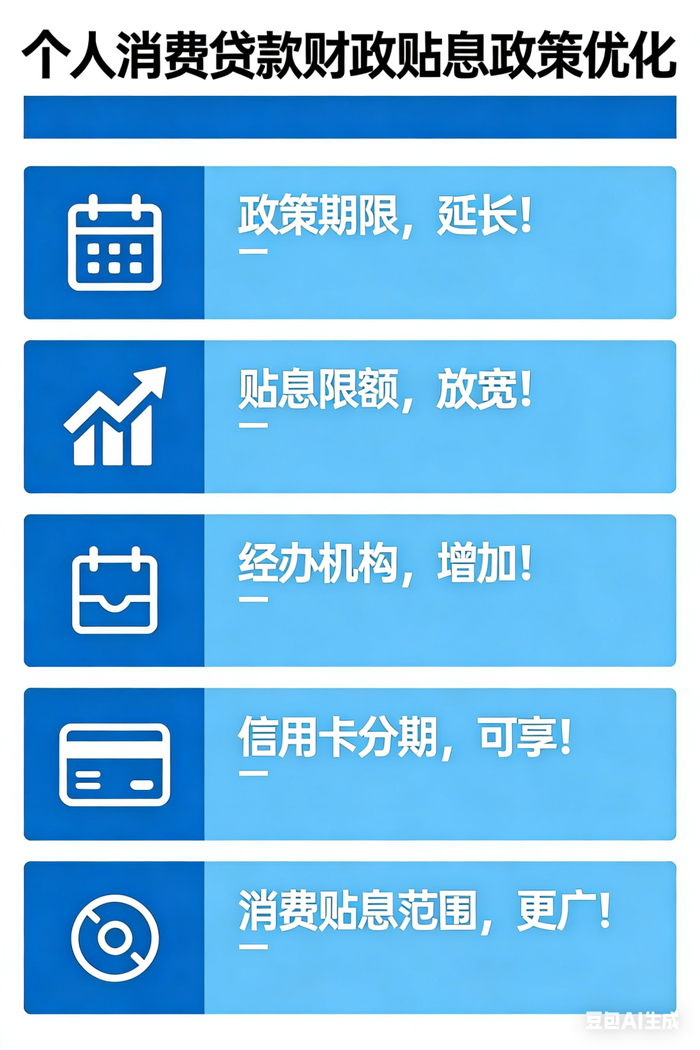
Group 1 - The core viewpoint of the news is the optimization of the personal consumption loan interest subsidy policy, which aims to stimulate consumer spending by extending the policy duration and expanding its coverage [1][2][4] - The new policy extends the implementation period until the end of this year and includes credit card installment payments in the subsidy scope, thereby broadening the areas eligible for interest subsidies [1][3] - Financial institutions, including major banks, are quickly responding to the policy by optimizing their services to ensure consumers can benefit from the subsidies seamlessly, enhancing the overall consumer experience [4][6] Group 2 - The collaboration between financial institutions and e-commerce platforms is highlighted, with initiatives like interest-free installment products being offered to consumers, which have led to significant increases in sales for participating brands [6] - The policy is part of a broader strategy to boost domestic demand and consumer confidence, aligning with the central economic work conference's focus on enhancing the domestic market [7] - The implementation of the policy is expected to improve consumer sentiment and market vitality, contributing to a stable economic outlook and encouraging higher quality consumption [7]



工商银行全额赎回债券,300亿规模,资本结构迎来新变化
Sou Hu Cai Jing· 2026-01-24 02:11
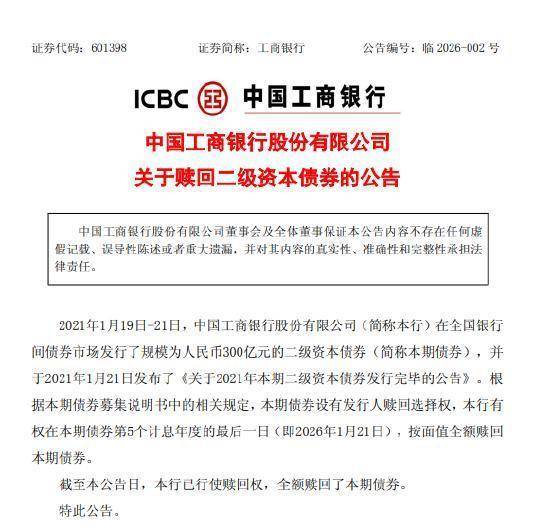
Core Viewpoint - The issuance and subsequent redemption of subordinated capital bonds by banks, particularly ICBC, reflect a strategic capital management decision that balances liquidity, cost, and regulatory compliance, while also transferring market uncertainties to bond investors [1][3][5]. Group 1: Bank's Perspective - The issuance of 30 billion yuan in subordinated capital bonds by ICBC is a common practice that allows banks to optimize their capital structure, especially if future interest rates decline or alternative capital tools become available at lower costs [1][3]. - The redemption of these bonds indicates that ICBC has sufficient liquidity or access to cheaper funding sources, suggesting a proactive approach to capital management [1][3]. - This action also highlights the bank's ability to navigate market conditions and regulatory requirements effectively, demonstrating a sophisticated understanding of capital management [1][3][5]. Group 2: Investor's Perspective - Investors in subordinated capital bonds face credit and liquidity risks, and they must be aware of the potential for capital write-downs, which are often underestimated due to a lack of risk pricing awareness [5][9]. - Many investors mistakenly treat these bonds as stable income-generating assets, particularly in a declining interest rate environment, leading to a mispricing of risks until redemption or market shocks occur [5][9]. - The need for investors to recognize the quasi-equity nature of these bonds is crucial, as they should not be viewed as safe alternatives like government bonds [9][12]. Group 3: Regulatory Perspective - Regulators encourage banks to diversify their capital sources to mitigate macro and micro risks, with subordinated capital bonds being a recognized component of this strategy [5][9]. - There is a tension between promoting bond issuance and preventing these instruments from becoming tools for evading capital constraints, leading to increasingly detailed regulations [5][9][12]. - The regulatory framework must evolve to provide clearer guidance on information disclosure and product suitability, ensuring that market participants are not left vulnerable to the complexities of capital management strategies [9][12][14]. Group 4: Market Implications - The full redemption by ICBC is seen as a normal capital management action, but it raises questions about the clarity of information disclosure and the need for transparent communication regarding the implications for capital adequacy [7][16]. - Frequent design of capital tools as "redeemable" could undermine investor confidence in the sustainability of returns, potentially leading to higher risk premiums and increased financing costs over time [14][16]. - The interaction between banks, investors, and regulators in this context emphasizes the importance of a well-functioning institutional framework, where transparency and risk awareness are prioritized for the benefit of all market participants [16].
智通ADR统计 | 1月24日



智通财经网· 2026-01-24 00:15
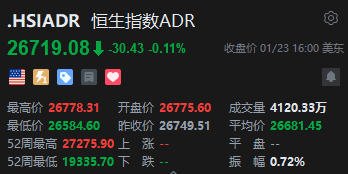
Market Overview - The US stock market indices showed mixed performance on Friday, with the Hang Seng Index ADR closing at 26,719.08 points, down by 30.43 points or 0.11% compared to the Hong Kong close [1]. Major Blue-Chip Stocks - HSBC Holdings closed at HKD 130.896, up by 0.69% from the Hong Kong close [2]. - Tencent Holdings closed at HKD 598.184, up by 0.54% from the Hong Kong close [2]. Stock Performance Summary - Tencent Holdings (HKD 595.000) saw a decrease of HKD 2.500, or -0.42%, with its ADR price at HKD 598.184, reflecting an increase of HKD 3.184 or 0.54% [3]. - Alibaba Group (HKD 168.500) increased by HKD 3.700, or 2.25%, with its ADR price at HKD 168.834, up by HKD 0.334 or 0.20% [3]. - HSBC Holdings (HKD 130.000) rose by HKD 0.300, or 0.23%, with its ADR price at HKD 130.896, up by HKD 0.896 or 0.69% [3]. - Xiaomi Group (HKD 36.240) increased by HKD 1.000, or 2.84%, with its ADR price at HKD 36.287, up by HKD 0.047 or 0.13% [3]. - AIA Group (HKD 83.050) rose by HKD 0.550, or 0.67%, with its ADR price at HKD 83.077, up by HKD 0.027 or 0.03% [3]. - Meituan (HKD 97.550) increased by HKD 0.550, or 0.57%, with its ADR price at HKD 97.735, up by HKD 0.185 or 0.19% [3]. - Kuaishou (HKD 81.250) rose by HKD 2.150, or 2.72%, with its ADR price at HKD 82.648, up by HKD 1.398 or 1.72% [3]. - Ctrip Group (HKD 485.400) increased by HKD 3.800, or 0.79%, with its ADR price at HKD 490.273, up by HKD 4.873 or 1.00% [3].
多家银行公告!落实个人消费贷款最新财政贴息政策
Sou Hu Cai Jing· 2026-01-23 19:43
Core Viewpoint - The implementation of the latest fiscal interest subsidy policy for personal consumption loans aims to boost consumption and expand domestic demand, with several major banks actively participating in this initiative [1][6][7][8][9]. Group 1: Policy Implementation - The fiscal interest subsidy policy for personal consumption loans has been extended until December 31, 2026, covering the period from September 1, 2025, to December 31, 2026 [6][10]. - The credit card installment payment subsidy policy will be effective from January 1, 2026, to December 31, 2026 [6]. Group 2: Policy Optimization - The policy has been optimized to include credit card installment payments, expanding the support range [9][11]. - The subsidy criteria have been broadened by removing the restriction on single transactions of 50,000 yuan and above [9][12]. - The subsidy standards have been improved by eliminating the 500 yuan cap on single transaction subsidies and the 1,000 yuan cap for individual borrowers at the same financial institution [9][12]. - Customers who have previously signed the personal consumption loan subsidy agreement will automatically benefit from the new subsidy policy starting January 1, 2026, without needing to re-sign the agreement [12].

最高分红率35%!上市银行春节前大派红包
Guo Ji Jin Rong Bao· 2026-01-23 16:22
Core Viewpoint - The banking sector is experiencing a trend of increasing mid-term cash dividends, with several banks announcing significant payouts, indicating a stable earnings outlook and attractiveness for conservative investors [1][2][4]. Group 1: Mid-term Dividends - As of January 23, 2025, Huaxia Bank and Chongqing Rural Commercial Bank distributed over 3 billion yuan in cash dividends, contributing to a total of 25 A-share listed banks that have completed dividend payouts [1][2]. - A total of 31 A-share listed banks announced mid-term dividends for 2025, with 25 having released their plans and completed payouts. The six major state-owned banks collectively distributed 204.657 billion yuan, with Industrial and Commercial Bank of China leading at 50.396 billion yuan [2]. - China Merchants Bank made its first mid-term dividend distribution of 25.548 billion yuan, with a per-share payout of 1.013 yuan, marking a 35% dividend ratio, the highest among listed banks [2]. Group 2: Investment Appeal - The banking sector remains attractive for stable funds due to its high dividend yield and stable earnings expectations, particularly for large banks and quality regional banks [3][4]. - Recent share buybacks by major shareholders and executives in banks like Nanjing Bank and Chongqing Rural Commercial Bank indicate confidence in the sector, with Nanjing Bank's major shareholder increasing its stake from 13.02% to 14.02% [3]. - Analysts suggest that the low-risk interest rate environment and the ongoing "asset shortage" make dividend-paying assets appealing, with banks signaling stable earnings growth and improved asset quality [3][4]. Group 3: Future Outlook - The banking industry is expected to continue its earnings recovery trend into 2026, with a stabilizing operating environment and potential for net interest margin recovery, which could enhance profitability [4]. - The market may see a divergence in performance, with high-dividend large banks and quality regional banks likely to outperform, while smaller banks may face challenges related to asset quality and profitability [4].



工商银行取得接口测试方法专利
Sou Hu Cai Jing· 2026-01-23 15:49
Group 1 - The State Intellectual Property Office of China has granted a patent to Industrial and Commercial Bank of China Limited for a technology related to "interface testing methods, devices, equipment, storage media, and products," with the authorization announcement number CN116257451B and an application date of March 2023 [1] - Industrial and Commercial Bank of China Limited, established in 1985 and located in Beijing, primarily engages in monetary financial services, with a registered capital of 35,640.6257 million RMB [1] - The bank has made investments in 28 companies, participated in 5,000 bidding projects, and holds 969 trademark records and 5,000 patent records, in addition to having 79 administrative licenses [1] Group 2 - ICBC Technology Co., Ltd., founded in 2019 and based in Shijiazhuang, focuses on software and information technology services, with a registered capital of 900 million RMB [1] - ICBC Technology has invested in 2 companies, participated in 347 bidding projects, and holds 798 patent records [1]
工商银行取得目标对象识别方法专利
Sou Hu Cai Jing· 2026-01-23 12:53
Group 1 - The State Intellectual Property Office of China has granted a patent to Industrial and Commercial Bank of China (ICBC) for a technology titled "Target Object Recognition Method, Device, Computer Equipment, and Storage Medium," with the authorization announcement number CN115713809B and an application date of November 2022 [1] - ICBC was established in 1985 and is headquartered in Beijing, primarily engaged in monetary financial services. The company has a registered capital of 35,640,625.7089 thousand RMB [1] - According to data analysis from Tianyancha, ICBC has invested in 28 enterprises, participated in 5,000 bidding projects, holds 969 trademark information records, and has 5,000 patent information records, in addition to possessing 79 administrative licenses [1]