
PSBC(01658)

Search documents
银行研究框架及25H1业绩综述:营收及利润增速双双转正
GOLDEN SUN SECURITIES· 2025-09-04 06:14
Investment Rating - The report indicates a positive outlook for the banking industry, with overall revenue and net profit growth rates turning positive in the first half of 2025, at 1.0% and 0.8% respectively, showing improvements from the previous quarter [4]. Core Insights - The banking sector's net interest margin for the first half of 2025 is reported at 1.42%, a decrease of 10 basis points compared to the previous year, but the decline is narrowing due to improved cost management on the liability side [5]. - Non-interest income, particularly from fees and commissions, has increased by 3.1% year-on-year, driven by a recovery in wealth management and a more active market environment [5]. - The asset quality remains stable, with a non-performing loan ratio of 1.23% and a provision coverage ratio of 239%, indicating a solid credit environment [5]. Summary by Sections Financial Performance Overview - The overall revenue and net profit growth for listed banks in the first half of 2025 were 1.0% and 0.8%, respectively, with both metrics showing improvement from the first quarter [4][22]. - The total assets of listed banks reached 321.3 trillion yuan, growing by 6.35% year-to-date, with loans and advances totaling 179.4 trillion yuan, accounting for 55.84% of total assets [21][24]. Income Sources - Net interest income decreased by 1.3% year-on-year, but the decline rate has slowed, reflecting better management of funding costs [5]. - Fee and commission income grew by 3.1% year-on-year, benefiting from a recovering market and the gradual impact of regulatory changes [5]. - Other non-interest income saw a significant increase of 10.7%, primarily due to favorable market conditions in the bond market [5]. Asset Quality and Management - The non-performing loan ratio remained stable at 1.23%, with a provision coverage ratio of 239%, indicating a robust asset quality [5]. - The credit cost for the first half of 2025 was 0.81%, a decrease of 5 basis points year-on-year, suggesting manageable credit risks [5]. Loan Growth and Composition - Loan growth was primarily driven by corporate lending, with significant contributions from infrastructure and manufacturing sectors [20]. - Personal loan growth was weaker, with a year-on-year increase of only 3.6%, reflecting a cautious approach to consumer lending amid rising risks [20]. Investment and Market Conditions - The investment asset proportion decreased to 34% as banks adjusted their strategies in response to market volatility [20]. - The overall yield on bonds fluctuated significantly, prompting banks to engage in tactical trading to enhance returns [20].




中期分红队伍持续壮大
Jin Rong Shi Bao· 2025-09-04 03:03
Core Viewpoint - The recent announcements of interim dividend plans by A-share listed banks highlight a trend towards increased shareholder returns, with a total proposed dividend amount exceeding 200 billion yuan from major state-owned banks and several joint-stock banks [1][4]. Group 1: State-Owned Banks - Six major state-owned banks have announced their interim dividend plans for 2025, with a total proposed dividend amount exceeding 200 billion yuan [1]. - Industrial and Commercial Bank of China leads with a proposed dividend of 1.414 yuan per 10 shares, totaling 503.96 billion yuan [1]. - Other state-owned banks, including Agricultural Bank of China, Bank of China, China Construction Bank, Bank of Communications, and Postal Savings Bank, have proposed dividends of 418.23 billion yuan, 352.50 billion yuan, 486.05 billion yuan, 138.11 billion yuan, and 147.72 billion yuan respectively [1]. Group 2: Joint-Stock Banks - Several joint-stock banks, including China Merchants Bank, CITIC Bank, Minsheng Bank, Ping An Bank, and Huaxia Bank, have confirmed their interim dividend plans for 2025 [1][2]. - China Merchants Bank announced its first interim profit distribution plan since its listing, with a cash dividend amounting to 35% of its net profit attributable to ordinary shareholders for the first half of 2025 [1][2]. - CITIC Bank plans to increase its interim dividend payout ratio to 30.7%, enhancing investor return expectations [2]. Group 3: New Participants in Interim Dividends - New entrants to the interim dividend group include Ningbo Bank, Changsha Bank, Su Nong Bank, and Jiangyin Bank, indicating a growing trend among listed banks to adopt interim dividends [2][4]. - Su Nong Bank announced its first interim dividend plan, proposing a cash dividend of 0.9 yuan per 10 shares, totaling 1.82 billion yuan [2][3]. Group 4: Overall Market Trends - A total of 23 A-share listed banks implemented interim dividends in 2024, distributing over 250 billion yuan, with the number of banks participating expected to increase in 2025 [4]. - The push for interim dividends is seen as a response to regulatory guidance aimed at enhancing shareholder returns and stabilizing market expectations [5].


商业银行“降成本”举措显效
Jin Rong Shi Bao· 2025-09-04 03:03
Core Insights - Major commercial banks in China have shown solid performance in managing costs and optimizing asset-liability structures, contributing to stable growth in operating results [1][4] - In the first half of 2025, 42 A-share listed banks achieved operating income exceeding 2.9 trillion yuan, a year-on-year increase of over 1%, and a net profit of 1.1 trillion yuan, up 0.8% year-on-year [1] - Several banks, including Industrial and Commercial Bank of China (ICBC), Agricultural Bank of China (ABC), China Construction Bank (CCB), and Postal Savings Bank of China (PSBC), reported net profits exceeding 100 billion yuan [1] Cost Management - Construction Bank reported a cost-to-income ratio of 23.72%, a decrease of 0.43 percentage points year-on-year, highlighting effective cost management [1] - PSBC achieved a significant reduction in its cost-to-income ratio by 5.15 percentage points through various cost control measures [1] - Bank of China reported a cost-to-income ratio of 25.11%, emphasizing its focus on reducing costs and improving efficiency [2] Asset-Liability Management - Agricultural Bank of China has focused on controlling key expenses and reducing flexible costs to save on expenditures [3] - Several banks, including ICBC and CCB, have successfully lowered their deposit interest rates, with ICBC's rate decreasing by 26 basis points and CCB's by 32 basis points [4] - Postal Savings Bank's self-operated deposit interest rate fell by 20 basis points to around 1.1%, indicating a trend of decreasing funding costs [4] Revenue Generation - Shanghai Pudong Development Bank reported a cost reduction of over 140 million yuan through effective management of rental costs and the disposal of idle properties [3] - China Everbright Bank has focused on optimizing its funding costs and increasing high-quality deposits, leading to stable profit growth [5][6] - Zhejiang Merchants Bank saw its deposit interest rate decrease by 31 basis points to 1.88%, while its total deposits grew by 7.47% year-on-year [4]
邮储银行(601658):盈利增速回正 息差边际企稳
Xin Lang Cai Jing· 2025-09-04 02:47
Core Viewpoint - Postal Savings Bank of China reported a slight increase in revenue and net profit for the first half of 2025, indicating a recovery in financial performance after previous declines [1][2]. Financial Performance - The bank achieved an operating income of 179.4 billion yuan, up 1.5% year-on-year, and a net profit attributable to shareholders of 49.2 billion yuan, up 0.8% year-on-year [1]. - The annualized weighted average ROE was 10.91% [1]. - Total assets reached 18.2 trillion yuan, a 10.8% increase year-on-year, with total loans and deposits growing by 10.1% and 8.4% respectively [1]. Revenue and Income Breakdown - Net interest income decreased by 2.7% year-on-year, but the decline was less severe than in the first quarter of 2025 [2]. - Non-interest income saw a significant increase of 19.1% year-on-year, with contributions from both middle-income and other non-interest revenues [2]. - Fee income rose by 11.6% year-on-year, driven by strong performance in investment banking and wealth management, which grew by 48.2% and 47.9% respectively [2]. Margin and Asset Quality - The net interest margin stabilized at 1.70%, with a narrowing decline compared to previous quarters [3]. - Loan rates decreased, with the average loan rate at 3.30%, down 48 basis points from the end of 2024 [3]. - The non-performing loan (NPL) ratio slightly increased to 0.92%, primarily due to fluctuations in personal loan quality, while corporate loan quality improved [4]. Risk Management and Outlook - The bank's provisioning coverage ratio remains high at 260%, indicating stable risk absorption capacity despite a slight decline [4]. - The bank's focus on retail banking and its unique "self-operated + agency" model continue to provide a competitive advantage, particularly in rural and central-western regions [5]. - Earnings per share (EPS) forecasts for 2025-2027 are projected at 0.74, 0.77, and 0.80 yuan, with corresponding growth rates of 2.6%, 3.6%, and 4.3% [5].

A股上市银行成绩单亮眼
2 1 Shi Ji Jing Ji Bao Dao· 2025-09-03 22:06
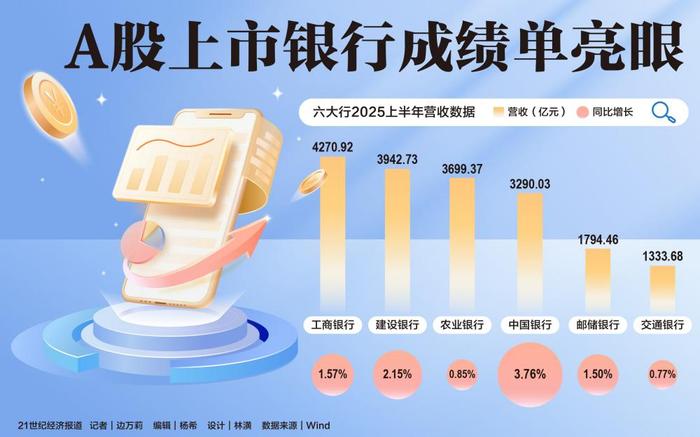
Core Insights - The banking sector in A-shares has shown resilience with a total revenue of 2.92 trillion yuan and a net profit of 1.1 trillion yuan for the first half of 2025, reflecting a year-on-year growth of 1% and 0.8% respectively [1][3] - The non-performing loan (NPL) ratio stands at 1.15%, indicating a slight improvement from the previous quarter [1][10] - The number of banks distributing mid-year dividends has increased to 18, with over half of them maintaining a dividend payout ratio of 30% or more [1][11] Revenue and Profit Growth - A-shares listed banks achieved a total revenue of 2.92 trillion yuan, marking a 1% increase year-on-year, while net profit reached 1.1 trillion yuan, up 0.8% [3][4] - Among the major banks, Industrial and Commercial Bank of China (ICBC) led with a revenue of 4270.92 billion yuan, showing a growth of 1.57% [3] - 30 out of 42 listed banks reported positive revenue growth, with 12 banks showing a reduced decline in revenue growth rates [3][4] Asset Quality and Loan Growth - The total assets of A-shares listed banks reached 321.33 trillion yuan, a 6.35% increase from the previous year [8] - Loans and advances amounted to 179.44 trillion yuan, reflecting an increase of approximately 13.4 trillion yuan or 8.07% [8][9] - The NPL ratio decreased by 1 basis point, with 25 banks showing a year-on-year decline in NPL ratios [10] Diversification of Income Sources - Non-interest income grew by 6.97% year-on-year, with significant contributions from investment income, which increased by 23.46% [6][7] - Banks are shifting towards a more diversified income structure, reducing reliance on traditional interest margins [6][7] - For instance, the non-interest income of China Bank surged by 26.43%, becoming a key driver of revenue growth [6] Dividend Distribution - The total cash dividends from the six major state-owned banks reached 2046.57 billion yuan, with ICBC leading at approximately 503.96 billion yuan [11][12] - Several banks, including China Merchants Bank and Jiangyin Bank, implemented mid-year dividends for the first time [11][12] - The dividend payout ratios for banks such as Shanghai Bank and CITIC Bank have also seen increases, reflecting strong performance [11][12]

A股近六成上市银行上半年中间业务收入同比增长
Zheng Quan Ri Bao Zhi Sheng· 2025-09-03 16:40
Core Viewpoint - The intermediary business income of A-share listed banks in China has shown improvement in the first half of 2025, becoming a crucial area for banks to transform and develop amid narrowing net interest margins [1][4]. Group 1: Overall Performance - In the first half of 2025, the total net income from fees and commissions of 42 listed banks reached 409.53 billion yuan, an increase of 3.06% compared to the same period last year [1]. - Out of the 42 listed banks, 25 reported positive growth in net income from fees and commissions, with three banks experiencing growth rates exceeding 100% and nine banks exceeding 10% [2]. Group 2: Performance by Bank Type - Among the six major state-owned banks, Bank of China and China Construction Bank both saw their fee and commission income grow by over 4%, while Agricultural Bank of China and Postal Savings Bank of China reported growth exceeding 10% [2]. - In the joint-stock banks category, four out of nine banks reported positive growth in net income from fees and commissions, with CITIC Bank achieving 16.91 billion yuan (up 3.38%), Industrial Bank at 13.08 billion yuan (up 2.59%), Huaxia Bank at 3.10 billion yuan (up 2.55%), and Minsheng Bank at 9.69 billion yuan (up 0.41%) [2]. Group 3: Notable Performers - Some city commercial banks and rural commercial banks exhibited significant growth in their fee and commission income, with Changshu Bank reporting a remarkable increase of 637.77% to 142 million yuan, followed by Ruifeng Bank with a 274.07% increase to 54 million yuan, and Zhangjiagang Bank with a 140% increase to 61 million yuan [3]. Group 4: Future Outlook - Analysts predict that the growth trend in intermediary business income is likely to continue in the second half of 2025, driven by supportive macroeconomic policies and increasing demand for high-yield products among residents [4]. - The focus for banks will be on expanding non-interest income, particularly in wealth management and other light-capital businesses, to optimize their income structure [4][6].

金融中报观|银行零售业务梯队格局背后,谁在领跑,谁在补课
Bei Jing Shang Bao· 2025-09-03 14:17
Core Insights - The competitive landscape of retail banking in A-shares is becoming clearer as the 2025 mid-year reports are disclosed, revealing a distinct tiered structure in retail AUM (Assets Under Management) [1][2] - The first tier consists of major state-owned banks and China Merchants Bank, all exceeding 16 trillion yuan in retail AUM, while the second tier includes joint-stock banks and some leading city commercial banks [1][2] - The retail business performance is mixed, with many banks facing pressure on retail revenue and net profit, highlighting a structural issue of profit growth without revenue increase [1][6] Tiered Structure of Retail AUM - The first tier banks, including Industrial and Commercial Bank of China (ICBC) and Agricultural Bank of China (ABC), lead with AUM exceeding 16 trillion yuan, with ICBC at over 24 trillion yuan and ABC at 23.68 trillion yuan [2][3] - China Construction Bank (CCB) and Postal Savings Bank of China also show strong performance, with CCB managing over 22 trillion yuan and Postal Savings Bank at 17.67 trillion yuan [2] - China Merchants Bank, known as the "king of retail," has a retail AUM of 16.03 trillion yuan, reflecting a 7.39% increase from the previous year [2] Second Tier Performance - The second tier banks have retail AUM ranging from 1 trillion to 6 trillion yuan, with notable growth from banks like Bank of Communications at 5.79 trillion yuan and Industrial Bank at 5.52 trillion yuan [3] - Joint-stock banks are active in this tier, with CITIC Bank and Shanghai Pudong Development Bank also showing significant growth in retail AUM [3] Third Tier Characteristics - The third tier banks have retail AUM mostly below 1 trillion yuan, with Nanjing Bank and Shanghai Rural Commercial Bank showing notable growth rates of 14.25% and 3.99% respectively [4] - Regional banks are leveraging local advantages to deepen market penetration, but face challenges in competing with larger banks [5] Retail Profitability Challenges - The retail banking sector is undergoing significant adjustments, with a shift in customer demand towards diversified financial solutions, which raises the bar for product innovation and service customization [6] - Leading banks like ICBC and China Merchants Bank are showing resilience, with ICBC's net profit rising by 46.05% despite a slight revenue decline [6][7] - However, some banks, including ABC and Ping An Bank, are experiencing declines in both revenue and net profit, indicating a challenging environment [7] Asset Quality Concerns - The retail banking sector is facing challenges in asset quality, particularly in personal loans, with rising non-performing loan (NPL) ratios reported by several banks [9][10] - For instance, China Merchants Bank's retail loan NPL ratio increased to 1.04%, while Chongqing Rural Commercial Bank's rose to 2.04% [9] - Some banks, like Ping An Bank and Industrial Bank, have managed to improve their asset quality through refined risk management practices [10] Strategic Recommendations - Analysts suggest that banks, especially smaller ones, should focus on enhancing their support for small and micro enterprises and optimizing financial resource allocation to uncover new growth points [8] - There is a call for banks to improve their digital capabilities and customer experience to better compete with larger institutions [8]


频繁举牌银行股中国平安学聪明了
Xin Lang Cai Jing· 2025-09-03 10:39
Core Viewpoint - Ping An Life has been actively increasing its stake in various bank stocks, particularly Agricultural Bank of China, indicating a strategic shift towards more stable investments after previous significant losses in other sectors [1][5]. Group 1: Investment Activities - Ping An Life has made multiple acquisitions of Agricultural Bank of China H-shares, reaching a 15% stake as of August 26, 2023, marking the third time this year it has increased its holdings in this bank [1]. - In addition to Agricultural Bank, Ping An Life has also targeted Postal Savings Bank and China Merchants Bank, with significant increases in their respective H-share holdings [2]. - The company has shown a pattern of increasing stakes in bank stocks, with a notable focus on state-owned banks that offer low volatility and high dividend yields [8]. Group 2: Historical Context and Lessons Learned - Ping An Life has faced substantial losses in past investments, notably in Fortis Group and China Fortune Land Development, leading to a more cautious investment strategy [4][5]. - The departure of the Chief Investment Officer, Deng Bin, has left the position vacant for over six months, indicating potential instability in investment strategy [3]. - The company’s past experiences have prompted a shift towards more secure investments, as evidenced by its recent focus on bank stocks [5]. Group 3: Financial Performance - As of the latest report, Ping An's total investment assets amount to 6.2 trillion, with a stock investment book value of 649.3 billion and net investment income of 92.8 billion [8].


A股42家银行上半年利润1.1万亿
21世纪经济报道· 2025-09-03 09:58
Core Viewpoint - The banking sector in China has shown resilience and adaptability in a complex economic environment, with positive growth in revenue and net profit, while maintaining stable asset quality and improving operational efficiency [2][4][12]. Group 1: Revenue and Profit Growth - In the first half of 2025, the total revenue of 42 A-share listed banks reached 2.92 trillion yuan, a year-on-year increase of 1%, while net profit attributable to shareholders was 1.1 trillion yuan, up 0.8% [4][5]. - Among the major state-owned banks, the six largest contributed 1.81 trillion yuan in revenue and 682.52 billion yuan in net profit, accounting for over 60% of the overall market [4]. - Industrial and Commercial Bank of China (ICBC) led with a revenue of 409.08 billion yuan, marking a 1.8% increase, indicating a positive turnaround in growth [4][5]. Group 2: Asset Quality and Support for the Real Economy - As of June 2025, the total assets of the 42 listed banks reached 321.33 trillion yuan, a 6.35% increase from the end of the previous year [9]. - The total loans and advances issued by these banks amounted to 179.44 trillion yuan, reflecting an increase of approximately 13.4 trillion yuan, or 8.07% year-on-year [10]. - The non-performing loan (NPL) ratio stood at 1.15%, a slight decrease, with 25 banks showing a year-on-year decline in NPL ratios [12]. Group 3: Dividend Distribution - The number of banks implementing mid-year dividends increased to 18, with a total cash dividend of 204.66 billion yuan from the six major state-owned banks [14][15]. - ICBC proposed a dividend of 1.414 yuan per 10 shares, totaling approximately 50.40 billion yuan, leading the mid-year dividend distribution among listed banks [14]. - Other banks, such as China Bank and China Merchants Bank, also reported significant increases in their dividend payout ratios, reflecting strong performance and investor confidence [15].
国有六大行上半年网点裁撤步伐显著放缓,农行、中行小幅增设
Cai Jing Wang· 2025-09-03 08:44
Core Insights - The number of physical bank branches among China's six major state-owned banks has stabilized, with a slight decrease of approximately 42 branches as of mid-2025 compared to the beginning of the year [1][5] - The focus of branch adjustments is shifting towards key urban areas such as the Beijing-Tianjin-Hebei region and county-level operations, indicating a strategic realignment in service delivery [1][6] Summary by Bank - **Industrial and Commercial Bank of China (ICBC)**: As of June 2025, ICBC has a total of 16,354 branches, with 15,941 located domestically and 413 internationally [2] - **Agricultural Bank of China (ABC)**: ABC reported 22,914 domestic branches and 17 overseas institutions as of June 2025 [2] - **Bank of China (BOC)**: BOC has a total of 11,516 branches, with 10,977 in mainland China and 539 in Hong Kong, Macau, Taiwan, and other regions [2] - **China Construction Bank (CCB)**: CCB has 14,727 branches, including 14,178 domestic branches [3] - **Bank of Communications (BoCom)**: BoCom operates over 2,800 domestic branches and 24 overseas branches [3] - **Postal Savings Bank of China (PSBC)**: PSBC has 39,188 branches and 71,435 ATMs as of mid-2025 [3] Overall Trends - The total number of branches across the six major banks is approximately 108,000, showing a decrease of about 42 branches in the first half of 2025 compared to the end of 2024 [5] - The pace of branch closures has significantly slowed, with projections indicating a reduction of around 300 branches by the end of 2024 [5] - The current phase of branch adjustments is characterized by a balance between closing redundant branches and opening new ones in high-demand areas [6]