VANKE(02202)

Search documents
万科旗下太原房地产开发公司增资至15.9亿 增幅约15768%
Xin Lang Cai Jing· 2026-01-22 07:30
天眼查工商信息显示,近日,太原万科嘉创房地产开发有限公司发生工商变更,注册资本由1000万人民 币增至约15.9亿人民币,增幅约15768%。太原万科嘉创房地产开发有限公司成立于2018年7月,法定代 表人为杨洪涛,经营范围为房地产开发经营、房屋租赁。股权全景穿透图显示,该公司由万科A (000002)旗下太原万嘉企业管理咨询有限公司全资持股。 ...
万科回应起诉万达案进展:目前依法查封冻结了万达集团股权资产
Feng Huang Wang· 2026-01-22 07:27
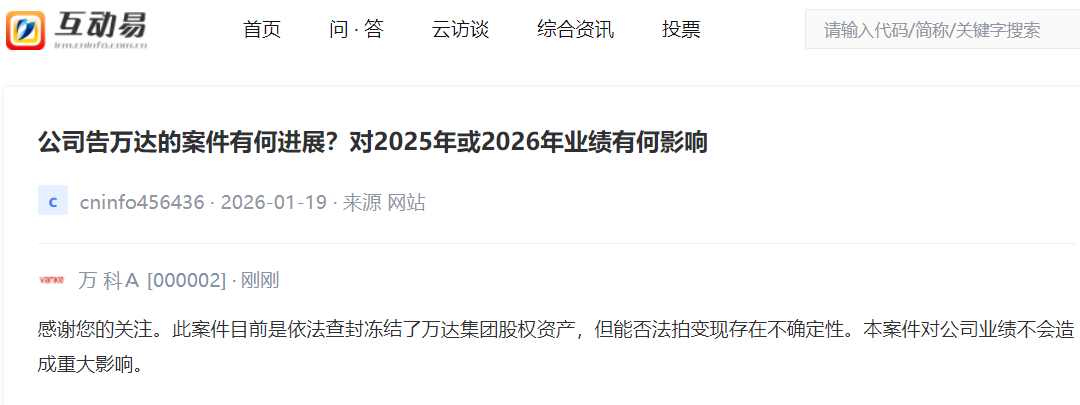
1月22日,针对投资者关于" 公司告万达的案件有何进展?对2025年或2026年业绩有何影响?"的提问, 万科A1月22日在互动平台回应称,此案件目前是依法查封冻结了万达集团股权资产,但能否法拍变现 存在不确定性。本案件对公司业绩不会造成重大影响。 ...
万科回应起诉万达案进展:目前是依法查封冻结了万达集团股权资产,能否法拍变现存在不确定性
Xin Lang Cai Jing· 2026-01-22 07:15
针对投资者关于" 公司告万达的案件有何进展?对2025年或2026年业绩有何影响?"的提问,万科A1月22日在互动平台回应称,此案件目前是依法查封冻 结了万达集团股权资产,但能否法拍变现存在不确定性。本案件对公司业绩不会造成重大影响。 | | | ...

万科首笔债券展期通过 灵活方案与增信担保获债权人支持
Xin Lang Cai Jing· 2026-01-22 05:36
Core Viewpoint - Vanke's bond extension proposal has been approved, offering various options to meet the demands of different bondholders, including fixed payment arrangements and partial principal repayment [1] Group 1 - The proposal includes a cash payment of 40% of the repurchased bond principal on January 30, 2026, with the remaining 60% extended for one year, addressing liquidity concerns of bondholders [1] - The plan incorporates both cash payments and credit enhancement measures, demonstrating Vanke's sincerity and leading to a high agreement rate among creditors [1] Group 2 - The experience gained from this debt extension negotiation will enhance Vanke's understanding of creditor demands, positively influencing future bond extension proposals [2] - Future bond extension designs must be flexible and diverse to meet different creditor needs while demonstrating sincerity and executable measures to achieve a high voting agreement rate [2] - Sufficient effective assets will be a critical test for Vanke's future bond extensions, as credit enhancement measures are essential for creditor agreement, especially in the context of declining real estate prices [2]
万科“21万科02”债券兑付调整议案高票通过,A+H股今日同步上涨
Xin Lang Cai Jing· 2026-01-22 04:50
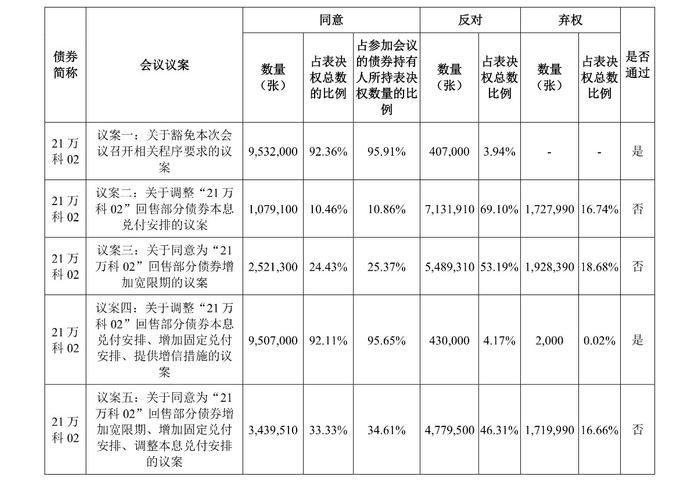
Core Viewpoint - Vanke A (000002.SZ) announced the resolution of the first bondholders' meeting for the "21 Vanke 02" bond, which received a high approval rate of 92.11% for a proposal aimed at alleviating short-term liquidity pressure, positively impacting Vanke A and H shares on the same day [2][6]. Bond Details - The "21 Vanke 02" bond has a balance of 1.1 billion yuan, with an interest start date of January 22, 2021, and a maturity of 7 years. The effective repurchase application scale is approximately 1.032 billion yuan, with the original payment date set for January 22 [2][6]. Proposal Adjustments - The approved proposal includes multiple safeguards for the repurchase portion of the bonds. A fixed payment arrangement will be implemented, where on January 30, 2026, small payments of up to 100,000 yuan will be made to bondholders who participated in the meeting and agreed to either proposal four or five. Full payment will be made for amounts less than 100,000 yuan to meet the liquidity needs of small bondholders [2][6]. Payment Structure - The repayment structure indicates that after deducting the fixed payment amount, 40% of the repurchase bond principal will be paid on January 30, 2026, with the remaining 60% extended for one year until January 22, 2027 [3][7]. Credit Enhancement Measures - Vanke has provided credit enhancement measures for unpaid principal and interest by pledging receivables from Wuhan Wanyun Real Estate Co., Ltd. and Xixian New Area Kezhu Real Estate Co., Ltd. as collateral, with a commitment to complete all necessary procedures within 60 working days after the proposal's approval [3][7]. Market Reaction - Following the announcement, Vanke A and H shares both experienced gains, with Vanke A closing at 5.01 yuan per share, up 4.59%, and Vanke Enterprises closing at 3.68 HKD per share, up 5.75% [3][7].
11亿元债券展期通过,万科缓了口气
Sou Hu Cai Jing· 2026-01-22 03:57
Core Viewpoint - Vanke's proposal to extend the maturity of its 1.1 billion yuan bond has been approved by bondholders, allowing the company to alleviate short-term repayment pressure and stabilize its financial situation [1][2]. Group 1: Bondholder Meeting Outcomes - The bondholder meeting on January 21 approved two key proposals: the exemption of procedural requirements and the adjustment of repayment arrangements for the "21 Vanke 02" bond, with 92.36% and 92.11% approval respectively [1]. - The repayment arrangement includes an initial payment of 40% of the principal on January 30, 2026, with the remaining 60% extended for one year, to be paid on January 22, 2027 [1]. Group 2: Market Reaction and Implications - Following the announcement, Vanke's bonds saw a general increase in trading prices, with "21 Vanke 06" rising over 6%, "21 Vanke 04" over 3%, and "22 Vanke 06" over 2% [1]. - The approval of the "21 Vanke 02" bond extension serves as a significant reference for Vanke's future bond extension efforts, potentially influencing similar proposals for other bonds totaling 5.7 billion yuan [2].
资讯早班车-2026-01-22-20260122
Bao Cheng Qi Huo· 2026-01-22 02:23
投资咨询业务资格:证监许可【2011】1778 号 期货研究报告 资讯早班车-2026-01-22 一、 宏观数据速览 | 发布日期 | 指标日期 | 指标名称 | 单位 | 当期值 | 上期值 | 去年同期值 | | --- | --- | --- | --- | --- | --- | --- | | 2026-01-19 | 2025/12 | GDP:不变价:当季同比 | % | 4.5 | 4.8 | 5.4 | | 2025-12-31 | 2025/12 | 制造业 PMI | % | 50.1 | 49.8 | 50.1 | | 2025-12-31 | 2025/12 | 非制造业 PMI:商务活动 | % | 50.2 | 50.0 | 52.2 | | 2026-01-15 | 2025/12 | 社会融资规模:当月值 | 亿元 | 22075 | 35299 | 28537 | | 2026-01-15 | 2025/12 | M0:同比 | % | 10.2 | 11.5 | 13.0 | | 2026-01-15 | 2025/12 | M1:同比 | % | 3.8 | 7.2 ...
万科完成“惊险一跃”,首笔11亿元债券成功展期
Xin Lang Cai Jing· 2026-01-22 01:32
Core Viewpoint - Vanke has achieved a significant breakthrough in its debt restructuring efforts, successfully passing a bond extension proposal with a high approval rate of 92.11%, marking its first successful extension since facing difficulties in 2025 [1] Group 1: Bond Details - The bond in question is "21 Vanke 02," issued on January 22, 2021, with a total balance of 1.1 billion yuan and a coupon rate of 3.98% for a seven-year term [1] - The approved proposal includes a 40% upfront payment of the principal, with the remaining 60% extended to January 22, 2027 [4] - The bond extension plan also incorporates cash payments and credit enhancement measures to satisfy various bondholder demands [2][4] Group 2: Market Reaction - Following the announcement, Vanke's A-share price surged over 4.5%, closing at 5.01 yuan, while its Hong Kong shares rose over 6%, closing at 3.68 HKD [1] - Multiple domestic bonds of Vanke also saw price recoveries, indicating a positive market sentiment [1] Group 3: Strategic Implications - The successful extension provides Vanke with crucial liquidity relief, as the company faces a cash shortfall exceeding 90 billion yuan, with cash and cash equivalents reported at 603.88 billion yuan against short-term borrowings of 1.514 billion yuan [4][5] - This extension serves as a model for future negotiations regarding other bonds, potentially influencing the outcomes of upcoming discussions for 5.7 billion yuan in medium-term notes [6] - The combination of cash payments, extensions, and credit enhancements is seen as a balanced approach to address both cash flow and creditor concerns [4][6]
固定兑付安排+先付40% 万科A11亿元债券展期议案获表决通过
Shang Hai Zheng Quan Bao· 2026-01-22 00:13
Core Viewpoint - Vanke's bond "21 Vanke 02" with a balance of 1.1 billion yuan has made significant progress in its extension matters, with a high vote approval for the proposal to adjust the repayment arrangements and provide credit enhancement measures [1] Group 1: Bondholder Meeting and Proposals - On January 21, Vanke announced the results of the bondholder meeting for "21 Vanke 02," where Proposal Four, which involves adjusting the repayment arrangements and increasing fixed payment arrangements, was approved [1] - The bond has a current coupon rate of 3.98% and a term of 7 years, with a redemption option for the issuer at the end of the 5th year [1] - Proposal One, which involves waiving related procedures to optimize processes, also received high approval [1] Group 2: Repayment Arrangements - The fixed payment arrangement allows for a small payment of up to 100,000 yuan on January 30, 2026, for bonds that have been declared for repurchase [1] - 40% of the principal for the repurchased bonds will be paid on January 30, 2026, while the remaining 60% will be extended for one year, with a repayment date of January 22, 2027 [1] - Vanke will provide credit enhancement by pledging receivables from project companies as collateral for unpaid principal and interest [1] Group 3: Interest Payment Details - The interest payment for the bond will occur on January 22, 2026, with a coupon rate of 3.98% for the 5th year [1] - Each 10 bonds with a face value of 1,000 yuan will distribute an interest of 39.80 yuan (tax included) [1] - The bondholder registration date is January 21, 2026, and the payment will be made to all registered holders as of that date [1] Group 4: Market Reactions and Future Considerations - Following the announcement, Vanke's A-share price surged over 6% during trading on January 21, closing at 5.01 yuan per share [1] - Market analysts view the approval of Proposal Four as a positive signal for other bonds, suggesting it may influence upcoming meetings for Vanke's other bonds [1] - The execution of the proposals remains a focal point for future market attention, particularly regarding Vanke's financing and recovery capabilities [1]
全球大公司要闻 | 苹果公司计划推出首款AI聊天机器人
Wind万得· 2026-01-21 22:40
Group 1 - Apple is accelerating its AI strategy by developing an AI wearable device called "Pin" and plans to significantly revamp Siri into its first AI chatbot, codenamed "Campos" [2] - Intel has secured a substantial contract with the U.S. military for chip supply under the SHIELD project, with a maximum limit of $151 billion, boosting expectations for its defense electronics business [2] - TSMC is facing production bottlenecks in its advanced 3nm process due to surging AI demand, with all capacity booked until 2027, highlighting strong demand in the global semiconductor supply chain [2] - Nvidia's CEO Jensen Huang plans to visit China to revive the AI chip market, emphasizing that AI represents a "platform shift" requiring trillions in infrastructure investment, with global AI venture capital expected to exceed $100 billion by 2025 [2] Group 2 - Alibaba's Qianwen series model downloads have surpassed 1 billion, making it the most popular open-source AI model globally, reinforcing the company's technological leadership in AI [4] - Vanke's bond extension proposal for "21 Vanke 02" has been approved, marking the company's first successful bond extension, with a scale of 1.1 billion yuan [4] - Xinda Real Estate expects a net loss of 7.6 billion to 8.2 billion yuan in 2025 due to industry adjustments and project sales underperformance, focusing on core areas for business transformation [4] - Cangge Mining has voluntarily reduced its potassium chloride production capacity from 2 million tons per year to 1.2 million tons based on resource conditions, without affecting existing production and sales plans [4] Group 3 - AI startup Anthropic PBC is raising at least $1 billion from investors, with annual revenue run rate doubling since last summer and projected to exceed $9 billion by the end of 2025 [6] - Meta's Super Intelligence Lab delivered its first batch of key AI models in January, with plans to focus on consumer products over the next two years [6] - Microsoft has resolved access issues with its 365 services and has introduced a basic subscription version of Microsoft 365 in China for an annual fee of 150 yuan [6] - Tesla clarified that there are no plans for layoffs or production cuts at its Berlin factory, while its Robotaxi fleet has reached 200 vehicles [6] Group 4 - Samsung Electronics is diversifying its HBM supply chain and has reported Q4 sales of 1.29 trillion won, a 2.3% year-on-year increase, with operating profit rising 62% [10] - Toyota anticipates a cost burden increase of 5 trillion yen over 4.5 years and plans to raise prices for some suppliers while sharing chip data among Japanese automakers [10] - SK Hynix is projected to achieve record revenue and profit by Q4 2025, with plans to distribute a record year-end bonus of 640,000 yuan per employee [10] - LG Electronics is testing sodium-ion battery production at its Nanjing factory and has launched AI air conditioning products overseas [10] Group 5 - Volkswagen Group expects a net cash flow of 6 billion euros in the automotive sector for FY2025, a 20% year-on-year increase, driven by lower operating capital and capital expenditures [13] - Rio Tinto anticipates an 11% increase in copper production to 883,000 tons by 2025, with a strong rebound in Q4 iron ore production [13] - Mercedes-Benz will unveil the 2026 S-Class on January 29, featuring heated seat belts to enhance low-temperature range and safety [13] - ASML's target price has been raised by JPMorgan from 587 euros to 800 euros, reflecting optimistic market expectations for semiconductor equipment demand [13]