PING AN OF CHINA(02318)

Search documents
中国平安涨0.49%,成交额27.81亿元,近3日主力净流入1460.63万
Xin Lang Cai Jing· 2025-09-24 07:35
Core Viewpoint - China Ping An's stock performance shows a slight increase of 0.49% with a market capitalization of 1,001.17 billion yuan, indicating stable investor interest in the company [1] Financial Performance - The company has reported dividend yields over the past three years of 5.15%, 6.03%, and 4.84% respectively, reflecting a consistent return to shareholders [2] - For the first half of 2025, China Ping An achieved a net profit of 68.05 billion yuan, a year-on-year decrease of 8.81% [6] Business Overview - China Ping An operates in various financial services, with revenue breakdown as follows: life and health insurance 46.58%, property insurance 33.65%, banking 14.26%, asset management 4.43%, and financial empowerment 4.15% [6] - The company has a diverse portfolio including subsidiaries like Lufax, Ping An Good Doctor, and others, with Lufax valued at 39.4 billion USD as of March 2019 [2] Shareholder Information - As of June 30, 2025, the number of shareholders decreased to 720,900, with an average of 0 shares per person [6] - The total cash dividends distributed by the company since its A-share listing amount to 374.70 billion yuan, with 133.99 billion yuan distributed over the last three years [7] Market Activity - The stock has seen a net inflow of 1.42 million yuan today, with no significant trend in the main capital flow [3][4] - The average trading cost of the stock is 51.65 yuan, with the current price approaching a resistance level of 56.10 yuan [5]

甘肃监管局同意中国平安撤销红古支公司
Jin Tou Wang· 2025-09-24 03:18
Core Viewpoint - The approval for the closure of the Honggu branch of China Ping An Life Insurance Co., Ltd. has been granted by the Gansu Regulatory Bureau of the National Financial Supervision Administration, indicating a strategic restructuring within the company [1] Group 1 - The Gansu Regulatory Bureau has officially approved the request for the closure of the Honggu branch of China Ping An Life Insurance Co., Ltd. [1] - The company is required to develop a business follow-up plan and specific arrangements to protect consumer rights during the closure process [1] - The insurance license of the Honggu branch will automatically become invalid upon approval of the closure, and the company must return the license within 15 days [1]
甘肃监管局同意中国平安撤销兰州市第二营销服务部
Jin Tou Wang· 2025-09-24 03:18
Group 1 - The National Financial Supervision Administration of Gansu has approved the request from China Ping An Life Insurance Co., Ltd. to revoke the Lanzhou Second Marketing Service Department [1] - The approval is in accordance with the relevant regulations of the "Administrative Measures for Market Access of Insurance Company Branches" [1] - China Ping An Life Insurance Co., Ltd. must ensure proper arrangements for business continuity and consumer rights protection during the revocation process [1] Group 2 - The insurance license of the Lanzhou Second Marketing Service Department will automatically become invalid upon approval of the revocation [1] - China Ping An Life Insurance Co., Ltd. is required to return the revoked insurance license to the National Financial Supervision Administration of Gansu within 15 days of the approval [1] - The company must announce the revocation and notify relevant policyholders, insured individuals, or beneficiaries regarding the handling of premium payments and claims [1]
智通港股通资金流向统计(T+2)|9月24日
智通财经网· 2025-09-23 23:34
Key Points - The top three companies with net inflows of southbound funds are Shandong High Holdings (22.20 billion), Yingfu Fund (21.69 billion), and Alibaba-W (17.13 billion) [1][2] - The top three companies with net outflows of southbound funds are Tencent Holdings (-6.24 billion), Xiaomi Group-W (-4.00 billion), and Xpeng Motors-W (-2.89 billion) [1][2] - In terms of net inflow ratio, Yanzhou Coal Mining (47.47%), Shenwei Pharmaceutical (44.33%), and Xinhua Wencuan (42.23%) lead the market [1][2] - The companies with the highest net outflow ratios are Zhenjiu Lidu (-59.14%), China National Heavy Duty Truck Group (-51.32%), and Yancoal Australia (-46.95%) [1][2] Net Inflow Rankings - Shandong High Holdings (22.20 billion, 37.22% increase) [2][3] - Yingfu Fund (21.69 billion, 9.52% increase) [2][3] - Alibaba-W (17.13 billion, 7.73% increase) [2][3] - Other notable inflows include Pop Mart (9.73 billion, 19.07% increase) and Meituan-W (8.48 billion, 12.33% increase) [2] Net Outflow Rankings - Tencent Holdings (-6.24 billion, -4.66% decrease) [2][3] - Xiaomi Group-W (-4.00 billion, -4.06% decrease) [2][3] - Xpeng Motors-W (-2.89 billion, -17.08% decrease) [2][3] - Other significant outflows include WuXi Biologics (-2.33 billion, -12.08% decrease) and Ping An Insurance (-2.14 billion, -10.00% decrease) [2]



智通ADR统计|9月24日



智通财经网· 2025-09-23 22:27
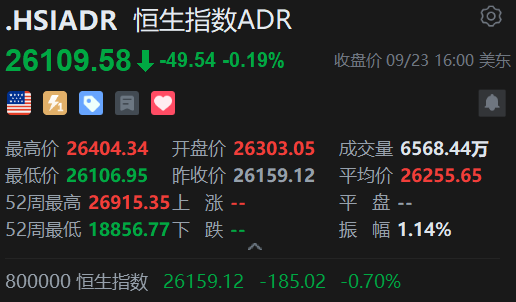
Market Overview - The Hang Seng Index (HSI) closed at 26,109.58, down by 49.54 points or 0.19% on September 23 [1] - The index reached a high of 26,404.34 and a low of 26,106.95 during the trading session, with a trading volume of 65.684 million shares [1] - The 52-week high for the index is 26,915.35, while the 52-week low is 18,856.77, indicating a volatility of 1.14% [1] Major Blue-Chip Stocks Performance - HSBC Holdings closed at 109.177 HKD, up by 0.53% compared to the previous close [2] - Tencent Holdings closed at 633.990 HKD, down by 0.24% compared to the previous close [2] - Alibaba Group (ADR) closed at 158.517 HKD, down by 0.55% compared to the previous close [3] - Other notable performances include: - AIA Group down by 1.53% to 70.900 HKD [3] - Meituan down by 2.79% to 101.000 HKD [3] - JD.com down by 4.40% to 128.300 HKD [3] Summary of Key Stock Movements - Tencent Holdings: Latest price 635.500 HKD, down by 0.86% [3] - Alibaba Group: Latest price 159.400 HKD, up by 0.13% [3] - HSBC Holdings: Latest price 108.600 HKD, up by 1.31% [3] - Xiaomi Group: Latest price 55.450 HKD, down by 1.16% [3] - BYD Company: Latest price 106.300 HKD, down by 3.10% [3] - Baidu Group: Latest price 128.400 HKD, down by 5.38% [3]

平安、太平等分红险保费增速超40%!太保、新华分红险新单期交增速超1000%,二季度分红险新单提速,三季度能否持续?
13个精算师· 2025-09-23 16:00
Core Viewpoint - The article discusses the growth of participating insurance premiums in the first half of 2025, highlighting a shift towards these products amid changing market conditions and sales strategies. Group 1: Participating Insurance Premium Growth - In 2025, participating insurance premiums achieved positive growth for the first time in five years, with a growth rate of approximately 4% by the end of 2024 [3] - By mid-2025, the total participating insurance premiums reached around 500 billion, showing a year-on-year growth of about 1%, which is a slowdown compared to the previous year [3] - The slowdown in premium growth is attributed to a shift in sales focus from participating insurance to traditional insurance products through bank insurance channels [3][14] Group 2: Company Performance - Major companies like Ping An, Taiping, and Xinhua reported participating insurance premium growth rates exceeding 20% in the first half of 2025 [5] - Taiping Life's participating insurance premiums doubled, marking the fastest growth among peers, while Ping An's growth rate reached 41% compared to the same period in 2024 [6] - New single premium growth for participating insurance saw significant increases, with Xinhua's first-year premiums reaching 4.6 billion, reflecting a high-speed growth [9] Group 3: Distribution Channels - The individual agent channel has become a significant driver for participating insurance, with companies like China Life and Taiping reporting that over 50% of their new single premiums come from participating insurance [12] - The growth rate of participating insurance in the individual agent channel is notably higher than in the bank insurance channel, which has shifted focus to traditional insurance products [14] - In the second quarter of 2025, participating insurance premiums experienced a growth rate of approximately 90%, significantly outpacing traditional insurance's growth rate of around 20% [14] Group 4: Market Conditions and Future Outlook - The adjustment of preset interest rates for traditional and participating insurance has narrowed the gap, potentially accelerating the industry's shift towards participating insurance products [19] - The overall dividend realization rate for participating insurance products improved to 61.7% in 2024, up by 10.9 percentage points year-on-year, indicating a favorable environment for continued growth [19] - The article suggests that the combination of reduced interest rate disadvantages and improved dividend realization rates may support the ongoing development of participating insurance in the future [19]


3人团队掌管300亿保费?保险业高管的生死减法
Tai Mei Ti A P P· 2025-09-23 13:03
Core Insights - The insurance industry is experiencing a significant reduction in executive numbers, with the average number of executives per company dropping from 11.2 in 2020 to 7.8 in 2025, a decrease of approximately 30% [1][2][5] - Smaller insurance companies are leading this trend, with some maintaining core teams of only three executives, reflecting a shift from "scale expansion" to "quality competition" driven by regulatory pressures, cost constraints, and technological advancements [2][3][5] Executive Reduction Trends - The demand for executive positions has decreased by 60% since 2020, indicating a shift in the hiring landscape within the insurance sector [2] - Among the 176 insurance companies, the average number of executives is now at its lowest in a decade, with life insurance companies averaging 7.8 executives and property insurance companies at 7.6, both down over 25% from five years ago [2][5] - Over 15% of small insurance companies have core management teams of fewer than four people, with some companies like BYD Property Insurance and Huahui Life retaining only three executives [2][3] Cost Management and Efficiency - The comprehensive expense ratio for BYD Property Insurance was reported at 6.11%, significantly lower than the industry average of 18.5%, highlighting the financial pressures faced by smaller firms [3] - Major insurance companies are also reducing executive numbers; for instance, Ping An Life cut its executive team from seven to five, saving approximately 800,000 yuan in annual salary costs, which is 12% of the company's net profit [3][7] - The average salary for executives in the industry exceeds 25% of total labor costs, with top executives earning between 5 million to 8 million yuan annually [6] Regulatory and Technological Influences - The implementation of the C-ROSS regulatory framework has necessitated clearer accountability for executive roles, leading to a reduction in redundant management layers [5][6] - Companies are increasingly adopting technology to streamline operations, with AI systems replacing traditional management roles, thus reducing the need for multiple layers of approval [7][12] New Operational Models - Smaller insurance companies are exploring new operational models, such as outsourcing non-core functions while maintaining a lean core team, exemplified by BYD Property Insurance's approach [9][10] - The "shared executive" model is being piloted among small insurers to reduce costs and improve governance, allowing multiple companies to share a CFO or other key roles [11] - Digital management platforms are being utilized to automate processes, significantly reducing the number of required executives while enhancing decision-making efficiency [12] Industry Evolution - The insurance sector is transitioning from a focus on executive quantity to a focus on value creation and operational efficiency, with a growing emphasis on technology and streamlined processes [17] - The future survival strategy for smaller insurers may involve specialization and efficiency rather than expansion, leveraging technology to enhance operational capabilities [17]
超强台风“桦加沙”今夜来袭:广州部分超市停止配送,保险公司全面出击
Di Yi Cai Jing· 2025-09-23 11:50
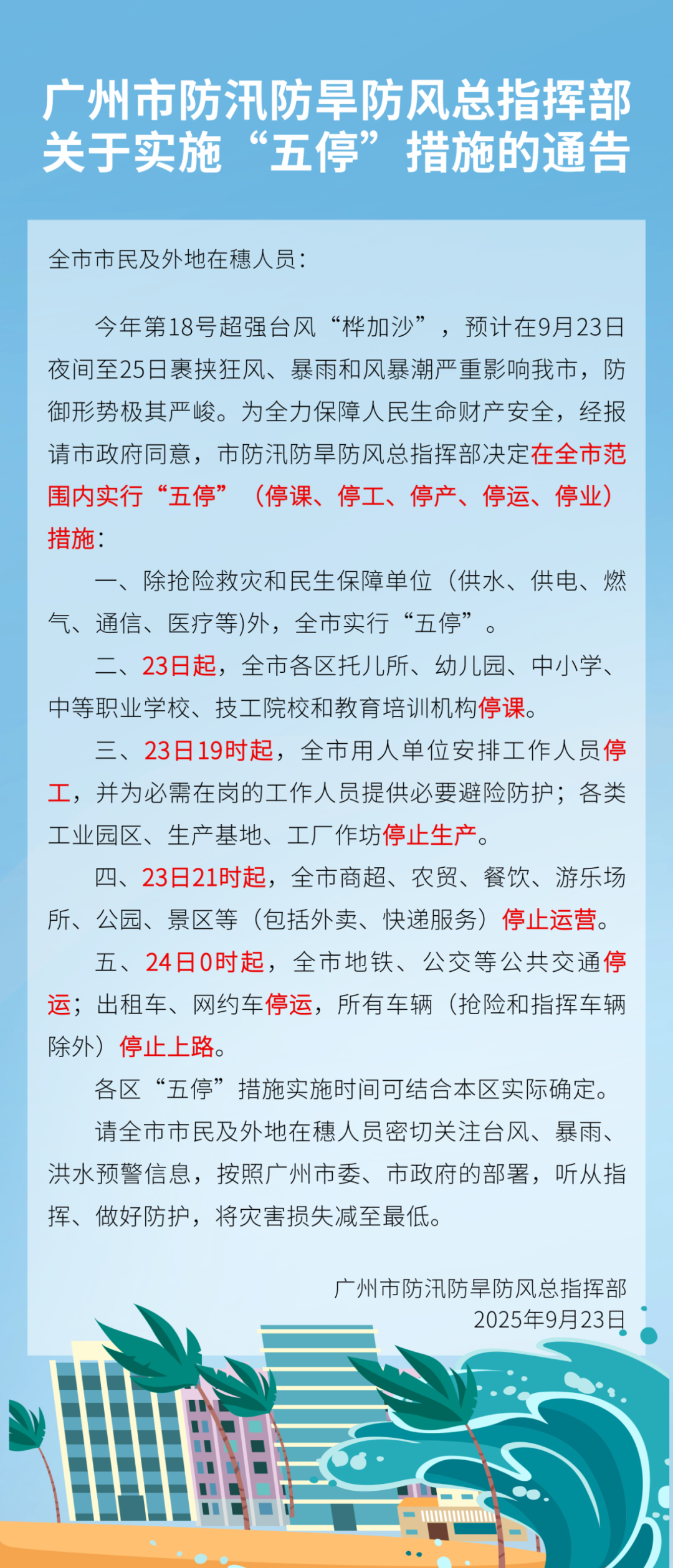
Core Viewpoint - The super typhoon "Haikui" is expected to hit Guangdong from the night of September 23 to 25, bringing severe winds, heavy rain, and storm surges, with wind speeds reaching 12 to 17 levels, potentially comparable to the destructive "Mangkhut" typhoon in 2018 [1] Group 1: Government and Emergency Response - The Guangzhou Flood Control and Drought Relief Headquarters has issued a "Five Stops" notice, halting classes, work, production, transportation, and business operations, except for emergency rescue and essential services [1] - Starting from 19:00 on September 23, all employers in the city are required to stop work, and by 21:00, all supermarkets, markets, restaurants, amusement parks, and scenic spots will cease operations [4] Group 2: Public Preparedness and Consumer Behavior - Reports indicate that major supermarkets in Guangzhou have seen a rush on pork, chicken, and vegetables, with many items sold out, leaving only chili peppers available, reflecting consumer panic buying [4] - Some community fresh food chain stores have closed, and online delivery services like Meituan have also suspended operations [11] Group 3: Insurance and Risk Management - Insurance companies are actively involved in disaster prevention efforts, with Ping An Property & Casualty Insurance leading the flood prevention work group in Shenzhen, sending out early warning messages and disaster prevention guidelines to over 20 million people [11] - Ping An has organized a special inspection team to assess flood-prone areas and has set up warning signs and promotional banners in critical locations [11][15]
创业板指数ETF今日合计成交额79.54亿元,环比增加47.79%
Zheng Quan Shi Bao Wang· 2025-09-23 11:46
Core Viewpoint - The trading volume of the ChiNext Index ETFs reached 7.954 billion yuan today, marking a 47.79% increase compared to the previous trading day [1] Trading Volume Summary - The E Fund ChiNext ETF (159915) had a trading volume of 6.866 billion yuan, an increase of 2.637 billion yuan, with a growth rate of 62.38% [1] - The FT Fund ChiNext ETF (159971) recorded a trading volume of 145 million yuan, up by 46.0618 million yuan, reflecting a 46.63% increase [1] - The ChiNext ETF Dongcai (159205) saw a trading volume of 95.7783 million yuan, increasing by 16.0524 million yuan, with a growth rate of 20.13% [1] - The FT ChiNext Enhanced Strategy ETF (159676) and the Puyin Ansheng ChiNext ETF (159810) had significant increases in trading volume of 88.73% and 78.24% respectively [1] Market Performance Summary - As of market close, the ChiNext Index (399006) rose by 0.21%, while the average increase of related ETFs tracking the ChiNext Index was 0.38% [1] - The top performers included the Harvest ChiNext Enhanced Strategy ETF (159675) and the FT ChiNext Enhanced Strategy ETF (159676), which increased by 0.86% and 0.59% respectively [1]

全力应对2025最强台风"桦加沙"!中国平安部署防灾预警、急难救援、抢险救灾多项应急举措
Di Yi Cai Jing· 2025-09-23 11:18
Core Viewpoint - The article highlights the proactive measures taken by China Ping An to respond to the impending impact of Typhoon "Haikui," emphasizing their commitment to disaster prevention and emergency response [1][3][7]. Group 1: Disaster Preparedness and Response - China Ping An has coordinated multiple insurance subsidiaries to implement disaster prevention and emergency response mechanisms in anticipation of Typhoon "Haikui," which is expected to bring severe winds and potential damage [1][3]. - The company has sent out early warning messages and disaster prevention guidelines to over 20 million people, covering potential disaster areas [3]. - A specialized team has been formed to inspect flood-prone areas in Shenzhen, identifying over 3,500 potential hazards and setting up warning signs [3][4]. Group 2: Technological Integration and Risk Management - Utilizing the Eagle Eye 3.0 system, China Ping An has launched a precise warning service for "waterlogged black spots" on roads, integrating historical data with real-time assessments [4]. - The company has deployed over 1,800 personnel to inspect and manage flood-prone areas, ensuring timely intervention [4]. Group 3: Emergency Resources and Support - China Ping An has prepared 266 rescue vehicles and helicopter resources for emergency response in the Greater Bay Area, ensuring rapid assistance for affected clients [7]. - A support team of 1,400 has been organized to facilitate claims processing and disaster relief, with a focus on efficient service delivery [7]. Group 4: Client Support and Claims Processing - The company has established a 24/7 claims hotline and is actively reaching out to potentially affected clients to provide claims services [9][10]. - Simplified claims procedures have been introduced for clients who may face accidental death due to the disaster, ensuring timely support [11]. - Provisions for pre-claims and no-policy claims processing have been set up to assist clients in need [12][13].