
PING AN OF CHINA(02318)

Search documents
26年险资配置调查结果出炉,增配权益而久期策略不变
GF SECURITIES· 2026-02-26 08:47
Core Insights - The report indicates that insurance assets are expected to steadily increase their allocation to equities in 2026, while maintaining their duration strategy unchanged [6] - The survey conducted by the China Banking and Insurance Asset Management Association reflects the industry's expectations regarding market trends and allocation strategies for 2026 [6] Asset Allocation - In terms of major asset allocation, stocks and securities investment funds are generally favored by insurance institutions for domestic investments in 2026, with some institutions planning to slightly increase their stock investments [6] - The allocation ratios for bank deposits and bonds are expected to remain stable compared to 2025 [6] - Most insurance institutions hold a neutral outlook on the bond market for 2026, with the overall duration strategy expected to remain unchanged [6] - The yield on 10-year government bonds is anticipated to be in the range of 1.8%-1.9%, while 30-year government bonds are expected to yield between 2.2%-2.4% [6] - Over half of the insurance institutions predict that the yield center for high-grade credit bonds will be around 2.0%-2.5%, with credit spreads expected to show a fluctuating trend [6] A-Share Market Outlook - Most insurance institutions maintain an optimistic view of the A-share market for 2026, with plans to slightly increase their allocation to A-shares [6] - The sectors favored include technology, non-ferrous metals, power equipment, computers, communications, pharmaceuticals, and basic chemicals, with a focus on themes such as semiconductors, defense, AI, robotics, and high-dividend stocks [6] Overseas Investment - Hong Kong stocks are the most favored overseas investment option for insurance institutions in 2026, with half of the asset management institutions planning to slightly increase their allocation to Hong Kong stocks [6] - Gold and US stocks are also receiving considerable attention from insurance institutions [6] Company Recommendations - The report suggests that the insurance sector's equity elasticity is expected to continue improving, with a favorable long-term trend for the insurance premium difference [6] - Specific companies recommended for investment include China Ping An (A/H), China Life (A/H), China Taiping (H), New China Life (A/H), China Pacific Insurance (A/H), China People’s Insurance Group (H), and AIA Group (H) [6]




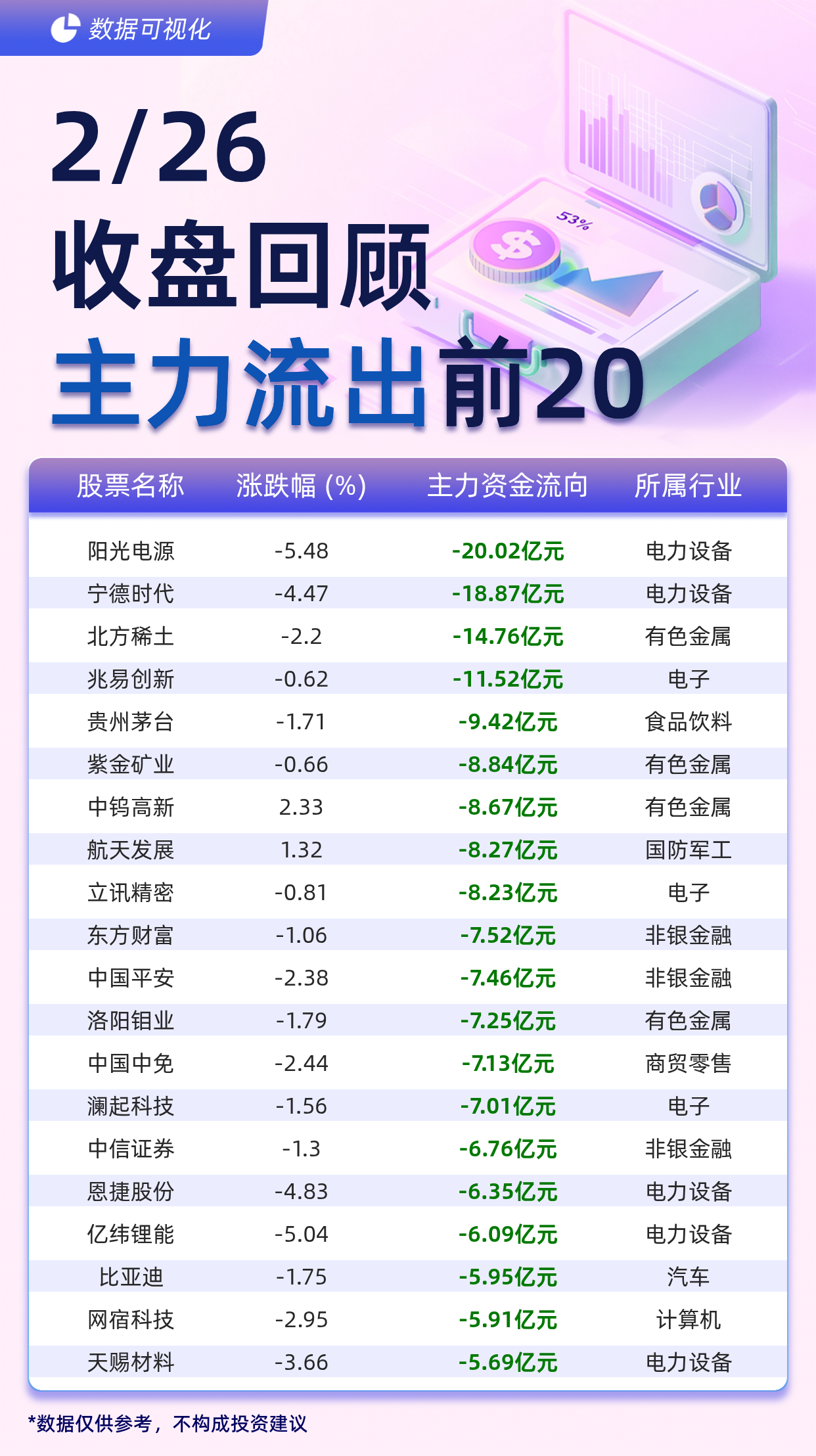
主力个股资金流出前20:阳光电源流出20.02亿元、宁德时代流出18.87亿元




Jin Rong Jie· 2026-02-26 07:11
Core Viewpoint - The data indicates significant outflows of main funds from various stocks, with notable amounts in the energy, materials, and financial sectors [1][2][3] Group 1: Stock Outflows - The stock with the highest outflow is 阳光电源, with a total of -20.02 billion yuan [1][2] - 宁德时代 follows closely with an outflow of -18.87 billion yuan [1][2] - Other significant outflows include 北方稀土 at -14.76 billion yuan and 兆易创新 at -11.52 billion yuan [1][2] Group 2: Sector Analysis - The electric equipment sector shows substantial outflows, with 阳光电源 and 宁德时代 leading [2] - The non-ferrous metals sector is also impacted, with 北方稀土 and 紫金矿业 experiencing notable outflows [2][3] - The financial sector, represented by 中国平安 and 中信证券, also shows significant fund outflows [2][3] Group 3: Additional Notable Stocks - 贵州茅台 has an outflow of -9.42 billion yuan, indicating a decline in investor interest [1][3] - 立讯精密 and 恩捷股份 also report outflows of -8.23 billion yuan and -6.35 billion yuan respectively, reflecting trends in the electronics and energy sectors [1][3] - 比亚迪, a key player in the automotive sector, shows an outflow of -5.95 billion yuan, suggesting potential shifts in market sentiment [1][3]

中国平安更新报告“产品加服务”,打造平安新的价值增长
GUOTAI HAITONG SECURITIES· 2026-02-26 00:25
Investment Rating - The report maintains a "Buy" rating for China Ping An, with a target price of 88.53 CNY [2][14]. Core Insights - China Ping An's strategic positioning as a "comprehensive finance + medical care and elderly care" entity is expected to drive long-term stable profit growth through its "product + service" model, creating a new value growth engine for the company [3][14]. - The report emphasizes the importance of demographic changes, such as an aging population and the increasing significance of commercial health insurance, which will support the company's strategic focus on "comprehensive finance + medical care services" [34][38]. Financial Summary - Projected revenue growth from 913.79 billion CNY in 2023 to 1,198.34 billion CNY in 2027, with a compound annual growth rate (CAGR) of approximately 7% [6][15]. - Net profit attributable to shareholders is expected to increase from 85.67 billion CNY in 2023 to 159.49 billion CNY in 2027, reflecting a significant recovery after a 23% decline in 2023 [6][15]. - Earnings per share (EPS) is projected to rise from 4.70 CNY in 2023 to 8.81 CNY in 2027, indicating a positive trend in profitability [6][15]. Strategic Development - The report outlines four strategic development phases for China Ping An, culminating in its current focus on "comprehensive finance + medical care and elderly care" since 2021 [22][34]. - The company aims to leverage its comprehensive financial foundation, early investments in medical and elderly care, and strong technological capabilities to build a more efficient "product + service" system [14][28]. Market Positioning - China Ping An is positioned to benefit from the growing demand for health management services, driven by an aging population and increasing health awareness among consumers [38][40]. - The report highlights that the current valuation of the company is low, providing a margin of safety for investors, particularly in the context of its comprehensive financial services [14][19].
智通港股沽空统计|2月26日
智通财经网· 2026-02-26 00:23
Group 1 - AIA Group Limited (友邦保险-R) and Li Ning Company Limited (李宁-R) have the highest short-selling ratios at 100.00%, followed by JD.com (京东集团-SWR) at 95.15% [1][2] - The top three companies by short-selling amount are HSBC Holdings (汇丰控股) at 1.676 billion, Tencent Holdings (腾讯控股) at 944 million, and Ping An Insurance (中国平安) at 872 million [1][2] - Li Ning Company Limited has the highest deviation value at 39.85%, followed by Standard Chartered (渣打集团) at 34.61% and AIA Group Limited at 33.51% [1][2] Group 2 - The top short-selling amounts are led by HSBC Holdings at 1.676 billion, followed by Tencent Holdings at 944 million and Ping An Insurance at 872 million [2] - The short-selling ratio for HSBC Holdings is 27.07%, while Tencent Holdings has a ratio of 7.88% and Ping An Insurance has 38.42% [2] - The highest short-selling deviation values are observed in Li Ning Company Limited at 39.85%, Standard Chartered at 34.61%, and AIA Group Limited at 33.51% [2]



中国平安(601318):中国平安更新报告:“产品加服务”,打造平安新的价值增长
GUOTAI HAITONG SECURITIES· 2026-02-25 15:11
Investment Rating - The report maintains a "Buy" rating for China Ping An, with a target price of 88.53 CNY [2][14]. Core Insights - China Ping An's strategic positioning as a "comprehensive finance + medical care and elderly care" entity is expected to drive long-term stable profit growth through its "product + service" model, creating a new value growth engine for the company [3][14]. - The report emphasizes the importance of demographic changes, such as aging population and the rising significance of commercial health insurance, which will support the implementation of the "comprehensive finance + medical care and elderly care" strategy [34][38]. Financial Summary - Projected revenue growth from 913.79 billion CNY in 2023 to 1,198.34 billion CNY in 2027, with a compound annual growth rate (CAGR) of approximately 7% [6][15]. - Net profit attributable to shareholders is expected to increase from 85.67 billion CNY in 2023 to 159.49 billion CNY in 2027, reflecting a significant recovery after a 23% decline in 2023 [6][15]. - Earnings per share (EPS) is projected to rise from 4.70 CNY in 2023 to 8.81 CNY in 2027 [6][15]. Strategic Advantages - China Ping An is leveraging its comprehensive financial foundation, early layout in medical and elderly care, and strong technological capabilities to build a more efficient "product + service" system [14][19]. - The company aims to integrate high-quality medical and elderly care resources, providing a one-stop service platform for clients, which enhances customer satisfaction and increases revenue from both financial and medical services [26][28]. Market Positioning - The report highlights that the current stock price reflects a low valuation, providing a safety margin for investors, particularly in the context of the comprehensive financial segment [14][19]. - The "product + service" model is anticipated to create a new value growth engine, with a target market capitalization of 1.6 trillion CNY corresponding to the target price of 88.53 CNY [14][19].
五万亿平安人寿换帅!杨铮卸任 85后蔡霆代行董事长职责
Nan Fang Du Shi Bao· 2026-02-25 12:50
刚满62岁的"保险老将"杨铮,掌舵5万亿级寿险机构多年之后,终于完成退休返聘使命。南都湾财社记 者日前从平安人寿了解到,杨铮退休后返聘任职期满,拟卸任公司董事长、董事等相关职务。根据平安 人寿《公司章程》的规定,副董事长兼副总经理蔡霆代行董事长职责。 平安人寿方面表示,杨铮在担任公司董事长期间恪尽职守、勤勉尽责,主导推动"渠道+产品"战略落地 显效,公司对杨铮任职期间所作的贡献表示衷心感谢。 史伟玉则是"75后",自1999年加入平安,系内部历练成长的典型"女将"。 值得注意的是,自2024年以来平安人寿管理层变动频繁,干部年轻化人事棋局渐明朗。2024年10月,曾 有阿里等互联网公司零售业务背景的宫秋伟出任平安人寿董事长特别助理跻身高管阵列。平安人寿对此 表示,此次引进人才是为了结合战略推进和经营管理需要,持续完善人才梯队体系,进一步深化寿险改 革。 对于未来"一把手"和高管矩阵,平安人寿解释称,将不断加强公司领导班子建设,推进公司战略落地, 迈向高质量发展。目前公司正有序推进董事长的聘任工作,后续将按照相关法律法规规定和监管要求及 时履行信息披露义务。 在中国平安的光环之下,这家头部寿险机构的继任者一直备 ...
五万亿平安人寿换帅!杨铮卸任,85后蔡霆代行董事长职责
Nan Fang Du Shi Bao· 2026-02-25 12:44
刚满62岁的"保险老将"杨铮,掌舵5万亿级寿险机构多年之后,终于完成退休返聘使命。南都湾财社记 者日前从平安人寿了解到,杨铮退休后返聘任职期满,拟卸任公司董事长、董事等相关职务。根据平安 人寿《公司章程》的规定,副董事长兼副总经理蔡霆代行董事长职责。 平安人寿方面表示,杨铮在担任公司董事长期间恪尽职守、勤勉尽责,主导推动"渠道+产品"战略落地 显效,公司对杨铮任职期间所作的贡献表示衷心感谢。 杨铮(图片来自网络) 蔡霆(图片来自网络) 早在去年3月5日,平安人寿宣布,经公司董事会审议,选举执行董事、副总经理蔡霆兼任公司副董事 长;副总经理史伟玉拟出任公司总经理。 南都湾财社记者了解到,作为"85后"少帅,彼时蔡霆还不足40岁,曾被业内称为"火箭式晋升"。 蔡霆于1985年10月出生,系上海交通大学安泰经济与管理学院人力资源管理专业学士毕业。从他的履历 看,曾在平安集团总部、银行和寿险板块均有历练。 自2014年加入平安以后,蔡霆历任平安集团首席 创新执行官办公室项目经理、平安集团战略发展中心研究助理/高级项目经理、平安集团员工服务部副 总经理(主持工作)、平安银行人力资源部总经理、平安集团副首席财务执行官、平 ...

中国平安:公司将保持稳定、一致的分红政策
Zheng Quan Ri Bao· 2026-02-25 11:40
Group 1 - The core viewpoint of the article highlights that Ping An Group places significant emphasis on shareholder returns, maintaining a consistent dividend policy over the years [2] - The company has increased its earnings per share dividend for the first half of 2025 by 2.2% year-on-year, continuing a trend of over 10 years of rising dividends [2] - Ping An Group is committed to a stable and consistent dividend policy moving forward [2]
智通港股空仓持单统计|2月25日
智通财经网· 2026-02-25 10:39
Core Insights - The top three companies with the highest short positions as of February 13 are COSCO Shipping Holdings (01919), CATL (03750), and Ping An Insurance (02318), with short ratios of 19.07%, 16.71%, and 15.47% respectively [1][2] Group 1: Companies with Highest Short Ratios - COSCO Shipping Holdings (01919) has a short position of 526 million shares, representing a short ratio of 19.07% [2] - CATL (03750) has a short position of 26.05 million shares, with a short ratio of 16.71% [2] - Ping An Insurance (02318) has a short position of 1.152 billion shares, reflecting a short ratio of 15.47% [2] - Dongfang Electric (01072) has a short position of 62.39 million shares, with a short ratio of 15.29% [2] - Sunny Optical Technology (02382) has a short position of 16.4 million shares, maintaining a short ratio of 15.17% [2] Group 2: Companies with Increased Short Positions - WuXi AppTec (02359) saw the largest increase in short ratio, rising by 2.66% to 12.45% [2][3] - Chifeng Jilong Gold Mining (06693) increased its short ratio by 1.63% to 3.60% [2][3] - Changfei Optical Fiber (06869) experienced a 1.55% increase in short ratio, reaching 4.13% [2][3] - Meitu (01357) had a short ratio increase of 1.38% to 8.00% [2][3] - Weimob (02013) saw a 1.33% increase in its short ratio, now at 12.16% [2][3] Group 3: Companies with Decreased Short Positions - Tianqi Lithium (09696) had the largest decrease in short ratio, dropping by 2.29% to 2.91% [3][4] - Vanke (02202) saw a reduction of 2.17% in its short ratio, now at 14.25% [3][4] - Jiangsu Ninhui Expressway (00177) decreased its short ratio by 1.02% to 10.61% [3][4] - Ganfeng Lithium (01772) experienced a decrease of 1.01% in its short ratio, now at 8.81% [3][4] - Country Garden (02007) saw a reduction of 0.91% in its short ratio, now at 1.02% [3][4]

花旗集团对中国平安H股的多头持仓比例增至6.09%
Xin Lang Cai Jing· 2026-02-25 09:16
Group 1 - Citigroup's long position in China Ping An Insurance (Group) Company Limited - H shares increased from 5.93% to 6.09% as of February 16, 2026 [1]
