
China Life(02628)

Search documents
中国人寿保险:公司法定代表人已变更为总裁利明光
Xin Lang Cai Jing· 2026-01-05 09:25
1月5日金融一线消息,中国人寿保险今日发布公告称,公司于2025年9月25日召开2025年第一次临时股 东大会,审议通过了《关于修订〈公司章程〉的议案》。国家金融监督管理总局已经核准公司2025年第 一次临时股东大会对《中国人寿保险股份有限公司章程》("《公司章程》")做出的修订。 中国人寿保险表示,根据修订后的《公司章程》,公司的法定代表人由董事长变更为总裁。近日,公司 已完成法定代表人工商变更登记手续,公司法定代表人已变更为总裁利明光。 责任编辑:曹睿潼 1月5日金融一线消息,中国人寿保险今日发布公告称,公司于2025年9月25日召开2025年第一次临时股 东大会,审议通过了《关于修订〈公司章程〉的议案》。国家金融监督管理总局已经核准公司2025年第 一次临时股东大会对《中国人寿保险股份有限公司章程》("《公司章程》")做出的修订。 中国人寿保险表示,根据修订后的《公司章程》,公司的法定代表人由董事长变更为总裁。近日,公司 已完成法定代表人工商变更登记手续,公司法定代表人已变更为总裁利明光。 责任编辑:曹睿潼 ...

中国人寿(601628) - 中国人寿法定代表人变更公告
2026-01-05 09:15
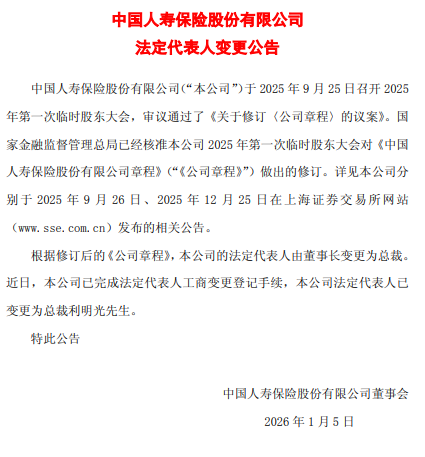
中国人寿保险股份有限公司 法定代表人变更公告 中国人寿保险股份有限公司("本公司")于 2025 年 9 月 25 日召开 2025 年第一次临时股东大会,审议通过了《关于修订〈公司章程〉的议案》。国 家金融监督管理总局已经核准本公司 2025 年第一次临时股东大会对《中国 人寿保险股份有限公司章程》("《公司章程》")做出的修订。详见本公司分 别于 2025 年 9 月 26 日、2025 年 12 月 25 日在上海证券交易所网站 (www.sse.com.cn)发布的相关公告。 根据修订后的《公司章程》,本公司的法定代表人由董事长变更为总裁。 近日,本公司已完成法定代表人工商变更登记手续,本公司法定代表人已 变更为总裁利明光先生。 特此公告 中国人寿保险股份有限公司董事会 证券代码:601628 证券简称:中国人寿 编号:临 2026-001 重要提示 本公司董事会及全体董事保证本公告内容不存在任何虚假记载、误导性陈述 或者重大遗漏,并对其内容的真实性、准确性和完整性承担法律责任。 2026 年 1 月 5 日 ...
中国人寿(02628.HK):公司法定代表人已变更为总裁利明光
Ge Long Hui· 2026-01-05 09:11
格隆汇1月5日丨中国人寿(02628.HK)发布公告,根据修订后的《公司章程》,公司的法定代表人由董事 长变更为总裁。近日,公司已完成法定代表人工商变更登记手续,公司法定代表人已变更为总裁利明光 先生。 ...
中国人寿(02628):法定代表人已变更为总裁利明光
智通财经网· 2026-01-05 09:09
智通财经APP讯,中国人寿(02628)发布公告,公司于2025年9月25日召开2025年第一次临时股东大会, 审议通过了《关于修订〈公司章程〉的议案》。国家金融监督管理总局已经核准本公司2025年第一次临 时股东大会对《中国人寿保险股份有限公司章程》("《公司章程》")做出的修订。根据修订后的《公司 章程》,本公司的法定代表人由董事长变更为总裁。近日,本公司已完成法定代表人工商变更登记手 续,本公司法定代表人已变更为总裁利明光先生。 ...
中国人寿(02628) - 海外监管公告 - 中国人寿保险股份有限公司法定代表人变更公告
2026-01-05 09:03
中國人壽保險股份有限公司 CHINA LIFE INSURANCE COMPANY LIMITED (於中華人民共和國註冊成立之股份有限公司) (股份代號: 2628) 香港交易及結算所有限公司及香港聯合交易所有限公司對本公告的內容概不負責,對其準確性或完 整性亦不發表任何聲明,並明確表示,概不對因本公告全部或任何部分內容而產生或因倚賴該等內 容而引致的任何損失承擔任何責任。 海外監管公告 本公告乃由中國人壽保險股份有限公司(「本公司」)根據香港聯合交易所有限公司上市 規則第 13.10B 條規定而刊登。 根據中華人民共和國(「中國」)有關法律法規,本公司於上海證券交易所網站 (www.sse.com.cn)及中國報章刊登「中國人壽保險股份有限公司法定代表人變更公告」。 茲載列該公告如下,僅供參閱。 2026 年 1 月 5 日 於本公告日期,本公司董事會由以下人士組成: 非執行董事: 王軍輝、胡錦、胡容、牛凱龍 獨立非執行董事: 林志權、翟海濤、陳潔、盧鋒 執行董事: 蔡希良、利明光、劉暉、阮琦 中國人壽保險股份有限公司董事會 2026 年 1 月 5 日 證券代碼:601628 證券簡稱:中國人壽 編號: ...
中国人寿:法定代表人由董事长变更为总裁利明光
Xin Lang Cai Jing· 2026-01-05 09:00
中国人寿公告称,2025年9月25日公司召开临时股东大会,审议通过修订《公司章程》议案,获国家金 融监督管理总局核准。根据修订后的章程,公司法定代表人由董事长变更为总裁。近日,公司完成法定 代表人工商变更登记手续,法定代表人变更为总裁利明光。 ...
保险25年显著跑赢大盘,险资举牌仅十年新高:保险行业周报(20251229-20251231)-20260105
Huachuang Securities· 2026-01-05 08:44
Investment Rating - The industry investment rating is "Recommended," indicating an expected increase in the industry index by more than 5% over the next 3-6 months compared to the benchmark index [19]. Core Insights - The insurance sector has significantly outperformed the market over the past 25 years, with insurance capital's stake acquisitions reaching a ten-year high [1]. - In 2025, there were a total of 31 stake acquisitions by insurance capital, marking a resurgence in activity, second only to 2015, and surpassing the 28 acquisitions in 2020 [3]. - The preference for H-shares among insurance capital is evident, with 26 out of 31 acquisitions targeting H-shares, likely due to favorable dividend yields [3]. - The main sectors attracting insurance capital include banking (7 acquisitions) and public utilities (6 acquisitions), reflecting a preference for dividend-yielding assets [3]. - The report anticipates that the trend of stake acquisitions will continue into 2026, driven by two main motivations: seeking stable dividend cash flows and targeting mature, monopolistic enterprises with solid ROE [3]. Summary by Sections Weekly Updates - China Pacific Insurance appointed Liu Long as the Chief Investment Officer [2]. - Great Wall Life successfully issued its first perpetual bond with a scale of 1 billion yuan and a rating of AAA [2]. - Great Wall Life increased its holdings in New Tian Green Energy and Datang New Energy, raising its shareholding percentages to 11.04% and 17.39%, respectively [2]. Stake Acquisition Overview - In 2025, insurance capital's stake acquisitions totaled 31 times, with a minimum of 38 times when accounting for repeated acquisitions [3]. - The report highlights a shift in acquisition activity towards larger insurance companies, with Ping An leading with 7 acquisitions, followed by Great Wall Life (5) and others [3]. Investment Recommendations - The insurance sector saw a general increase in December, driven by expectations of rising long-term interest rates and favorable sales performance [3]. - Despite anticipated pressure from high investment baselines, the report suggests that the sector's valuation may continue to recover due to stabilizing interest rates and declining liability costs [3]. - Companies recommended for investment include China Ping An and China Pacific Insurance, which are expected to manage liability costs effectively [3]. Valuation Metrics - The report provides PEV valuations for major life insurance companies, with China Life at 0.87x, Ping An at 0.82x, and China Pacific at 0.68x for A-shares [4]. - For H-shares, Ping An is valued at 0.75x, while China Life is at 0.51x [4]. - The report recommends a ranking of investment opportunities: China Ping An, China Pacific Insurance, China Life H, and China Property Insurance [4].


中国人寿法定代表人变更,利明光接任
Xin Lang Cai Jing· 2026-01-05 07:22
1月5日金融一线消息,爱企查工商信息显示,近日,中国人寿保险股份有限公司发生工商变更,白涛卸 任法定代表人,由利明光接任。 1月5日金融一线消息,爱企查工商信息显示,近日,中国人寿保险股份有限公司发生工商变更,白涛卸 任法定代表人,由利明光接任。 责任编辑:李琳琳 责任编辑:李琳琳 ...
中国人寿财产保险股份有限公司北京市门头沟支公司换领《保险许可证》公告
Bei Jing Wan Bao· 2026-01-05 06:40
变更事由:营业场所地址变更 机构编码:000108110109 机构名称:中国人寿财产保险股份有限公司北京市门头沟支公司 机构住所:北京市门头沟区滨河路64号1幢6层601、602、606室 发证日期:2025年12月30日 批准日期:2020年04月14日 许可证流水号:00154064 业务范围:由总公司在核准的业务范围内授权决定。 联系电话:010-61820072 2026年1月5日 中国人寿财产保险股份有限公司北京市门头沟支公司,经国家金融监督管理总局北京监管局批准,因营 业场所地址变更换领《保险许可证》,现予以公告。 ...
非银金融行业周报(2025/12/29-2025/12/31):公募费率改革收官,非银板块向上突破动能充盈-20260105
Shenwan Hongyuan Securities· 2026-01-05 06:06
Investment Rating - The report maintains a positive outlook on the brokerage sector, suggesting it has good upward momentum for 2026, while the insurance sector is viewed as having systemic value reassessment opportunities [4][30]. Core Insights - The brokerage sector is expected to benefit from improved chip structure, reduced turnover rates, and a limited downside in current valuations. The sector is also positioned for increased public fund allocations due to its relative performance and high index weight [4]. - The insurance sector is projected to experience a decline in premium income growth due to the impact of policy changes and market conditions, but new business growth is anticipated to drive net profit value (NBV) growth, particularly for leading companies [4][30]. Market Review - The Shanghai Composite Index closed at 4,629.94 with a decline of 0.59%, while the non-bank index fell by 1.84% to 2,054.14. The brokerage, insurance, and diversified financial sectors reported declines of 1.37%, 3.33%, and 1.37% respectively [8][10]. - As of December 31, 2025, the average daily trading volume in the stock market was 21,283.52 billion yuan, reflecting an increase of 8.29% compared to the previous period [19]. Key Data - As of December 31, 2025, the total assets of the insurance industry reached 40.64 trillion yuan, with life insurance companies holding 35.75 trillion yuan and property insurance companies holding 3.15 trillion yuan [30]. - The financing balance in the brokerage sector was reported at 25,552.84 billion yuan, marking a 37% increase from the end of 2024 [19]. Sector News - The China Securities Regulatory Commission (CSRC) has implemented new rules for commercial real estate REITs, allowing various types of commercial properties to be financed through public REITs [20]. - The CSRC has also finalized the regulations for public fund sales fees, which are expected to reduce the overall fee levels by approximately 20%, saving investors around 51 billion yuan annually [21].


