China Life(02628)

Search documents
中国人寿:法定代表人变更为利明光
Bei Jing Shang Bao· 2026-01-05 11:33
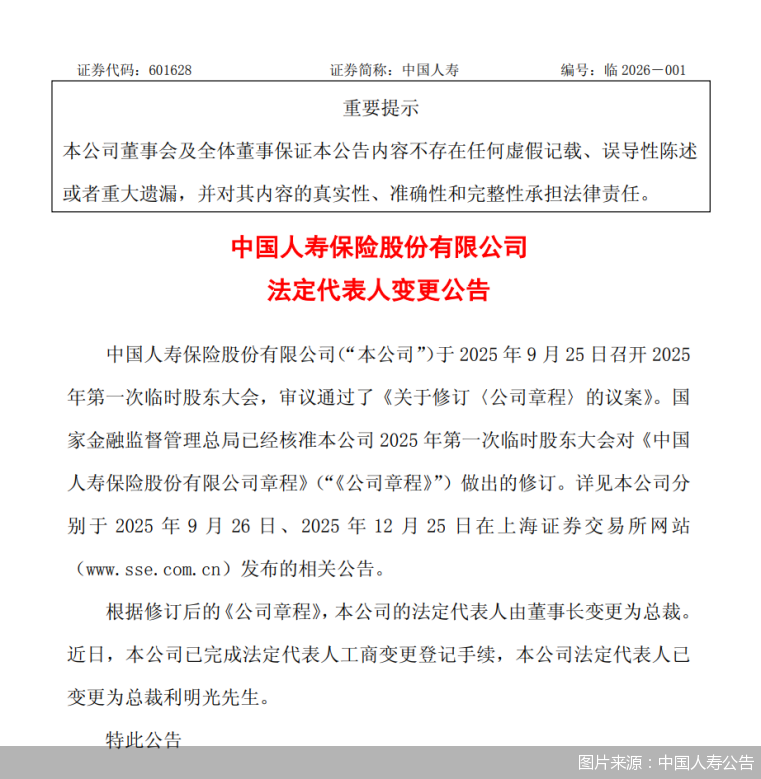
北京商报讯(记者 李秀梅)1月5日,中国人寿保险股份有限公司(以下简称"中国人寿")发布法定代表人 变更公告表示,根据修订后的《公司章程》,公司的法定代表人由董事长变更为总裁。近日,公司已完成法 定代表人工商变更登记手续,公司法定代表人已变更为总裁利明光。 | 证券代码:601628 证券简称:中国人寿 | 编号:临 2026-001 | | --- | --- | | 重要提示 | | | 本公司董事会及全体董事保证本公告内容不存在任何虚假记载、误导性陈述 | | | 或者重大遗漏,并对其内容的真实性、准确性和完整性承担法律责任。 | | ...


智通港股通活跃成交|1月5日





智通财经网· 2026-01-05 11:02
深港通(南向)十大活跃成交公司 沪港通(南向)十大活跃成交公司 | 公司名称 | 成交金额 | 净买入额 | | --- | --- | --- | | 阿里巴巴-W(09988) | 55.70 亿元 | -2.39 亿元 | | 中芯国际(00981) | 53.49 亿元 | +296.90 万元 | | 盈富基金(02800) | 52.86 亿元 | +52.72 亿元 | | 腾讯控股(00700) | 34.23 亿元 | -4.38 亿元 | | 中国海洋石油(00883) | 27.89 亿元 | -1.05 亿元 | | 快手-W(01024) | 26.93 亿元 | +4.02 亿元 | | 小米集团-W(01810) | 21.64 亿元 | +6.02 亿元 | | 南京熊猫电子股份(00553) | 16.35 亿元 | +1.05 亿元 | | 中国移动(00941) | 15.04 亿元 | -4.06 亿元 | | 华虹半导体(01347) | 14.99 亿元 | -1.02 亿元 | 智通财经APP获悉,2026年1月5日当天,阿里巴巴-W(09988)、中芯国际(00 ...
12连阳,沪指创33年最长连阳纪录!机构资金和各路游资纷纷出手,A股春季躁动行情渐入高潮,高盛高呼高配中国股票
Jin Rong Jie· 2026-01-05 10:47
整体看,A股交投气氛十分活跃,机构资金和各路游资纷纷出手,各有斩获。 数据显示,多家机构席位出现在了蓝色光标、盐湖股份、海格通信、西测测试的龙虎榜中,此外A股实 力游资章建平也出现在蓝色光标龙虎榜中,单日买入了6482.08万元,卖出了2.59亿元。 12连阳,沪指创33年最长连阳纪录,A股春季躁动行情渐入高潮! 1月5日,A股迎来2026年首个交易日,三大指数全天高开高走,截至收盘,沪指涨1.38%,报4023.42 点,深成指涨2.24%,报13828.63点,创业板指涨2.85%,报3294.55点,科创50指数涨4.4%,报1403.41 点。与此同时,资金纷纷疯狂涌入A股,今日沪深两市合计成交额25463.47亿元,较上一个交易日放量 5011亿。 值得注意的是,沪指在2025年末已经走出11连阳的强势走势。在今日A股实现开门红之后,沪指从2025 年12月17日至2026年1月5日的12个交易日中,成功实现12连阳,创下A股1993年以来最长连阳纪录。最 近33年间A股最长连阳纪录为11天,分别在2006年以及2017-2018年出现过。A股最长连阳纪录为99天, 但彼时A股才处于起步阶段,市场体 ...


利明光任中国人寿法定代表人
Xin Lang Cai Jing· 2026-01-05 10:38
Core Viewpoint - Recently, China Life Insurance Co., Ltd. (601628) underwent a business change, with Bai Tao stepping down as the legal representative and Li Mingguang taking over [1][2] Company Overview - China Life Insurance Co., Ltd. was established in June 2003 with a registered capital of approximately 28.26 billion RMB [1][2] - The company's business scope includes various types of personal insurance such as life insurance, health insurance, and accident insurance, as well as fund utilization businesses permitted by national laws and regulations or approved by the State Council [1][2] Shareholder Information - The company is jointly held by China Life Insurance (Group) Company, Hong Kong Central Clearing Limited (agent), and China Securities Finance Corporation Limited, among others [1][2]
锚定普惠金融坐标 勇立民生服务潮头
Xin Lang Cai Jing· 2026-01-05 10:32
Core Viewpoint - The company emphasizes its commitment to inclusive finance and high-quality insurance services, aligning with national strategies for economic development and social welfare [1][11]. Group 1: Inclusive Finance and Insurance Services - In 2024, the company provided coverage for 3.733 million individuals and served 8,406 enterprises, with a total coverage amount of 3.51 trillion yuan and claims paid amounting to nearly 196 million yuan [1][11]. - The company positions itself as a leader in promoting inclusive finance in Zhuhai, actively participating in the implementation of national policies [1][11]. Group 2: Healthcare and Medical Insurance - The company has been involved in building a multi-layered medical insurance system in Zhuhai, providing services to over 200,000 basic medical insurance participants and achieving a claim payout of over 500 million yuan over nine years [2][12]. - The "Great Love Without Boundaries" project, initiated in collaboration with the Zhuhai government, has insured over 590,000 individuals, with total claims exceeding 700 million yuan [2][12]. Group 3: Health Management Initiatives - The "Love Health" initiative has launched various health management projects, including cancer screening and chronic disease management, significantly improving early detection and treatment outcomes [5][17]. - The company has mobilized over 280,000 participants for cancer screenings, identifying more than 1,000 high-risk cases and facilitating timely medical interventions [5][16]. Group 4: Special Group Insurance Programs - The company has developed specialized insurance programs for vulnerable groups, including the elderly and women, ensuring comprehensive coverage and support [18][19]. - The "Silver Age Health" program has insured over 1.5 million elderly individuals, with a 100% coverage rate for six consecutive years, providing significant claim payouts [18][19]. Group 5: Rural Development and Agricultural Insurance - The company is actively promoting inclusive financial services in rural areas, providing agricultural insurance to over 5,200 employees in the aquaculture sector, with total coverage amounting to 1.9 billion yuan [20]. - The company has implemented an efficient online claims process for agricultural insurance, enhancing service accessibility for rural clients [20].
图解丨南下资金净买入港股187亿港元,大幅买入快手和小米
Ge Long Hui A P P· 2026-01-05 10:28
Group 1 - Southbound funds net bought Hong Kong stocks worth 18.723 billion HKD today [1] - The top net purchases included: - Tracker Fund of Hong Kong: 6.826 billion HKD - Kuaishou-W: 1.556 billion HKD - Xiaomi Group-W: 1.019 billion HKD - SMIC: 360 million HKD - CNOOC: 328 million HKD - Hua Hong Semiconductor: 322 million HKD - Meituan-W: 279 million HKD - Alibaba-W: 272 million HKD - China Life: 245 million HKD - Nanjing Panda Electronics: 105 million HKD [1] Group 2 - Southbound funds net sold Tencent Holdings worth 918 million HKD and China Mobile worth 406 million HKD [2] - Tencent has seen a continuous net sell for 6 days, totaling 4.86189 billion HKD [2] - Hua Hong Semiconductor has experienced a continuous net buy for 5 days, totaling 936.63 million HKD [2] - SMIC has seen a net buy for 3 consecutive days, totaling 1.5115 billion HKD [2] - Xiaomi has also seen a net buy for 3 consecutive days, totaling 1.48281 billion HKD [2] Group 3 - In the Shanghai Stock Connect, Alibaba-W had a net sell of 239 million HKD with a trading volume of 5.57 billion HKD [3] - In the Shenzhen Stock Connect, Kuaishou-W had a significant increase of 11.1% with a net buy of 1.154 billion HKD [3] - Xiaomi Group-W experienced a decrease of 2.3% with a net buy of 602 million HKD [3] - Nanjing Panda Electronics saw a notable increase of 39.8% with a net buy of 105 million HKD [3]




盘点2025 | 万亿健康险转型深水区:政策破局、生态重构
Xin Lang Cai Jing· 2026-01-05 10:10
Core Insights - The establishment of the Ping An Health Management Company marks a significant step in the transformation of the health insurance sector, reflecting a shift towards a "managed care" model and the reconstruction of a new ecosystem in health insurance [1][16] - As of November 2025, the cumulative premium for commercial health insurance reached 943.9 billion yuan, with a year-on-year growth of 2.3%, indicating a stable market but falling short of the 2 trillion yuan target set for 2025 [1][16] - The Chinese commercial health insurance market is at a crossroads, focusing on high-quality development driven by regulatory guidance and innovation in health management and product offerings [1][16] Market Structure - The commercial health insurance market is maintaining stability amid slowing growth, with a shift in focus from scale expansion to quality improvement [3][18] - In the first 11 months of 2025, life insurance companies accounted for 76.8% of health insurance premiums, totaling 725.2 billion yuan, but their growth rate has stagnated, while property insurance companies saw a 10.2% increase in premiums [3][18] - The market's stability is evidenced by a monthly premium of 49.6 billion yuan in November 2025, with life insurance companies contributing 40.2 billion yuan and property insurance companies 9.4 billion yuan [3][18] Policy Support - Regulatory measures have been pivotal in driving the transformation of the health insurance industry, with multiple initiatives launched to enhance product standards and payment reforms [4][19] - The "Guiding Opinions on Promoting the High-Quality Development of Health Insurance" issued on September 30, 2025, outlines a vision for the role of health insurance in the national health security system by 2030 [4][19] - The policy emphasizes the integration of health insurance with health management, aiming to create a new health service guarantee system that combines prevention, management, and protection [4][19] Product Innovation - The health insurance sector is entering a phase of deep product innovation, with a focus on dual attributes of "protection + returns" in dividend insurance products [7][22] - Personal account-based long-term medical insurance is highlighted as a key area supported by policy, addressing the industry's challenges with traditional short-term medical insurance [7][22] - The mid-to-high-end medical insurance market is expanding, with major players enhancing their offerings to include comprehensive solutions beyond mere reimbursement [8][23] Ecosystem Reconstruction - The competition in the health insurance industry is shifting towards building an ecosystem, with a consensus on the "insurance + health management" model [10][26] - Major insurance companies are establishing health management firms to create a comprehensive health service system, moving from post-claim reimbursement to full-cycle health management [10][26] - The establishment of health management companies by leading insurers is seen as a localized innovation of the mature "managed care" model from developed markets, aiming to enhance service quality and sustainability [12][27] Technological Empowerment - The application of new technologies such as AI, big data, and blockchain is deepening in the health insurance sector, enhancing efficiency across product design, underwriting, and customer service [13][28] - Ping An has integrated AI into its health strategy, creating a comprehensive service system that covers various health service scenarios [13][28] - The focus on digitalization and the development of personalized health management platforms are expected to improve user experience and support dynamic pricing and risk control [13][28]


北水动向|北水成交净买入187.23亿 可灵玩法海外破圈 北水抢筹快手超15亿港元
智通财经网· 2026-01-05 10:05
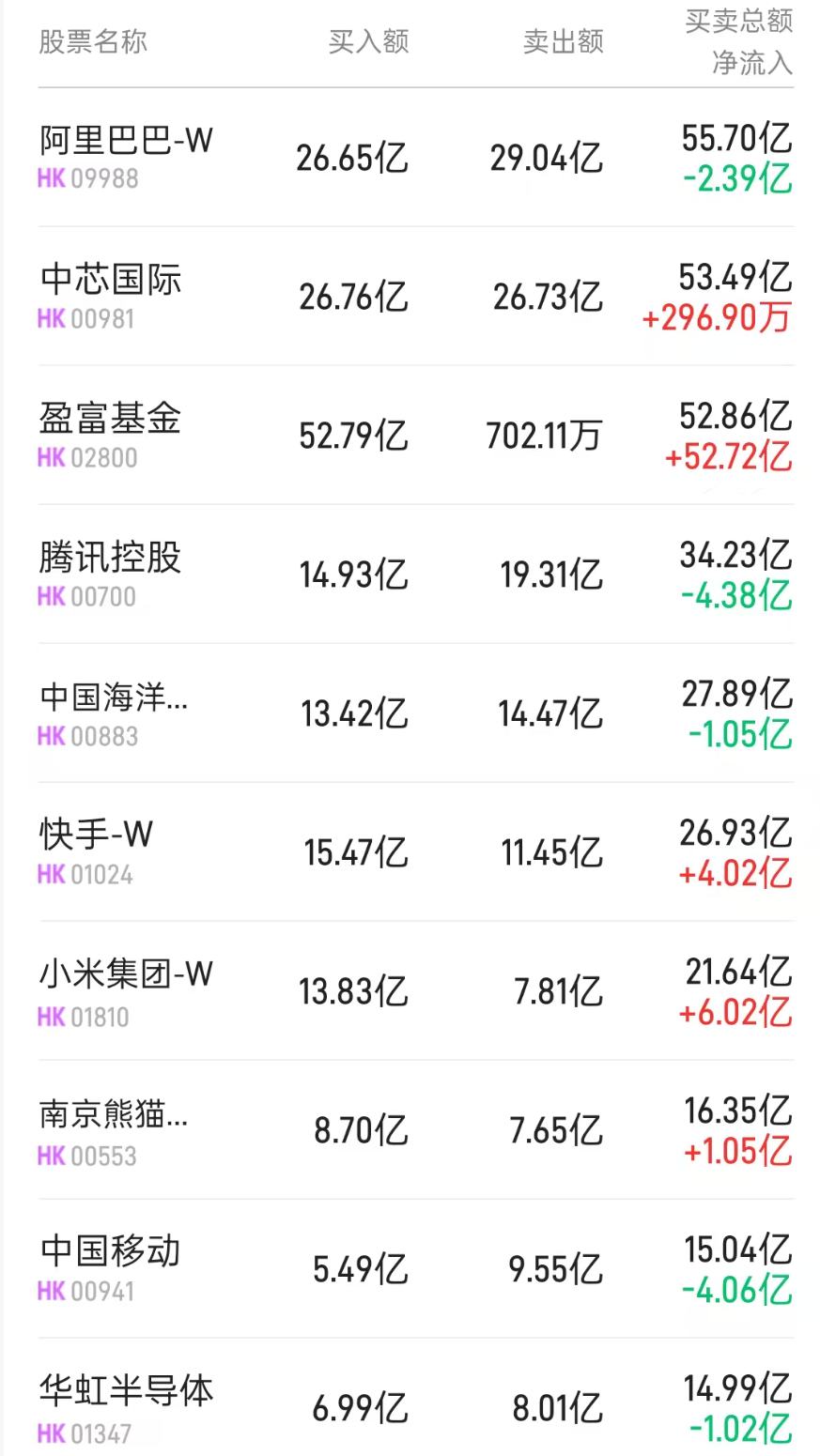
智通财经APP获悉,1月5日港股市场,北水成交净买入187.23亿港元,其中港股通(沪)成交净买入98.09亿港元,港股通(深)成 交净买入89.14亿港元。 北水净买入最多的个股是盈富基金(02800)、快手-W(01024)、小米集团-W(01810)。北水净卖出最多的个股是腾讯(00700)、中 国移动(00941)。 | 股票名称 | 买入额 | 卖出额 | 买卖总额 | | --- | --- | --- | --- | | | | | 净流入 | | 阿里巴巴-W HK 09988 | 26.65亿 | 29.04亿 | 55.70亿 | | | | | -2.39 亿 | | 中芯国际 | 26.76 乙 | 26.73亿 | 53.49 乙 | | HK 00981 | | | +296.90万 | | 盈富基金 | 52.79 乙 | 702.11万 | 52.86 亿 | | HK 02800 | | | +52.72 乙 | | 腾讯控股 | 14.93亿 | 19.31亿 | 34.23 乙 | | HK 00700 | | | -4.38 Z | | 中国海洋 ... | 13.42 ...
北水动向|北水成交净买入187.23亿 可灵玩法海外破圈 北水抢筹快手(01024)超15亿港元
智通财经网· 2026-01-05 10:03
智通财经APP获悉,1月5日港股市场,北水成交净买入187.23亿港元,其中港股通(沪)成交净买入98.09亿港元,港股通(深)成 交净买入89.14亿港元。 北水净买入最多的个股是盈富基金(02800)、快手-W(01024)、小米集团-W(01810)。北水净卖出最多的个股是腾讯(00700)、中 国移动(00941)。 | 股票名称 | 买入额 | 卖出额 | 买卖总额 | | --- | --- | --- | --- | | | | | 净流入 | | 阿里巴巴-W | 26.65亿 | 29.04亿 | 55.70亿 | | HK 09988 | | | -2.39 Z | | 中芯国际 | 26.76 乙 | 26.73亿 | 53.49 乙 | | HK 00981 | | | +296.90万 | | 盈富基金 | 52.79 乙 | 702.11万 | 52.86亿 | | HK 02800 | | | +52.72 乙 | | 腾讯控股 | 14.93亿 | 19.31 乙 | 34.23 亿 | | HK 00700 | | | -4.38 Z | | :洪映圖中 | 13.42 乙 ...
全线大涨!亚太股市爆发
证券时报· 2026-01-05 09:48
值得注意的是,今日A股市场近20股成交额超过100亿元,其中中国卫星、三花智控分别成交194.5亿元、192.1亿元,分别位居成交额第一 和第二位,且两股盘中均创出新高。 今日(1月5日),亚太主要股指全线大涨,日经225指数收盘上涨2.97%报51832.8点,韩国综合指数上涨3.43%报4457.52点,续创历 史新高。 A股市场迎来"开门红",主要股指放量大涨,沪指12连阳,涨超1%重返4000点上方;科创50指数大涨超4%。 具体来看,两市股指高开高走,创业板指涨近3%,科创50指数大涨超4%。截至收盘,沪指涨1.38%报4023.42点,深证成指涨2.24%,创 业板指涨2.85%,科创50指数涨4.4%,沪深北三市合计成交25674亿元。 保险板块强势 全A近4200股飘红,保险板块强势,新华保险大涨近9%,中国太保涨超7%,双双创出新高;人脑工程概念爆发,倍益康、三博脑科、翔宇 医疗、伟思医疗等逾10股涨停;创新药概念强势,乐普医疗、冠昊生物等涨停,百济神州涨超10%;存储芯片概念活跃,恒烁股份、普冉 股份等涨停;AI应用概念崛起,当虹科技、蓝色光标等涨停。此外,锋龙股份连续7日涨停,雷科防务、 ...