
BANK COMM(03328)

Search documents
交通银行发布2025年年终决算日大额支付系统运行时间公告
Jin Tou Wang· 2025-12-30 03:30
以上情况请您知悉,给您带来不便,敬请谅解。如有其他疑问,请致电交通银行全国统一客服热线 95559。 2025年12月29日,交通银行(601328)发布公告称,根据人民银行的有关要求,2025年12月31日人民银 行的大额支付系统业务受理截止时间为12月31日18:00,2026年1月3日20:30开始正常运行。大额系统关 闭期间,小额及网上支付跨行清算系统均正常运行。为确保资金及时到账,请合理安排您的汇款时间。 ...
交通银行“沃德财富万里行”全国巡演郑州站温暖启程,赋能中原财富管理新征程
Sou Hu Cai Jing· 2025-12-29 19:48
Core Insights - The event "Wode Wealth Nationwide Roadshow" was successfully held in Zhengzhou, gathering over 300 guests to discuss macro trends and investment opportunities [1] - The "Wode Wealth" brand, launched by the Bank of Communications in May 2006, has evolved from exclusive services to comprehensive wealth management solutions, including asset allocation, family trusts, cross-border finance, and tax planning [1][4] - The bank aims to deepen its wealth management business and enhance customer trust, especially in the current complex global economic environment [4] Brand Development - The "Wode Wealth" brand has served over 200 million individual customers and manages financial assets totaling nearly 60 trillion yuan [4] - The brand's development philosophy focuses on being customer-centric and adapting to market changes, collaborating with nearly 200 professional asset management institutions [4] Event Purpose - The "Wode Wealth Nationwide Roadshow" aims to increase residents' property income and stimulate consumption, marking an important step in the bank's wealth management business reform [5] - The event serves as a platform for professional financial services to assist in the growth of residents' property income and fulfill social responsibilities in financial education [5] Market Insights - The event featured two market experts who provided insights into the macroeconomic outlook for 2026, focusing on investment opportunities in gold, stock markets, and foreign exchange [8] - The analysis included a systematic review of the economic landscape and policy environment, offering key perspectives for investors [10] - The discussion also covered the impact of geopolitical factors and monetary policies on asset pricing, particularly for safe-haven assets like gold [12] Commitment to Clients - The wealth management team at the Bank of Communications comprises experts from various financial sectors, utilizing rigorous quantitative models to select quality assets for clients [13] - The bank emphasizes investor education and aims to create a rich non-financial ecosystem, including health services and cultural projects, to enhance the overall wealth management experience [13] - The "Wode Wealth Nationwide Roadshow" will continue with over 50 events across the country in the coming months, reinforcing the bank's commitment to wealth management and economic development [13][14]

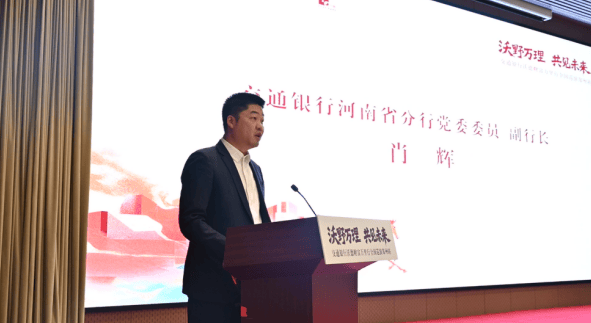
交通银行“沃德财富万里行”河南站活动举行
Shang Hai Zheng Quan Bao· 2025-12-29 19:06
"财富管理业务是增加居民财产性收入、提振消费、促进共同富裕的重要渠道。"交通银行河南省分行副 行长肖辉在致辞时称,交通银行始终秉持"以客户为中心"的服务理念,与广大客户携手同行,不仅是在 管理资产,更是在守护千万家庭的信任与托付。 肖辉表示,多年来,交通银行坚持践行金融工作的政治性和人民性,通过专业严选和贴心陪伴,打 造"金融+非金融"全场景服务生态。交通银行河南省分行精心筹备本次活动,旨在搭建一个智慧共享的 平台,以专业视野陪伴客户的财富旅程。 交通银行是财富管理行业的先行者,"沃德财富"品牌凝聚着百年交行的底蕴与智慧。据交通银行河南省 分行个金部产品与市场推广经理赵雅琦介绍,交通银行随时关注产品的运营以及机构的投资水平,同时 注重客户陪伴,在选择合作机构的时候,除了看投研能力、产品管理能力,也看重合作机构能否与交通 银行一起穿越周期,坚定地为客户做好服务,实现金融为民的初心。 "交通银行与合作机构携手,为超过2亿个人客户,管理着近6万亿元的金融资产,我们深知肩上承负的 信任与责任。"赵雅琦表示。 指引资产配置航向 ◎记者 马慜 近日,交通银行河南省分行携手德邦基金成功举办"沃野万理·共见未来——沃德财富万 ...
东海增裕债券型发起式证券投资基金基金份额发售公告
Shang Hai Zheng Quan Bao· 2025-12-29 18:29
Fund Overview - The fund is named Donghai Zengyu Bond Type Initiated Securities Investment Fund, with a minimum total subscription of 10 million units and a minimum fundraising amount of 10 million RMB [13][2]. - The fund is a contract-based open-end bond fund, with an indefinite duration [13][14]. Fund Management and Custody - The fund is managed by Donghai Fund Management Co., Ltd., and the custodian is Bank of Communications Co., Ltd. [1][46]. Fund Subscription Details - The fund will be publicly offered from January 6, 2026, to April 3, 2026, with a maximum fundraising period of three months [19][19]. - The minimum subscription amount for both initial and additional subscriptions is 1 RMB, including subscription fees [22][29]. Subscription Process - Investors must open a fund account with the management company to purchase the fund, and only one account per investor is allowed [6][30]. - Subscription applications must be fully paid, and any incomplete payments will be deemed invalid [20][22]. Fees and Interest Handling - The A-class fund shares will incur a subscription fee that decreases with the amount subscribed, while C-class shares do not have a subscription fee [22][24]. - Interest accrued on valid subscription funds during the fundraising period will be converted into corresponding fund shares for the investors [25][43]. Risk Management - The fund may face various risks, including market risk, credit risk, and liquidity risk, particularly due to its investment in securities and futures markets [5][7]. - The fund has specific provisions for managing large redemption requests through a side pocket mechanism [11][10]. Investor Eligibility - The fund is open to individual investors, institutional investors, qualified foreign institutional investors, and other investors permitted by laws and regulations [17][18]. Sales Channels - The fund will be sold through direct sales and other sales institutions, with specific details available in the fund's sales announcement [15][18].
交通银行南阳分行:以跨境人民币业务服务实体经济
Zheng Quan Ri Bao Zhi Sheng· 2025-12-29 17:13
Core Viewpoint - The Bank of Communications Nanyang Branch is focusing on serving the real economy and actively promoting the development of cross-border RMB business, fulfilling its responsibilities as a state-owned bank [1] Group 1: Business Development - The Nanyang Branch is expanding its cross-border RMB business through targeted strategies, including precise promotion and proactive engagement with key foreign-related enterprises [1] - As of the end of November, the cross-border RMB payment and receipt volume of the Nanyang Branch increased by 200 million yuan compared to the same period last year, significantly enhancing its market share [1] Group 2: Tailored Services - The Nanyang Branch provides refined services to meet the actual needs of enterprises "going out," such as addressing multi-currency financing demands and exchange rate fluctuation risks [1] - A local enterprise successfully financed 200 million yuan from overseas banks through the Nanyang Branch, which helped reduce financial costs and exchange rate risks, benefiting both the enterprise and the bank [1] Group 3: Future Outlook - The Nanyang Branch plans to continue promoting the deepening development of cross-border RMB business in the Nanyang region with an open attitude, innovative products, and efficient services [1]
与股份行争财富管理新蛋糕?国有行设财管部门 ,竞争力何在
Nan Fang Du Shi Bao· 2025-12-29 09:03
Core Insights - The establishment of wealth management departments by state-owned banks like Bank of Communications and Postal Savings Bank is a strategic response to the pressure of narrowing interest margins and the opportunity presented by the transformation of resident wealth [2][5][7] - Wealth management is seen as a crucial avenue for increasing residents' property income and boosting consumption, aligning with national economic priorities [3][6] Group 1: Bank Initiatives - Bank of Communications has launched a nationwide promotional project called "Wode Wealth Tour," marking the first market initiative following the establishment of its wealth management department [3] - As of June 2025, Bank of Communications reported a balance of 2,131.61 billion yuan in personal public fund products and 10,044.77 billion yuan in personal financial products [4] - Postal Savings Bank has also formed a wealth management department, transitioning from a product-selling model to a consulting approach, aiming to enhance its wealth management capabilities [6] Group 2: Market Context - The establishment of wealth management departments reflects a significant strategic shift in the banking sector, driven by a dual pressure of a persistent low-interest environment and the growing demand for diversified asset management due to aging populations [7][9] - Many joint-stock banks have already elevated wealth management from a retail segment to a core strategic focus, indicating a broader industry trend [7][8] Group 3: Competitive Advantages - State-owned banks possess unique advantages in wealth management, including a vast customer base, deep customer trust, and extensive physical branch networks, which provide a solid foundation for their wealth management services [9] - For instance, Postal Savings Bank reported having 670 million personal customers and nearly 40,000 branches, with retail assets under management (AUM) reaching 17.67 trillion yuan [9] Group 4: Challenges and Future Outlook - Despite their advantages, state-owned banks face challenges such as organizational inertia and the need to enhance professional capabilities to compete with top-tier investment firms [10] - The success of these banks in wealth management will depend on their ability to leverage their scale to develop refined customer management skills and competitive digital service experiences [10]


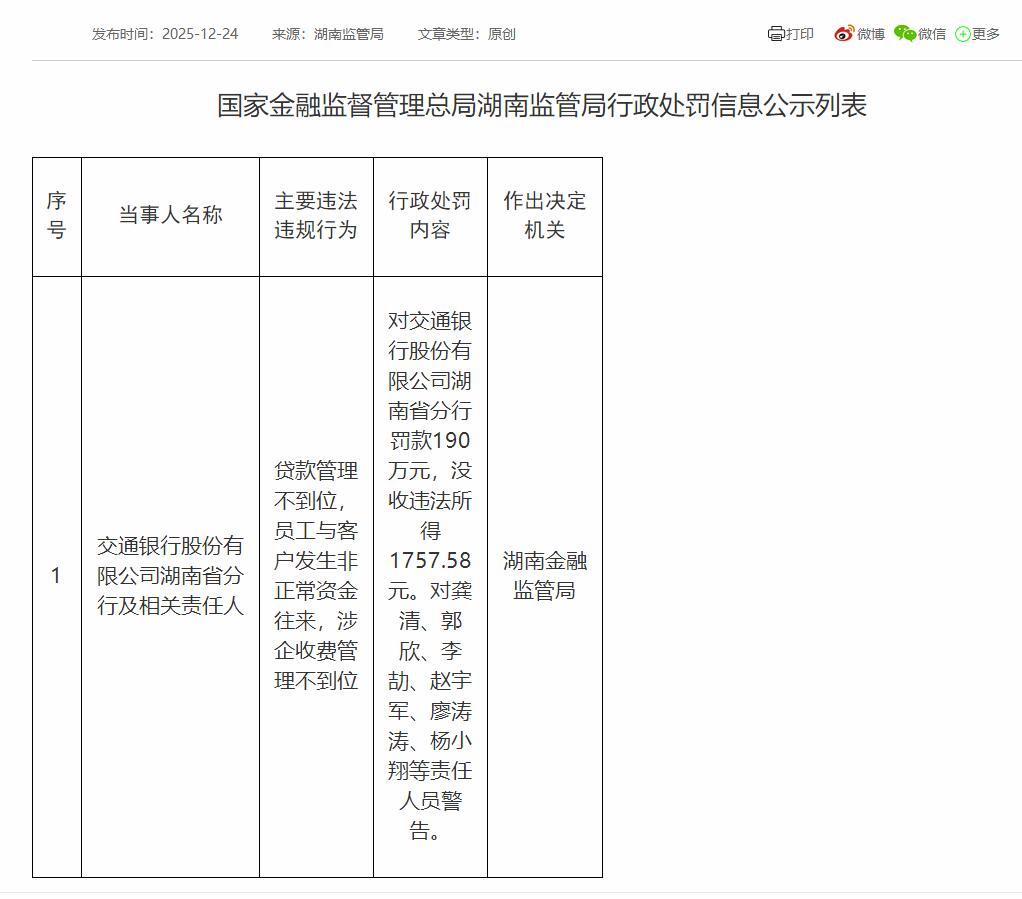
交通银行湖南省分行违规被罚190万 贷款管理不到位等
Zhong Guo Jing Ji Wang· 2025-12-29 07:48
Core Viewpoint - The Hunan branch of Bank of Communications has been penalized for inadequate loan management and improper financial dealings with clients, resulting in a fine of 1.9 million yuan and the confiscation of illegal gains amounting to 1,757.58 yuan [1] Summary by Categories Regulatory Actions - The Hunan Financial Regulatory Bureau imposed a fine of 1.9 million yuan on the Hunan branch of Bank of Communications for failing to manage loans properly and for employees engaging in abnormal financial transactions with clients [1] - The regulatory body also confiscated illegal gains of 1,757.58 yuan from the bank [1] Responsible Individuals - Warnings were issued to several individuals responsible for the violations, including Gong Qing, Guo Xin, Li Jie, Zhao Yujun, Liao Taotao, and Yang Xiaoxiang [1]
交通银行(03328) - 海外监管公告
2025-12-28 10:54
香港交易及結算所有限公司及香港聯合交易所有限公司對本公告之內容概不負責,對其準確性 或完整性亦不發表任何聲明,並明確表示,概不就因本公告全部或任何部分內容而產生或因倚 賴該等內容而引致之任何損失承擔任何責任。 公司秘書 (於中華人民共和國註冊成立的股份有限公司) (股份代號:03328) 海外監管公告 本公告乃根據香港聯合交易所有限公司證券上市規則第13.10B條而作出。 茲載列交通銀行股份有限公司於上海證券交易所網站刊登的《交通銀行股份有限 公司第十一屆董事會第四次會議決議公告》,謹供參閱。 承董事會命 交通銀行股份有限公司 何兆斌 中國上海 2025年12月28日 於本公告發佈之日,本行董事為任德奇先生、張寶江先生、殷久勇先生、 周萬阜先生、常保升先生*、廖宜建先生*、陳紹宗先生*、穆國新先生*、 艾棟先生*、石磊先生 # 、張向東先生 # 、李曉慧女士 # 、馬駿先生 # 、王天澤先生 # 及 肖偉先生 # 。 * 非執行董事 # 獨立非執行董事 股票代码:601328 股票简称:交通银行 编号:临 2025-080 交通银行股份有限公司 第十一届董事会第四次会议决议公告 交通银行股份有限公司(以下简称 ...
交通银行副行长、首席信息官钱斌:AI将从根本上重塑金融运行逻辑和发展范式
Zheng Quan Ri Bao Zhi Sheng· 2025-12-28 10:42
Core Viewpoint - The integration of AI technology in the financial industry is unprecedented, fundamentally reshaping the operational logic and development paradigm of finance [1] Group 1: AI Integration in Finance - The trend of "AI + Finance" is irreversible, and banks must adapt to the future of the intelligent economy by creatively applying new technologies and innovating products and services [1] - Banks should focus on three directions: building a strong technological foundation, leading applications, and innovating operational models to inject intelligent momentum into high-quality development [1] Group 2: Strategic Directions for AI Application - Strengthening infrastructure is crucial for promoting AI applications, requiring coordinated resource investment to solidify the foundation for cloud, data, intelligence, and blockchain [2] - AI technology should be applied at scale, targeting business pain points and focusing on high-value scenarios to create benchmark AI applications that serve the real economy [2] - A shift in mindset is necessary to innovate operational models, emphasizing customer-centric approaches and utilizing dynamic data to provide personalized services [2] Group 3: AI Governance and Talent Development - Strengthening AI governance is essential for ensuring safe, stable, and sustainable development in the financial sector [3] - It is important to combine technological transformation with institutional optimization, establishing suitable systems and mechanisms [3] - Developing a talent pool that combines business insight, technical understanding, and data thinking is critical for bridging the gap between business and technology [3] - The fundamental principle is that humans must remain the key decision-makers in AI applications, ensuring that technology enhances efficiency while maintaining the warmth and responsibility of financial services [3]
交行副行长钱斌:加快建立健全与数字化发展深度匹配的政策框架,为AI技术嵌入金融场景扫清机制障碍
Xin Lang Cai Jing· 2025-12-28 09:53
钱斌表示,信息系统是制度流程、规章细则的数字化反映,信息系统的底层逻辑是业务规则,如果没有 配套的流程机制的改革,再多的数据、再强的AI都无法发挥作用。因此,为了更好的适应线上化、移 动化、数字化的发展趋势,要系统推动现有的规章制度的动态迭代、考核机制的靶向优化、运营模式的 柔性升级,同步加快建立健全与数字化发展深度匹配的政策框架,为AI技术嵌入金融场景扫清机制障 碍,为创新实践塑造有利条件。此外,要持续升级组织能力,逐步探索工作方式向人机协同转型,按 照"一岗位一助手""一人一分身""一客一管家"的理念,强化业绩融合,推动从跨职能的专班,敏捷协同 到人+智能体的组织进化,持续锻造智能人工和超级数字员工,驱动数字技术研发模式的创新和效能的 提升,加速AI在各场景实现协同创新的突破。 12月28日,交通银行副行长、首席信息官钱斌在中国财富管理50人论坛2025年会上表示,人工智能是一 项系统性工程,需要以战略眼光强化AI治理,在体制机制层面主动变革,要关注人才队伍的培养,促 进长期可持续发展。 钱斌指出,要守牢底线,防范AI等新技术的风险。"人工智能时代的风险特征已经发生了根本性变化, 从手工时代的逐笔差错、机 ...