
BANK COMM(03328)

Search documents
交通银行安徽省分行:做好绿色金融大文章 助力安徽实体经济发展腾飞
Ren Min Wang· 2025-12-12 08:32
Group 1: Green Finance Initiatives - The Bank of Communications Anhui Branch focuses on green development, investing in key areas such as green infrastructure, new energy, ecological environment governance, and green consumption upgrades [1] - The Anhui Province has been promoting multimodal transport development to create a modern, safe, and efficient transportation system, exemplified by the Wuhu Tower Bridge multimodal transport base, which has a total investment of 7.18 billion and covers an area of 2,910 acres [2] - The Wuhu Tower Bridge multimodal transport base is set to become the largest and most comprehensive "road, rail, and water" multimodal transport hub in Anhui Province, enhancing regional economic development [2][3] Group 2: Support for Local Enterprises - The Huangshan Branch of the Bank of Communications is innovatively promoting the synergy between green finance and technology finance to support local specialty industries, such as the century-old Xie Yuda Tea Company, which has transitioned to modern production methods [4] - The bank tailored financial products for the tea company, including the "Sci-Tech Easy Loan" that offers large credit loans without collateral, and online mortgage loans to facilitate quick funding for equipment purchases and capacity expansion [5] Group 3: Environmental Protection Financing - The Bank of Communications Huaibei Branch is actively addressing ecological issues caused by over-extraction of groundwater by supporting a water source replacement project, which aims to convert industrial water sources to domestic use [6] - The bank established a dedicated team to streamline the approval process for the project, providing significant long-term credit support while ensuring risk management and compliance [7] - The Anhui Branch plans to deepen its green finance system, focusing on key areas such as the Yangtze River protection, clean energy development, and rural revitalization, to enhance financial support for various green projects [7]

交通银行“蕴通万里行”系列活动2025年圆满收官,打通金融服务实体经济的“最后一公里”
2 1 Shi Ji Jing Ji Bao Dao· 2025-12-12 06:49
Core Insights - The article emphasizes the role of financial services in driving high-quality development of the real economy, highlighting the initiatives of Bank of Communications (BoCom) in 2025 to enhance corporate financing and operational efficiency through innovative financial solutions [1] Group 1: Financial Services Initiatives - BoCom launched the "Yun Tong Treasury" brand service, offering a comprehensive financial service system tailored for central state-owned enterprises and large enterprises, which includes a combination of financial products and systems to enhance financial resource management [2] - The "Yun Tong Treasury Management System (Cloud Cross-Bank 3.0)" was introduced to expand financial management capabilities, enabling direct connections with over 220 domestic and international banks for improved cash management and decision-making [3] Group 2: Collaborative Financing Ecosystem - BoCom collaborates with local governments to create a financing ecosystem that combines policy support, credit enhancement, and data empowerment, exemplified by the "Jike Points Loan" initiative in Hebei, which uses innovation points for credit assessment [4] - The "Kechuang Cloud Guarantee Loan" was introduced in Yunnan, providing up to 10 million yuan in unsecured loans for qualified technology enterprises, thereby lowering financing barriers [4] Group 3: Scenario-Based Financial Innovation - BoCom developed the "Electric Grid Pass" comprehensive financial service plan to meet the financial needs of the electric power industry, which has been upgraded to "Electric Grid Pass 2.0" to include services for new energy charging stations [5][6] - The "Cloud Electric Quick Loan" was introduced to assess corporate vitality based on electricity consumption patterns, offering credit support to high-quality electricity-using enterprises [6] Group 4: Digital Tools and Efficiency Enhancement - BoCom launched the "Yun Tong Account Management" payment settlement solution to address common pain points in corporate financial management, providing integrated services for payment, reconciliation, and fund supervision [7] - The bank aims to create a digital financial ecosystem that integrates financial technology into various operational aspects of enterprises, facilitating deep collaboration between financial services and business operations [7]
交通银行“蕴通万里行”系列活动2025年圆满收官,打通金融服务实体经济的“最后一公里”
21世纪经济报道· 2025-12-12 06:46
Core Viewpoint - The article emphasizes the role of financial services in driving high-quality development of the real economy, highlighting the initiatives of the Bank of Communications (BoCom) to enhance corporate financing and operational efficiency through innovative financial solutions and deep collaboration with government and enterprises [1][11]. Group 1: Financial Services Initiatives - BoCom launched the "Yun Tong Treasury" brand service, offering a "1+3+N" smart treasury service system tailored for state-owned enterprises and large corporate groups, facilitating a comprehensive upgrade in financial resource management [2]. - The "Yun Tong Treasury Management System (Yun Kua Hang 3.0)" was introduced to enhance financial management capabilities, enabling direct connections with over 220 domestic and international banks for improved global account management and payment solutions [3]. Group 2: Collaborative Financing Ecosystem - BoCom collaborates with local governments to create a financing ecosystem that combines policy support, credit enhancement, and data empowerment, exemplified by the "Jike Points Loan" initiative in Hebei, which uses innovation points for credit assessment [5]. - The "Kechuang Cloud Guarantee Loan" was introduced in Yunnan, providing up to 10 million yuan in pure credit loans for qualified tech enterprises, thereby lowering financing barriers and supporting the expansion of tech finance [5]. Group 3: Scenario-based Financial Innovation - BoCom developed the "Electricity Network Pass" comprehensive financial service plan, addressing the financial needs of the electricity industry chain, and upgraded it to "Electricity Network Pass 2.0" to include services for new energy charging stations [7][8]. - The "Yun Dian Quick Loan" was created to assess corporate vitality based on electricity consumption patterns, offering credit support to high-quality electricity-using enterprises [8]. Group 4: Digital Tools and Efficiency Enhancement - The "Yun Tong Account Management" payment settlement solution was launched to address common pain points in corporate finance, providing flexible account and payment functionalities to enhance efficiency and security [10]. - BoCom aims to integrate financial technology into various operational aspects of enterprises, fostering a future-oriented digital financial ecosystem [10]. Group 5: Future Directions - BoCom plans to continue the "Yun Tong Wanli Xing" series of activities, focusing on resource allocation and financial integration to support regional high-quality development and modernization efforts in China [11].


三家国有行增资获监管批准!分析称有助于增强信贷投放能力
Nan Fang Du Shi Bao· 2025-12-12 06:09
国有大行资本补充迎来重要进展。近日,中国银行、建设银行和交通银行陆续发布变更注册资本事项获 得国家金融监督管理总局批复同意的公告。根据公告,三家银行注册资本分别增加278.25亿元人民币、 115.89元人民币和141.01亿元人民币。分析称,增加注册资本将提升大行服务实体经济能力,夯实抵御 风险的屏障。 三家国有行增加注册资本获批 12月4日,中国银行发布公告称,该行近日收到批复,国家金融监督管理总局同意该行注册资本增加 278.25亿元人民币,由2943.88亿元人民币变更为3222.12亿元人民币。 12月9日,建设银行发布公告称,该行收到批复,国家金融监督管理总局同意该行注册资本增加115.89 亿元人民币,由2500.11亿元人民币变更为2616.00亿元人民币。 2025年3月5日,国务院总理李强在政府工作报告中提出,拟发行特别国债5000亿元,支持国有大型商业 银行补充资本。 随后,中国银行、建设银行、交通银行、邮储银行均于3月30日发布公告,拟通过向特定对象发行A股 股票的形式,募集资金合计5200亿元,用于补充核心一级资本。其中,建设银行、中国银行的发行对象 均为财政部;交通银行的发行对象为 ...

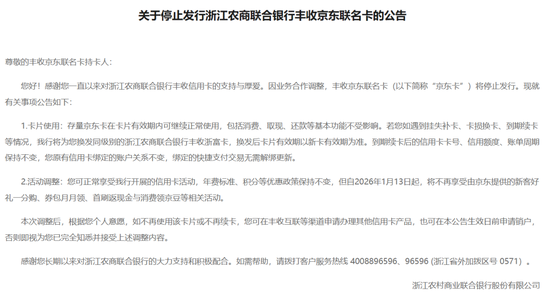
中小银行跟进“停卡潮” 信用卡行业驶入存量竞争新航道
Xin Lang Cai Jing· 2025-12-12 01:24
Core Viewpoint - The credit card market is undergoing significant adjustments, with many banks, especially smaller ones, halting the issuance of co-branded credit cards due to rising costs and risks associated with these products [1][5][6]. Group 1: Market Trends - The trend of halting credit card issuance is not isolated, as it has become a common practice among both national and regional banks throughout the year [1][6]. - Major banks, including China Construction Bank and Postal Savings Bank, have collectively stopped issuing over 100 credit card products since the beginning of 2025, with co-branded cards being a significant portion of these [6][11]. - The total number of credit cards in circulation has decreased by 100 million over the past three years, indicating a shift away from the previous era of aggressive expansion [10][11]. Group 2: Bank Strategies - Banks are transitioning from a focus on quantity to quality in their credit card offerings, prompted by regulatory changes and market dynamics [11][12]. - The recent adjustments include the closure of credit card centers and the integration of credit card functionalities into main banking apps, reflecting a strategic shift towards efficiency and cost reduction [14][15]. - The halting of co-branded cards is seen as a necessary step for banks to concentrate resources on more viable products and improve operational efficiency [8][9]. Group 3: Future Directions - The future of credit card business is expected to focus on three main transformation directions: integrating various service scenarios, upgrading technology for better digital experiences, and deepening customer segmentation to enhance value creation [16].




数智引擎驱动未来 以“AI+”重塑金融服务新范式
Jing Ji Ri Bao· 2025-12-11 22:05
Core Viewpoint - The article emphasizes the significant role of artificial intelligence (AI) in the digital transformation of the banking industry, particularly highlighting the efforts of Bank of Communications (BoCom) in leveraging technology for high-quality development [1]. Group 1: Digital Transformation Strategy - BoCom has positioned digital transformation as a crucial breakthrough for achieving high-quality development, with a focus on enhancing technological leadership and value creation [1]. - The bank has implemented a comprehensive digital financial development plan and an "AI+" action plan, reflecting its commitment to building a robust digital foundation [2]. - Over the past three years, BoCom's technology investment has consistently accounted for over 5% of its operating income, with its fintech talent pool growing from approximately 4,000 to nearly 10,000, representing nearly 10% of the workforce [2]. Group 2: AI Core Capability Development - BoCom is accelerating the construction of a "super brain" through its "AI+" strategy, establishing a framework that includes a trillion-level financial model algorithm matrix [3]. - This "intelligent hub" has developed hundreds of application scenarios and digital employees across various fields, transforming human labor into value creation [3]. Group 3: Data Utilization and Innovation - The bank has built an enterprise-level data service system that connects with national platforms and local data institutions, facilitating the flow and application of data for decision-making [4]. - BoCom has pioneered a data asset financing platform in Shenzhen, successfully implementing a project that capitalizes on data knowledge rights, which won the first prize at the 2024 Web3.0 Innovation Competition [4]. Group 4: Business Empowerment through Technology - BoCom is integrating its digital capabilities into core business areas such as technology innovation, cross-border finance, and supply chain services, driving high-quality business development [5]. - The bank's mobile banking platform has over 53 million monthly active users, expanding its service reach [5]. - In the technology finance sector, BoCom has supported over 60,000 tech enterprises with loans, with the balance of technology loans exceeding 1.5 trillion yuan [5][6]. Group 5: Innovative Practices and Recognition - BoCom's Qingdao branch has developed an industrial internet financial service platform that enhances financing efficiency and has received multiple awards for its innovative approach [6]. - The bank's systematic approach to digital finance development is evident from its foundational investments to business empowerment, showcasing its commitment to high-quality growth [6].
交通银行股份有限公司关于变更注册资本的公告
Shang Hai Zheng Quan Bao· 2025-12-11 19:12
本行在完成向特定对象发行14,101,057,578股A股股票后,就变更注册资本事项向国家金融监督管理总局 提出了申请。 近日,本行收到《国家金融监督管理总局关于交通银行变更注册资本的批复》(金复〔2025〕703 号),国家金融监督管理总局同意本行注册资本增加14,101,057,578元人民币,由74,262,726,645元人民 币变更为88,363,784,223元人民币。本行根据批复修订了公司章程相应条款,修订后的《公司章程》全 文请参见上海证券交易所网站(www.sse.com.cn)和本行网站(www.bankcomm.com)。本行随后将办 理注册资本变更登记等相关手续。 特此公告 股票代码:601328 股票简称:交通银行 编号:临2025-076 交通银行股份有限公司 关于变更注册资本的公告 交通银行股份有限公司(以下简称"交通银行"或"本行")董事会及全体董事保证本公告内容不存在任何 虚假记载、误导性陈述或者重大遗漏,并对其内容的真实性、准确性和完整性承担法律责任。 交通银行股份有限公司董事会 2025年12月11日 ...
交通银行“云跨行3.0”:“重构时间”,赋能企业财资管理数智跃迁
凤凰网财经· 2025-12-11 14:47
Core Viewpoint - The article emphasizes the transformation of China's manufacturing industry towards high-quality development, focusing on the competition of "time and efficiency" in the global supply chain restructuring. The shift from a "demographic dividend" to an "efficiency dividend" is highlighted, where financial flows, information flows, and credit flows are crucial for gaining a competitive edge in the market [1]. Group 1: Reconstruction of "Settlement Time" - The launch of "Yun Kuan Hang 3.0" aims to revolutionize payment processes, reducing international remittance times from 1-3 working days to seconds, addressing the pain points of high costs and inefficiencies in traditional cross-border payments [2]. - The system integrates various channels like bank-enterprise direct connections and SWIFT, allowing seamless connections with over 220 domestic and international banks, providing a one-stop global cash management service [2]. Group 2: Reconstruction of "Management Time" - The article discusses the challenges in financial management, such as manual operations and long reconciliation cycles, which hinder efficiency. For instance, a provincial state-owned enterprise has over 600 bank accounts with a direct connection coverage of less than 40% [5]. - The "1+3+N" smart treasury service system offers customized solutions for large group clients, enabling seamless coordination of domestic and international operations through a comprehensive treasury platform [5][6]. Group 3: Reconstruction of "Decision Time" - Traditional financial management relies on outdated data, leading to delayed decision-making. "Yun Kuan Hang 3.0" provides a dynamic visual dashboard for real-time cash flow forecasting and risk monitoring, enhancing decision-making capabilities [7][8]. - The system supports a complete feedback loop for decision-making, transforming financial management from a cost center to a core value creation component for enterprises [8]. Group 4: Reconstruction of "Ecological Time" - The article highlights the importance of ecosystem collaboration in the digital economy, moving from isolated efficiency improvements to chain acceleration through collaborative networks involving enterprises, supply chains, banks, and ecosystem partners [9][10]. - "Yun Kuan Hang 3.0" facilitates real-time collaboration across the supply chain, providing efficient financing support to smaller enterprises and enhancing overall funding turnover efficiency [10][11]. Group 5: National Responsibility and Financial Productivity - The system's capabilities stem from Traffic Bank's continuous investment in financial technology, with "Yun Kuan Hang 3.0" being fully self-developed and equipped with proprietary intellectual property [12]. - The system aligns with national strategies, enhancing industrial chain efficiency and supporting the dual circulation development pattern by providing secure and efficient global funding channels for enterprises [12][13].

交通银行(601328)披露关于变更注册资本的公告,12月11日股价上涨0.68%
Sou Hu Cai Jing· 2025-12-11 14:19
截至2025年12月11日收盘,交通银行(601328)报收于7.36元,较前一交易日上涨0.68%,最新总市值 为6503.57亿元。该股当日开盘7.32元,最高7.36元,最低7.29元,成交额达8.62亿元,换手率为0.45%。 最新公告列表 以上内容为证券之星据公开信息整理,由AI算法生成(网信算备310104345710301240019号),不构成 投资建议。 《交通银行股份有限公司章程》 《交通银行关于变更注册资本的公告》 近日,交通银行发布关于变更注册资本的公告。公告显示,交通银行在完成向特定对象发行 14,101,057,578股A股股票后,向国家金融监督管理总局申请变更注册资本。该局已批复同意交通银行注 册资本增加14,101,057,578元人民币,由74,262,726,645元人民币变更为88,363,784,223元人民币。交通银 行已根据批复修订公司章程相应条款,后续将办理注册资本变更登记等相关手续。 ...
华资实业:关于控股股东部分股份质押的公告
Zheng Quan Ri Bao Zhi Sheng· 2025-12-11 12:40
证券日报网讯 12月11日晚间,华资实业发布公告称,控股股东盛泰创发本次质押股份72,497,015 股,占其持股数量50.00%,占公司总股本14.95%,用于担保中裕科技向交通银行滨州分行的融资。 (编辑 丛可心) ...
