
CM BANK(03968)

Search documents
港股红利资产成资金“避风港”
Zhong Guo Zheng Quan Bao· 2025-05-18 21:27
Group 1 - The Hong Kong stock market has been active this year, with a low interest rate environment attracting risk-averse funds into high dividend sectors such as finance, energy, utilities, and real estate, resulting in over 130 billion HKD net inflow into these sectors from southbound funds in the past three months [1][2] - The total scale of domestic Hong Kong dividend-themed ETFs has rapidly increased from less than 30 billion to over 42 billion HKD, with net inflows of approximately 10 billion HKD [2] - Insurance funds have frequently increased their stakes in high dividend Hong Kong stocks, indicating a strong preference for dividend-yielding assets among long-term investors [3] Group 2 - Insurance funds have made over ten significant purchases of Hong Kong stocks this year, primarily in sectors like banking, utilities, and non-bank financials, with a focus on high dividend characteristics [3] - The preference for Hong Kong stocks by insurance funds is attributed to their attractive discount rates and dividend yields, along with tax benefits for long-term holdings [3] - The demand for dividend assets is expected to remain strong due to the continuous growth in insurance premium income and the pursuit of absolute returns by institutions [3] Group 3 - Southbound funds have also shown significant interest in new consumption and technology sectors, with net purchases of Alibaba exceeding 70 billion HKD and substantial investments in Meituan and Tencent [4] - The top three Hong Kong-themed ETFs have collectively attracted over 40 billion HKD in net inflows this year, indicating a strong market interest [4] - The Hong Kong market is seen as a leader in the current asset revaluation trend in China, with expectations of continued inflows from southbound funds [4] Group 4 - A "barbell" investment strategy is recommended, balancing high-growth technology and new economy sectors with stable dividend-yielding assets to mitigate external volatility [5] - The focus on sectors benefiting from domestic policy support and economic transformation is emphasized, alongside attention to cyclical sectors related to domestic demand [5]

奋发有为 闪耀今“招”——招商银行南昌分行27周年发展纪实
Zhong Guo Jin Rong Xin Xi Wang· 2025-05-18 02:40
Core Viewpoint - The article highlights the achievements and strategic initiatives of China Merchants Bank Nanchang Branch in supporting the economic development of Jiangxi province through various financial services and products. Group 1: Financial Contributions and Growth - Since its establishment in May 1998, the bank has invested over 920 billion yuan in credit funds in Jiangxi and contributed over 7 billion yuan in taxes [1] - As of April 2025, the bank's asset scale exceeded 140 billion yuan, ranking first among local joint-stock banks in terms of deposit and loan scale, serving 4.29 million personal clients and 68,000 corporate clients [1] Group 2: Support for Key Industries - In 2024, the bank provided nearly 13 billion yuan in loans to 12 key industrial chains in Jiangxi, with a year-on-year increase of 18.67% in loan balances for five major industries: non-ferrous metals, electronic information, equipment manufacturing, new energy, and pharmaceuticals [2] Group 3: Financial Services for the Real Economy - The bank has established a specialized working group to implement a series of action plans aimed at integrating financial services with the modernization of the industrial system in Jiangxi [3] - It has developed a comprehensive financial service system for technology enterprises, introducing standardized financing products such as "Science and Innovation Loan" and "Government Procurement Loan," serving over 3,200 technology companies [3] Group 4: Green Finance Initiatives - The bank has set up green finance promotion areas in 44 outlets and issued over 3.2 billion yuan in green loans in 2024, supporting the green transformation of the manufacturing industry [4] - It promotes innovative products like "Green Energy Insurance" to provide financial services for renewable energy companies [4] Group 5: Inclusive Finance Efforts - The bank has launched a new operating model for inclusive finance, enhancing service coverage for small and micro enterprises, with over 25,000 clients benefiting from inclusive loans [4] - In 2024, the average pricing of newly issued inclusive loans decreased by over 52 basis points compared to the previous year [4] Group 6: Pension and Elderly Services - The bank provides pension services to over 40 enterprises and has established a one-stop online service area for personal pensions, serving over 200,000 residents [5] - It enhances the online experience for elderly clients and optimizes offline services using portable smart devices [5] Group 7: Digital Finance Strategy - The bank actively implements a digital finance strategy, serving nearly 13,000 enterprises through the "Salary Welfare" platform and over 140 enterprises through the "E-Catering" platform [6] - It has integrated tax data with the Jiangxi Provincial Taxation Bureau to enhance the efficiency of financial services for the real economy [6]
险资巨头,又举牌!
Zhong Guo Ji Jin Bao· 2025-05-16 07:00
Core Viewpoint - Ping An Life has significantly increased its holdings in two banks, Agricultural Bank of China and Postal Savings Bank of China, triggering mandatory disclosures due to reaching 10% ownership in both banks [1][3][4]. Group 1: Investment Activities - On May 12, Ping An Life increased its holdings in Agricultural Bank of China H-shares by 147 million shares, raising its total to 3.191 billion shares, which is 10.38% of the bank's H-share capital [3]. - On May 9, Ping An Life acquired an additional 23.29 million shares of Postal Savings Bank, increasing its total holdings to 1.997 billion shares, representing 10.05% of the bank's H-share capital [3]. - This marks the second time in 2023 that Ping An Life has triggered mandatory disclosures for both Agricultural Bank and Postal Savings Bank [4]. Group 2: Market Context - The trend of insurance capital increasing investments in bank stocks is notable, with insurance companies having made 15 mandatory disclosures this year, 8 of which were related to bank stocks [7]. - The total number of bank shares held by insurance capital reached 27.821 billion shares, with a combined market value of 265.78 billion yuan, making it the largest sector for insurance holdings [7]. - Analysts suggest that the frequent purchases of state-owned banks by insurance companies are driven by factors such as dividend yield, tax advantages, and regulatory requirements [7]. Group 3: Financial Position - As of September 30, 2024, Ping An Life's equity assets amounted to 961.1 billion yuan, accounting for 20.96% of its total assets of 48,258.96 billion yuan [5]. - The net assets of Ping An Life were reported at 317.613 billion yuan, with a comprehensive solvency adequacy ratio of 200.45% [5]. Group 4: Strategic Implications - The stability and high dividend yield of bank stocks are seen as beneficial for insurance companies to match their asset-liability profiles and mitigate profit volatility under new accounting standards [8]. - Future collaborations between insurance companies and banks are expected to strengthen as several banks modify their governance structures, potentially altering board compositions [7].



我为什么弃用了用十六年的招商银行信用卡
Xin Lang Cai Jing· 2025-05-16 02:33
Core Viewpoint - The article emphasizes the importance of genuine service experience over standardized processes, highlighting that efficiency blind spots can lead to a complete breakdown of trust between service providers and customers [2][11]. Group 1: Service Experience - The company previously had a long-term relationship with a bank, relying on its credit card for various payments, but faced issues when a new card was issued without prior consent, leading to frustration and a loss of trust [3][4][9]. - The customer service experience was described as overly standardized and lacking in genuine problem-solving, which ultimately resulted in the decision to discontinue using the bank's services [10][11]. Group 2: Efficiency Blind Spots - Efficiency blind spots are defined as situations where service processes are efficient but fail to provide customers with a sense of resolution or closure [12][11]. - The article argues that many service companies mistake visible actions for actual customer satisfaction, leading to a disconnect between service delivery and customer expectations [16][18]. Group 3: Service Improvement Strategies - To address service failures, companies should focus on reconstructing service motivations rather than merely optimizing processes [22]. - A shift from a "patchwork logic" to a "delivery logic" is necessary, where service is seen as a collaborative effort to build trust rather than just a reactive measure to customer complaints [27][28]. Group 4: Final Thoughts - The decision to abandon the bank was not solely based on a single negative experience but rather on the realization that the standardized service process did not equate to a genuine service experience [30].
港股概念追踪|公募基金改革方案发布 机构重视基金改革下银行配置新逻辑(附概念股)
智通财经网· 2025-05-16 01:15
近段时间,金融板块整体表现亮眼,成为市场关注的焦点。 Wind 资讯数据显示,截至 5 月 15 日收盘,Wind 银行行业指数报 7072.61 点,创历史新高。 而前一日,银行、保险、券商等板块齐发力,带动上证指数站上 3400 点,提振了市场情绪。在此背景 下,金融板块后续配置价值如何,成为投资者的关注点。 在业内人士看来,中国人民银行降准降息、公募基金改革方案发布、险资权益投资力度持续加大等积极 因素叠加,有望为包括银行板块在内的金融板块带来增配机遇,推动更多资金流入。 华泰证券认为公募改革落地有望驱动银行板块估值。 智通财经APP获悉,证监会最近发布《推动公募基金高质量发展行动方案》,显著强化业绩比较基准约 束力,预计未来基金配置或向业绩基准靠拢。2025 年一季度主动权益深度欠配银行,较沪深 300 偏离 度近 10pct,改革驱动下或有较大增配空间。近期一揽子政策落地,驱动经济修复。华泰证券最新研报 认为,被动基金持续扩容,险资加速入市,增量资金持续流入可期,有望进一步支撑板块行情。个股关 注:1)2025 年一季度公募低配的股份行;2)稳健大行仍有配置价值;3)质优个股。 内银相关港股企业: ...
银行周报(0505-0511):增量政策稳定预期,板块配置价值凸显
Tai Ping Yang· 2025-05-16 01:15
Investment Rating - The overall industry investment rating is "Positive" for state-owned banks, joint-stock banks, and regional banks [3][40]. Core Views - Incremental policies are stabilizing market expectations, enhancing the allocation value of the banking sector. The banking sector remains attractive as a dividend asset under a moderately loose monetary policy environment [5][36]. - Recommended stocks include: CITIC Bank (Increase), China Merchants Bank (Buy), Chongqing Bank (Increase), and Yunnan Rural Commercial Bank (Buy) [3][38]. Market Review - The Shanghai Composite Index and CSI 300 Index saw weekly changes of 1.92% and 2.00%, respectively. The Shenwan Banking Index increased by 3.88%, outperforming the CSI 300 by 1.88 percentage points, ranking 4th among Shenwan's primary industries [12][11]. - The performance of various banking sectors was as follows: state-owned banks increased by 1.75%, joint-stock banks by 5.33%, city commercial banks by 3.80%, and rural commercial banks by 3.47% [12][11]. Data Tracking - As of May 9, 2025, the banking sector's PB-LF valuation was 0.67 times, at the 74.10 percentile level over the past five years. The median dividend yield for individual stocks was 4.53%, exceeding the 10-year government bond yield by 2.90 percentage points [4][21]. - The total social financing stock was 424 trillion yuan, with a year-on-year increase of 8.70%. The loan and deposit balances of Chinese banks were 258.36 trillion yuan and 293.94 trillion yuan, respectively, with year-on-year increases of 7.73% and 7.99% [4][34]. Industry Dynamics - The People's Bank of China released the "2025 Q1 Monetary Policy Implementation Report," emphasizing the need for macroeconomic stability and the implementation of moderately loose monetary policies to support economic recovery [33][35]. - A comprehensive financial policy package was announced by the People's Bank of China, the Financial Regulatory Administration, and the Securities Regulatory Commission to stabilize the market and expectations, providing strong financial support for economic recovery [36][37].


数据生态建设需秉持长期主义思维
Zheng Quan Shi Bao· 2025-05-15 19:25
Core Viewpoint - The digital transformation of commercial banks has entered a critical phase, with a focus on accelerating the layout of data assets while maintaining a long-term strategic vision [1][4]. Group 1: Data Asset Development - Various financial institutions, including state-owned and joint-stock banks, are actively exploring the inclusion of data assets in their annual reports and are showing a preference for talent recruitment in this area [1]. - The value of core data, such as transaction and credit assessment data, has surpassed mere business support and is now a strategic asset that will determine the future competitiveness of commercial banks [1]. Group 2: Building a High-Quality Data Ecosystem - Building a high-quality data ecosystem requires continuous efforts in three dimensions: governance system investment, forward-looking technology architecture, and systematic talent development [2][3]. - Data governance is an ongoing process that requires continuous optimization rather than a one-time project [3]. - New technologies like distributed databases, privacy computing, and blockchain are reshaping data infrastructure, and banks should align with these technological trends to build flexible and scalable data platforms [3]. - There is a need for a talent mechanism that combines recruitment and development to attract scarce composite talents who understand both financial business and data technology [3]. Group 3: Challenges and Strategic Focus - Commercial banks face several challenges in building their data ecosystems, including valuation difficulties due to the lack of recognized data asset pricing methods, compliance risks in balancing data utilization and privacy protection, and long investment cycles that may take 3 to 5 years to yield significant benefits [3]. - Maintaining strategic focus and establishing comprehensive internal control processes and assessment mechanisms are essential for banks to navigate these challenges [3]. Group 4: Future Outlook - The digital transformation wave is expected to lead to a new round of differentiation in the banking industry based on data capabilities, with banks that excel in data capabilities gaining advantages in customer service, risk control, and operational efficiency [4]. - The true winners in the data asset monetization race will be those innovators who continuously improve their data ecosystems with a long-term perspective, rather than mere followers [4]. - Balancing innovation and risk management, as well as establishing sustainable data business models, will be ongoing challenges for the banking industry [4].

1.7折起!信用卡现金分期利率低过消费贷,你会用吗?
Xin Lang Cai Jing· 2025-05-15 15:14
Core Viewpoint - Several banks have adjusted consumer loan interest rates, ceasing discounts below 3%, while simultaneously offering promotional rates for credit card cash installment services, indicating a shift in strategy towards more refined customer management in credit card operations [1][5]. Group 1: Credit Card Cash Installment Promotions - Banks like China Merchants Bank and Bank of Communications are offering significant discounts on cash installment rates, with annualized rates as low as 2.76% and 5.49% for specific terms [2][3]. - Credit card cash installment services allow banks to provide cash credit directly to customers' designated accounts, with flexible repayment options and generally do not occupy credit card limits [3][4]. Group 2: Market Trends and Regulatory Environment - The People's Bank of China has emphasized the need for financial institutions to support consumer loans, which may lead to increased competition in the retail loan market [5][6]. - The credit card market is transitioning from a phase of broad expansion to one of meticulous management, with a decline in the issuance of new cards due to market saturation and stricter regulations [6][7]. Group 3: Industry Challenges and Future Outlook - The proportion of credit card loans in retail lending has decreased from 13.09% in 2022 to 12.54% in 2024, while personal business and consumer loans have seen an increase [6][7]. - Industry experts suggest that the focus should shift towards retaining valuable customers and leveraging technology and risk management to ensure sustainable growth in the credit card sector [7].

招商银行迎一“70后”副行长:30年老将雷财华任职获批
Nan Fang Du Shi Bao· 2025-05-15 11:19
Core Viewpoint - The appointment of Lei Caihua as the vice president of China Merchants Bank has been approved, marking a significant leadership change within the bank [2] Group 1: Leadership Changes - Lei Caihua, born in September 1974, is the youngest member of the current leadership team at China Merchants Bank, having joined the bank in 1995 and accumulated 30 years of experience [3] - Lei's previous roles include positions such as general manager of various departments and branch manager, culminating in his recent appointment as vice president in December last year [3][5] - Xu Mingjie, who also joined the bank in 1995, has been appointed as vice president pending regulatory approval, which would create a leadership structure of one president and six vice presidents [5] Group 2: Financial Performance - In the first quarter, China Merchants Bank reported revenue of 83.751 billion yuan, a year-on-year decrease of 3.09%, and a net profit attributable to shareholders of 37.286 billion yuan, down 2.08% [5] - Despite the decline in revenue and profit, the bank maintains a leading position in the industry [5] - The bank's asset quality remains strong, with a non-performing loan ratio of 0.94%, the only national joint-stock bank with a ratio below 1%, and a provision coverage ratio of 410.03%, leading among joint-stock banks [5]

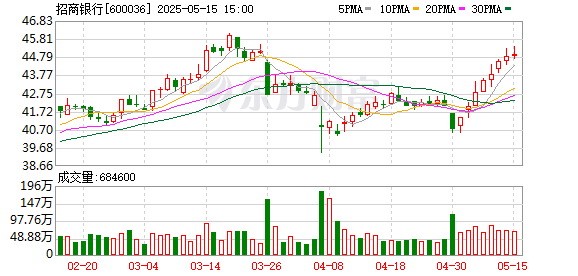
招商银行(600036) - 招商银行股份有限公司关于副行长任职资格核准的公告
2025-05-15 10:00
A 股简称:招商银行 A 股代码:600036 公告编号:2025-023 招商银行股份有限公司 关于副行长任职资格核准的公告 本公司董事会及全体董事保证本公告内容不存在任何虚假记载、误导性陈述或者 重大遗漏,并对其内容的真实性、准确性和完整性承担法律责任。 招商银行股份有限公司(简称本公司或招商银行)收到《国家金融 监督管理总局关于雷财华招商银行副行长任职资格的批复》(金复〔2025〕 298号)。根据上述批复,雷财华先生招商银行副行长的任职资格已获得 核准。 雷财华先生担任本公司副行长的任期自核准日2025年5月13日起生 效,至本公司第十二届董事会届满之日止。雷财华先生的简历及相关信 息请参阅本公司刊登在上海证券交易所网站(www.sse.com.cn)和本公 司网站(www.cmbchina.com)的2024年度报告。 特此公告。 招商银行股份有限公司董事会 2025 年 5 月 15 日 ...