BABA(09988)

Search documents
港股收盘,恒指收涨0.28%,科指收跌0.69%,科网股高开低走,京东健康(06618.HK)跌6.2%,阿里巴巴(09988.HK)跌2.8%,美团(...
Jin Rong Jie· 2026-03-05 08:30
Group 1 - The Hang Seng Index closed up 0.28%, while the Tech Index fell by 0.69% [1] - Tech stocks experienced a volatile session, with JD Health (06618.HK) dropping by 6.2% and Alibaba (09988.HK) declining by 2.8% [1] - Other major tech companies such as Meituan (03690.HK), JD.com (09618.HK), and NetEase (09999.HK) also saw declines of over 1% [1]




谷歌DeepMind向千问团队抛橄榄枝
第一财经· 2026-03-05 07:08
Group 1 - Google DeepMind's Omar Sanseviero invited Qwen's team to collaborate on building models and contributing to the open model ecosystem, indicating an exciting development roadmap ahead [1] - Alibaba approved the resignation of Lin Junyang from the Tongyi Laboratory, signaling potential changes within the company's research and development structure [1]



林俊旸,只恨不是梁文锋
投中网· 2026-03-05 06:49
Core Viewpoint - The departure of Lin Junyang, the core leader of Alibaba's Qwen series model, highlights a strategic shift within Alibaba, focusing on commercial viability over open-source development [5][7][14]. Group 1: Departure and Strategic Changes - Lin Junyang's resignation is attributed to internal conflicts regarding strategic direction, particularly the shift towards a more commercialized approach for Qwen [6][10]. - Alibaba's restructuring aims to enhance talent acquisition and resource allocation, indicating a move to integrate model development with commercial objectives [6][11]. - The internal communication suggests that Qwen is now viewed as a critical asset for the entire group, not just the model team, leading to a potential reduction in Lin's management authority [6][10]. Group 2: Industry Context and Competitive Landscape - The AI model industry in China is experiencing intense competition, with major players like Baidu, Tencent, ByteDance, and Alibaba all vying for market share [8][11]. - The shift towards closed-source models for commercial efficiency contrasts with Lin's vision of maintaining an open-source approach, which has been pivotal for Qwen's initial success [7][9]. - The competitive landscape has evolved, with a focus on user acquisition and revenue generation becoming paramount, as evidenced by the significant investments in AI by leading firms [11][14]. Group 3: Implications for Qwen and Alibaba - Lin's departure may disrupt the technical development pace of Qwen, potentially hindering Alibaba's position in the core technology of large models [14]. - The ongoing tension between research and commercialization reflects a broader industry trend where technical teams must align with business strategies to ensure survival and growth [12][15]. - Alibaba's decision to prioritize commercial outcomes over pure technical innovation may lead to a reevaluation of its long-term strategy in the AI sector [14][15].
模型砍掉一大半,准确率反升15%!华科&阿里安全新研究实现ViT近乎无损的类特定压缩|ICLR'26
量子位· 2026-03-05 06:33
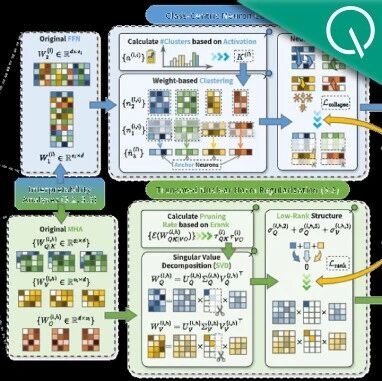
Core Viewpoint - The article emphasizes the limitations of large, general-purpose visual models in real-world applications, advocating for smaller, specialized models that are more efficient and better suited for specific tasks [1][2]. Group 1: Limitations of Large Models - Large visual models, while powerful, have high computational costs and are not optimal for deployment in resource-constrained environments [1][4]. - Many applications only require a focus on a few key target categories, making the extensive knowledge in general models unnecessary and counterproductive [1][8]. Group 2: Advantages of Customized Models - Customized models, described as "small and specialized," align better with practical needs, reducing deployment costs and enhancing long-term operational stability [2]. - The new paradigm proposed by Huazhong University of Science and Technology and Alibaba, named Vulcan, allows for the derivation of specialized models from general ones, focusing on key target categories while minimizing knowledge loss [3]. Group 3: Methodology of Vulcan - Vulcan introduces a "train-then-prune" approach, which is a departure from traditional methods that prune first and then train, thus preserving critical information related to target categories [3][13]. - The methodology includes two main components: Class-Centric Neuron Collapse (CCNC) and Truncated Nuclear Norm Regularization (TNNR), which work together to refine the model's focus on relevant information [15][16]. Group 4: Experimental Results - The Vulcan-derived models demonstrated a significant accuracy improvement of up to 15.12% on ImageNet tasks while reducing the model size to 20%-40% of the original [19]. - In various tests across different datasets and model sizes, Vulcan showed superior performance compared to existing structured pruning methods, achieving up to 13.92% higher accuracy in class-specific tasks [19][21]. Group 5: Practical Deployment - In practical deployment scenarios, Vulcan achieved inference speedups ranging from 1.23× to 3.02× and reduced memory usage by 20.59% to 76.47% on edge devices [22][23]. - The research indicates that understanding the internal knowledge structure of models is crucial for achieving reliable lightweight deployment [25].
阿里巴巴回应!
券商中国· 2026-03-05 06:04
Core Viewpoint - Alibaba's CEO, Wu Yongming, confirmed the resignation of Lin Junyang from the Qianwen core team and emphasized the company's commitment to its open-source model strategy and increased investment in AI research and talent acquisition [1][2]. Summary by Sections Resignation of Lin Junyang - The company has approved Lin Junyang's resignation and expressed gratitude for his contributions [1][2]. - Lin Junyang was appointed as the technical head of the Qianwen series of large models in 2022 and played a key role in the development of the Chinese CLIP pre-training model [1]. Future Strategy - Wu Yongming stated that the company will continue to adhere to its open-source model strategy while increasing R&D investment in artificial intelligence [2]. - A foundational model support group will be established, coordinated by Wu Yongming, Jingren, and Fan Yu, to support the development of foundational models [1][2].

阿里巴巴CEO回应林俊旸离职
21世纪经济报道· 2026-03-05 05:33
Group 1 - The core viewpoint of the article highlights Alibaba's commitment to its open-source model strategy and increased investment in AI research and talent acquisition following the resignation of key personnel in its AI division [1][2]. - Alibaba's CEO Wu Yongming confirmed the approval of Lin Junyang's resignation and expressed gratitude for his contributions, while announcing the establishment of a foundational model support group to coordinate resources for model development [2]. - The company emphasizes that technological development is crucial for future success, indicating a strategic focus on foundational large models as a key area for growth [2]. Group 2 - The article mentions a surge in demand for investment gold bars, with some stores reporting daily sales of over one million yuan, indicating a strong market trend [3]. - It also notes that several banks have sold out of gold products, reflecting a significant increase in consumer interest and investment in gold [3].

阿里回应林俊旸离职
证券时报· 2026-03-05 04:25
Core Viewpoint - Alibaba's CEO, Wu Yongming, emphasized the company's commitment to open-source model strategies and increasing investment in AI research and talent acquisition following the resignation of Lin Junyang [1][2]. Group 1 - The company has approved Lin Junyang's resignation and expressed gratitude for his contributions [2]. - The company will continue to advance its foundational model development as a key strategic focus for the future [2]. - A foundational model support group will be established, coordinated by Wu Yongming, Jing Ren, and Fan Yu to support the construction of foundational models [2].
阿里批准林俊旸离职,CTO周靖人接管千问!Gemini周浩确定加盟
量子位· 2026-03-05 04:13
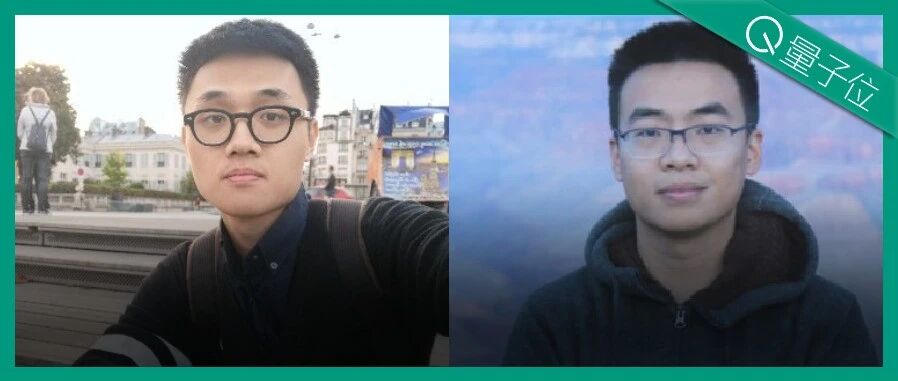
Core Viewpoint - Alibaba's CEO Wu Yongming has officially approved Lin Junyang's resignation, which has raised questions about the sudden leadership changes within the company, particularly in the Tongyi Lab and the Qwen team [1][2][3][4]. Group 1: Leadership Changes - Lin Junyang's resignation was unexpected, and the company has not provided details regarding the reasons behind it or the appointment of a successor [3][12]. - The All Hands meeting revealed that the leadership transition was not planned and that there was a lack of communication regarding the organizational changes [5][8]. - The company aims to expand its team and resources, indicating that the adjustments are not related to internal political struggles [9][11]. Group 2: Team Dynamics - The Qwen team, which Lin Junyang led, reportedly had only a few hundred members, significantly smaller than comparable AI teams in other major companies [10]. - The team is currently facing a "resource-tight situation," which has been acknowledged by Alibaba Cloud's CTO [11]. Group 3: New Leadership Candidate - Zhou Hao, a senior researcher from Google DeepMind, has emerged as a potential successor to Lin Junyang, with expectations that he will lead the subsequent training efforts for the Qwen model [13][17]. - Zhou Hao has a strong background, having contributed significantly to the Gemini series of models at Google, which includes advancements in large language models [18][20][21]. Group 4: Zhou Hao's Background - Zhou Hao holds a bachelor's degree in Mathematics and Statistics from the University of Science and Technology of China and has pursued advanced degrees in the United States [23][24]. - His previous experience includes roles at Meta and Google, where he was involved in deep learning and conversational AI, contributing to major projects that have garnered significant academic citations [28][34].
阿里批准林俊旸离职,成立基础模型支持小组
新华网财经· 2026-03-05 04:10
Group 1 - The CEO of Alibaba, Wu Yongming, confirmed the resignation of Lin Junyang and expressed gratitude for his contributions [2] - The company will continue to advance its foundational model development under the leadership of Jiang Ren, with a new support group being established to coordinate resources [2] - The development of foundational large models is identified as a key strategic focus for the future, with a commitment to increasing investment in AI research and attracting top talent [2]

Alibaba CEO confirms departure of Qwen AI division head
Reuters· 2026-03-05 03:33
Core Viewpoint - Alibaba's CEO Eddie Wu announced the departure of the head of its artificial intelligence division, Qwen, and committed to reallocating more resources towards the company's AI development efforts [1] Group 1 - The head of Alibaba's AI division, Qwen, has left the company [1] - Eddie Wu emphasized the importance of AI in the company's future strategy in a staff letter [1] - The company plans to enhance its investment in AI technologies and initiatives [1]