BABA(09988)

Search documents
谷歌TurboQuant大反转,被锤学术不端?曝腾讯挖走字节Seed多名核心骨干,向姚顺雨汇报;传月之暗面赴港上市,估值飙至1200亿|AI 周报
AI前线· 2026-03-29 11:08
Group 1 - The AI model company "Moonlight's Dark Side" is considering an IPO in Hong Kong, with its valuation skyrocketing from $4.3 billion to $12 billion in just three months [2][3][4] - The founder Yang Zhilin previously stated that the company was not in a hurry to go public, citing sufficient cash reserves exceeding 10 billion RMB [3] - The recent performance of peers in the AI sector, such as Zhizhu and MiniMax, which have market capitalizations of approximately 307 billion HKD and 312 billion HKD respectively, may have influenced this decision [4] Group 2 - Tencent has recruited several key technical personnel from ByteDance's Seed team, who will report directly to Tencent's Chief AI Scientist Yao Shunyu [5] - The new hires include leaders from various AI departments, indicating Tencent's strategic focus on enhancing its AI capabilities [5] Group 3 - Google faces allegations of academic misconduct regarding its TurboQuant paper, which claims significant improvements in memory efficiency and speed for AI models [6][7] - The TurboQuant algorithm reportedly allows for a sixfold reduction in memory usage without loss of accuracy, but has been criticized for its lack of proper citation and comparison with prior work [6][7][8] Group 4 - Anthropic is reportedly planning to go public as early as October, aiming to raise over $60 billion, with discussions involving major investment banks [9][10] - The company recently completed a funding round of $30 billion, achieving a valuation of $380 billion, and has established partnerships with major tech firms [10] Group 5 - Elon Musk's AI startup xAI has seen the departure of its entire founding team, coinciding with preparations for a potential IPO of SpaceX, which aims to raise between $40 billion and $80 billion [11][12][13] - SpaceX's IPO strategy includes unique offerings for retail investors, aiming to create a strong connection with its supporter base [13] Group 6 - Apple's App Store is experiencing delays in app review processes due to an influx of low-quality AI applications, extending review times significantly [14] - The surge in "AI junk" applications has led to complaints from developers regarding the increased workload on the review team [14] Group 7 - OpenAI has decided to shut down its Sora video generation service to streamline its product line in preparation for an IPO [16][17] - The decision reflects OpenAI's focus on enterprise-level products and the need to present a company ready for public offering [17] Group 8 - The AI industry is witnessing a surge in new job roles, such as "Chief Lobster Officer," reflecting the growing demand for expertise in AI and agent systems [22] - Companies are increasingly looking for talent to drive AI-native transformations across various sectors, indicating a shift in workplace dynamics [22]







腾讯《洛克王国:世界》上线并登顶iOS畅销榜,OpenAI关停Sora
GF SECURITIES· 2026-03-29 10:08
Group 1: Core Insights - The report suggests a positive outlook for the internet sector, particularly in e-commerce, social entertainment media, online travel, short videos, and IP-driven markets, with expectations of marginal improvements in profitability and stock performance for companies like Meituan and Tencent [4][15][18] - The gaming sector is expected to maintain strong fundamentals, with Tencent and NetEase identified as companies with significant valuation advantages, alongside recommendations for Century Huatong and Giant Network due to their robust product pipelines [4][18] - The advertising sector shows promising growth, with a notable increase in internet advertising investments, particularly around major events like the Winter Olympics and World Cup, indicating a potential boost for companies like Focus Media [4][18] Group 2: Industry Trends - The report highlights the ongoing competition in the e-commerce space, with Meituan focusing on high-quality growth and improving its economic model, which may lead to a rebound in stock prices [4][15][16] - In the social entertainment media sector, Tencent is expected to leverage the commercialization potential of WeChat, while Bilibili is projected to lead in advertising growth [4][15][18] - The AI sector is anticipated to enter a new phase of model iteration in Q2 2026, with significant investment trends centered around computing power and model development, suggesting a potential revaluation of AI-related companies [4][20] Group 3: Company Performance - Meituan's first quarter of 2026 is expected to show improvements in its delivery service profitability, with a focus on maintaining market share in core categories [4][15][16] - Tencent's new game "King of Glory: World" has recently topped the iOS sales chart, indicating strong market competitiveness and potential for future growth [4][12][18] - Kuaishou reported a total revenue of 142.8 billion yuan for 2025, reflecting a 12.5% year-on-year growth, with adjusted net profit increasing by 16.5% [4][33]




计算机行业研究:国内算力部分进入业绩临界点
SINOLINK SECURITIES· 2026-03-29 08:24
Investment Rating - The report indicates a positive investment outlook for the domestic AI computing industry, highlighting significant growth potential and performance improvements among key players [5][12]. Core Insights - The domestic average daily token usage has surpassed 140 trillion, marking a growth of over 1000 times in two years, with Chinese AI models leading globally [11][12]. - A CPU price increase is underway, with Intel and AMD planning to raise prices by 10-15% due to supply shortages and increased demand from large enterprises [14][15]. - The report predicts that 2026 will be a pivotal year for China's computing demand, transitioning from "cloud training" to a dual-driven model of "training + inference" [5][26]. Summary by Sections Section 1: Domestic Token Surge and CPU Price Increases - The average daily token usage in China has grown from 100 billion at the beginning of 2024 to 140 trillion by March 2026, with significant contributions from domestic AI models [11]. - Domestic AI computing and leasing companies are reaching a performance inflection point, with companies like Cambricon and Lito Electronics expected to see substantial revenue growth [12]. Section 2: Rapid Release of Computing Demand - Major internet companies are advancing their AI models, with a focus on high-quality and multi-modal capabilities, driving up the demand for computing resources [26]. - The inference side of computing demand is expected to grow steeply, with applications in AI entertainment and programming gaining traction [41]. Section 3: Supply Side Improvements and Domestic Production Acceleration - The supply side is transitioning from a state of scarcity to structural balance, with increased availability of computing resources to meet rising demand [5]. - Domestic chip manufacturers are achieving significant performance milestones, with companies like Huawei and Cambrian making strides in their product offerings [20][22]. Section 4: Full Chain Inflation in Domestic Computing - The report anticipates a "full-chain inflation" cycle in the computing industry, with growth expected across various segments including AI data centers and cloud services [5]. - Investment strategies should focus on companies closely tied to major internet firms, which are likely to yield significant returns due to their established supply chains [5]. Section 5: Related Companies - Key companies mentioned include Dongyangguang, Cambrian, Haiguang Information, Lito Electronics, YN Energy, and others involved in the AI computing ecosystem [3].



蒸发1万亿!阿里巴巴,又跌麻了
商业洞察· 2026-03-28 09:22
Core Viewpoint - Alibaba's stock price has dropped significantly, losing one-third of its value in just two months, causing distress among investors [3]. Financial Performance Summary - For the third fiscal quarter of 2026, Alibaba reported revenue of 284.843 billion yuan, a year-on-year increase of 2%. Excluding disposed businesses, the same-store revenue grew by 9% [6]. - Operating profit fell to 10.645 billion yuan, a 74% decline year-on-year. Net profit attributable to ordinary shareholders was 16.322 billion yuan, down 67%. Adjusted net profit also decreased by 67% to 16.71 billion yuan [6]. - Net cash flow from operating activities was 36.032 billion yuan, a 49% drop, while free cash flow plummeted by 71% to 11.346 billion yuan [6][7]. Causes of Financial Decline - The financial downturn is attributed to the impact of "instant retail business investments," particularly the intensified competition in the food delivery sector, which has severely affected Alibaba's cash flow [8]. Stock Market Reaction - Following the financial report, Alibaba's stock price fell sharply, with a drop of over 7% on March 19, resulting in a loss of nearly 230 billion USD, approximately 1.6 trillion yuan [9]. - The stock continued to decline, with a drop of over 6% on March 20 and more than 3% on March 23. Since the end of January, Alibaba's stock has decreased from 174.2 HKD to 117.7 HKD, marking a decline of 32.4% and a market value loss exceeding 1 trillion HKD [11]. Competitive Landscape and Market Concerns - The decline in Alibaba's stock is part of a broader trend affecting major players in the food delivery market, including Meituan and JD.com, which have also seen significant stock price drops due to concerns over their cash-burning market share acquisition strategies [14]. - Alibaba's sales and marketing expenses surged to 71.9 billion yuan, nearly 300 billion yuan more than the previous year, representing 25.3% of the company's revenue, up from 15.2% [15]. Future Outlook and Strategic Direction - Alibaba's management has reiterated its goal to achieve over 1 trillion yuan in gross merchandise volume (GMV) for its instant retail business by fiscal year 2028, with expectations of profitability by fiscal year 2029 [16]. - The company is committed to continuing its aggressive investment in instant retail, which poses a significant challenge to its cash flow [17]. AI and Cloud Investments - Alibaba has announced plans to invest over 380 billion yuan in cloud and AI infrastructure over the next three years, setting a record for private enterprise investment in AI in China [22]. - The market responded positively to Alibaba's AI initiatives, with stock prices rising significantly during periods of major announcements related to AI investments [24]. - However, recent stock declines are attributed to concerns over the immediate costs associated with the instant retail business overshadowing the positive sentiment around AI developments [27].

试用近10个AI助理,我决定自己把活干了
创业邦· 2026-03-28 03:45
Core Viewpoint - The article discusses the rapid advancements in AI technologies, particularly focusing on tools like OpenClaw, Claude, and Manus, and their implications for productivity and user interaction with computers [8][10][12]. Group 1: AI Tools and Their Features - Anthropic's Claude has introduced a desktop application that allows users to control their computers, performing tasks like opening files and using browsers, with a focus on user safety through permission requests [10][12]. - OpenClaw is described as a system-level technology that translates natural language into commands for computer files, while Claude relies on visual models to interact with the user interface [12]. - Manus, another AI tool, operates through command line instructions and can automate tasks across devices, although it currently faces limitations in accurately executing user commands [16][18]. Group 2: Market Response and Development - Major smartphone manufacturers, including Xiaomi and Huawei, have begun testing their own AI agents, indicating a competitive landscape similar to the early days of Android [19][21]. - Various tech giants are actively integrating OpenClaw into their platforms, with companies like JD, Tencent, and Alibaba packaging it into user-friendly applications [23][25]. - Alibaba has launched a B2B agent named Accio, aimed at cross-border e-commerce, showcasing the trend of specialized AI agents for specific market needs [32][41]. Group 3: Financial Investments in AI - Alibaba has established a new business unit focused on AI, merging several departments under CEO Wu Yongming, while Tencent reported over 18 billion yuan invested in AI products in the previous year [29][30]. - Baidu's financial report indicates that AI business revenue constitutes 43% of its overall income, highlighting the growing importance of AI in major tech companies [29]. Group 4: User Experience and Challenges - Users have expressed mixed experiences with AI tools, noting that while they can automate tasks, they often require significant user input and may not always perform as expected [17][47]. - The article emphasizes the need for clear use cases for AI, as many users struggle to find effective applications for these technologies in their daily work [51][52]. - The concept of "tokens" is introduced, indicating that the operational costs of using AI tools can be high, which may deter users from fully utilizing these technologies [54][56].


阿里巴巴-W(09988):更新报告:AI云业务高景气,静待规模效应带来利润弹性
ZHESHANG SECURITIES· 2026-03-27 14:07
Investment Rating - The report maintains a "Buy" rating for Alibaba Group [5] Core Insights - Alibaba's Cloud Intelligence Group achieved revenue of 43.284 billion RMB in FY26Q3, representing a year-over-year growth of 36%. The external commercialization revenue of Alibaba Cloud surpassed 100 billion RMB as of February 2026, with a target of exceeding 100 billion USD in annual revenue from cloud and AI commercialization over the next five years, implying a CAGR of over 40% for the cloud and AI business [2] - The capital expenditure for FY26Q3 was 28.999 billion RMB, indicating quarterly fluctuations [2] - The profitability of the cloud business is expected to improve as the scale increases, with an EBITA of 3.911 billion RMB and a profit margin of 9% [2] - The revenue projections for FY2026-2028 are 1,027.639 billion RMB, 1,140.707 billion RMB, and 1,266.106 billion RMB, with year-over-year growth rates of 3.0%, 11.0%, and 11.0% respectively. The adjusted net profit attributable to ordinary shareholders is forecasted to be 79.979 billion RMB, 123.702 billion RMB, and 162.882 billion RMB, with growth rates of -30.0%, 8.0%, and 26.0% respectively [3] - The valuation method used is a segmented valuation approach, applying a 12x PE ratio for the e-commerce business and a 7x PS ratio for the cloud business in FY2027, resulting in a target price of 196.29 HKD per share [3] Summary by Sections Cloud Business - The cloud business is experiencing high growth driven by AI demand, with a clear strategy to capitalize on the expanding market [9] - The cloud business's profit margin is expected to improve significantly as scale effects are realized [2] E-commerce Business - The e-commerce segment faced challenges, with revenue of 159.347 billion RMB in FY26Q3, and customer management revenue (CMR) growing by only 0.8% year-over-year, below Bloomberg's consensus estimate of 3.9% [9] - Instant retail showed high growth with a revenue increase of 56.0% year-over-year, but its short-term impact on the overall e-commerce business is limited [9] - The e-commerce group's EBITA decreased by 43% year-over-year to 34.613 billion RMB, but showed a quarter-over-quarter improvement, indicating enhanced operational efficiency in the instant retail segment [9]
用多少Token,要被写进工资条了
36氪· 2026-03-27 13:50
Core Viewpoint - A productivity revolution driven by Token is transforming enterprise management and workplace rules, with significant increases in Token usage and its integration into employee compensation and performance incentives [5][6][10]. Token Usage and Corporate Strategies - As of March 2024, China's daily Token usage exceeded 140 trillion, a growth of over 1000 times since early 2024, with a further increase of over 40% expected by the end of 2025 [5]. - Companies like Alibaba and 58.com are implementing internal plans to provide Token allowances to employees, encouraging the use of advanced AI tools [5][6]. - 58.com Chairman Yao Jinbo emphasized the importance of Token usage, stating that the company consumes nearly 2000 billion Tokens daily, with plans to increase this to 3000 billion [6]. - Kunlun Wanwei has integrated AI programming capabilities into its performance evaluation system, with employees facing potential termination for not meeting AI coding standards [7][9]. Financial Implications of Token Investments - Kunlun Wanwei spends approximately 1.05 million yuan monthly on Token subsidies for its 1500 technical staff, equating to about 1200 million yuan annually, which is deemed a worthwhile investment due to significant improvements in R&D speed [9][10]. - The shift towards AI-driven coding has led to a transformation in labor value, with companies needing to view Token expenditures as essential IT procurement rather than mere subsidies [9][10]. Market Dynamics and Future Trends - The demand for Tokens is creating a new industry chain involving cloud vendors, model companies, and hardware suppliers, with significant growth in Token consumption reported by major players like ByteDance [21][23]. - The price of Tokens has decreased significantly over the past few years, but the increase in usage has offset these costs, making Tokens a new profit growth point for cloud vendors [21][23]. - Major companies are beginning to restructure their workforce towards AI collaboration, reducing reliance on traditional roles and shifting costs towards Token consumption [18][19]. Challenges and Considerations - Companies face challenges in effectively integrating AI tools into their operations, with concerns about the potential for increased burdens without corresponding returns [17][24]. - The rise in Token consumption must be closely tied to business value and efficiency improvements to ensure sustainable growth and avoid employee dissatisfaction [25].
任泽平年度预测:2026十大趋势
泽平宏观· 2026-03-27 11:18
Group 1 - The core viewpoint of the article is that AI will significantly change the world, marking the beginning of a new Kondratiev wave driven by innovation and technology [10][29][58] - The first major trend identified is the global monetary easing cycle, which is expected to exceed expectations, leading to an AI explosion and a bull market in commodities and stock markets [10][12][19] - The article predicts that by 2026, the US Federal Reserve will implement a "rate cut + weak dollar" strategy to alleviate debt burdens and attract manufacturing back to the US, prompting other countries to follow suit [12][15][17] Group 2 - The second major trend is the dawn of a new Kondratiev wave, which will bring about a decade of upward innovation, presenting significant opportunities for individuals [29][34][36] - The article emphasizes that economic cycles are driven by innovation, with the current Kondratiev wave being led by AI, which is expected to create new wealth opportunities and companies by 2026 [34][36][38] - It discusses the cyclical nature of economies, highlighting the importance of recognizing and adapting to these cycles for financial success [32][36][38] Group 3 - The third major trend is that AI is not just a trend but a "tsunami," indicating a profound and rapid transformation across various sectors [58][60] - The article highlights the advancements in AI showcased at events like CES, where AI technologies, including robotics and autonomous driving, are rapidly evolving and gaining public attention [61][63] - It predicts that AI will fundamentally alter industries, leading to the replacement of many jobs and the emergence of new business models, such as "one-person companies" utilizing AI agents for various tasks [70][72][73] Group 4 - The article addresses the challenges posed by population aging, declining birth rates, and the rising costs of education and child-rearing, exacerbated by AI-induced job displacement [87][89] - It reflects on the historical development of AI, noting its ups and downs, and emphasizes the breakthroughs that have led to its current capabilities [90][94][96] - The narrative includes the story of Geoffrey Hinton, a key figure in AI development, and his concerns about the implications of AI advancements for humanity [117][120][122]



用多少词元(Token),要被写进工资条了
创业邦· 2026-03-27 10:28
Core Viewpoint - A productivity revolution driven by Tokens is transforming enterprise management and workplace rules, with significant increases in Token usage observed in recent months [6][7][21]. Token Usage and Corporate Strategies - As of March 2023, China's daily Token usage exceeded 140 trillion, a growth of over 1000 times since early 2024, and a 40% increase in just three months [6]. - Companies like 58.com and Kunlun Wanwei are heavily investing in Token subsidies, with 58.com consuming nearly 2000 billion Tokens daily and planning to exceed 3000 billion [7][12]. - Kunlun Wanwei has integrated AI programming capabilities into its employee evaluation system, with penalties for those not meeting AI coding requirements [10][12]. Financial Implications and ROI - Kunlun Wanwei spends approximately 1.2 million yuan annually on Token subsidies for its 1500 technical staff, equating to the cost of 20 employees, yet reports a 50% increase in R&D speed [12][13]. - The shift towards AI-driven productivity is seen as a necessary investment, with companies like Alibaba and 58.com emphasizing AI capabilities in their management and hiring processes [16][19]. Market Dynamics and Industry Trends - The demand for Tokens is creating a new industry chain involving cloud vendors, model companies, and hardware suppliers, with significant growth in Token consumption reported by companies like ByteDance [21][25]. - Major cloud service providers are launching competitive Token plans to attract users, while the supply of GPUs and computing power is struggling to keep pace with demand, leading to potential price increases for Tokens [25][26]. Future Outlook and Challenges - The integration of AI into business processes is expected to reshape workforce structures, reducing the need for traditional middle management roles [19]. - Despite the enthusiasm for Token usage, there are concerns about the practical application and value generation of AI tools, with some users finding them ineffective for simple tasks [26].


三大指数齐涨 小米涨超1.7% B站、快手涨超1%!锂电板块爆发,赣锋锂业涨超9% | 港股收盘
Mei Ri Jing Ji Xin Wen· 2026-03-27 08:45
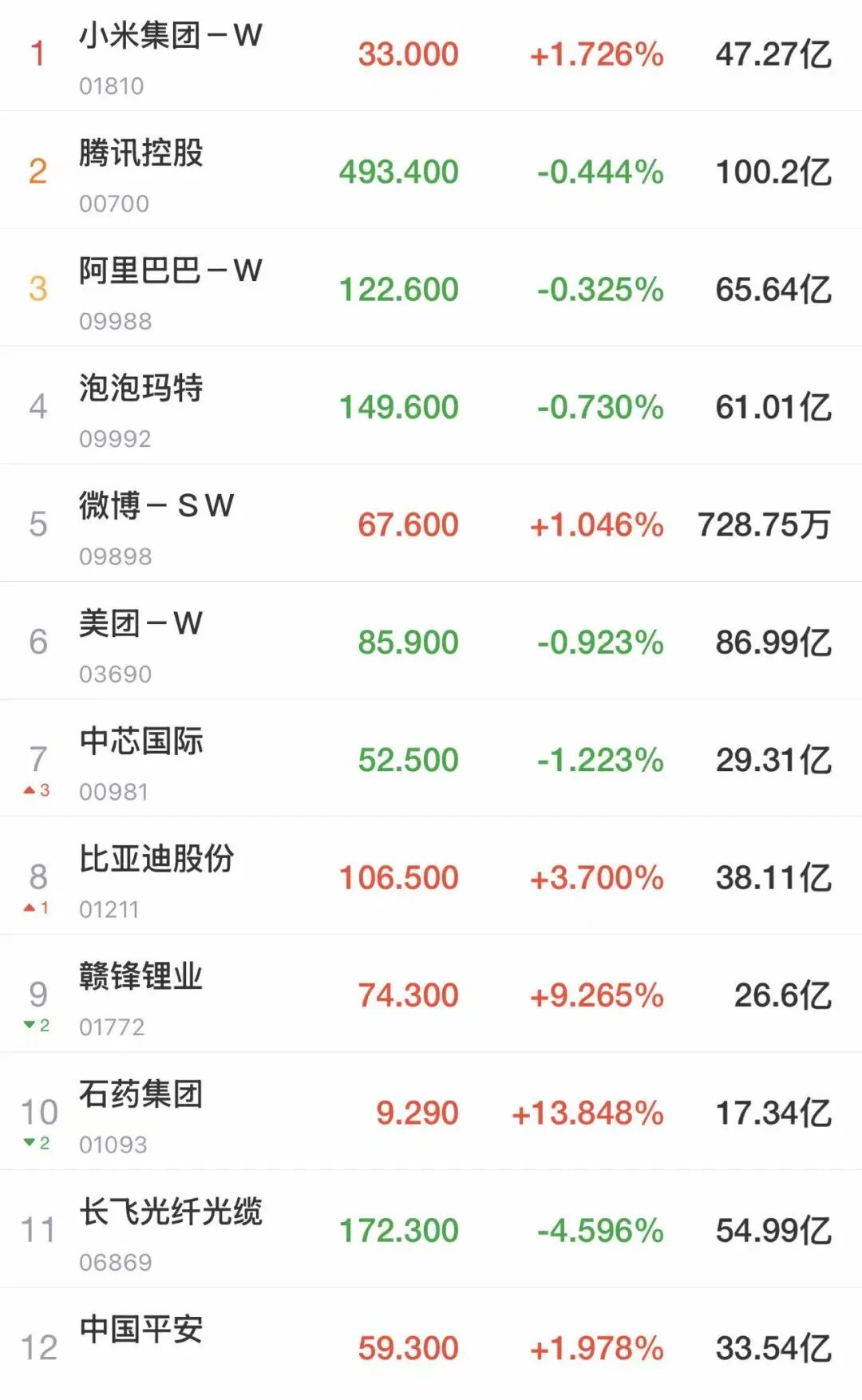
Market Performance - The Hong Kong stock market indices collectively rose on March 27, with the Hang Seng Index increasing by 0.38% to close at 24,951.88 points, the Hang Seng Tech Index up by 0.35%, and the National Enterprises Index rising by 0.76% [1] Sector Performance - Technology stocks showed mixed results, with Kuaishou and Xiaomi both rising over 1%, while Bilibili fell by more than 1% [1] - Innovative pharmaceutical stocks surged, with CSPC Pharmaceutical Group increasing by over 13% [1] - The lithium battery sector performed well, with Ganfeng Lithium rising by over 9% [1] - The commercial aerospace sector faced declines, with Junda Co., Ltd. dropping by over 9% [1] Stock Highlights - Xiaomi Group saw a price increase of 1.726%, closing at HKD 33.00 with a trading volume of 4.727 billion [2] - Ganfeng Lithium reported a price increase of 9.265%, closing at HKD 74.30 with a trading volume of 2.66 billion [2] - CSPC Pharmaceutical Group experienced a significant rise of 13.848%, closing at HKD 9.29 with a trading volume of 1.734 billion [2] Investor Sentiment - Goldman Sachs indicated that international investor interest in Chinese stocks has likely reached a near-high point, with only about 10% of surveyed clients considering the Chinese stock market "non-investable," a significant improvement from approximately 40% two years ago [4] - Haitong International's Chief Economist Zhang Yidong believes that the recent market fluctuations do not alter the long-term trend, with both A-shares and H-shares expected to reach new highs in the second half of the year [4]