BABA(09988)

Search documents
恒生科技指数跌逾3% 快手跌逾13%
Shang Hai Zheng Quan Bao· 2026-03-26 06:45
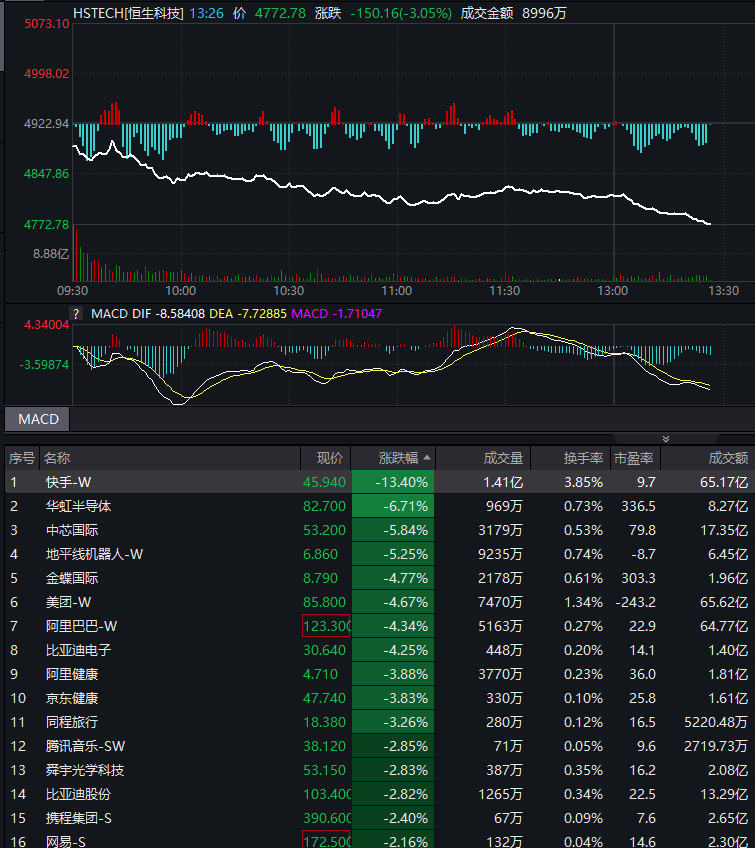
Group 1 - The Hang Seng Tech Index experienced a decline of over 3% in the afternoon of March 26 [2] - Among the constituent stocks, Kuaishou fell by more than 13%, while Meituan, Alibaba, and BYD Electronics dropped over 4% [2]




恒指收升272点,两日累涨953点
Guodu Securities Hongkong· 2026-03-26 05:21
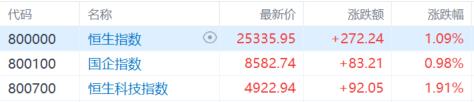
Group 1 - The Hang Seng Index rose by 272 points, closing at 25,335 points, marking a two-day cumulative increase of 953 points or 3.91% [3][4] - The market experienced a high of 25,390 points during the day, with a total trading volume of 350.93 billion [3] - Notable stock performances included Meituan, which surged by 13.9% to HKD 90, and Alibaba, which increased by 4.6% to HKD 128.9 [4] Group 2 - The Hong Kong Monetary Authority announced a salary increase of 2.65% for its employees, along with a performance-based bonus amounting to 20.04% of total salaries [7] - The appointment of Liang Fengyi as the chair of the Asia-Pacific Committee of the International Organization of Securities Commissions was confirmed, aiming to enhance regional market resilience [8] - China’s Ministry of Commerce emphasized the importance of maintaining stable semiconductor supply chains during a meeting with Samsung's leadership, highlighting opportunities for investment cooperation [10] Group 3 - Conch Venture's annual profit increased by 11.17% to RMB 2.245 billion, with a revenue rise of 4.42% to RMB 6.548 billion [11] - New World Development secured a HKD 20 billion syndicated loan for refinancing, with a competitive interest rate [12] - China Eastern Airlines signed a purchase agreement for 101 A320NEO aircraft, with a total catalog price of approximately USD 15.802 billion, indicating significant investment in fleet expansion [13] Group 4 - Kingsoft Cloud reported a narrowed annual net loss of RMB 936 million, with total revenue increasing by 22.78% to RMB 9.559 billion [14]


千问胆子太大了,打车都要插一脚了
半佛仙人· 2026-03-25 18:19
Core Viewpoint - The article emphasizes that Qianwen's AI ride-hailing service is not just a technological advancement but a significant evolution in how AI can integrate into daily life, addressing real-world problems effectively [3][7]. Group 1: AI Ride-Hailing Functionality - Qianwen has launched an AI ride-hailing feature that allows users to book rides with simple voice commands, showcasing its ability to understand complex user needs [3][7]. - The AI can interpret fragmented and abstract requests, such as multi-stop rides or specific driver preferences, thus enhancing user experience [11][13]. - This service aims to eliminate the standardization issues prevalent in traditional ride-hailing apps, which often fail to meet personalized user demands [6][17]. Group 2: User Experience and Market Position - The article discusses the pain points of existing ride-hailing services, highlighting issues like poor driver quality and the cumbersome app interface that complicates the user experience [5][6]. - Qianwen's approach is positioned as a solution to these problems, focusing on understanding and fulfilling individual user needs rather than just providing a basic transportation service [19][24]. - The ride-hailing market is described as highly competitive with low margins, but Qianwen's strategy is to position itself as a gateway to broader consumer experiences, linking transportation to dining and entertainment [24][28]. Group 3: Ecosystem Integration - Qianwen benefits from being part of Alibaba's ecosystem, which allows seamless integration with other services like navigation and payment, enhancing overall user convenience [22][28]. - The interconnectedness of services within the Alibaba ecosystem enables Qianwen to offer a comprehensive solution that goes beyond just ride-hailing, facilitating a complete consumer journey [22][28]. - The article argues that this strategic positioning within a larger ecosystem is crucial for capturing consumer loyalty and driving future growth [28][30].

Why Are Alibaba Shares Surging On Wednesday?
Benzinga· 2026-03-25 13:18
Industry Overview - Reports indicate that China's food-delivery price wars are concluding, with state media signaling a regulatory shift towards industry stability [1] - The Economic Daily published an opinion piece advocating for an end to price competition, suggesting official regulatory endorsement [2] Company Focus - Alibaba has rebranded Ele.me to Taobao Instant Commerce, focusing on higher-value food orders to enhance unit economics [3] - The latest fiscal report from Alibaba highlights that expanding its quick commerce business has improved user efficiency [3] Technical Analysis - Alibaba shares are currently trading 3.4% below the 20-day simple moving average (SMA) and 15.8% below the 100-day SMA, indicating a downward trend [4] - Over the past 12 months, shares have decreased by 5.48% and are closer to their 52-week lows [4] - The Relative Strength Index (RSI) is at 31.58, indicating neutral territory but coming off an oversold signal [4] Stock Price Activity - Alibaba shares increased by 3.84% to $130.30 during premarket trading [5] - Key resistance level is identified at $139.00, while key support is at $128.50 [5]
阿里巴巴-W(09988):闪购补贴导致盈利大幅下滑,AI+云推动收入增长
First Shanghai Securities· 2026-03-25 13:07
Investment Rating - The report maintains a "Buy" rating for the company, with a target price set at $175 for US shares and HK$170 for Hong Kong shares, reflecting a potential upside of approximately 39% and 42% respectively [4][36]. Core Insights - The company experienced significant profit decline due to strategic investments in instant retail and technology, while revenue growth was primarily driven by the cloud and AI sectors [9][25]. - The Alibaba China E-commerce Group showed resilience with a revenue increase of 6% year-on-year, despite profitability pressures from strategic investments [4][16]. - The cloud business is projected to exceed $100 billion in revenue over the next five years, supported by strong growth in public cloud services and AI-related products [3][25]. Revenue and Profit Summary - For FY2026 Q3, total revenue reached CNY 284.84 billion, a 2% year-on-year increase, with core business growth remaining robust [9][4]. - The Alibaba China E-commerce Group generated CNY 159.35 billion in revenue, while the Cloud Intelligence Group reported CNY 432.84 billion, marking a 36% year-on-year growth [4][25]. - Adjusted EBITDA was CNY 340.57 billion, reflecting a 45% decline year-on-year, primarily due to increased operational costs and strategic investments [30][9]. Business Segment Performance - The Alibaba China E-commerce Group's adjusted EBITA was CNY 346.13 billion, down 43% year-on-year, with a profit margin of 21.7% [4][17]. - The Alibaba International Digital Commerce Group reported a revenue of CNY 392.01 billion, with a significant reduction in losses, indicating improved operational efficiency [22][23]. - The Cloud Intelligence Group's adjusted EBITA was CNY 39.11 billion, with a stable profit margin of 9%, driven by strong public cloud revenue growth [25][26]. Cash Flow and Financial Health - Operating cash flow decreased by 49% year-on-year to CNY 360.32 billion, while free cash flow fell by 71% to CNY 113.46 billion, largely due to increased investments in instant retail [11][30]. - The company maintains a strong cash reserve of CNY 560.18 billion, approximately $80.10 billion, providing a solid foundation for ongoing strategic investments [11][36].
两个“零估值”,一个新阿里
远川研究所· 2026-03-25 13:03
Core Viewpoint - The latest quarterly report from Alibaba highlights AI as a central theme, with investment banks reassessing Alibaba's valuation logic amidst market anxieties [2][3]. Group 1: Financial Performance and Valuation - Alibaba's current market value is only 10 times the expected earnings from its domestic e-commerce business, indicating that investors are only recognizing the value of this single business [5]. - Morgan Stanley's report categorizes Alibaba as a "global AI winner," emphasizing its comprehensive AI strategy and vertical integration capabilities [22][24]. - The company aims for its cloud and AI commercialization revenue to exceed $100 billion in the next five years, representing a compound annual growth rate of over 40% [33][34]. Group 2: AI and Capital Expenditure - High capital expenditures (Capex) are a common concern among major tech companies, including Alibaba, as they invest heavily in AI infrastructure [9][10]. - Alibaba's recent quarterly capital expenditure reached 29 billion RMB, reflecting a significant acceleration in investment [18]. - The company plans to invest 380 billion RMB over three years for cloud and AI hardware infrastructure [19]. Group 3: AI Strategy and Infrastructure - Alibaba has established a four-layer vertical integration capability around AI, including self-developed chips and the largest cloud computing infrastructure in the Asia-Pacific region [21]. - The integration of self-developed AI chips and cloud services has allowed Alibaba to mitigate external supply chain challenges and maintain competitive pricing [25]. - The company has developed a business model that transforms raw computing power into high-margin cloud service revenue, leveraging its cost advantages [29][30]. Group 4: Organizational Changes and Market Position - Alibaba has formed the ATH business group to enhance collaboration between AI models and applications, addressing the need for tight integration in the Agentic era [35][42]. - The restructuring aims to overcome organizational silos that have historically hindered innovation and responsiveness in large companies [37][40]. - The company's strategic focus on AI and computing power is seen as a necessary evolution to capture new growth opportunities in a changing market landscape [52][53].

净买入超223亿港元 回补三大ETF加仓泡泡玛特及美团
Xin Lang Cai Jing· 2026-03-25 10:28
Group 1: Market Overview - Southbound funds traded approximately 165.56 billion HKD today, an increase of 21.8 billion from the previous day, accounting for 47.18% of the total turnover of the Hang Seng Index [1] - The Hong Kong stock market continued its rebound, with a net inflow of southbound funds amounting to 22.32 billion HKD, including a net inflow of about 14.23 billion HKD from the Shanghai-Hong Kong Stock Connect and approximately 8.09 billion HKD from the Shenzhen-Hong Kong Stock Connect [1] Group 2: ETF Activity - After a significant outflow the previous day, funds reversed to buy three major ETFs: the Tracker Fund of Hong Kong (02800.HK) received 11.38 billion HKD, the Southern China Technology ETF (03033.HK) received 3.40 billion HKD, and the Hang Seng China Enterprises Index ETF (02828.HK) received 1.32 billion HKD [1] Group 3: Individual Stock Performance - Pop Mart (09992.HK) saw a net buy of 2.31 billion HKD despite a drop of 22.51% today, with funds increasing their holdings by 3.07 million shares over the past five days [4] - Meituan-W (03690.HK) experienced a net buy of 1.72 billion HKD, with a price increase of 13.92%, although funds reduced their holdings by 1.04 million shares in the last five days [9] - Alibaba-W (09988.HK) had a net buy of 1.51 billion HKD, with a price increase of 4.63% and an increase in holdings by 4.34 million shares over the past five days [9] - Xiaomi Group-W (01810.HK) saw a net buy of 0.97 billion HKD, with a slight decrease of 0.49% today and an increase in holdings by 7.27 million shares over the past five days [5] Group 4: Notable Outflows - China National Offshore Oil Corporation (00883.HK) experienced a significant net outflow of 1.06 billion HKD, with a price drop of 3.19% and a decrease in holdings by 1.78 million shares over the past five days [3][6] - Tencent Holdings (0700.HK) had a net outflow of 0.62 billion HKD, with a price drop of 1.65% and a decrease in holdings by 0.86 million shares over the past five days [3][7]




港股收评:连续两日反弹!恒生科技收涨1.91%,美团涨超13%,南下资金净买超200亿港元
Ge Long Hui· 2026-03-25 09:58
Market Overview - The Hong Kong stock market experienced a significant rebound, with the Hang Seng Technology Index rising by 2.6% at one point and closing up by 1.91% [1]. - The Hang Seng Index and the China Enterprises Index increased by 1.09% and 0.98%, respectively, marking the second consecutive day of market recovery [1]. - Southbound funds recorded a net purchase of over 20 billion HKD in Hong Kong stocks [1]. Sector Performance - Technology stocks led the market rally, with Meituan surging nearly 14% [2]. - Other notable performers included nuclear power stocks and optical communication concept stocks, with Changfei Optical Fiber Cable rising over 12% [2][8]. - The airline sector also showed strength, with domestic flight ticket bookings during the Qingming holiday increasing by approximately 20% year-on-year [2][11]. Key Stock Movements - Meituan's stock price reached 90.000 HKD, up by 13.92% [5]. - JD.com and Alibaba saw increases of 4.85% and 4.63%, respectively [5]. - Gold stocks performed well, with Ji Hai Gold and Lingbao Gold rising over 6% [6][7]. Industry Insights - A commentary in the Economic Daily called for an end to the "food delivery war," highlighting its negative impact on the restaurant industry and the broader economy [4]. - The article emphasized that healthy competition should focus on technological innovation, efficiency improvement, and service optimization [4]. Future Outlook - China Galaxy Securities indicated that if a prolonged conflict occurs between the U.S. and Iran, the Hong Kong market may experience a three-phase evolution: short-term emotional shock, mid-term fundamental transmission, and long-term structural differentiation [19]. - The report suggested focusing on cyclical sectors, financial sectors at valuation bottoms, and technology sectors with self-controllable logic [19].

Alibaba Just Made a $100 Billion Bet on AI. Here's What It Means for Investors.
The Motley Fool· 2026-03-25 09:25
Core Insights - Alibaba Group aims to generate over $100 billion in annual revenue from its cloud and AI businesses within the next five years, indicating a significant shift in its strategic focus [1][2][15] Company Strategy - The company is transitioning from being primarily known for its e-commerce platforms to becoming a technology platform centered on cloud and AI [7][15] - Alibaba is building a full-stack ecosystem for AI, starting with Alibaba Cloud for computing infrastructure and including its Qwen family of large language models for enterprise applications [10][11] Market Opportunity - The demand for AI infrastructure is rapidly growing, with the China AI cloud market projected to reach $253 billion by 2033 [4] - Alibaba's cloud revenue grew approximately 36% year over year, largely driven by AI-related workloads, with AI-related revenue increasing at triple-digit rates for several consecutive quarters [5][8] Financial Context - Alibaba's current annualized cloud revenue is about $25 billion, indicating that reaching the $100 billion target will require sustained high growth over multiple years [8] - The company is facing pressure on margins due to investments in logistics and quick commerce, while cloud and AI present a different growth trajectory [7][9] Competitive Landscape - Intense competition exists in the AI space, with major players like Tencent, Huawei, and ByteDance in China, as well as global leaders such as Amazon and Microsoft [12] - The capital-intensive nature of AI infrastructure development poses challenges, as significant investments are needed for data centers and computing capacity [13]
Alibaba Stock Rises. Why China's Food Delivery War Could End Soon.
Barrons· 2026-03-25 09:23
Core Viewpoint - Alibaba, JD.com, and Meituan are engaged in an intense price war, especially in the food delivery sector [1] Group 1: Companies Involved - Alibaba is one of the major players in the food delivery market, competing aggressively with other companies [1] - JD.com is also heavily involved in the price competition, indicating a significant focus on food delivery services [1] - Meituan is another key competitor in the food delivery space, contributing to the ongoing price war [1] Group 2: Industry Dynamics - The food delivery industry is experiencing a brutal price war, which may impact profit margins for the companies involved [1] - Intense competition among these companies suggests a shift in market strategies, focusing on pricing to attract customers [1]